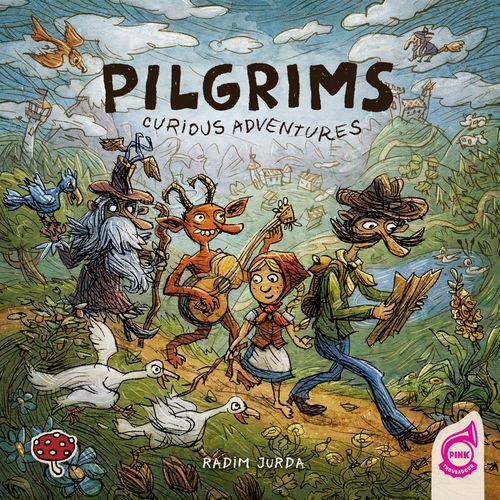
Pilgrims: Curious Adventures
Pilgrims: Curious Adventures Rulebook
Table of Contents
Table of Contents
- Game Components
- About the Game
- Game Setup
- Player Setup
- Playing the Game
- 1. Move
- 2. Activate
- Item Cards
- Characters
- Character Abilities
- 3. Adventure
- Public Quests
- 4. Replenish
- End of the Round
- Clover Tokens
- End of the Game
- Journey Cards (Advanced Game)
- Solo Game
- Public Quests List
- Reference: Triggers
- Reference: Abilities
Game Components
- 64 item cards
- 32 companion cards
- 5 player boards (1 per player + 1 solo)
- 26 clover tokens
- 1 map
- 20 level I adventure cards
- 17 level II adventure cards
- 6 figures (1 per player + 2 solo)
- 12 public quest tiles
- 12 solo cards
- 18 journey cards
- 10 quill tokens (2 per player + 2 solo)
- 1 rulebook
- 12 movement tokens (3 per player)
- 4 reference tiles
- 4 leader tiles
- 1 sun token
- 12 map tokens (3 per player)
About the Game
Pilgrims is a competitive family game for 1-4 players. The game is played over 4 rounds, during which players try to score victory points. Victory points symbolize the fame and wealth—both material and spiritual—that a player's party has acquired. The player with the most victory points at the end of round 4 wins!
Each player moves their figure across the map to collect item cards and add new companion cards to their party. By successfully combining their item and companion cards, players can trigger additional abilities.
These cards are also used to complete adventure cards, which allow a player to score victory points, and may also reward them with useful improvements or clover tokens.
Game Setup
-
Place the map in the center of the playing area. The map is divided into 25 spaces. Some spaces show a campfire symbol, and the rest are empty.
-
Shuffle the companion cards and create a face-down companion deck. Place it below the map. Draw 6 companion cards from the top of the deck and place one face-up on each of the 6 campfire spaces.
-
Shuffle the item cards and create a face-down item deck. Place it below the map. Draw item cards from the top of the deck and place them face-up one by one on the map's empty spaces.
-
Shuffle the level I adventure cards (blue) and create a face-down level I adventure deck. Draw and place 3 adventure cards from this deck face-up to the left above the map. Place the deck above those cards.
-
Shuffle the level II adventure cards (green) and create a face-down level II adventure deck. Draw and place 2 adventure cards from this deck face-up to the right above the map. Place the deck above those cards.
Note: These face-up adventure cards are called the "display."
-
Place the sun token on the left-most space of the round counter at the top of the map.
-
Shuffle the public quest tiles and draw random tiles until 3 are drawn with different letters in the bottom-right corner (A, B, C). Place them in a random order on the 3 spaces to the right of the round counter. Return the remaining tiles to the box; they won't be needed for this game.
-
Create a supply of clover tokens below the map.
Note: The advanced game of Pilgrims adds the journey deck. To set up an advanced game, see "Journey Cards."
Note: A solo game against the falconer adds the solo board and the solo deck. To set up a solo game, see "Solo Game."
Player Setup
-
Each player takes the player board of their chosen color. Put the leader tile of the same color on its left side.
Note: For the first game, use side A of the leader tile. In advanced games, try using side B for different abilities. All players should use the same side.
-
Each player takes the figure, 3 movement tokens, and 2 quill tokens which match their chosen color.
-
Take a reference tile and put it to the right of the player board. The player who woke up earliest today takes the reference tile with a rooster symbol—they will take the first turn.
-
Each player draws 1 item card from the deck and adds it to their hand.
-
Each player gains 1 clover token from the supply.
-
Starting with the last player (seated to the right of the first player) and proceeding counterclockwise, each player chooses one of the corner spaces, takes that space's item card and adds it to their hand, then places their figure on that space. Each player must choose a different corner.
Note: For the first game, try this simpler alternative—just choose the closest corner space to each player.
Playing the Game
Pilgrims is played over 4 rounds, representing individual days. Each round begins with the first player's turn (the player with the rooster reference tile). Play then continues clockwise. On their turn, each player must use 1 of their movement tokens. When each player has completed 3 turns, using all of their movement tokens, one of the 4 rounds ends.
The sun token shows the current round. After each player completes 3 turns, the sun token moves 1 space to the right.
Player Turn
A player's turn consists of the following phases in a fixed order:
- Move
- Activate
- Adventure
- Replenish
1. Move
Four movement spaces are on the right side of the player board. Each space shows a type of travel and a movement diagram. The diagram's symbol marks the current position of a player's figure.
During the Move phase, place a movement token on any empty movement space. Choose one of the black dot spaces shown in its movement diagram. The player takes that space's card, then moves their figure to the indicated space. A player may rotate or flip the diagram in any way to match their position on the map.
Note: Always take the card first, then move the figure onto the space.
If the player takes an item card, they add it to their hand.
A player's hand may hold any number of item cards. Don't show them to other players!
Campfire map spaces give companion cards. Other map spaces give item cards.
If the player takes a companion card, they place it in their party. Keep the party in a row to the leader's left, and leave some space below to play item cards.
A player may have up to 3 companion cards in their party, in addition to their leader. If they would gain another companion card, the player must retire an old one to free up space. To retire a companion card, slide it under the leader tile. Discard all item cards played under a retired companion card.
Note: Some improvements allow players to have more than 3 companion cards in their party.
If the player moves to a space without a card (either empty or occupied by another figure or figures), they draw a card from the corresponding deck.
- On campfire map spaces, they draw a companion card.
- On common map spaces, they draw an item card.
Note: If the movement diagram shows multiple black dot spaces, choose just one. Players can't gain cards from both spaces!
2. Activate
During the Activate phase, do one of the following:
- Play an item card to activate a character's ability.
- Gain a clover token from the supply.
To activate a leader tile or a companion card, an item card must be played face-up under a character with a matching activation symbol. For more on character abilities, see "Character Abilities."
Item cards can only be played under characters in the player's party. A player can't activate retired companion cards.
Each character can only hold one item card at a time. To activate a character that is already holding one, first discard the existing item card.
If the player is unable (or doesn't want) to activate a character, they may instead gain 1 clover token from the supply.
Item Cards
Item cards are used to activate character abilities and to complete adventure cards. The adventure and activation symbols in an item card's top-left corner determine how it can be used.
- Item cards have one of four adventure symbols in the top left corner: red fist (representing strength), blue speech bubble (representing communication), green leaf (representing navigation through the wilderness), gold coin (representing wild card). A wild item card substitutes for any adventure symbol. Each adventure symbol corresponds to the card's background color.
- Item cards also have one of four square activation symbols: sword (weapon), notes (musical instrument), compass (wayfarer item) or star (magic item).
Place discarded item cards in a face-up discard pile next to the item deck. If the item deck runs out of cards, shuffle the discard pile to create a new item deck.
The wild (coin) adventure symbol can replace any other adventure symbol when completing an adventure card.
Characters
Characters are divided into leader tiles and companion cards. Together, a player's characters form their party. A party consists of 1 leader and up to 3 companion cards.
- The leader is a player's starting character, and never leaves the party. Leader tiles have a hat symbol in the top-left corner.
- Companion cards are new friends who join the leader's journey. Companion cards have a type symbol in the top-left corner. There are four companion card types: wanderers, noblehearts, beasts, and scoundrels.
Note: Some companion cards, like the Shepherd, have multiple types.
Character Abilities
After activating a character, the player performs their ability. If the card has multiple (divided by the line with "+"), the player uses them in any order. Each ability can be used only once per activation.
Most character abilities have a movement diagram. This allows the player to move their figure a second time, gaining an additional item or companion card. For quick reference during play, abilities are detailed on the back of the rulebook.
Each leader has two abilities: a movement diagram and reserve an adventure card. To reserve a card, either take any one adventure card from the display or draw one from either adventure deck. Place the reserved adventure card face-up to the right of the player board.
A player may only have one adventure card in their reserve at a time.
Note: Some abilities allow players to have more than 1 reserved card.
To reserve a new adventure card, first put the current reserved adventure card on the bottom of the corresponding deck. Then, reserve the new one as usual.
Note: If an ability appears right next to a movement diagram (without a "+" line), it is performed when using that movement.
3. Adventure
The Adventure phase is optional. During this phase, the player may either complete one adventure card or sign up for one public quest (see "Public Quests").
Adventures
Adventure cards represent tasks the player completes during the game. They are divided into level I adventures (blue) and level II adventures (green).
Each adventure card rewards the player with victory points, and may also give an improvement or clover token(s). Victory points are added up at the end of the game.
Note: A player may complete either a reserved adventure card or one from the display. Completing reserved adventure cards before others is not mandatory, but doing so allows the player to reserve a new adventure card without discarding the old the next time they activate their leader.
Level I adventure cards are relatively easy to complete, allowing players to score victory points quickly. Although level II adventure cards are more challenging, they reward players with more victory points and mighty improvements!
Adventure Cards
-
Each adventure card has a party requirement. The participating companion cards are shown by the white type symbols in the adventure card's top-left corner. Symbols in this box indicate companions a player needs to have in their party to complete the adventure card.
Note: The party may include more companion cards than required by the adventure card.
-
Beneath the party requirement may be one or more cross marks. They show the number of participating companion cards the player must retire when completing the adventure.
-
Each adventure card also has an items cost. The required item cards are shown by the adventure symbols at the top of the adventure card.
-
The bottom-left of an adventure card shows an improvement that the player gains after completing the adventure. For quick reference during play, improvement abilities are detailed on the back of the rulebook.
Note: Some adventure cards only offer victory points!
-
The bottom-right of an adventure card shows how many victory points the player will score at the end of the game. Some adventure cards also immediately reward the player with one or more clover tokens.
Completing an Adventure
To complete an adventure, the player must meet the party requirement and discard item cards. Their party must have companion card(s) with a matching type symbol, and the player's party and/or hand must have item cards with matching adventure symbols. Then, follow these steps in order:
-
To pay the items cost, discard item cards with matching adventure symbols. The player may discard item cards held by their party and/or item cards from their hand.
Note: It's usually advantageous to discard item cards held by the party to free up space for activating companion cards with another item card.
-
If there are one or more cross symbols in the party requirement, retire one companion card from the party for each cross symbol.
Note: The question mark means the party requirement is satisfied by any companion, regardless of the type.
-
Slide the adventure card beneath the player board so that the bottom part of all completed adventures remains visible. The player gains the adventure card's improvement and clover token(s). They'll also score victory points at the end of the game.
If there are one or more clover tokens next to the victory point symbol, take them from the supply.
Public Quests
Public quests are shared objectives that any player can complete to earn additional victory points—but only after signing up for them! Players who sign up early also score bonus victory points.
Instead of completing an adventure card, the player may sign up for a public quest tile. Like an adventure card, players must pay an items cost. This cost is shown on the map through the tile's top-left section. Public quest tiles do not have a party requirement.
There must also be at least one empty quill space on the public quest tile. Up to three players can sign up for each tile.
To sign up for a public quest, follow these steps in order:
- Discard item cards to pay the items cost. This follows the same process as when completing an adventure card.
- The player places a quill token on the tile's top-most empty quill space.
Each player has 2 quill tokens. Thus, players can sign up for, at most, two public quest tiles. A player can't sign up twice on the same tile.
Public quest tiles reward players for completing a mission. This requires collecting adventure cards or companion cards which match the tile's symbol (see "Public Quests List"). At the end of the game, the player scores victory points for their matching cards (see "End of the Game").
The player scores additional victory points for placing their quill token on the top or middle quill space.
In addition, if a player signs up for the C tile, they immediately gain a clover token.
4. Replenish
At the end of each player's turn, they replenish cards on the map and in the display. During the Replenish phase, the player draws cards from the appropriate deck and places them face-up.
Replenish the map row by row from top to bottom, and within each row from left to right. If a figure is on a map space, that space doesn't replenish.
- Replenish each campfire space with a companion card.
- Replenish each empty space with an item card.
Next, replenish adventure cards in the display. Draw level I and level II adventure cards according to the round counter's ratio. Place them face-up.
- During rounds 1 and 2, replenish the display to contain 3 level I and 2 level II adventure cards.
- During rounds 3 and 4, replenish the display to contain 2 level I and 3 level II adventure cards.
If an adventure deck has no cards remaining, instead draw from the remaining deck. If both adventure decks run out of cards, do not replenish the display.
After replenishing cards, the player's turn is over. Play proceeds clockwise to the next player.
End of the Round
When all players have completed 3 turns, the round ends. Perform these steps:
- Move the sun token 1 space to the right.
- Remove all movement tokens from the player boards.
At the end of round 2, the display's adventure card ratio changes. Put the rightmost level I adventure card (the middle one in the display) on the bottom of its deck. Draw a new level II adventure card, and replenish the display with it face-up.
Note: A reminder is indicated on the round counter.
After round 4, the game ends.
Clover Tokens
Clover tokens represent a bit of good luck. They can help activate characters, complete adventure cards, gain additional item cards, trigger improvements, or earn victory points at the end of the game.
Players can spend clover tokens—returning them to the supply—for the following options:
-
Spend 1 clover token in the Activate phase to convert an item card's activation symbol to match a companion card.
-
Spend 1 clover token in the Adventure phase to convert an item card's adventure symbol to match the items cost and complete the adventure. Improvement discount symbols aren't affected.
Note: This allows players to use any item card to activate a character or complete an adventure card! Spend clover tokens wisely…
-
Spend 2 clover tokens during the Adventure phase to convert a companion card's type to match an adventure card's party requirement.
-
Spend 2 clover tokens to draw an item card from the deck. The player can draw any number of cards this way, if they have enough clover tokens. They may do this any time during their turn.
Note: Players can't spend clover tokens to take an item card from the map.
Additionally, some abilities and improvements show a crossed-out clover symbol. This indicates that the player must spend a clover token to trigger that ability or improvement.
There is no limit to the number of clover tokens a player can acquire. If the supply runs out, use any suitable substitute.
Note: See the green section of the reference tile for an overview of clover token use.
End of the Game
When all players have completed round 4, the game ends. They flip over their player boards, take a clover token from the supply, and use it to track victory points. Then, they score victory points from the following categories:
- Each completed adventure card
- 1 victory point per 3 remaining clover tokens
- Public quest tiles' quill spaces and missions
Players score victory points from each public quest tile they signed up for with a quill token. The top quill space scores 2 victory points, and the middle space scores 1 victory point.
In addition, a player scores victory points for completing a public quest tile's mission. The victory points scored depends on the number of matching companion or adventure cards the player has collected.
| Collected cards | Victory points |
|---|---|
| 1 | 1 |
| 2 | 2 |
| 3 | 4 |
| 4 | 6 |
Players can't score more than 6 victory points from completing a public quest tile's mission.
Public quest tiles have three mission types:
-
A tile missions require companion cards of the shown type.
-
B tile missions require companion cards with the shown activation symbol.
Note: The leader tile's activation symbols don't count.
-
C tile missions require adventure cards with the shown characteristic.
Note: Reserved adventure cards don't count.
Public quest tiles count companion cards in the player's party and retired under their leader, or adventure cards the player has completed. Each public quest tile's mission is described in "Public Quests List."
Before adding up victory points, remove the companion cards retired under the leader. Lay out the cards so their companion types and activation symbols are easily visible.
The player with the most victory points is the most experienced pilgrim, and wins the game! In case of a tie, the player with more item cards left in their hand wins. If there is still a tie, the players share the victory.
Journey Cards (Advanced Game)
Experienced players can play an advanced game of Pilgrims by using journey cards to add variety and complexity.
After setup, follow these steps in order:
- Shuffle all 18 journey cards and create a face-down deck. Place it between the adventure decks (see "Game Setup").
- Each player draws 2 journey cards. They choose one and place it face-up next to their player board. They return the second card to the bottom of the journey deck.
- Each player takes 3 map tokens of their color. Place the map tokens on the journey card, covering each marked space.
Journey cards reward players for visiting the marked spaces during the game. When their figure moves onto a marked space, remove the corresponding map token.
Once a player removes the third map token, the journey card is completed and the player gains the reward shown in the top-right corner. All journey cards score victory points at the end of the game. Some also grant an immediate reward (such as gaining a clover token).
After completing a journey card, slide it under the upper part of the player board. Then, draw 2 journey cards from the deck. Choose one and return the other face-down to the bottom of the deck. Place the map tokens and continue journeying!
If a figure's position and a new journey card's marked space are the same, do not remove that space's map token. The player must move their figure and return later to remove it.
A player can complete any number of journey cards. If the journey deck runs out of cards, players can only complete the cards they already have.
At the end of the game, each player scores victory points from the following categories:
- Each completed journey card.
- 1 victory point per map token removed from an incomplete journey card.
Add victory points scored from journey cards to the player's total as usual.
Solo Game
In a solo Pilgrims game, one player competes against the falconer! The falconer plays with purple components: a solo board, 2 quill tokens, and 2 figures (the falconer and his loyal falcon).
The game plays as usual. The player goes first, and then the falconer. The game ends after round 4. Then, add up victory points to determine the winner.
Solo Setup
- Perform game setup as usual. During step #6 of player setup, place the player's figure on any corner of the map.
- Place the falconer's solo board within arm's reach. Leave some space between the boards.
- Place both of the falconer's figures on the middle space of the map. Take the item card from that space and place it above the solo board.
- Draw an item card and place it above the solo board. These cards are the falconer's hand.
- Put the falconer's purple quill tokens near their board.
- Set up the solo deck. First, select 6 solo cards of the desired difficulty. Shuffle them and create a face-down solo deck. Place the deck on the right side of the solo board.
Note: Place the player board and the solo board next to the game map. This setup keeps everything within reach and makes managing the falconer's turns simple.
Pilgrims includes four sets of 3 solo cards, marked A, B, C, and D. The solo game's difficulty is determined by which two sets are used:
- Easy: A and B
- Medium: B and C
- Hard: A and D
- Hardcore: C and D
Note: The solo game always uses 6 solo cards—no more, no less. Return the unused cards in the box.
Falconer's Turn
The falconer's turn consists of three phases in fixed order: Move, Adventure, and Replenish. He doesn't have an Activate phase.
1. Move
Each turn, the falconer moves both of his figures.
-
Flip the top card of the solo deck. The falconer gains any reward shown on the top of the card (a clover token or an item card).
-
Move the falcon figure according to the solo card's movement diagram. Each space is marked with a priority number. The falconer selects the first possible numbered space in ascending order.
-
Take the selected space's card. Put item cards above the solo board, and companion cards to the left of it. When the falconer takes a companion card, they also gain 1 clover token. After taking a card, move the falcon figure to the selected space.
-
Flip the next card of the solo deck and move the falconer figure in the same way.
Note: If either figure lands on the same space as another figure, the falconer draws a card as usual.
Any time the falconer has 2 clover tokens, he spends them immediately to draw an item card. This is the only way the falconer spends clover tokens.
Note: Stack all of the falconer's companion cards in a pile to the left of his board. They have no in-game effects. The falconer can score victory points at the end of the game if their companion cards match a public quest tile.
Tip: Keep the falconer's cards oriented the same way as the map. If sitting near the long side of the map, rotate the falconer's cards 90° after flipping to correctly move his figures.
2. Adventure
During the Adventure phase, falconer tries to complete an adventure card in the display or sign up for a public quest tile. The falconer doesn't reserve adventure cards.
The arrow on the last flipped solo card shows the direction in which the falconer checks the display. For example, with a right arrow he checks the display from left to right.
The falconer always completes the first possible adventure card. He only needs to meet the items cost.
Note: The falconer's companion cards stay in one pile the whole game. Since he doesn't have to meet the party requirement, he doesn't retire companion cards.
If the falconer is unable to complete an adventure card, he checks the public quest tiles. Follow the arrow's direction as before. The falconer receives clover tokens from adventure cards and public quest tiles as usual.
If falconer cannot complete an adventure card or sign up for a public quest tile, he does nothing during this phase.
When the falconer completes an adventure card or signs up for a public quest tile, he discards the used item cards. He only uses wild cards if absolutely necessary. Slide the completed adventure card under the falconer's board.
Ignore the improvements on the falconer's completed adventure cards.
3. Replenish
Replenish cards as usual (see "4. Replenish").
Solo: End of the Round
After 3 turns, all 6 of the solo cards have been used. Shuffle them together and create a new deck before starting the next round.
Solo: End of the Game
After round 4, the game ends. Flip the solo board, take a clover token from the supply, and use it to track the falconer's victory points. The falconer scores victory points from the following categories:
- Each completed adventure card
- Public quest tiles' quill spaces and missions
- 1 victory point per remaining item card
Note: The falconer does not score for a remaining clover token.
When playing a solo game with journey cards, the falconer does not complete them like the player. Instead, he gains an additional 5 victory points at the end of the game.
The player with more victory points wins. In case of tie, the player with more item cards left in their hand wins.
Note: The icons on the left of the falconer's board are a reminder of how the falconer scores.
Public Quests List
- Collect companion cards of the shown type (in party or retired). 1a: wanderers, 1b: noblehearts, 1c: beasts, 1d: scoundrels.
- Collect companion cards with the shown activation symbol (in party or retired). 2a: star, 2b: sword, 2c: notes, 2d: compass.
- Collect adventure cards with a clover token(s) reward.
- Collect adventure cards with an improvement with any means of movement.
- Collect level II adventure cards.
- Collect adventure cards with a discount improvement.
Reference: Triggers
Some abilities must be triggered. If the player does one of the following, they get the reward to the arrow's right. Multiple abilities can be triggered at once. Perform their effects in any order.
- When moving by the depicted means.
- When the player moves their figure over or onto a space with another player's figure (even solo figures).
- When the player plays an item card of the shown color to activate a character.
- When the player completes an adventure card (excluding this one).
- When the player moves their figure to a corner space on the map.
- When the player plays an item card with the shown activation symbol to activate a character.
- To perform the following ability, you must pay a clover token (crossed-out clover symbol).
Reference: Abilities
Companion and adventure cards provide the following abilities and/or rewards.
- Take any item card of the shown color from the map.
- Take any item card of the shown color from an orthogonally adjacent space.
- The player may play another item card to activate another character this turn.
- Draw 1 item card from the deck.
- Reserve an adventure card.
- Gain 1 clover token.
- Draw 2 item cards from the deck. Keep one, then put the other face-down on the bottom of the item deck.
- Draw 2 companion cards from the deck. Keep one, then put the other face-down on the bottom of the companion deck.
- The player may have an additional adventure card reserved.
- The player may have an additional companion card in their party. More of these abilities can be active at the same time.
- Take 1 item card from a passed-over space during travel. If a figure is on that space, draw an item card as usual.
- Move to one of the spaces shown on the card's diagram and take a card from that space.
- Discount the cost to complete an adventure or to sign up for a public quest by 1 item card of the indicated type. More discount abilities (of the same or a different type) can be used to complete a single adventure card.
- Discount of 1 adventure symbol of any type.
- When moving by the depicted means, you may move 1 more space in any possible direction. Only gain the card from the space where the figure ended its movement. Multiple instances of this ability stack.
- Before moving, you may swap two mutually orthogonally adjacent item cards on the map.
Example: When the player travels by walking, the Lost Sheep adventure card allows them to gain 1 clover token and move 1 more space. That means they can move 2 spaces diagonally or orthogonally instead of only 1 space.
Example: When the player moves by horse, the Bonfire Bonding adventure card allows them to gain 1 clover token and swap two item cards.