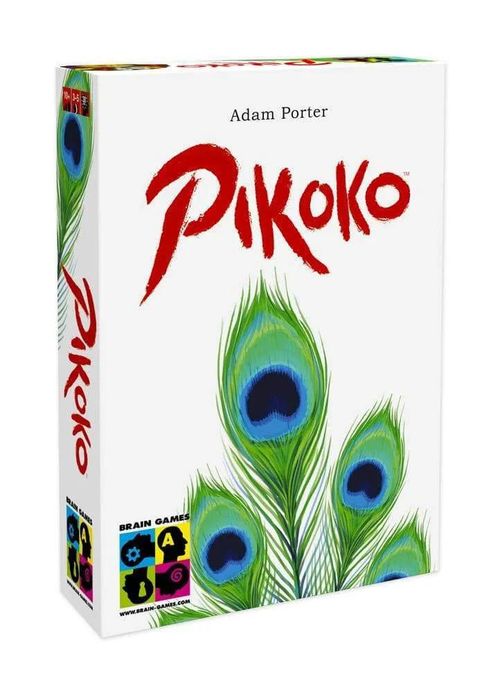
Pikoko
Pikoko Rulebook
Table of Contents
Table of Contents
Components
47 feather cards
- Each number from 1–11 is represented once across each of 5 colors in the game (red, yellow, purple, white, and blue). There are 4 multi-colored cards (1 each at numbers 1, 4, 7, and 10) in the game, which each represent 3 different colors on 1 card.
- Multi-suit 1: Purple, Yellow, Red
- Multi-suit 4: Blue, White, Yellow
- Multi-suit 7: Purple, White, Red
- Multi-suit 10: Blue, White, Red
Note: The multi-colored cards represent 3 of the 5 colors for their number. There are 2 other (single-colored) feather cards for the other 2 colors not shown on the multi-colored card.
30 confidence cards (6 cards in 5 player colors).
5 peacocks — card holders (have to be assembled)
45 betting tokens (9 tokens in 5 player colors)
1 starting player token
1 score pad
Setup
Each player chooses a color, and takes the peacock, 6 confidence cards, and 9 betting tokens in the chosen color. If fewer than 5 players are playing, place the unused components back in the box.
Prepare the deck of feather cards, based on the number of players:
- 5 players: use all cards
- 4 players: remove cards numbered 10 and 11
- 3 players: remove cards numbered 8, 9, 10 and 11
Randomly choose a starting player and give him the starting player token. The game is ready to begin!
Assemble the peacocks into a 3D figure.
Playing the Game and the Round
The game consists of 3 rounds. Each round consists of 4 phases — Preparation, Bidding, Playing and Scoring.
Phase 1 — Preparation
Take all the feather cards and shuffle them. Then deal out 8 face down cards to each player and put the remaining cards in a face down pile. Turn over the top card of this pile — this card defines the trump color for the round. However, if it is a multi-colored card, this round has no trump.
The players take their cards without looking at them and put them into their peacock facing the other players so that the other players can see the numbers on each of their cards. Note: players never look at the values of the cards in their own peacock!
Phase 2 — Bidding
In this phase players bid on how many tricks they think the other players will take this round.
Starting with the starting player, and going around the table clockwise, each player will have a turn being bid on. The player who is being bid on does not participate in bidding. For each bid, players take all their bidding tokens in one hand and secretly put any number of them in their fist without showing this number to other players.
When everyone is ready, they simultaneously reveal how many tokens they bid and then place them in front of the player being bid on. Repeat this process for the next player in clockwise order, and so on, until each player has been bid on (remember, that the player being bid on does not participate!). After each player has been bid on, then the players all individually bid on themselves. Again, each player takes the number of tokens secretly in their hands and when everyone has chosen their amount, reveals the bid and places it in front of themselves. After the players have bid on themselves, they can place any remaining tokens behind their peacocks. These tokens are not taken into consideration this round.
Additional notes on bidding
- You can bid any number of tokens you have, including 0. It is possible that a player will not take any tricks during the round, therefore 0 can potentially be a correct bid.
- You do not have to bid all 9 tokens in a round. If you do bid all 9 tokens, it will be impossible for all your bids to be correct, as there are only 8 tricks played in a round. The same is true if you bid fewer than 8 tokens.
The Confidence Cards
After all bids have been placed, each player secretly chooses 1 of their confidence cards and places it face down on the table (to be revealed at the end of the round). Players should choose the confidence card that matches the bid they trust the most (out of all the bids they just placed).
At the end of the round, confidence cards score 3 points if they are correct or –1 point if they are incorrect.
If a player is unsure about their bids or doesn't want to take a risk, they can choose the "No Confidence" card (with a +1 depicted on it). This card will always score 1 point. It is still played face down, so other players don't know what have you played.
Play then proceeds to the playing phase.
Phase 3 — Playing
Playing into a trick
The starting player starts this phase by choosing any of the cards from his Target player's hand, placing it face up on the table. A player's Target player is the player sitting on that player's left. Players only play the cards from the player on their left.
Then the next player in clockwise order chooses a card from their Target player and plays it, and so on, until each player has played out exactly one card into the trick.
Rules for playing cards into a trick:
- The first card can be any card regardless of color or number.
- All other cards must follow the color of the first card, if able.
- If your Target player doesn't have any cards of the required color, then you can play a card of any color for them — either a trump card or a card of another color.
- The card can be any number as long as the above rules are observed.
Multi-colored Feathers
The multi-colored feather cards can be played as any of the 3 colors depicted on them.
When you play a multi-colored card and any of its 3 depicted colors is the required color for the trick, then you must treat the card as that color. In all other cases, when the multi-colored card doesn't contain the required color for the trick, then the player playing this card chooses its color.
If a trick is started with a multi-colored card, the player, who played it out (not its "owner"), chooses which color it is and states it loudly.
Taking a Trick
The trick is complete after each player has played a card from their Target player, the trick is then taken by one of the players. There are 2 possibilities:
- If a trump card was played, the player who played the highest trump card wins the trick.
- If no trump card was played, the player who had the highest number of the required color wins the trick.
Important! The trick is won by the player who "owned" the card (The players whose peacock the card came from). Meaning: the players who plays the card wins the trick for their Target player.
After the trick is taken, the player who won the previous trick becomes the first Target player of the next trick, meaning that his card is the first one played (by the player on his right). Again, each player in clockwise order chooses a card from their Target player and plays it out, after which the trick is taken by 1 of the players. The game continues in this manner until all 8 tricks have been take. Then this phase ends.
The Blue Peacock begins the trick by playing the blue 3 card from the Red Peacock's hand. The Red Peacock must match the same color, so they play the blue 5 card from the Yellow Peacock's hand. The Yellow Peacock cannot match the color, so they play the red 2 from the Blue Peacock's hand. Red is the trump color for the round, so the Blue Peacock takes the trick. Otherwise, the Yellow Peacock would have taken it.
Phase 4 — Scoring
In this phase, players score points for their previous bids, as well as for their confidence cards.
First, players score points for their bidding tokens. Each player looks at how many tricks they took and how many tokens each other player bid on them.
There are 3 possibilities:
- Correct bid — The number of tokens a player bet is equal to the number of tricks the player he bet on took. In this case, the bidding player scores 2 points.
- Close bid — the number of tokens a player bet is 1 higher or 1 lower than the number of tricks the player he bet on took. In this case, the bidding player scores 1 point.
- Bad Bid — the number of tokens a player bet is off by 2 or more. In this case, the bidding player scores no points.
REMEMBER: Don't forget to consider bids of 0 when determining if a bid is correct, close, or bad.
Then, score the confidence cards. Players reveal the confidence cards they chose during the Bidding phase. There are 3 possibilities:
- If the color of a player's confidence card matches a player whom they placed a "correct" bid on this round, then the bidding player score 3 points.
- If the color of a player's confidence card matches the color of player whom they placed a "close" or "bad" bid on this round, then the bidding player loses 1 point.
- If a player chose the "No Confidence" card, they automatically score 1 point.
After the scoring is done, write each player's score down on the score pad.
If this is the end of the first or second round, give the starting player token to the player with the fewest points (in case of tie, give it to the tied player closest in clockwise order to the starting player from the previous round). Then begin a new round starting with the phase 1 — Preparation!
After 3 rounds of play, proceed to the end of game.
Scoring example: The Red Peacock placed a bad bid on himself (0 points), a bad bid on the Yellow Peacock (0 points), and a close bid on the Blue Peacock (+1 point). His confidence card was incorrect (–1 point). Total: 0 points.
The Yellow Peacock placed a correct bid on himself (+2 points), a close bid on the Blue Peacock (+1 point), and a close bid on the Red Peacock (+1 point). He chose the automatic confidence card (+1 point). Total: 5 points.
The Blue Peacock placed a bad bid on himself (0 points), a correct bid on the Red Peacock (+2 points), and a bad bid on the Yellow Peacock (0 points). His confidence card was correct (+3 points). Total: 5 points.
End of the Game
The game ends after the third round. The player with the most total points is the winner of the game. In case of a tie, the tied player with the highest score from a single round wins. If there is still a tie, then the victory is shared.