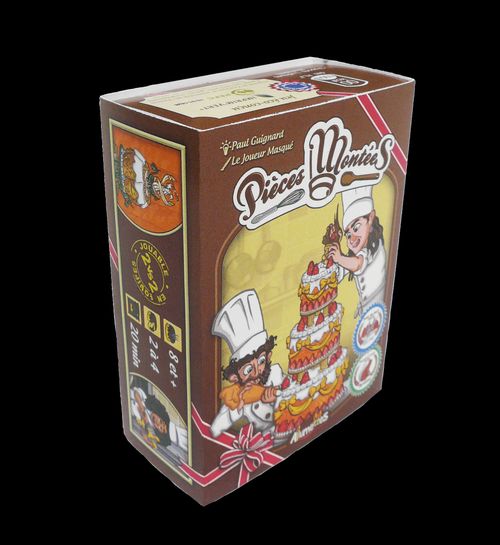
Pièces montées
Pièces montées Rulebook
Table of Contents
Table of Contents
Introduction and Goal of the Game
(Printed heading: "Introduction & But du jeu.")
It's the great pastry contest where you hope to be elected "Pastry Chef of the Year"! To win it, you must prepare a maximum of pièces montées for five occasions: the traditional wedding pièce montée, one for a birthday, one to celebrate Saint Valentine, one to celebrate Christmas, and one special Halloween pièce montée to finish.
A pièce montée consists of 3 étage cards to be stacked on top of one another, and it can be prepared with a chocolate or a cream topping.
At the end of the game, the player whose pièces montées total the most points becomes the Pastry Chef of the Year!
Components
- 45 étage cards (9 per colour, 5 colours): chocolate side (recto chocolat) and cream side (verso crème)
- 5 small décoration cards (1 per colour, 5 colours)
- 1 small couverture card
- 1 small 1er joueur (first player) card
- 1 small flèche (arrow) card
- 3 cuillère (spoon) cards
- 4 Chef Pâtissier cards
- 4 aide de jeu (player aid) cards "APPRENTIS PÂTISSIERS" (recto and verso)
- 4 aide de jeu (player aid) cards "PÂTISSIERS CONFIRMÉS" (recto and verso)
Game Modes
This rulebook offers several game modes:
- "APPRENTIS PÂTISSIERS" (Apprentice Pastry Chefs): ideal for discovering the game, for the youngest players, and for playing with children. To play this mode, read only the rules on pages 2 to 5.
- "PÂTISSIERS CONFIRMÉS" (Experienced Pastry Chefs): for the most experienced players. Add the rules on pages 6 and 7.
- "DUEL DE PÂTISSIERS" (Pastry Duel): a dessert face-to-face game for two players. Add the rules on page 8.
- "PÂTISSER EN ÉQUIPES" (Pastry Teams): to savour victory as a pair. Add the rules on page 8.
Setup
- Each player chooses a Chef Pâtissier card and places it in front of them, on the face that shows the Chef Pâtissier with its commis (assistant) visible.
- Each player takes an "APPRENTIS PÂTISSIERS" player aid card and places it in front of them, with the player aid side visible.
- Shuffle the étage cards. Cut the pile into two, turn one of the halves over, and shuffle again (so that both faces and colours of the cards are mixed).
- With 4 players, deal 3 étage cards to each player. With 3 players, deal 4 cards to each player.
- The remaining étage cards form a draw pile in the centre of the table.
- Each player picks up their cards and holds them in hand, keeping the faces that were showing during the deal (turned towards that player only).
Caution: you must not look at the other side of the étage cards in your hand. Each player therefore knows only one face of the cards they hold.
- Return to the box the 4 "PÂTISSIERS CONFIRMÉS" player aid cards, the 5 small décoration cards, the small couverture card, and the small flèche card. They are not used in "APPRENTIS PÂTISSIERS" mode.
- The last player to have eaten a pastry takes the 1er joueur card and the 3 cuillère cards and places them in front of them. That player starts the game.
Turn Structure
On your turn, you have 3 action points to start or continue your pièces montées. These action points are called cuillères (spoons) and are symbolised by the 3 cuillère cards in front of you at the start of your turn. Your cuillères can be used to:
PLAY CARDS or TURN CARDS
Caution: you may act on the cards in your own hand as well as on the cards that are visible in the other players' hands.
Playing Cards
You may play étage cards, taken from your hand or from the hand of any other player.
Playing the 1st étage of a pièce montée (costs 1 cuillère)
Place the card in front of you. It forms the base of a pièce montée.
Example: Yannick decides to play the cream-side étage 1 card of the green pièce montée that he sees in Laura's hand. He takes the card and places it in front of him. He gives one cuillère card to Audrey, who is the next player to play.
Playing the 2nd étage of a pièce montée (costs 2 cuillères)
Place the card in front of you, on top of the 1st étage, slightly overlapping it so that the design matches.
Example: Yannick plays the cream-side étage 2 card from the green pièce montée that he has in hand. He places it on top of the étage 1 card he just played. He gives 2 cuillère cards to Audrey, who is the next player to play.
Playing the 3rd étage of a pièce montée (costs 3 cuillères)
Place the card in front of you, slightly overlapping the 2nd étage so that the design matches.
Example: On his next turn, Yannick sees a cream-side étage 3 card of the green pièce montée in Audrey's hand. He uses his 3 cuillère cards to play it and complete his green pièce montée.
Pastry Competition Rules
Rules of the contest for preparing pièces montées
- You must play the étage cards in order (étage 1, then étage 2, then étage 3).
- You may not mix colours or toppings within the same pièce montée.
- You may prepare up to 3 pièces montées at a time. To start a 4th, one of the first 3 must first be completed by receiving its étage 3 card. (You will see further on how you can exceed this limit with the help of your commis.)
- All the pièces montées you prepare must be different (by colour or by topping).
Clarifications
- The number in the corners of the cards indicates both the number of the étage card and the number of cuillères to spend to play the card.
- You do not need another player's agreement to play a card taken from their hand. The cost is the same.
- When you play an étage card, you must always use the face that is visible to you.
Turning Cards
Turning an étage card (costs 1 cuillère)
As explained above, you cannot play cards other than on the faces you can see. To access the hidden face of an étage card, you must spend a cuillère to turn the card over (the card may be in your hand or in another player's hand). Once the étage card has been turned, you may choose to play it if you still have enough cuillères to do so.
Caution: turning an étage card over does not mean taking it. It stays where it is, on the face now showing.
Example: Audrey cannot see an orange chocolate étage 2 card in her hand, nor in the hands of the other players, to continue her orange pièce montée. However, she notices an orange cream étage card in Yannick's hand. She decides to turn it over to find out whether the other side hides an étage 2 card (1). It is indeed an étage 2 chocolate card that comes into view (2). Audrey uses her 2 remaining cuillères to play it (3).
Using Your Chef Pâtissier (Commis)
Turning your Chef Pâtissier card (costs 2 cuillères)
During your turn, you may use your commis for a choice of:
-
having an extra cuillère (symbolised by the cuillère in the bottom-right corner of the Chef Pâtissier card), OR
-
starting a new pièce montée even if you already have 3 (or more) in preparation (symbolised by the fouet (whisk)).
Once you have used your commis, turn your Chef Pâtissier card back to its face showing the Chef Pâtissier alone.
To have access to your commis again, you must spend 2 cuillères to turn your Chef Pâtissier card back (this cost is reminded on the card by the icon "- 2 cuillères").
Example: Laura is looking for a red chocolate étage 3 card. She turns over a red cream étage 1 card from her hand, and it is indeed a chocolate étage 3 card that comes into view. She has only 2 cuillères left, so she is one short of what she needs to play the étage 3 card. However, she has not yet used her commis, and she decides to use it to gain an extra cuillère for this turn. This lets her play the étage 3 card. In doing so, she turns her Chef Pâtissier card over to the face where the Chef is alone in the kitchen.
Tip when playing with children: when your commis is visible, to help you see the extra actions available, you may turn your player aid card to its cuillère + fouet side and place it next to your commis. This card symbolises both the extra cuillère you can add to your 3 cuillères for the turn, if you spend them, and the possibility of starting a new pièce montée even if you already have 3 in preparation (the fouet).
Clarifications:
- You may not use your commis on the same turn on which you called it. You may use it from your next turn.
- If you use your commis to have a 4th pièce montée in preparation, the cost of playing the first étage of that pièce montée is included in the action of your commis (symbol cuillère + fouet). This action is in addition to your 3 cuillères for the turn.
- You may not store several cuillère + fouet cards thanks to your commis.
- You may, however, call on your commis several times during the game.
End of a Player's Turn
During your turn, for each action point spent, give one cuillère card to your neighbour on the left. When you have no cuillère cards left, your turn is over. If you do not wish to use all your cuillères, give the remaining cuillère card(s) to the next player without performing an action.
Then refill your hand to 3 étage cards (or to 4 if you are playing with 2 or 3 players), and in turn order each player does the same.
At the start of a player's turn, all players must always have the correct number of cards in hand.
Caution: each time a player draws a card, they add it to their hand keeping the face that was showing on top of the draw pile visible to them alone (turned towards them). Only the other players know what appears on the other side.
Example: Yannick has used his 3 cuillère cards, which are now in front of Audrey. During his turn, he played one card from his hand and another taken from Laura's hand. He adds to his hand the first card from the draw pile, then Laura, who also needs one, receives the second.
End of the Game
The game ends as soon as the étage card draw pile is empty AND a player can no longer complete their hand.
The round is then finished so that every player has played the same number of times. The last player to play will therefore be the one to the right of the first player (the player who has held the 1er joueur card in front of them since the start of the game).
Each player adds up the points shown in the toque (chef's hat) at the top of the last étage card of each of their pièces montées (complete or not):
- 1 point for a pièce montée of 1 étage
- 4 points for a pièce montée of 2 étages
- 10 points for a pièce montée of 3 étages
Étage cards still in hand score nothing.
The player who totals the most points wins the game and becomes the Pastry Chef of the Year!
Tie-break: in case of a tie, the player with the most complete pièces montées wins. If the tie persists, the player with the most chocolate-topped pièces montées (complete or not) wins.
Example: Laura has managed to prepare 2 complete pièces montées (10 pts + 10 pts = 20 pts), 3 pièces montées of 2 étages (4 + 4 + 4 = 12 pts), and one pièce montée of 1 étage (1 pt). This gives her a total of 33 pts. Audrey has 31 points and Yannick ends on 29.
Note on the source: the printed scoring illustration for this example shows the six values 10, 10, 4, 4, 4 and 1 (which add up to 33), but its caption reads "Total de Laura = 29 pts". The printed caption and the written example disagree; the caption is transcribed here as printed, and the written example's total of 33 points is consistent with the values shown. This is a discrepancy in the source, not a rule.
Experienced Pastry Chefs Mode ("PÂTISSIERS CONFIRMÉS")
Apply the same rules as for the "APPRENTIS PÂTISSIERS" mode, with the following changes.
Setup for This Mode
- Each player chooses a Chef Pâtissier card and places it in front of them (on the face where the Chef Pâtissier is found alone in the kitchen).
- Each player takes a "PÂTISSIERS CONFIRMÉS" player aid card (in place of the "APPRENTIS PÂTISSIERS" one). Its back shows the distribution of cards for each colour, so you now have an indication of what may be on the back of each card.
- Stack the 5 small décoration cards with their cream face up, shuffle them, then cover them with the small couverture card from the decoration booklet. Place this pile in the centre of the table. It constitutes the decoration booklet (livret des décorations).
- Place the small flèche card, cream side up, at the top of the booklet. It indicates the direction in which the pages will be turned at the start of the game.
Obtaining a Décoration Card
Décoration cards represent possible bonuses of 2 or 3 points for your pièces montées.
During your turn, you may obtain a décoration card if you fulfil both of the following conditions:
- You must have a complete pièce montée (1st, 2nd and 3rd étages placed face up in front of you).
- The décoration card for that pièce montée (same colour AND same topping) must be visible in the decoration booklet.
If both conditions are met, take the décoration card and place it on top of your pièce montée. This costs you no cuillère.
If the décoration card for your pièce montée has already been taken by another player, you will not obtain a décoration card for that pièce montée.
Example: During her turn, Audrey sees that the orange chocolate décoration card is visible. She takes it and places it on top of her orange chocolate pièce montée (without spending a cuillère for this action).
Clarifications:
- You may obtain only one décoration card during the same turn.
- Once won by a player, a décoration card can no longer be lost.
- A pièce montée may receive a décoration card several turns after it was completed.
Additional Action During Your Turn (Experienced Mode)
In this mode, a new action is available during your turn:
Turning a card in the decoration booklet (costs 1 cuillère)
For one cuillère, you may turn a card in the decoration booklet. These décoration cards turn like the pages of a book. When 2 cards are visible, you may turn the one of your choice (either moving forward in the booklet or going back).
Caution: you are not obliged to respect the direction of the flèche card. It is only used for the last step of your turn (see the example below and the paragraph "End of your turn" below).
Example: Laura has finished her red chocolate pièce montée. She now seeks to add the corresponding décoration card. For one cuillère, she turns a page of the decoration booklet (1). The red cream décoration card is now visible. She turns it over by spending a second cuillère (2), which reveals its chocolate side. She can now obtain the décoration card, and she still has one cuillère left to use.
End of Your Turn (Experienced Mode)
After using your 3 cuillères, and once each player has completed their hand if necessary, you MUST turn a page of the decoration booklet in the direction indicated by the flèche card.
Once you reach the end of the booklet, turn the flèche card over horizontally onto its chocolate side (the rounded corners stay oriented the same way). At the end of a turn, each player must turn a décoration card in this new direction until the booklet is closed again (as at the start of the game, only the couverture card is visible). The flèche card is then turned back onto its cream side, and so on until the end of the game.
Caution: you may not take a décoration card after this step.
Example: Audrey has used her 3 cuillères. She now refills her hand to 4 cards, then, in turn order, Laura and Yannick do the same. Finally, Audrey turns a page of the decoration booklet in the direction indicated by the flèche card (1).
End of the Game (Experienced Mode)
The end of the game is triggered when the étage card draw pile is exhausted OR the décoration cards are exhausted. Then the round is finished so that each player has played the same number of times.
Pièces montées with a cream décoration score 12 points, and those with a chocolate décoration score 13 points (because chocolate is better!).
Tie-break: in case of a tie, the player who completed the most pièces montées wins. If the tie persists, the player who obtained the most décoration cards wins. If there is still no winner, the player who prepared the most chocolate-topped pièces montées (complete or not) wins.
The other rules do not change.
Two-Player Duel ("DUEL DE PÂTISSIERS")
To play with two players, during setup remove the 9 étage cards of one colour of your choice (as well as its décoration card if you are playing the "PÂTISSIERS CONFIRMÉS" mode).
Deal 4 étage cards to each of the two players, then place 4 étage cards on one side of the table. These cards constitute the hand of a fictitious neutral player, and both players may use them (you may turn them over and play them on your pièces montées).
At the end of your turns, complete the neutral player's hand to 4 cards if necessary.
The other rules do not change.
Team Play ("PÂTISSER EN ÉQUIPES")
With 4 players, and once you know the game well, we advise you to play in teams of 2 players for a more tactical game.
The players of each team sit alternately around the table.
A team game is played like the normal game, except that you may play étage cards in front of you as well as in front of your partner.
At the end of the game, the winning team is the one that totals the most points by adding together the points of its two partners' pièces montées. The two players are elected the duo of Pastry Chefs of the Year!
Caution: partners may not communicate about their actions.