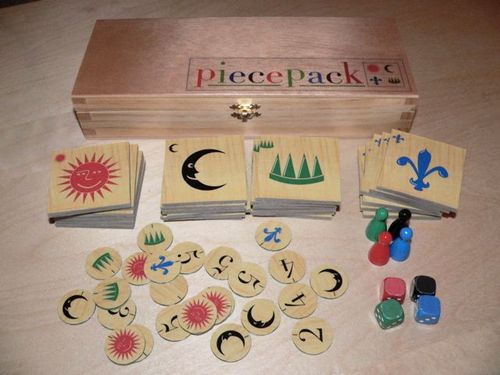
Piecepack
Piecepack Rulebook
Table of Contents
Table of Contents
What Is a Piecepack?
What is a piecepack?
Flexible. Portable. Affordable. Public domain. The piecepack is a set of boardgame parts that can be used to design and play a wide variety of games. Anyone may design and publish a piecepack rule set. Any manufacturer or individual may produce piecepacks.
What's in a piecepack?
The Anatomy section below has a complete listing of what goes into a piecepack. The Glossary section provides explanations for common piecepack terms.
What games can you play with a piecepack?
Rule sets for well over a hundred games have been developed for the piecepack, and since it is an open-source type system, new games appear frequently.
Can I make my own piecepack?
Anyone is free to make their own piecepack. All the files and instructions needed to create a piecepack set are freely available.
Can I buy a piecepack?
Piecepack sets are available from a number of independent manufacturers, since the standard is public domain and anyone may produce and sell piecepacks without paying royalties.
Anatomy of a Piecepack
Notes
The suit of Arms is represented by the Fleur De Lis.
Aces are represented by the appropriate suit symbol.
Nulls are represented by the absence of a numeral or symbol.
Standard Color Associations
Arms are blue.
Crowns are green or yellow.
Moons are black.
Suns are red.
Components
24 tiles (square):
- one tile per suit/value pair
- suits are Suns, Moons, Crowns, Arms
- values are null, ace, 2, 3, 4, 5
- faces are marked with value at center and a small suit symbol at top-left, both in color to match suit
- backs are marked with small black crosses to suggest a division into four square quarters
24 coins (round):
- one coin per suit/value pair
- suits are Suns, Moons, Crowns, Arms
- values are null, ace, 2, 3, 4, 5
- faces are marked with value in black (aces are spiral symbols)
- backs are marked with suit in appropriate color
- both fronts and backs are marked with a small mark near the edge to indicate direction
4 dice (cubic):
- one die per suit
- suits are Suns, Moons, Crowns, Arms
- values on each die are null, ace, 2, 3, 4, 5
- die sides are marked with value in color to match suit
4 pawns (non-specific shape):
- one pawn per color
Notes for Manufacturers
- The piecepack is public domain; anyone may manufacture and distribute (for profit) piecepacks without pay of royalty or license.
- Although piecepacks may certainly be stylized or personalized (e.g. for promotional purposes), it is important that piecepacks conform to the basics outlined in the Anatomy section above.
- Coin diameter should not exceed 1/2 tile width, so that a coin may fit on a tile quarter-section.
- As a point of reference (not a requirement), the Mesomorph piecepack pieces are the following dimensions: tiles are 2" x 2" x 1/4", coins are 3/4" diameter x 1/8", dice are 1/2" x 1/2" x 1/2", and pawns are 5/8" diameter x 1-1/8" tall.
- The word piecepack is not capitalized, as it is a compound word rather than a title.
Accessories
Pawn Saucers
Pawn saucers were developed by Karol M. Boyle at Mesomorph Games. They are included as standard equipment in all of the MG piecepack sets and available separately from MG.
The pawn saucer is a small round piece with a depression on one side that a pawn can sit down in. It can be used to add a directional mark to a pawn or as a separate piece. If used separately, it has a directional mark and may indicate a suit, depending on the side that is exposed. It is also reversible, so the suit information can be alternately hidden or displayed.
The pawn saucer concept has been released into international public domain; anyone may manufacture and distribute pawn saucers without paying a royalty or license.
Manufacturing Notes:
- The pawn saucer is a round piece with a depression in one side.
- The depression must be large enough to accommodate one of the pawns.
- The saucer should be stable resting with either side facing up.
- The saucer must be small enough to fit in one space on the back of a tile (4 per tile).
- The bottom of the depression is marked with a colored dot to signify suit.
- The other side of the saucer is not marked with a color.
- Both sides are marked along one edge to signify direction.
For reference, MG uses undrilled 7/8" craft buttons, but these have to be special ordered from the manufacturer in bulk. Standard 7/8" craft buttons may be a suitable replacement, and can be found at many craft supply stores.
Glossary
ace — n. a special value used on coins, tiles, and dice; the default numerical equivalent for an ace is 1, but rulesets often ascribe special meaning to the ace; an ace is represented by a suit symbol on tiles and dice, and by a swirl or spiral symbol on coins.
arms — n. one of the four standard piecepack suits; the suit of arms is represented by the color blue and the fleur-de-lis symbol.
coin — n. a disk-shaped token marked with a suit symbol (in associated color) on one side and a value (in black) on the other; there is one coin for each value and suit combination in a piecepack, for a total of 24 coins.
crowns — n. one of the four standard piecepack suits; the suit of crowns is represented by either the color green or the color yellow and by a crown-shaped symbol.
die — n. a cube with each side marked with one of the standard piecepack values; a piecepack has one die for each suit and the values on a die are marked in the color associated with its suit.
face-down — adj. when referring to a tile, face-down indicates that the tile's value and suit are hidden; when referring to a coin, face-down indicates that the coin's value is hidden.
face-up — adj. when referring to a tile, face-up indicates that the tile's value and suit are visible; when referring to a coin, face-up indicates that the coin's value is visible.
facing — n. the direction indicated on a coin or tile by its pip.
flick — v. to move a coin or other component using one's finger; to flick properly, the tip of the finger should begin on the table, and the motion of the finger should cause the fingernail to strike the edge of the coin.
flip — v. to turn over a tile or coin so that the side previously hidden is now visible, and vice-versa.
moons — n. one of the four standard piecepack suits; the suit of moons is represented by the color black and a quarter-moon symbol.
null — n. a special value used on coins, tiles, and dice; the default numerical equivalent for a null is 0, but rulesets often ascribe special meaning to the null; a null is represented by the absence of a number or symbol.
obverse — n. the side of a coin showing the value.
pawn — n. a game token often used to represent a player's position on a game board; a piecepack contains one pawn for each suit, for a total of four pawns; a pawn is marked in the color associated with its suit and, ideally, is marked with the suit symbol as well.
piecepack —
- n. a simple, flexible, public domain standard for abstract board games.
- n. a set of game components built for compatibility with the piecepack standard; a piecepack consists of 24 tiles, 24 coins, 4 dice, and 4 pawns.
- adj. of or having to do with a piecepack.
pip —
- n. a dot, small line, or other suitable symbol marked near the edge of a coin, which can be used to indicate facing.
- n. the suit symbol in the corner of a tile, which can be used to indicate facing.
public domain — n. or adj. the total absence of copyright protection; the piecepack is public domain.
reverse — n. the side of a coin showing the suit.
ruleset — n. a set of instructions for playing a game using a piecepack (possibly in conjunction with other components).
shake — v. to mix coins by agitating them so as to create a random distribution (in an opaque cup, an opaque bag, or an enclosure created with two hands cupped together).
shuffle — v. to mix face-down tiles so as to create a random distribution.
suit — n. an arbitrary division or categorization of components; there are four standard piecepack suits: (in default order from highest to lowest) suns, moons, crowns, and arms.
suns — n. one of the four standard piecepack suits; the suit of suns is represented by the color red and a sun-shaped symbol.
tile — n. a square component marked with suit and value (in color associated with the suit) on one side and a two by two grid on the other; a piecepack contains one tile for each combination of suit and value, for a total of 24 tiles.
value — n. the ordinal rank of a coin, tile, or die roll; there are six standard values for piecepack components: (in default order from lowest to highest) null, ace, 2, 3, 4, and 5.
Origins of the Piecepack
In Search of a Generic, Universal Boardgame Set
When I was a lad, my folks used to visit my aunt and uncle to play cards. When I asked my father what games they played, he informed me that they usually played Hearts. One evening in my teens, he taught my siblings and I to play Hearts, and it remains one of my favorite card games to this day.
But I'm not a fan of Poker, though I give it a limp attempt now and then. I absolutely loathe Euchre (knowledge of which is a prerequisite for acceptance to every university in the state of Michigan). Spades looks fun, but I've not yet taken an opportunity to try it. Bridge appears too complicated for my weak faculties. Pinochle sports some interesting twists which seem a bit much to remember between games unless you play regularly. I've had something of a yen to learn Whist ever since I enjoyed "Around the World in Eighty Days".
Now, you may agree or disagree with my taste in traditional card games, but it is certain that you know each of them by name, and you likely know the rules to several of them. And they all use the same game equipment, namely a deck of playing cards, which I would give good odds that you own. In fact, playing card decks are so common, and rules to traditional card games are so well known, that if you were to ask any random group of four individuals, the chance is good that they could sit down together and play at least one traditional card game.
But what if that same group of individuals wished to play a board game rather than a card game? Their choices become much more limited, perhaps Monopoly, Clue, Risk, Scrabble, or Pachisi (Parcheesi) if you live across the drink. It's not that there aren't plenty of more interesting choices, it's just that the set of multiplayer boardgames known to the general population is rather small. Take note that each game they might consider would require a different set of equipment (i.e., different board, tokens, etc.) And even if the group were to settle on one of these games, the probability that the hostess owns that particular game is much lower than the chance she owns a deck of playing cards.
So there seems to be an unfilled niche for a single set of playing pieces able to be enjoyed with a multitude of boardgame rules. The first question that presents itself is whether anything appropriate already exists that might simply need popularizing (though this would be no trivial undertaking). Candidates must be examined for suitability with regard to both flexibility (including genericy, adaptability, and variety) and availability (including cost and distribution), since these are the primary traits of playing cards which led to their ubiquity.
One such possibility is the marvelous Icehouse set designed by Andrew Looney. The Icehouse set is a group of stackable, colored plastic pyramids in three sizes. The set was originally designed as a single game (called Icehouse) which is played in real time without a board. Because the game is abstract, and because the pieces display multi-tiered variance (differing in size and color), several game designers have found it well suited for the development of other games. Dozens of games have been designed for play with Icehouse pieces. But for the purposes of a universal boardgame set, it has a few drawbacks. Since it is produced in relatively small quantities by a small (but growing) publisher, Icehouse is not yet popularly priced. An inexpensive "origami" version is available, but lacks the durable, tactile nature required for a universal boardgame set to become popular. Also, the lack of a board reduces versatility, though some of the games designed for the Icehouse set utilize other common game equipment, such as a chess board or tarot cards. Ultimately, as a universal boardgame set, the flexibility of Icehouse is moderate, and availability is inadequate.
Another option to consider is the traditional chess set. Chess sets are widely available in myriad sizes and prices. Though the game of chess is intended for only two players, the pieces show acceptable variance except in color; for example, one could design a four player game in which each player uses four pieces (rooks, knights, bishops, or pawns). Adaptability is possible, though strained; you could play checkers with a chess set, but certain aspects would prove inconvenient. Also, the board is fixed and there is no inherent method of displaying token status, such as stacking or flipping. In short, chess possesses excellent availability, but rates poorly in flexibility.
A few more contenders can be found, but each falls short of the ideal universal boardgame set in some respect. Of course, no set can be perfect, but if materials were to be designed specifically as a generic, universal boardgame set, what features would be expected? How would one go about designing such a set? It seems reasonable to look toward the traditional playing card deck for inspiration, given its indisputable success in a related role. But while designing a set cast in the shadow of traditional playing cards, care must be taken not to lose sight of the fact that it is intended to be utilized for boardgames, rather than card games.
Blending all of the ingredients set out before us (namely flexibility, availability, classicism, a nod to playing cards, acknowledgment of board game necessities), some ideas come into focus: tiles (able to be configured into a multitude of boards), suits and values, tokens, probably dice, and likely pawns. From these raw materials, the piecepack was forged. Although it is by no means perfect, it is the first set of components, to the best of my knowledge, that has been designed specifically as a universal boardgame set.
A piecepack consists of the following:
24 square tiles
- obverse marked with suit and value, both in color matching the suit
- reverse marked with two lines forming a two space by two space grid
- one tile per suit/value combination
24 round coins
- obverse marked with value, in black
- reverse marked with suit, in color matching the suit
- both sides marked with one directional indicator (tick mark) at the edge
- one coin per suit/value combination
4 (six sided) dice
- faces marked with values, in color matching the suit (ace icon indicates suit)
- one die per suit
4 pawns
- one pawn per suit, in color matching the suit
The piecepack suits are suns, moons, crowns, and arms (fleur-de-lis). The piecepack values are 5, 4, 3, 2, ace, and null (blank).
So, how does the piecepack fare against our test of flexibility? Well, the tiles can be configured in many different board shapes. Face down, with the spaces showing, the tiles lend themselves well to classical, abstract application, including the traditional 8 space by 8 space chess board pattern (4 tiles by 4 tiles, face-down). Face up, with the suits and values showing, the tiles can be used as individual spaces with game-mechanical significance implied by the suit, the value, or both. Also, since the suit is marked in one corner of the tile, the tiles can clearly show orientation if needed.
The coins are equally versatile. Since the suit and value are marked on opposite sides of each coin, and since values of ace are all represented by the same symbol on coins (instead of the suit icon used to mark aces on dice and tiles), a game design can take advantage of hiding either suit or value. If coins need to be picked at random without prior knowledge of both suit and value, they can be drawn from a bag or cup. The tick mark (pip) can be used to show direction or rotation if a game design calls for such.
The values used in the piecepack were selected in particular for their flexibility. Having both nulls and aces offers game designers two values to potentially take on special meaning. Alternatively, they can operate in their default roles of zero and one, producing a simple, flat range of values 0-5 for each suit (and on each die). The range of 0-5 also has an advantage over the natural 1-6 range (albeit a rather insignificant one) in that the roll of 3 dice covers all possible totals of tile values or coin values within a suit. That is, given a random subset of the tiles (or coins) within a single suit, the total value of those tiles will be in the range 0-15, which is the same range achieved by the roll of 3 dice.
The flexibility of the piecepack has lived up to its expectations. So far, games have been written for the piecepack that include a wide variety of styles (chance, manual dexterity, memory, tactics, and strategy) and genres (fantasy, finance, history, science fiction, and sports). It has adapted acceptably to themed games as well as abstract. A few games have even taken advantage of the 3-dimensional nature of the tiles, making them visually appealing and sometimes challenging in ways previously unexplored. Games have been written to be played with as few as 1 player and as many as 6, and more players could easily be included by a game design with the addition of a second piecepack (just as with decks of playing cards).
As with any other candidate for universal boardgame set, there is no need to limit designs to piecepack components exclusively. Jim Doherty of Eight Foot Llama (publishers of "LifeLinks" and "Who Stole Ed's Pants?") has devised an excellent baseball game for the piecepack in conjunction with a deck of playing cards. Imagine the chess variants possible if a set of chessmen were let loose on the vast array of board shapes possible with a piecepack. What new challenges would be introduced to Scrabble if the players first formed the board with piecepack tiles, then populated it with suit-side-up coins with each suit designating a different Scrabble scoring bonus? What designs would become possible by combining a piecepack with an Icehouse set?
But we must also test the piecepack for availability, clearly the piecepack's greatest challenge. In response to this, the piecepack was made international public domain in October of 2000. This means that anyone may freely craft themselves a piecepack; downloadable images and instructions for doing so are available. Indeed, any manufacturer may publish piecepacks and owe no royalty or commission of any kind. The piecepack specification outlined above is materials independent; piecepacks could be manufactured from wood, plastic, cardboard, ceramic, or even metal, and are fairly economical to produce. Also, anyone may design games for the piecepack, and may distribute the rules to these games in any manner desired (though designers are encouraged to distribute the rules free of charge). The distribution model for the piecepack, therefore, matches that of the traditional playing card deck.
Will the piecepack ever take off and become a household item? Will the set gradually evolve as playing cards have? If four random individuals are stranded on an otherwise deserted island some day in the future, will they be able to share a piecepack game to alleviate their tedium? Only time will tell.