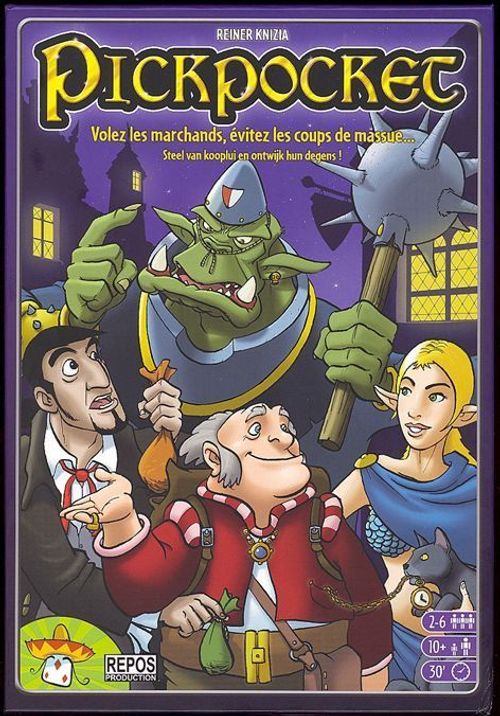
Pickpocket
Pickpocket Rulebook
Table of Contents
Table of Contents
Components
Basic game
- 1 game board
- 6 character tiles (the +50 side is used to show when you have completed a lap of the board)
- 6 character figures with their bases
- 6 experience point markers
- 71 loot tiles, including 7 guards
- 1 merchant tile
- 1 Prince of Thieves tile / player aid
- 1 rulebook
- 1 bag
Variant: Powers
- 7 special power tiles
Setup
- Place the board on the table (or underneath it if you are really cramped for space). Give each player a character tile and place the matching figures in the centre of the board, in the inn.
- Randomly stack the experience point markers on space 0 of the score track.
- Set aside the seven Power tiles; they are not used in the basic rules.
- Shuffle the loot tiles in the bag and deal three to each player. Players must not hold any Guard tiles. Anyone dealt a Guard discards it and draws new tiles. Return the discarded tiles to the bag.
- Place the merchant tile (double-sided, with the merchant) below the board.
- The marker at the bottom of the stack indicates which player goes first.
Basic Rules
Pickpocket is a simple game with original mechanisms, so we recommend that your first game be played without the powers. Afterwards, feel free to play with the variant; your enjoyment will only grow.
Principle
A game of Pickpocket is played over a number of nights. A night ends with the Double or Quits player's action or with the arrival of a second guard in the inn. The game ends instantly when the seventh guard arrives.
In Pickpocket, the thieves present inside the inn each take a turn in clockwise order, doing one of the following:
- try to stay in the inn by playing a loot tile;
- leave the inn and score experience points.
The last player in the inn becomes Double or Quits.
Loot Tiles
Loot tiles show cut or continuous lines of the four elements of the game (purses, keys, vials and jewels). Purses, which are at the top of the tiles, are the most frequent; keys are a little less frequent than purses, and so on.
Tiles with a single line but with two elements are worth 2 experience points when they are part of a series.
At the end of the game, the tiles remaining in players' hands are worth experience points. The amount is shown at the bottom right of each loot tile.
The Loot
The Loot is the row of tiles that begins with the merchant tile; new tiles are placed next to it, in a line from left to right.
The Loot is worth as many points as there are elements on the unbroken lines counted from the first tile. If a line of elements is not continuous from start to end, it scores no points.
In the example above, the vial and jewel lines are broken. The purse and key lines are continuous, with two elements per line, which is worth 4 points in total (2 points per line). When a guard is present, it adds its value to the Loot: it is the bravado of daring to leave the inn with your loot past a guard!
Below, the purse, key and vial lines are broken. The jewel line is continuous, with four elements in total (one of the tiles has two elements), which is 4 points. To this is added the value of the guard, 4. The player who decides to leave the inn therefore scores 8 points.
Guards
If the revealed tile is a first guard, its value is added to the Loot when a player voluntarily leaves the inn.
Place it on the board, on one of the two spaces provided for this purpose. If the revealed tile is a second guard, the night stops! The two guards block both exits, and it is now impossible to leave with one's loot. All thieves present in the inn are thrown out without scoring experience points.
Turn of a Player
On his turn, a player present in the inn must:
- A. either play a tile from the draw pile or from his hand to add it to the current Loot;
- B. or voluntarily leave the inn and score the experience points corresponding to the current Loot.
Each player may perform only one of these two actions. Players who have left the inn no longer take part for the rest of the night.
Warning: the last player present in the inn is Double or Quits and must perform another action (see C).
Translator's note: the printed rules use "pioche" (draw pile) and "sac" (bag) for the same pile of loot tiles set up at the start of the game. Both are translated accordingly.
A. Play a Tile from Hand or the Bag
A.1 Steal a Tile from the Bag
The player draws a random loot tile from the bag. If the tile extends one of the four element lines (purses, keys, vials or jewels) that is continuous from the draw pile, the player is safe.
However, if the revealed tile extends no element line, the player is caught red-handed and scores no points for this night. The revealed tile goes to the discard pile, and the player removes his figure from the inn. He is out of the game until the next night.
A.2 Play a Tile from Hand
Players who do not want to take a risk may play a tile from their hand. This tile must extend one of the continuous lines of the Loot. It is forbidden to play a tile that extends no line.
B. Leave Voluntarily with the Loot
A player who leaves voluntarily scores as many points as the current Loot. The tiles of the Loot stay in place for the other players. He advances his experience point marker on the score track and removes his figure from the inn. He is out of the game until the next night.
C. Double or Quits
When only one player remains in the inn, he must leave voluntarily, but he is Double or Quits. He must play two tiles, one after the other. These tiles may come from his hand and/or the bag.
The first tile played must complete the Loot, and the second must complete the Loot taking into account the first tile played.
If the player is caught red-handed on either tile, or if a second guard appears, the night is over and this player scores no points!
If both tiles played are good, the player scores the points of the Loot multiplied by two, plus the bonus of the guard, if any.
End of Night
A night ends when:
- the last player present in the inn has finished his Double or Quits;
- the second guard of the night has just been drawn.
Start of a New Night
The guards revealed during the previous night are placed beside the board. The tiles of the previous Loot are placed in the discard pile.
From the second night on, the player with the most points is named Prince of Thieves; he takes the corresponding tile and begins the next night. If several figures are tied for Prince of Thieves, the first to arrive (the figure at the bottom of the stack) is the Prince of Thieves.
The player aid repeats the steps to follow at the start of each night.
End of the Game: Arrival of the Last Guard
When the seventh and last guard is drawn, it triggers the immediate end of the game. All players are expelled from the inn without scoring points.
Players add the value of the tiles remaining in their hands to their experience points. The player with the most experience points is elected King of Thieves! In case of a tie, the player who had the fewest tiles in hand wins the game. In case of another tie, play again. In case of yet another tie, call an exorcist.
Variant: Powers
The game is played in the same way as the introductory game, except for the Power phase.
Power Phase
At the start of each night except the first, the players choose a special power for the night, except the Prince of Thieves.
In ascending order, starting with the player with the fewest experience points, each player chooses a Power tile and takes it in front of him. If players are tied on the score track, the figure at the top of the stack is considered to have priority.
When everyone except the Prince has a power, the Prince begins the new night.
At the end of each night, players return their power. There are always seven powers available during the Power phase.
Rules for Two and Three Players
With two or three players, two slight changes apply to the rules of the game. Players are entitled to a warning before being expelled, and they have two powers (the Prince of Thieves has only one).
Power Phase for Two and Three Players
The Power phase is the same as in the normal game, except that players choose two powers, and the Prince of Thieves chooses only one.
In ascending order, starting with the player with the fewest experience points, each player chooses a Power tile and takes it in front of him. The Prince of Thieves takes his power on his turn. The other players (except the Prince) then take a second power, in the same order.
Warning
With two or three players, a player gets a chance when he is caught red-handed (drawing a tile with no continuous element). When this happens, the player lays his character down to show that he has received a warning, and he passes his turn. If he is caught red-handed again the same night, he is expelled from the inn without scoring experience points.
When a player leaves the inn voluntarily, he must lay down another player's character, who thereby loses his chance. If everyone is already lying down, he loses this right.
Caution: the player who is Double or Quits must lay down his character if he has not already done so, since he no longer gets a warning.
Setup of a New Night (Summary)
- Place the loot tiles of the previous night's Loot in the discard pile.
- If guards were revealed during the night, place them beside the board.
- All players return to the inn.
- Power phase in ascending order of experience points (except the Prince of Thieves).
- The Prince of Thieves begins.
Power Cards
The Illusion Spell. The Illusion Spell grants extra experience points if the elements it displays are present in the Loot (unbroken line) when you voluntarily leave the inn. When all 3 elements are present, you receive 6 points. If 1 element is present, you receive 1, 2 or 3 points. If 2 elements are present, you receive 3, 4 or 5 points, depending on the broken line. These points are never doubled.
The Magic Glove. When you voluntarily leave the inn, after scoring your points, you receive the first tile of the draw pile. You may play it later or keep it for the end-of-game count. If you draw a guard, bad luck! You must reveal it, and it is added to the current night (if it is the second guard, the night stops). You do not draw a replacement tile.
Translator's note: the printed power text calls the loot tiles "cartes" (cards) in this section; they are translated as tiles to match the rest of the rulebook.
The Secret Passage. You know the location of the secret passage. When the second guard of the night arrives in the inn, you score the Loot points and the bonuses of both guards, and you leave through the secret passage. This works if this second guard ends the game and if you were Double or Quits. The points are not doubled.
The Accomplice. You have a friend among the guards. If a guard is already present when you voluntarily leave the inn, you double its bonus. This power does not work with the 7th guard.
Bruce, the Ninja Mouse. You have recruited Bruce, the ninja mouse. When you voluntarily leave the inn, you receive an automatic bonus of 2 experience points. This bonus cannot be doubled.
A Beer at the Bar. Instead of playing a card, you may go and drink a beer at the bar, thereby passing your turn. You may also go and drink a beer when you are Double or Quits, to replace one of the two tiles you must draw/play. This works only once, and it also works if you are Prince of Thieves.
The Ambidextrous. If you are caught red-handed, you may steal another tile from the bag. If you are caught red-handed again, you are expelled from the inn. This power works only once. It can be used during a Double or Quits.