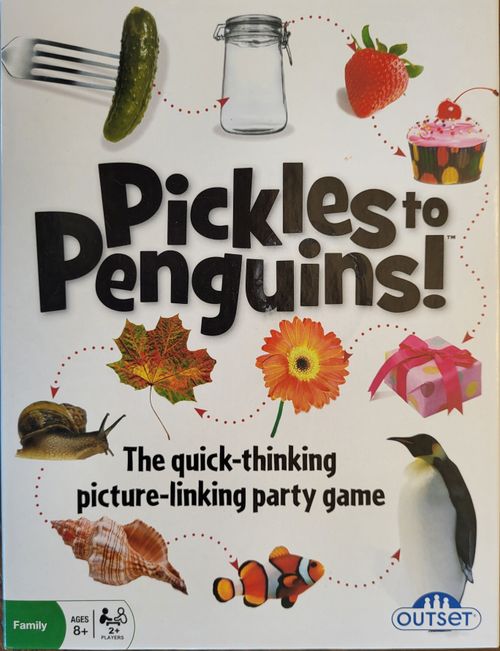
Pickles to Penguins
Pickles to Penguins Rulebook
Table of Contents
Table of Contents
Aim of the game
To be the first player to use all of their cards.
Setting up
Shuffle and deal 25 cards to each player. Place the remaining cards in a draw pile.
Playing the game
Players place five of their cards out in front of them in a row (this is called the player's deck) and the rest are left in a pile beside each player. Cards have an item on both sides, so players may want to look at both sides of the cards before beginning the game, to familiarize themselves with all the items.
When everyone is ready, the top two cards from the draw pile are turned over by the dealer and placed side-by-side in the center of the table.
The dealer starts the game by saying 'Go' and all players frantically place cards from their own player's deck on top of either of the two cards in the center. But to do this, they must say out loud the connection between their card and either of the top cards on the center piles. Players must state the connection in a full sentence, and must include the name of both items in the sentence. Remember you can use both sides of the cards.
A snail card played on a leaf card: "Snails eat leaves!"
A spoon card played on a rolling pin card: "Spoons and rolling pins are both items from the kitchen!"
Ice cube card played on water card: "Frozen water makes ice!"
A train card played on an airplane card: "A train and an airplane are both modes of transport!" But just saying, "Both are modes of transport" would not be enough information.
A red balloon card played on a red rose card: "The balloon and the rose are both red!"
A basketball card played on a coin card: "The basketball and the coin are both round!"
Players may only place one card on the center piles at a time. As players use cards from their player's deck, they replace them with cards from their own pile (of 25 cards that they were originally dealt).
If all players become 'stuck' and no one can find a linking image in their player's deck, the dealer turns over two new cards from the draw pile and play begins again.
If a player places a card without giving a credible link between it and the previous card on the pile and it is disputed by another player, all play immediately stops. After discussing, the other players either decide to accept the connection, or penalize the player by giving them an extra five cards from the draw pile. However, if a player makes a 'bad' connection and another player plays their card before the connection is disputed, they have gotten away with it!
The same connection cannot be used twice in a row. For example: if a player puts a kitten picture on a dog picture and says, "The dog and kitten are both animals" another player cannot then play a picture of a lion saying, "A lion and a kitten are both animals". However they could say, "Lions and kittens are both cats".
Invalid Connections
The following connections are not allowed:
- Both items start with the same letter.
- Both items have the same number of syllables.
- Both items have the same colored background.
Wild cards
If a player draws a wild card, they can use that card to 'automatically' link to the card on either pile. The card placed directly on top of the wild card also links without any association.
Winning the game
The first player to use all of their cards wins the game!
Quick Rules
- Shuffle the cards and deal 25 to each player.
- Players each lay five of these cards in front of them.
- Dealer turns over two cards in the center of the table and says 'Go'.
- Players race to place their cards on top of one of the center cards.
- Players must call out the link between the two items.
- First player to use all their cards is the winner.
Variants
Shout
The dealer flips over two cards. The first player to shout out a connection between them wins the two cards. The first player to collect 20 cards wins the game.
You don't necessarily need a dealer. If there are only two players, each player can flip over one card at the same time.
Missing Link
This game is similar to the Basic Game. However, in this version, players are trying to find a card that will link BOTH cards that are face up on the table.
Give each player five cards. Flip over two cards from the draw pile. The first player who can link one of their own cards to BOTH face-up cards wins the round. The winner of the round keeps the three cards in a "win" pile.
Example: let's say a yellow tractor and an apple are the face-up cards. A player can lay down a banana card and say, "The apple and the banana are both fruits and the tractor and the banana are both yellow."
After each round, players are dealt five new cards. The first player to collect 30 cards wins the game.
Fast Five
Deal five cards to each player. The dealer then flips over one card from the draw pile and places it in the center. Players use their cards as dealt (no turning over cards) to make direct associations as they do in the Basic Game.
If play stops (i.e. no player can make a connection) flip over another card from the draw pile.
The first player to get rid of their five cards wins the game. Rotate dealers and play again.
Chain Reaction
Players are dealt five cards. As soon as the dealer says 'Go' players must connect all five of their cards in a sequence. For example, let's say the player is dealt cards that show a boat, taxi, soap, banana, and baby. Here's what they might link: "A banana and a taxi cab are both yellow. A taxi cab and a boat are both types of transportation. A boat and soap both float. Soap is used to wash babies." The first player to link all their cards wins the round. There are 7 rounds to a game.
Minute Time Trial
Players are given 60 seconds to flip through the deck as fast as possible and see how many connections they can make. Each card has to connect to the card before it. Any time a player gets stuck, they can just discard the card and go on to the next card in the deck. The player who can make the most connections in 60 seconds wins the game.
Sample Connections
The booklet's final page shows a sample set of cards. Each printed connection is a speech bubble placed between two neighbouring pictured cards; the pairings below follow that layout, since the graphic does not label each pair separately.
- Hot air balloon and kite: "Hot air balloons and kites blow in the wind."
- Kite and violin: "Kites and violins have strings."
- Violin and record: "You can listen to violins on records."
- Record and pancakes: "Records and pancakes are flat and round."
- Pancakes and egg: "Pancakes and eggs are breakfast foods."
- Egg and chicken: "Chickens lay eggs."
- Chicken and horseshoe: "Chickens and horseshoes are found on farms."
- Horseshoe and clover: "Horseshoes and clover are lucky."
- Clover and bee: "Bees like clover."
- Bee and honey: "Bees make honey."
- Honey and milk: "Honey and milk are served with tea."
- Milk and bottle: "Milk comes in bottles."
- Bottle and nest: "The bottle and nest are empty."
- Nest and birdhouse: "Birds live in nests and birdhouses."
- Birdhouse and bulb: "Birdhouses and bulbs are found in gardens."
- Bulb and onion: "Onions are a kind of bulb."
- Onion and peanuts: "Onions and peanuts grow underground."
- Peanuts and walnut: "Peanuts and walnuts are nuts."
- Walnut and nutcracker: "A nutcracker can be used on walnuts."
- Nutcracker and tu-tu: "The Nutcracker is a ballet where they wear tutus."
- Tu-tu and tuxedo: "Tutus and tuxes are dance costumes."
- Tuxedo and zebra: "Tuxedos and zebras are black and white."