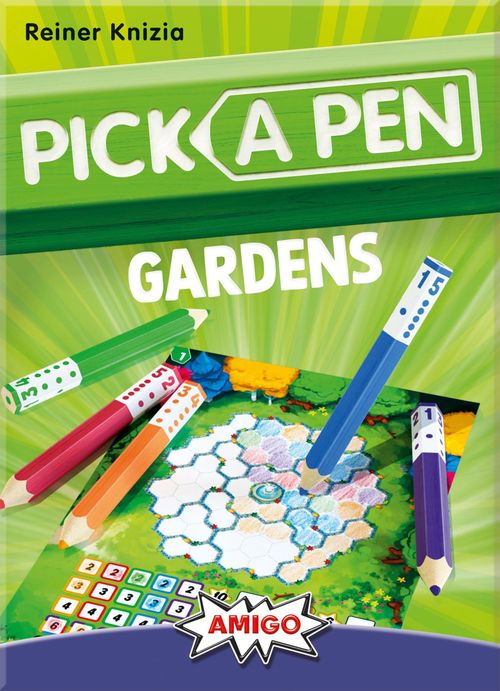
Pick a Pen: Gardens
Pick a Pen: Gardens Rulebook
Table of Contents
Table of Contents
Game Material
- 5 colored pencils (with the sides: 1, 1, 2, 3, 4, and 5)
- Play sheets with 3 different levels
Possible pencil-roll results: the five pencils show the numbers 1, 5, 2, 1, 3, 4 across their sides (each pencil has six sides, several repeating the value 1).
Play Sheet Overview
- Level: the level number shown on the play sheet.
- Play sheet: the whole sheet you color on.
- Field: a single hexagonal space you can color in.
- Garden: a group of fields enclosed by a thicker border.
- Points for single-color gardens: the score boxes for completing a garden in one color.
- Points for colorful gardens: the score boxes for completing a garden in all five colors.
- Pencil symbols: the boxes you cross off instead of coloring fields, when you let a roll go to waste.
- Score boxes: the boxes you color in to record points as you earn them.
- Bonus goals: the goals on the right side of the sheet.
- Bonus points: the point values earned for bonus goals and for completing rows of score boxes.
- Total score: the large box for your final score.
Game Idea
Roll the colored pencils and cleverly decide which fields to color in which color. Depending on the level, you try to score points through different combinations. Whoever has the most points at the end wins.
Setup
- Place the 5 colored pencils in the middle of the table.
- Decide together which level you want to play, and hand out the corresponding play sheet to each player. Playing your first game? Then we recommend Level 1.
Course of Play
- Whoever is dressed most colorfully begins. On your turn, you take the 5 pencils and roll them into the middle of the table. If any pencils land on top of each other, roll those pencils again.
- Once you have rolled the pencils, you must take a pencil from the middle of the table first. Say the color and the rolled number on your chosen pencil out loud. Example: "Red, one" or "Green, three." Then color that many fields with this color (see "Coloring Fields").
- After that, the next person clockwise takes a turn picking a pencil from the middle of the table. This continues around the table until no pencils remain there. At least one person will end up with more than one pencil.
- If it is your turn and there are no more pencils in the middle of the table, you may start the next round. Take all 5 pencils and roll them. Continue play as described above.
- Tip: Keep your pencil until every other player has chosen a pencil and finished coloring.
Coloring Fields
You must completely color the number of fields shown on your pencil onto your play sheet. Follow these rules:
- Each field can only be colored once. Some play sheets have fields with flowers (Level 2) or trees (Level 3). These also count as fields that can be colored.
- All fields that you newly color with one pencil must be connected to each other, forming a single group.
Within a group, you may ignore the borders of the gardens, but you may not color outside the play area.
Example diagrams from the rulebook: rolling a red pencil showing "3," the group of three red fields must be connected to each other — one example is marked valid (a compact connected group), the other invalid (a disconnected pair plus a lone field). Rolling a purple pencil, a new group of purple fields must touch at least one already-colored field — one example shows a valid connection to the existing colored fields, the other an invalid group placed with no connection to them.
- You may color the first color group anywhere on your play sheet. Every color group after that must be adjacent to at least one field of an already-colored group. This means all colored fields must always be connected.
- If you cannot, or do not want to, completely fill in the exact number of fields of a color, you must let all those fields go to waste. You take a pencil from the middle of the table and, instead of the rolled fields, color in the first free pencil symbol -1. Color the pencil symbols in order from left to right.
Gardens
The fields on your play sheet form gardens. These are marked by a thicker border.
Single-color gardens: If you color all the fields in a garden the same color, you may color the corresponding score box (labeled 2) in the lower part of your play sheet. Color the score boxes for that color in order from top to bottom. It does not matter how many fields the garden you completed has. The first complete garden of a color is worth 2 points, the second 3 points, and so on. If you have already colored in all the score boxes of a color, you get no further points for completing gardens in that color.
Bonus points: You get bonus points when you have colored in all the score boxes of a row. For example, if you have completed a garden in every color, color in the corresponding bonus-point star at the end of the first row. If you have completed two gardens in every color, you get the bonus points at the end of the second row, and so on.
Colorful gardens: If you color in all the fields in a garden and the garden contains all 5 colors at least once, then you color in the first colorful score box (labeled 6) in the lower part of your play sheet. Here too, color the score boxes in order from left to right. If you have already colored in all the colorful score boxes, you get no further points for completing gardens that contain all five colors.
Bonus points: Levels 1 and 2 let you collect bonus points when you have colored in all the score boxes for gardens in five colors. Then color in the corresponding bonus-point star at the end of the row.
Bonus Goals
At the bottom right of your play sheet there are bonus goals:
- Bonus points for the first person to color in all the outer fields on their play sheet.
- Bonus points for the first person to color in all the fields on their play sheet. This ends the game immediately (see "End of the Game").
Only the person who reaches each of these two goals first gets the bonus points for it. Everyone else can no longer earn those bonus points.
- At the end of the game, count the fields of your largest connected area of one color. The person with the largest area gets these bonus points. In case of a tie, no one gets the bonus.
If you reach a bonus goal, color in the corresponding bonus-point star next to it.
Marking points: When you meet one of the conditions to score points, color in the corresponding score box or the corresponding bonus-point star (see "Final Scoring").
Note: Announce it out loud when you score points, so all the other players can follow along. If one of you reaches a "first person" bonus goal, everyone else should cross out that bonus-point star.
End of the Game
The game ends immediately when someone meets a condition marked with a red exclamation point. These are:
- A: A person colors in the last field on their play sheet.
- B: A person colors in the last pencil symbol on their play sheet.
Any pencils not yet chosen at this point remain in the middle of the table. The round is not played out to the end.
Final Scoring
Now add up your points by totaling all the values in the colored score boxes and any bonus-point stars. Note the score of each row in the corresponding white field of that row. For every colored-in pencil symbol you get as many minus points as the box shows. Note the total number of minus points in the corresponding white field. Add up all the points and write the total score into the large white field on the far right.
Whoever has the most points wins. If several people are tied for the most points, they win together.
Example of a Final Scoring
Razia has one complete garden in every color. For this she gets 10 bonus points. She also has a colorful garden, which is worth 6 points. She has not colored in any pencil symbols, so she gets no minus points. She was the first to color in all the outer fields, and was also the first person to color in all the fields on her play sheet. For this she alone gets 6 + 6 bonus points. She also has the largest connected area of one color, giving her an additional 6 bonus points. Her total score is therefore 60 points.
Overview of the Play Sheets
Level 1: Small Gardens — The rules described above contain everything you need for this play sheet. Level 1 is the perfect start for your first game!
Level 2: Flower Gardens — In addition to the rules described so far, note the following additions:
- A — Flowers: If you color a field with a flower in the matching color, you may color in the flower box of that color in the lower part of your play sheet. At the end of the game, every colored-in flower box is worth 2 points.
- Note: If you color a flower field with a color that does not match the flower's color, nothing happens.
- Bonus points: If you color in all five flower boxes, you get the corresponding 10 bonus points at the end of the row.
- Bonus goal: The first person to color in all 5 flower fields (even if the color does not match) gets the corresponding bonus points.
Level 3: Tree Gardens — In addition to the rules described so far, note the following additions:
- Bonus goal: The first person to color in 4 gardens of one color gets the corresponding bonus points. You can earn these bonus points once per color.
- B — Trees: If you color a field with a tree, you may color in the corresponding tree box of the same color in the lower part of your play sheet.
- Bonus points: If you color in all five tree boxes, you get the corresponding 10 bonus points.
- Note: Tree boxes are not worth points on their own.
Tips for People with Color Vision Deficiency
It is unfortunately not possible to make this game fully accessible for people with color vision deficiency. However, here are a few tips to make playing easier:
- The five colors are listed on the back of this rulebook. After rolling, place the pencils into the box of the matching color.
- Instead of coloring the fields on the play sheet, you can also write the first letter of each color into them. You can also write these letters onto the pencils.
The rulebook's back cover lists the five colors with labeled boxes: Orange, Red (Rot), Green (Grün), Blue (Blau), and Purple (Lila).