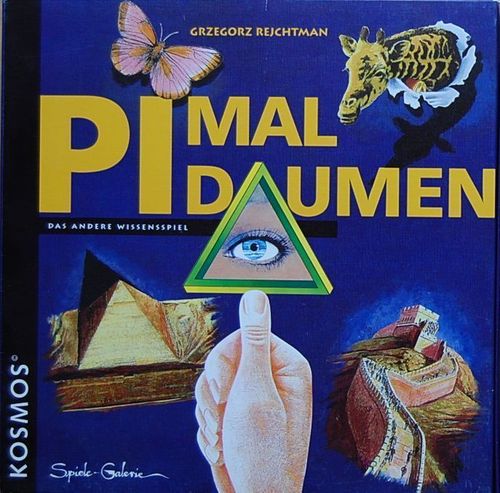
Pi mal Daumen
Pi mal Daumen Rulebook
Table of Contents
Table of Contents
Game Material
- 1 triangular game board
- 6 game pieces ("Daumenhände", thumb hands)
- 220 double-sided question cards (1320 questions)
Setup
- Place the game board in the middle of the table.
- Place about a quarter of the cards in two stacks, to the left and to the right of the board, so that all players can reach a stack easily. First, play through the cards with the white frame colour (violet side up). If these questions are known to many players after many games, read the questions with the violet frame instead.
- Each player chooses a game piece and places it on the start field with the butterfly.
- Whoever first raises a thumb may begin. After that, play proceeds clockwise.
Course of Play
- The starting player goes first, and after that each player in clockwise order becomes the questioner ("Vorleser"). The questioner takes a card from the top of one of the two stacks and turns it over without letting the other players see the question. The valid question is therefore always read from the back of the card.
- The colour of the field on which the questioner's own piece stands determines which question is read:
- yellow field: yellow question
- green field: green question
- salmon-coloured field: salmon-coloured question
- If the questioner's own piece is still on the start field, the top (salmon-coloured) question is always read.
- If a unit of measurement is given in brackets, e.g. (cm), it is read out as well.
- The answer must always be a number.
- The player to the left of the questioner makes the first attempt at an answer. The questioner compares the stated answer with the scale on the question card.
- If the answer lies to the left or to the right of the solution scale, the questioner says "außerhalb" ("outside"), and the player receives 0 points for the answer. His piece stays where it is.
- If the answer lies within the solution scale, the player receives the point value given there. His piece moves forward the corresponding number of fields.
- Whenever a piece moving forward reaches a field that is occupied, it moves on to the next free field in the direction of travel.
- If a player does not reach the highest point value (which is always 6 points), the next player clockwise makes an attempt at the same question. However, his answer must achieve a higher point value than the previous answers; otherwise he receives 0 points. It is therefore not enough to "append" to the answer of the previous player.
- If he achieves a higher point value, he may move his piece forward by the points he has achieved.
- The guessing round continues in this way until one player has achieved 6 points, or the last player of the round has given an answer.
Points for the Questioner
- If no player in a round achieves the highest result of 6 points, the questioner also receives points. He is awarded 6 points minus the highest result of the best guesser.
- After points are awarded, the questioner reads out the correct answer (if nobody has guessed it) and returns the used question card to the box. The player sitting to the left of the old questioner becomes the new questioner.
Example of a Question Round
Wolfgang, Bärbel, Gaby, Annette and Peter are playing. Peter is the questioner and takes the top card from the face-down stack. Wolfgang's piece stands on a salmon-coloured field, so Peter reads the first question (see the illustration below), including the unit of measurement in brackets (millions of years).
- Wolfgang guesses "10". This is "outside" the scale, so he receives 0 points.
- Bärbel says that 10 million is wrong, but does not know whether the correct figure is larger or smaller. She guesses "500". Since 500 lies between 330 and 520, she receives 3 points and may move her piece 3 fields forward.
- Gaby guesses "350". Since 350 also lies between 330 and 520, she would receive 3 points. She may not move, because she would have had to achieve a higher point value than Bärbel.
- Annette guesses "240". Her answer lies between 10 and 350, and 240 falls in the 6-point range, so she receives 6 points and may move her piece forward by 6 fields.
- At the end, Peter reveals that the exact answer would have been 175.
- Wolfgang is then the new questioner.
The illustration shows three example question cards with their solution scales. Each scale lists the values alternately with the point values awarded between them. The first card, "How long did the dinosaurs live on earth? (in millions of years)", reads from left to right: 12 | 3 | 120 | 6 | 175 | 6 | 240 | 4 | 330 | 3 | 520 | 2 | 600. The second card, "How many stations did the New York subway have at the end of 1993?", reads: 100 | 3 | 390 | 6 | 463 | 6 | 490 | 4 | 570 | 3 | 700 | 2 | 980. The third card, "Normally, people feel the urge to empty their bladder when 100 to 150 millilitres of urine have collected in it. How much urine can the bladder hold when it is completely full? (millilitres)", reads: 300 | 3 | 400 | 6 | 600 | 6 | 800 | 4 | 930 | 3 | 1,050 | 2 | 1,300.
The rulebook also gives this example of point distribution in a round: Wolfgang has 0 points, Bärbel had 2, Annette 3 and Peter has 4 points. Gaby, the questioner, is therefore awarded 2 more points (6 - 4 = 2).
Special Fields
Bonus Fields
(marked with the triangle with the eye symbol)
- A player who stands on a bonus field (or voluntarily stays there) and is last on the track receives a bonus question.
- First, the round is played to its end, meaning until the question card has been returned to the box and everyone entitled to move has moved with their piece.
- If a piece stands on a bonus field, the player to the left of that player reads a question. He draws a new card, and the colour of the bonus field determines which question is read from the back of the card.
- The player on a bonus field has only one answer possibility. If he achieves a point result with it, he may immediately move his piece forward by double the number of fields.
- To use the bonus chance of this special field deliberately, a player crossing this field may let his points lapse and stay on it (if no other piece is already standing there). However, he is only asked the bonus question if, at the end of the question round, he is actually last on the track.
Minus Fields
(marked with "-3" and similar values)
- At the end of the track there are fields with minus values. These are brake fields for the leading player.
- If a player's piece stands on a field with a minus value and at the same time that player is first on the track, he must subtract the minus value from his point result and move his piece accordingly.
- Examples:
- Point value 4, field count -1: the piece moves 3 fields forward.
- Point value 2, field count -2: the piece stays where it is.
- Point value 3, field count -4: the piece moves 1 field back.
- Point value 0, field count -4: the piece moves 4 fields back.
- By moving backwards, it can happen that several players in one round stand first on the track, in the leading position, when it is their turn, and therefore must take such a minus field into account.
- The questioner must also take the minus value into account if he is awarded points and stands first on one of these minus fields.
- If a piece moving backwards reaches an occupied field, it is placed on the next free field behind it.
End of the Game and Winner
- As soon as a player moves his piece onto the goal field (the pyramid), the game ends immediately, and this player has won. Any other remaining points lapse.