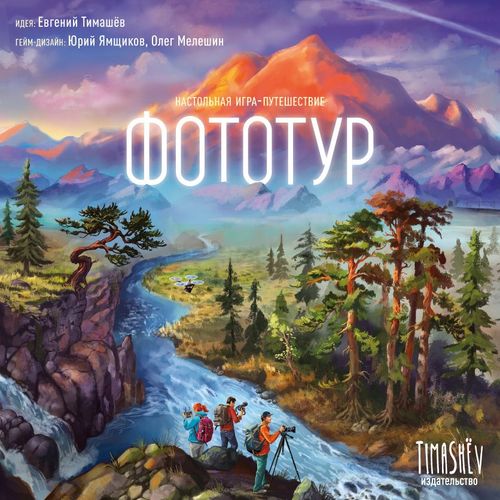
Фототур (Phototour)
Фототур (Phototour) Rulebook
Table of Contents
Table of Contents
Game Contents
- 1 game board
- 50 sight cards (достопримечательности)
- 50 equipment tokens: 10 tokens each of 5 kinds, in a cloth bag
- 5 transport dice
- 4 traveler's diaries (player boards)
- 4 player pawns
- 1 first-player token
- 1 scoring notepad
- 17 photo contest cards (Strategic Mode only)
Objective
Your goal is to earn as many points as possible for the photographs you take, the equipment tokens you rent, and (in Strategic Mode) the general objectives you complete. Photograph sights and fill in your traveler's diary, and use rented equipment to improve the quality of your photographs.
The rules below describe the Basic Mode first, then the additional and changed rules for the Strategic Mode.
Setup (Basic Mode)
- Lay out the game board in the center of the table.
- Shuffle the deck of sight cards and deal 5 random cards face up next to the board — these are the currently available sights.
- Put all the equipment tokens in the bag and mix them. Draw 5 random tokens into the equipment slots on the board — this is the equipment currently available to rent.
- Roll all 5 transport dice and place them in the transport slots on the board — this is the currently available transport.
- Each player takes a traveler's diary and a pawn of their chosen color. Put unused components back in the box. Players place their diary with side A face up.
- Each player is dealt 3 random sight cards from the top of the deck. Each player chooses 1 of the 3 cards and places it face up in the discard pile next to the deck, then places one of their pawns on the location whose number matches the number of the discarded card.
- The player who placed their pawn in the location with the highest number takes the first-player token and goes first.
Turn Order
Players take turns in clockwise order. On your turn you perform 1 of the 4 main actions:
- Planning
- Renting equipment
- Movement
- Taking a photograph
Main Actions
Planning
The sight cards laid out on the table are the sights currently most popular among photographers and their followers. By choosing a sight card, you are planning to visit it. Other photographers don't want to repeat your choice, so they choose from what remains.
- Choose 1 of the available sight cards and take it into your hand. There is no limit to the number of cards in your hand.
- If you took the last card from the table, deal 5 new cards. If there are fewer than 5 available sight cards, you do not need to refill.
Renting equipment
Every photographer has their own equipment, which they use to take photographs. In almost every location you can take more interesting photographs, but this requires extra equipment. It is expensive and is not needed for constant use, so a photographer rents it. After photographing the chosen sight (the card is placed in the diary), the equipment rented for it is returned to the renter — discarded onto the card.
The size of your bag (reserve) is limited to 3 pieces of equipment.
- Choose 1 available equipment token on the game board and move it into one of the free slots of your traveler's diary (reserve).
- If you took the last token from the board, deal 5 new tokens. If there are fewer than 5 available equipment tokens, you do not need to refill.
- If the bag runs out of tokens, return all discarded tokens to the bag.
- You may hold no more than 3 tokens in reserve. If you pick up a 4th token, discard 1 of the ones you have.
Movement
Russia is a huge country with great distances — crossing it from edge to edge takes a very long time. The fastest way is by plane, but not every place you need to go has an airport. Traveling by train is somewhat slower, and rail lines are not laid everywhere either. You can rent a car: this is the slowest way, but you can get anywhere — along both highways and roads that run alongside railways.
The transport dice on the game board represent the train and plane tickets, and cars for rent, currently available.
Choose 1 transport die on the game board. What is shown on its top face determines how you may move your pawn on the game board.
- By car, you can travel from one location to another using up to 2 path segments. You may use either highways or railways.
- By train, you can travel from one location to another using up to 6 path segments. You may use railways only.
- By plane, you can fly from one location with an airport to any other location with an airport. Distance does not matter.
Example: Sergei wants to move from location #34 to location #41. He uses the car die and moves along 2 path segments: first a highway, then a railway.
Example: Oleg needs to get from location #44 to location #33. He uses the train die and moves along 4 path segments — railways.
Example: Yura needs to get to the red region while on the opposite side of the country. Luckily, he is in location #16, which has an airport. Yura uses the plane die and moves to location #44, which also has an airport.
Slide the transport die you chose and used upward, freeing the slot it occupied. If you used the last die, roll all 5 set-aside dice and lay them out again in the transport slots on the game board.
Taking a photograph
To photograph a desired sight, you must obviously be in its location. While taking the photograph, you may use previously rented additional equipment to make more interesting and higher-quality photographs.
To take a photograph, carry out the following steps in order:
- Check the location. Your pawn must be in the location whose number matches the number of one of the sight cards in your hand. If you do not have a card with that number in hand, you cannot perform this action.
- Place the sight card into your traveler's diary. You may choose any of the 7 slots.
- Use equipment tokens (optional step). You may place 1 to 3 equipment tokens from your reserve onto the sight card you just placed, to gain extra victory points at the end of the game. The symbols on the token and the card must match. Cards can have up to 3 spaces for equipment tokens, and some cards have none at all. The universal symbol means a token of any kind fits.
Important: equipment tokens may only be placed during the current photograph; you cannot add tokens to already-placed cards or move tokens from one card to another.
Example: Sergei can only place tokens on the card he just placed, card #20. Among his tokens, one fits — the Quadcopter. The Lens and Photo Film tokens do not fit this card. The Quadcopter fits card #46, but that was placed earlier and can no longer receive tokens.
Additional Action: Refresh
Planning trips, buying tickets, renting a car and equipment costs money. You can return rented equipment or cancel a hotel booking made earlier and get your deposit back. This gives you new options for travel.
In addition to your main action, you may perform the additional Refresh action. You may perform this action at any point during your turn, and any number of times.
Spend 1 equipment token from your diary or 1 sight card from your hand to discard and lay out new components of 1 of 3 kinds: sight cards, equipment tokens, or transport dice. During a refresh you do not have to discard all the chosen components — you may leave any number of them on the table and then lay out new ones so that there are 5 in total.
By the end of this action there must be exactly 5 of the refreshed component type (5 sight cards, 5 equipment tokens, or 5 transport dice).
Example: Yura takes the last token and wants to lay out 5 new tokens on the game board, but the bag has run out of tokens. Yura puts all the tokens from the discard pile into the bag.
Example: Yura discards one of his tokens, then sends the available sight cards to the discard pile, and then lays out 5 new cards.
Determining the Winner
Players tally their points in 5 categories and record them in the scoring notepad:
- Points on the sight cards in your traveler's diary. The number of points is shown on the cards. Cards in hand score no points.
- 3 points for each equipment token placed on those cards.
- 1 point for each equipment token remaining in your reserve.
Add up your points. The resulting sum is your final score.
The player with the most points wins.
In case of a tie, the tied contender who took fewer photographs (has fewer cards in their diary) wins. If the tie remains, victory goes to whichever of them has more equipment tokens on their cards. If the tie remains even after that, the contenders split the win.
End of Game
As soon as a player places their 7th sight card into their diary, the current round is declared the last one. That player finishes their turn, after which the remaining players who have not yet had a turn this round take their turns. The game ends after the turn of the player seated to the right of the first player (the first player does not take a turn).
Example: in a three-player game, the 2nd player places their 7th sight card into their diary. They finish their turn, then the 3rd player takes a turn, after which the game ends.
Strategic Mode
The Strategic Mode is recommended for advanced players familiar with modern board games and concepts such as "combo," "drafting," and "randomness." You can also play by these more complex rules once you have played the Basic Mode thoroughly and want to "raise the bar."
In Strategic Mode you will also compete in photo contests. Your goal is to earn as many points as possible for the photographs and bonuses in your traveler's diary, your equipment tokens, and the photo contests.
Setup Differences
Setup follows the same steps as Basic Mode, with these changes:
- Players place their traveler's diary with side B face up (instead of side A).
- Special step for the strategic game: lay out 3 random photo contest cards face up next to the game board. These are the shared objectives for all players for the game.
- The player who places their pawn in the location with the highest number takes the first-player token and goes first (as in Basic Mode).
Sight Card Bonuses
Every sight is unique, and visiting it opens up new opportunities. Moscow has cheap plane tickets, Novosibirsk has a great view from the railway bridge. Those who have been to Kamchatka gain access to destinations unavailable to others, and guests of Yamal gain equipment.
Most sight cards have bonus abilities that let a player make more efficient moves. Each sight's bonus can only be activated after that sight has been photographed — that is, after the card has been placed in the diary. The cards indicate when exactly the bonus can be activated (during the player's own turn, during another player's turn, or at the end of the game).
On your turn, you may activate only 1 sight bonus. In addition, once between your turns you may activate only 1 bonus that works during opponents' turns. You are not obliged to activate a bonus even if its condition is met.
There are several kinds of bonuses:
- On your turn: activated during the player's own turn. Some bonuses can enhance the result of a main action.
- Bonus to an action: also activated during the player's own turn, but not tied to a main action, and can be performed at any point during that turn.
- If the opponent...: can be activated when an opponent performs a specific main action.
- At the end of the game: activated at the end of the game, during scoring.
Diary Bonuses
Traveler's diaries are asymmetric in their bonuses, but are built on the same principle. On the diary slots meant for cards, both one-time bonuses and bonuses that grant extra points at the end of the game are shown. These bonuses can only be activated after a photograph is taken — that is, after a sight card of the matching type (city or nature) is placed into the corresponding slot. If the card's type and the slot's type do not match, the bonus is closed off and unavailable.
- The top row of slots holds one-time bonuses. These represent chance events you did not plan for during your trip — somewhere you got a free ride and didn't have to pay for transport, somewhere train tickets unexpectedly turned up, and so on. You may use any available diary bonus on your turn. After using the bonus, slide the card down, closing off the one-time bonus you used. You may use several one-time diary bonuses in sequence during a single turn. These bonuses may also let you activate a sight bonus (but you can still only activate 1 sight bonus per turn).
- The bottom row of slots grants extra victory points for fulfilling stated conditions. These represent the photographer's personal projects — for example, shooting a photo project about the cities of Russia earns you points for city photographs.
Additional Action: Refresh (Strategic Mode)
The Refresh action works as in Basic Mode.
End of Game
The end-of-game trigger is the same as in Basic Mode: as soon as a player places their 7th sight card into their diary, the current round is declared the last one, and so on.
Determining the Winner (Strategic Mode)
Players tally their points in 5 categories and record them in the scoring notepad:
- Points on the sight cards in their traveler's diaries. The number of points is shown on the cards. Cards in hand score no points.
- 3 points for each equipment token placed on those cards.
- 1 point for each equipment token remaining in reserve.
- Points for placing in the 3 photo contests. The photo contest goals are for the most photographs taken in a particular region, or for the greatest number of equipment tokens. 1st place in a photo contest earns 7 points, 2nd place earns 3 points. To take a placing spot, a player must at least minimally fulfill the contest's condition. If several players tie for 1st place, they add together the points for both placing spots (10 points) and split them among themselves (rounding down); 2nd place is not separately determined in that case. If several players tie for 2nd place, they split the 3 points for 2nd place among themselves (rounding down).
- Points for fulfilling the conditions of diary bonuses and sight card bonuses.
Reminder: only bottom-row diary slots holding a matching sight card count — city slots score for city cards, nature slots score for nature cards. Bonuses on slots with a non-matching card, or on empty slots, score no points.
Add up your points. The resulting sum is your final score.
The player with the most points wins. In case of a tie, the tied contender who took fewer photographs (has fewer cards in their diary) wins. If the tie remains, victory goes to whichever of them has more equipment tokens on their cards. If the tie remains even after that, the contenders split the win.