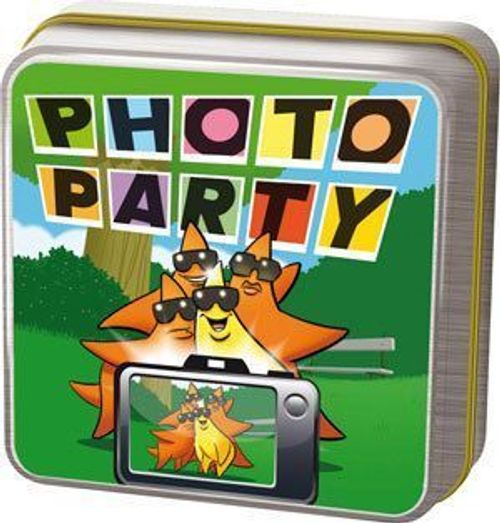
Photo Party
Photo Party Rulebook
Table of Contents
Table of Contents
Overview
The game is played in two phases:
- The Photographer (one of the players, who "runs the game") photographs the group of players, explaining before each shot the condition for scoring points. For example: be in the air (jumping) in the photograph.
- The photographs are reviewed and points are awarded from them. For example: every player clearly in the air in the shot receives one point.
The player with the most points at the end of the game wins.
Components
- 45 "task" cards
- 3 "rules" cards
Players: 6 to 15, including the Photographer (1 person). Age 8 and up.
Warning: this game requires a camera, preferably with a self-timer (the ability to delay the shot).
Setup
- The Photographer sets up the camera as stably as possible; a tripod is the best option.
- The Photographer shows (on the camera screen) or precisely describes to the players the edges of the frame: top, bottom, right and left. It is best to set the frame so that all players fit in full height, while leaving room outside the frame so that players can easily enter and leave it.
- The Photographer marks on the ground (floor) a "no-crossing" line at the level of the lower edge of the frame, to protect the camera from unexpected collisions with players and to be sure that no player blocks everyone else by being too close to the lens.
- The Photographer takes the first "normal" photograph of the players, so that everyone is clearly visible.
- The Photographer puts a stack of 12 task cards next to them. These cards are best selected in advance, taking into account the abilities of the players and the conditions of the place of shooting (see "Tips for the Photographer" at the end of the rules).
Gameplay
Phase 1. Shooting
The Photographer takes the first card. If the card has an arrow, the Photographer must first look at the back of the card and take into account the instructions written there (for example: seat all players). These are not read aloud. Then the Photographer reads the task to the players and makes sure they have understood it well. After that, the Photographer starts the camera's self-timer countdown (10 seconds). This way it will be hard for the players to determine exactly the moment the shot is taken. If the camera has no self-timer, see "Tips for the Photographer".
Depending on the tasks, the Photographer may give players more or less time between announcing the task and the moment of pressing the button. Sometimes (according to the instructions on the back of the card) the task should be announced only after the self-timer has been started. The more experienced the players, the less time should be allowed between announcing the task and the shot.
Cards of completed tasks are placed in a stack in the same order in which they were played, to make scoring easier later.
For 12 or more players: split them into 2 groups and take 2 photos.
Phase 2. Scoring
Scoring can be done in several ways:
- "While it's hot": on a computer screen, television or the camera screen immediately after photographs have been taken for all 12 task cards;
- Later, after posting the photographs on a publicly accessible resource.
The Photographer counts the points for each player. Results are determined by what is visible directly in the photograph (arguments such as "I assure you I was in the air, but you can't see me behind Vasya!" are not accepted).
Whatever the task, a player captured in the photograph between the "no-crossing" line on the ground and the lens receives no points.
The illustrations on the task cards show how to resolve some special cases. In case of disputes, the Photographer has the deciding vote.
End of the Game
The player with the most points after scoring is declared the great Photo Star of the Day!
Tips for the Photographer
If you are playing with a camera without a self-timer, or if activating this function takes too many actions, or an indicator on the camera clearly tells the players when the shot will be taken: as soon as the task is announced, the Photographer begins counting down aloud from 10 to 5, then continues counting silently after 5, and from 4 with eyes closed. At "zero" the shot is taken. When counting silently, the Photographer may change the rhythm of the count at will.
Choosing tasks
There are four different types of tasks, which are best given mixed together so the game stays varied. Pictograms on the back of the cards make them easy to sort:
- Playing with the frame
- Posing
- The minority wins
- Strike a figure (form a shape)
- Scoring is possible by looking at the camera screen
- Ideal for the start of the game
Also take into account the "athletic level" of the players and the possibilities of the place where the game is played (pictograms: Athletic / Family):
- Is there something to climb on?
- Are there any objects around?
- Is there a ball or an object that can replace it nearby?
- Etc.
Clarification on "the minority wins" cards
These cards offer two positions (for example, sitting or standing). Players in the smallest group each receive 1 point. Scoring begins by discarding players whose poses are unclear (neither sitting nor standing; they may be poorly visible or in intermediate positions). If after that, for example, two people are standing and one is sitting, the sitting player gets the point. If the number of sitting and standing people is equal, the winning position is determined according to the instructions on the card.
(Illustration caption: Bus (standing / sitting).)