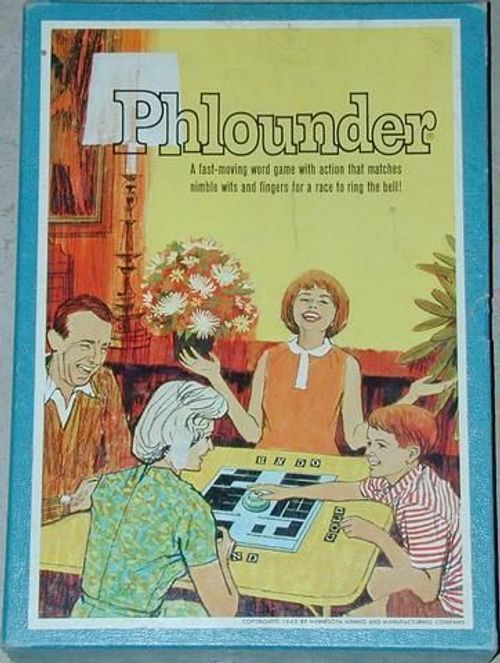
Phlounder
Phlounder Rulebook
Table of Contents
Table of Contents
Object of the Game
Players race to form the kind of word indicated by special dice. First person to complete a word rings the bell to end a round. Points are awarded for winning the round and for forming words. Points are deducted for letters taken but not used and for mistakes. A game is 11 rounds—and the player with the highest score wins!
Setup
Players' names are written on a score sheet. Tiles can be placed face down on the table and shuffled, or they can be placed face down in the tracks on the playing board.
If the board is used, letters may be taken from any of the six track openings (marked with an arrow) at the outer edge of the board. Letters may be retuned [sic] to any track, but at the opposite corner only.
Play
One player rolls the dice to determine kind of word. (See LEGITIMATE WORDS for explanation of dice.) All players begin to form words immediately by placing letter tiles together on the table before them. There is no limit to the number of tiles a player may take. He may replace, face down, any tile which he thinks he cannot use.
When a player has completed a word conforming to the requirements shown on the dice—and replaced all of his unused tiles --- he rings the bell. Play stops immediately.
Any word made by the winner or another player may be challenged before the next round begins. When in doubt, refer to the dictionary; but remember that properly formed plurals or verb forms may be used, even if they are not included in the dictionary.
Scores are recorded. Players return all of the tiles face down to the table and the tiles are shuffled or, if using the board, tiles are placed face down in the tracks. The dice are passed to the next player and another round begins. There are 11 rounds in a game.
Legitimate Words
The dice are rolled to determine the kind of word to be made.
Letter die: N = noun, V = verb, * = any category.
Number die: Numbers indicate specific length of word., * = any length from 4-7 letters.
When two dice are used in combination, they are read thus:
- 5N = 5 letter noun
- 6* = 6 letter word of any category
- *V = 4-7 letter verb
- ** = 4-7 letter word of any category
Each word formed by the end of a round must be the minimum length (4) in order to score it. Players should use a standard dictionary as reference; however, properly formed plurals or verb forms may be used, even if they are not included in the dictionary. Clip words (abbreviated forms which require no periods), such as "memo", may be used. Words with periods (abbreviations, hyphens or apostrophes) may not be used, since there are no tiles with these forms. Capitalized and foreign words may not be used.
Scoring
Winner: The winner gets 2 points for winning the round, plus 1 point for each letter in his word. When children and adults play together, using the two different letter dice, children should get 4 points for winning the round (to compensate for lower scores from shorter words).
Other players: Each of the other players gets 1 point for every letter of any legitimate word formed by the time the bell is round. The word can be of any category (even if N or V show on the letter die), but cannot exceed the length indicated on the number die, or contain fewer than 4 letters.
After the bell has been rung, other players may form words by removing as many letters as they wish from either end of an incomplete word, but they cannot add letters or shift the sequence of the letters. For example, if a player has the following when the bell rings,
P R U I N E D
he could remove the P and the E to form RUIN, but he could not form PRUNE, PRUNED, or RUINED. Players lose a point for every letter taken but not used. Thus, a player's score will be the total letters in his word minus the letters taken but not used. (In the above example, the player's score for the round would be 1: 4 for RUIN minus 3 for P, E, and D.) Scores can run into minus figures.
Challenged Words
Any player's word can be challenged after the bell is rung:
- If the bell-ringer's word is legitimate but another player's word is not legitimate, the latter player's letters count against him as if he had formed no word at all. Other players receive usual scores.
- If the bell-ringer's word is not legitimate, scores for the round are not based on words formed; instead, the bell-ringer scores a –5 and each of the other players scores a +7.
- If a challenged word proves to be legitimate, play simply continues.
- A player who rings the bell illegally is considered to have been successfully challenged.
Phlounder for Partners
PHLOUNDER can be played by partners: two or three teams of 2, or two teams of 3. The same rules apply, with the following exceptions.
Both (or all three) partners must complete legitimate words before they can ring the bell. In doing so, they may aid each other in any way, for example, by exchanging letters, suggesting words, helping to replace unused letters, etc.
The round-winning team receives 2 points. Individual scores are combined with these points to make team scores. Penalty and bonus scores for successfully challenged words are doubled (or tripled).
Helpful Hints for Success at Phlounder
Try to work with as few letters as possible. As you play, replace letters you think you will not be able to use. If any unusable letter is facing upward on the table near you when the bell rings, it always counts against you.. Try to form at least a four-letter word; then go on to expand, if necessary.
Letter Frequency
PHLOUNDER letter frequency is based on normal word usage; game letters are assorted in the following amounts:
- A-7, B-2, C-2, D-3, E-10, F-2, G-2
- H-5, I-6, J-1, K-1, L-4, M-2, N-6
- O-7, P-2, Q-1, R-5, S-5, T-8, U-2
- V-1, W-2, X-1, Y-2, Z-1
90 tiles in total.