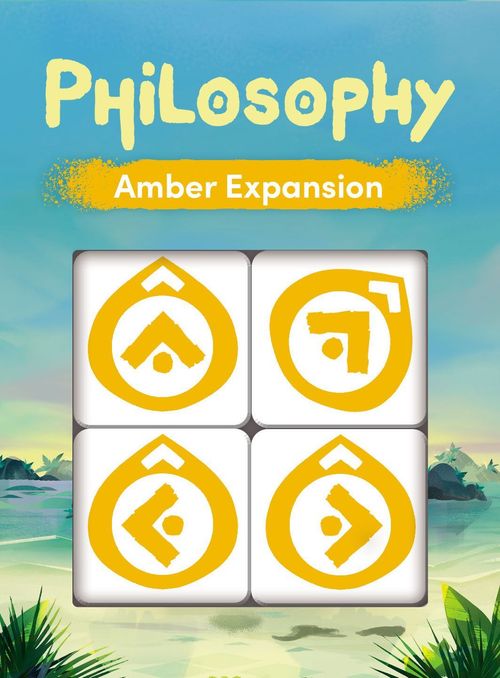
Philosophy: Amber Expansion
Philosophy: Amber Expansion Rulebook
Shared rules: the Amber Expansion is the same 3-player expansion as the Sage Expansion, differing only in tile colour; no separate Amber rulebook exists. The text below is the official English "Philosophy 3p Expansion - Sage" rulebook (Quality Beast), and its wording "Sage" refers to the tile colour of that edition. Requires the base game, Philosophy.
Table of Contents
Table of Contents
Introducing... Sage!
What are these new pieces?
The Sage Expansion allows you to play Philosophy with 3 players. You can also use it in a 2-player game to replace one of the base game colors for aesthetic reasons or to improve accessibility.
Components
A. 12 Sage Idea Tiles B. 1 Rulebook
Accessibility
Using Sage in a 2-player game:
- For red-blind 1 or green-blind 2 vision, any combination should be fine.
- For blue-blind 3 or monochrome 4 vision, we recommend playing with Indigo & Sage.
Using Sage in a 3-player game:
- For red-blind 1 or green-blind 2 vision, it should be fine to play with Sage, Indigo, & Teal.
- For blue-blind 3 or monochrome 4 vision, we recommend playing with the Amber Expansion instead of Sage.
1 Protanopia 2 Deuteranopia 3 Tritanopia 4 Achromatopsia
Setup
2-Player Game Setup
For a 2-player game, you can use Sage instead of Indigo or Teal.
3-Player Game Setup
For a 3-player game, you'll use the Sage Tiles for the third person.
3-Player Game
After setting up the board and tiles, randomly determine the direction of play, clockwise or counterclockwise.
3-Player Rules
Turn Order
When playing multiple 3-player games with the same group, it's recommended to change the turn order after each game.
Player Turns
Because you have 2 opponents in a 3-player game, your Ideas can target either of your opponents' tiles. And likewise, both of your opponents' tiles can target yours.
Reminder: As in the 2-player game, only your own Idea Tiles activate on your turn.
Winning & Losing
As in a 2-player game, if anyone's turn ends with a single player having reached a Conclusion anywhere on the board, that player wins the game and the other 2 players lose.
However, if a single player loses by running out of Ideas, or chooses to concede, any of their tiles on the board remain where they are while the other players finish the game.
Note: If a player loses because the center 9 spaces are occupied, the next player will also immediately lose for the same reason, leaving the third player as the winner!
Conceding
Discuss with your fellow players whether you want to allow conceding in a 3-player game*.
If you do play with conceding, whenever you concede, instead of placing one of your Ideas face down on the board, place it face down beside the board.
*Note: You may not want to allow conceding in a highly competitive 3-player game because it could automatically allow the next player to win.
Respect
When giving out the Respect Token for the first time in a 3-player game, simply take the Respect Token from the middle. Afterwards, only the player who currently has the Respect Token can give it to another player.