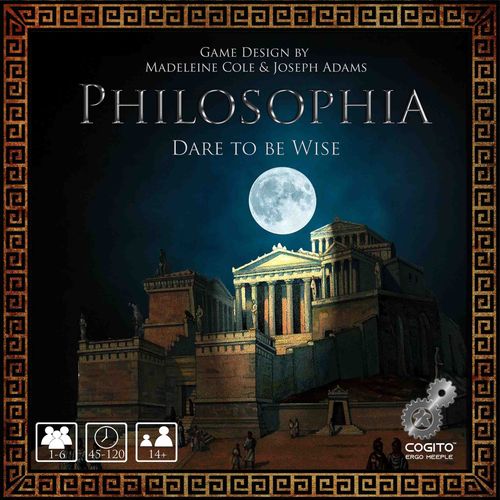
Philosophia: Dare to be Wise
Philosophia: Dare to be Wise Rulebook
Table of Contents
Table of Contents
What's in the Box
- 1 Double Sided Game Board
- 6 Miniatures of Ancient Greek Thinkers
- 6 Individual Player Boards
- 38 Coins (head symbol denotes a value of 1, owl symbol a value of 5)
- 1 Hourglass miniature
- 12 Game Reference Cards
- 6 Olympic Request Cards
- 12 Athena Offering Disks
- 18 Labyrinth Tokens (12 Regular and 6 Numbered)
- 6 Study Tokens
- 24 Builder Tokens
- 19 Sophist Tokens
- 18 Wisdom Cards
- 22 Moirai Cards (one double-sided)
- 19 Oracle Cards (6 Delphi, 6 Dodona and 7 Trophonius)
- 24 School Tokens (6 colours)
- 54 Following Cubes (6 colours)
- 96 Argument Cards (54 Sophistry and 40 Syllogism)
- 18 Debate Winning Tokens
- 27 Location Tokens (7 black, 7 yellow, 6 blue, 4 red and 3 green)
Introduction and Overview
Objective
The goal is to gain three labyrinth tokens before the ancient Greek world is superseded by the Romans. There are many different paths you can take to do this, from building schools dedicated to your teaching to locking yourself away in temples to develop your ideas. To see all the different paths go to the How to Win section. All players who gain three labyrinth tokens will finish the game with a final public debate; exchanging sophistry and syllogistic arguments until one thinker is crowned the greatest mind of ancient Greece.
How to use this Guide
- White boxes contain the rules of the game. Everything in these boxes is written to get you playing as fast as possible. If it is not in a white box then it is not essential to learning the fundamentals of the game.
- Blue boxes feature towards the end of the guidebook. They are rules needed to play a variant of the game. For example, if you want to play solo you will need this information in addition to information in the white boxes.
- Green boxes will be more prevalent at the end of the rule book. They do not need to be read in order to play the game but, instead, are useful as reference information during gameplay (especially for the first few games).
- Grey boxes provide little bits of information on how the game was designed and/or its relationship to Ancient Greek history. These boxes are not recommended for use if you want to get started playing as fast as possible.
Setup
To set up Philosophia: Dare to be Wise you will need to perform the following steps in the order listed below:
- Place the main board on the table with the correct side for your number of players. Check by looking at the number in the lower left corner.
- Take a player board, its corresponding miniature and wooden tokens. Place the 4 school tokens and 9 follower cubes of your colour onto your player board in the indicated spaces. Remember to check out your special ability!
- Collect your character's three wisdom cards and place them face down (with the red padlock facing up) near your player board. These are currently locked.
- Place your miniature onto the starting location indicated on your player board.
- Shuffle the Sophistry and Syllogism card decks (separately) and place them on the main board in their corresponding locations.
- Separate the Oracle cards into three piles; Delphi (6 cards), Dodona (6 cards) and Trophonius (7 cards). Place them face down near the main board. The difference between these three piles is indicated by the name and sky colour found on the back of each card.
- Shuffle the Athena disks and place them face up in their corresponding location at the bottom of the main board.
- Shuffle the location tokens and place them, bonus side down, onto locations on the main board corresponding with their colour (return any remaining tokens to the box). No location tiles are to be placed in the four Acropolis locations. Ensure this is done after step 4, as location tiles also do not go onto players' starting locations.
- Give each player a random Olympic Request card, which they should keep a secret.
- Give each player a copy of the two reference cards, if needed.
- Put the money, study, sophist, labyrinth, debate winning and builder tokens near the main board within easy reach of all players. These piles will be referred to as the general supply.
- Place the hourglass miniature at 1194BC (far left) on the timeline section in the top right of the main board.
- Give each player their starting items as indicated by their player board.
- Choose the starting player, the player who has most recently had a philosophical debate goes first (or choose randomly).
You are now ready to play!
How to Play
On your turn you must do two things, first you must move to a new location and then you must take an action. This process continues clockwise until the end of the game.
Moving
You start each turn by moving to a new location on the board. The locations are any of the circle locations indicated on the map. You may move to any location as long as it is not currently occupied by another player. If you are in the Acropolis at the start of your turn, you may remain in the Acropolis but cannot remain at the same Acropolis location (there are four different Acropolis locations).
On moving to a new location, if you move to a location that contains another player's school then, if you are able, you must pay that player 1 coin. If you do not have any coins then there is no charge for being in that location.
After paying for any schools, if there is a location tile on that location you turn it over. It will have a bonus underneath it. You may choose at this point, to either take the bonus, in which case, after collecting the bonus, the location tile goes back onto that location as you found it (with the bonus face down) so other players can take advantage of it on future turns. Alternatively, you can take the tile and place it onto your player board in the appropriate spot. If you do this, you do not get the indicated location tile bonus. After, you then must perform an action (each action is detailed in the next section).
Movement Example: Caro, playing as Socrates, is in Ithica at the start of her turn and she has a coin. For her turn she moves to Samos which has a location tile on it and one of Ali's schools. As Caro has a coin, she must pay it to Ali before doing anything else. As this location has a location tile on it, Caro turns it over and sees it has a Sophistry card bonus. She decides to take a Sophistry card from the deck (on the main board) and thus replaces the location tile back to the Samos location with the Sophistry card bonus icon face down. She then must take an action.
Actions
The game is run by game actions, players must take 1 action per turn. 13 different actions are available in the game although some are only possible in specific locations (all action icons are indicated on the pages to follow, they are also summarized in the lower left hand corner of the main board, as well as on the reference cards).
Standard Actions
- Tutor
- Create a Following
- Hire a Builder
- Build a School
- Hire a Sophist
- Use a Sophist
- Collect a Labyrinth Token
Special Actions 8. Study (available in temples only) 9. Collect Oracle Card (available in Oracles only)
Acropolis Actions 10. Observe the Debaters 11. Progress the Timeline 12. Give Offering to Athena 13. Initiate a Public Debate
Standard Actions
If you are in any location on the board, except the four Acropolis locations (where none of these actions are permissible), then you may perform any of the standard actions if you have the required resources.
Tutor (Standard Action)
You may spend your turn earning money. To do this, take the tutor action and you may collect 1 coin, plus an extra coin for each wisdom card you have unlocked throughout the game. There is no cost to perform this action.
Note: Coins are not intentionally limited in Philosophia. On the rare occasions you may run out, use a suitable replacement.
Example: Caro performs the tutor action and takes 2 coins from the general supply. She gets a second coin as she has unlocked one of her wisdom cards.
Create a Following (Standard Action)
You may take your turn to generate support for your ideas in your area of the map. To do this, take the create a following action: take a follower cube from your player board and place it in your location. There is no cost for this action, however you may only do this on locations where you do not already have a follower. You also must have a follower cube available on your player board.
Example: Caro moves to Ithica which already has one of Ali's follower cubes on it. Caro takes the create a following action and places one of the available follower cubes from her player board onto this location. In future turns she cannot place any more follower cubes onto this location.
Hire a Builder (Standard Action)
If you want to build schools you will need a builder to do so. To get one, you take the hire a builder action. Pay 2 coins to take a builder token from the general supply. You may only ever have a maximum of 4 of these tokens.
Build a School (Standard Action)
Building schools helps you get victory conditions and money since people entering a location where you have a school must pay you a coin (if they are able). To do this, take the build a school action. You will pay 1 builder token to the general supply to place one of your four school tokens from your player board, onto your current location.
Note: If you do not have a builder token or if there is already a school of any colour on your location, you may not take the build a school action.
Example: Caro wants to build a school in the location she has just moved to, Knossos. As her action she gives her builder token to the general supply and places one of her school tokens from her player board into the indicated space next to Knossos.
Four schools start on your player board. When you have built all four schools you are eligible to collect a Labyrinth Token on a future turn.
Historical Note: Famous Ancient Greek Philosophers would often build their own schools. Some famous examples were, Plato's Academy, Aristotle's Lyceum and the Garden of Epicurus.
Hire a Sophist (Standard Action)
Sophists are professional debaters who will use their knowledge to convert other players followers to your own teachings. To hire a Sophist, pay 1 coin to take a Sophist token from the general supply. If there are no Sophists available in the general supply then you may not take this action (they are all busy!).
Use a Sophist (Standard Action)
Let your Sophist loose in your current location! Pay 1 Sophist token to the general supply and you may take a follower cube of your choice from the location you are in and replace it with one of your own. The opponent's follower cube will go back on their player board. You may only perform this action if there are other players' follower cubes on your current location.
Example: Caro has moved to a location, the Oracle of Delphi, which has one of Ali's follower cubes on it. As her action this turn, she pays a Sophist token to the general supply to put that following cube back onto Ali's player board and then Caro replaces it with one of her own from her player board.
Follower cubes start in the Followers area of your player board. When you have placed all nine, you are eligible to collect a Labyrinth Token on a future turn.
Historical Note: Sophists were professional public speakers in Ancient Greece. They would use their oratory and rhetorical skills to win arguments. They could be hired to argue any side of any case. As such, the term Sophistry has come to mean the use of clever but false arguments. Socrates was famous for seeking out Sophists and picking holes in their ideas.
Collect Labyrinth Token (Standard Action)
If you have satisfied one or more of the 6 criteria for a Labyrinth Token or alternatively if you have satisfied the criteria of an Olympic request card, then you may use your action to collect the token(s). You may only collect 1 token at a time in this manner*. Once you have a Labyrinth Token you cannot lose it even if you no longer possess the criteria for which you earned it. Similarly, if you lose the criteria for the Labyrinth Token before you have claimed it, then you may not claim the token until you have once again satisfied the criteria.
*Note: If you achieve all of the criteria on your Olympic Request card then you may collect 3 Labyrinth Tokens all in one action during your turn. Other than this exception, you can only take 1 Labyrinth token at a time.
Example: Caro has placed all of her schools in different locations and has placed all of her follower cubes into different locations also. As such, she is eligible to collect 2 Labyrinth Tokens. However she may only use the collect Labyrinth Token action to collect 1 at a time. So, she takes 1 now and announces it is for the schools, she will have to wait until a future turn to take her next 1, assuming she still has the criteria.
Player boards keep track of several important things during the game. You can see how many follower cubes and schools you still need to place onto the main game board to collect Labyrinth Tokens. You also keep your location tiles and debate winning tokens on this board.
Labyrinth Tokens come in Regular and Numbered form. For the first two Labyrinth Tokens you earn, you collect Regular Labyrinth Tokens. For the third, you collect the lowest available Numbered Labyrinth Token, to mark the order players finished. This is important for the final debate.
You can get more information on the Labyrinth Token Victory Conditions on your reference card and on the How to Win section of this Guidebook.
Historical Note: In Greek Mythology the Labyrinth was an elaborate and cunning maze, made to house the terrible Minotaur. Its creator, Daedalus, was said to have made it so well he could barely escape himself. It was said to have been built in Knossos for King Minos. The Labyrinth is said to symbolise a meandering but purposeful path towards our goals and so is an appropriate metaphor for this game!
Special Actions
There are two types of locations that enable the player to perform special actions. These are the Temples (red outline locations) and the Oracles (green outline locations). The actions available in these locations are detailed below.
Study (Special Action, Temple)
You are a great thinker and you need time to develop your ideas. Whilst in the tranquil calm of a temple, you may pay four coins to perform a study action. This means that you will collect a study token as a sign of the time you have spent reflecting on the great mysteries of life. If you already have a study token in your possession, then your study action will be to exchange that token for one of the three wisdom cards you collected during setup. Simply return the study token to the general supply and flip one of your wisdom cards to the unlocked position (green padlock).
Note: You may only ever have a maximum of one study token at a time, so if you already possess one, your study action will be to take a wisdom card.
(Illustration: 4 coins = a study token; a study token = flipping a wisdom card, which differs depending on chosen character.)
Collect an Oracle Card (Special Action, Oracles)
If you are in an oracle location (green outlines) then, in addition to the actions available in all locations, you may perform a collect an Oracle card action. To do this, simply take the oracle cards that correspond to your location. For example, if you are in the Oracle of Delphi then you will take the remaining Oracle of Delphi cards, look through them and choose one to keep. You may only perform this action once in each oracle location throughout the game. Once you have selected a card you may not look at that oracle deck again for the rest of the game, however, you may visit the oracle location again to perform a standard action.
Note: Heraclitus's Special Ability and some Athena Disks will allow you to take an extra oracle card.
Note: Unless otherwise stated, Oracle cards may be kept until the player who drew them decides they want to play the card.
- Most of the Oracle cards will have a brief blurb and an icon to explain the card's unique power. (Example shown: Delphi, "Spirit of the Acropolis".)
- There are three Favours of the Oracle cards, one in each Oracle deck. If you collect all three of them then you are eligible for a Labyrinth Token.
- Dodona cards include an argument card (for example, Reductio ad Absurdum) that beats all Sophistry and Syllogism Cards. It should be treated the same as a normal Argument card and discarded back to the box after it is used.
- The Oracle of Trophonius has many take that style cards which can hinder your opponent's progress.
- The "Retraction of Promises" card allows you to cancel the effect of an Oracle card played by another player. It must be played immediately after the card you want to cancel. Note: "Retraction of Promises" cannot be used against a "Favours of the Oracle" card.
Historical Note: The Oracle of Delphi was overseen by the Pythia, the high priestess of the temple of Apollo at Delphi. The Pythia was without doubt the most powerful woman in the whole ancient world. The Pythia was known to give prophecies and wisdom which could greatly influence the actions of the receivers. She famously regarded Socrates as the 'wisest man in Athens'.
Acropolis Actions
Acropolis locations differ from the other locations in four important ways:
- When you enter the Acropolis in Athens you may no longer perform any of the Standard or Special actions, however, depending upon your location in the Acropolis, you may perform one of four Acropolis actions.
- Acropolis locations do not get location tokens placed on them during setup.
- Schools cannot be built in Acropolis locations.
- Follower cubes cannot be placed in Acropolis locations.
Other than these four points, Acropolis locations should be treated the same as all other locations.
Observe the Debaters (Acropolis Action)
There is much to learn from listening to others debate. Place your character here to take either two Sophistry cards OR one Syllogism card from the game board. These will help you win public debates which are discussed in the public debate action section of the rulebook.
Note: If there are no Sophistry or Syllogism cards remaining, you cannot take this action.
Progress the Timeline (Acropolis Action)
Place your character here to move forward through the timeline of Ancient Greece. Take this action to move the hourglass token one space to the right on the timeline section of the main board (top-right). You cannot move it to the last spot (146BC) until you have received your third labyrinth token. Collect a Syllogism card after performing this action.
The timeline spaces are: 1194BC, 800BC, 508BC, 399BC, 146BC.
Note: If the timeline moves to 146BC and only one player has three Labyrinth Tokens then that player is the winner. If multiple players have three Labyrinth Tokens, then the winner is decided by a final debate. See the End of the Game section for details.
Athena Offering (Acropolis Action)
Athena, the Goddess of Wisdom and protector of Athens, is the favoured God of the Philosophers. An offering to her can have large one time benefits.
This action allows you to start an auction for an Athena disk. Athena disks have large one time rewards on them. To get this reward, one of the players must take the Athena offering action in the Acropolis. The disk at the top of the Athena pile is usually the one available to bid on, however the player taking the Athena offering action may decide to remove the top disk (to the bottom of the pile) and instead start an auction for the newly revealed disk below it. They may not look at the new disk before making this choice.
The auction works as follows: first, each player secretly selects an amount of coins they would like to bid for the disk. They then hold that amount out over the table in their closed hand. Players may discuss with each other and make deals during this phase, but they are not required to stick to any deals made. Once ready, all players open their hands simultaneously and reveal how much they have bid. The player with the highest bid immediately takes the disk's indicated reward. The disk is placed to the bottom of the pile and the next disk is revealed. All losing players keep their money but the winner must pay the amount they bid to the general supply. In the event of a tie, the player who initiated the auction wins the reward. If this player is not involved in the tie, all players keep their money and the Athena Disk is moved to the bottom of the pile.
Examples of Athena disks:
- The Architects gives the winning bidder two builder tokens.
- Chronos allows the winner to reset the timeline to 1194BC, giving players more time to get their Labyrinth Tokens.
- There are three Athena disks that allow the winning bidder to immediately take the top Oracle Card from that particular Oracle deck if one is available (e.g. Trophonic Influence).
- Unknown Oracle gives the winning bidder a fourth chance to get the three required Favours of the Oracle symbols needed to gain a Labyrinth token.
Example: Caro moves to the Athena offering Acropolis location during her turn. As her action, her only choice in this location is to start an auction for an Athena disk. She decides to remove the top disk (Trophonic Influence) and places it at the bottom of the pile (face up), revealing the bid will be for the Athena's Silver disk. Caro bids three coins and, when they both reveal their coins, it turns out Ali bid the same. As there is a tie, Caro gets the reward (seven coins) and Ali does not. This is because Caro was the one who initiated the auction. Caro pays her bid of three coins to the general supply and Ali puts her bid back by her player board.
Initiate Public Debate (Acropolis Action)
Take this action to prove your ideas superior to those of your opponents. When taking the public debate action, you must choose one opponent to argue with. They cannot refuse the challenge. You will then start the debate which works as follows:
First, the player who initiated the debate must play one Sophistry or Syllogism card face up. The challenged player then has two options; play a card of their own or, end the debate.
If they play a card of their own then the players must look to see if it beats the card played initially (indicated at the top of both of the cards). The player that wins this round takes both cards face up into a temporary discard pile next to their player board.
The challenged player then has the option to play a card or end the debate. If they play a card, the process above repeats with the player commencing the debate playing a card of their choice and both players checking to see who won that round and taking the cards accordingly. This process continues with debating players switching who goes first in each round. When both players have decided not to play any more cards, the debate is over. The player with the most cards in their temporary discard pile is the winner, they take a debate winning token and place it on their player board. If the debate ends with both players having an equal amount of cards in their temporary discard pile, then the player who initiated the debate is declared the winner. After the debate, all used cards are shuffled back into their respective Sophistry and Syllogism decks. Oracle cards used in the debate go back to the box.
Argument cards:
- Sophistry cards lose to all Syllogism cards and tie with other Sophistry cards. This is referenced in the same way on all Sophistry cards. Each Sophistry card contains a brief description of the logical fallacy it references.
- Syllogism cards beat all Sophistry cards. However, they lose to some other Syllogism cards. These are all referenced at the top of each card ("Beats" / "Beaten by"). Each Syllogism card contains a brief description of the propositional logic rule it references.
- Note: Syllogism cards only tie if played against an identical Syllogism card.
- The center of the argument cards contain the card's name, its colour and its symbol.
Example of a Public Debate
Caro moves to the public debate action location in the Acropolis. She challenges Ali to a public debate. As Caro started the debate, she will play a card first. She starts with a Modus Ponens Syllogism card which she places face up between them. Ali sees that she has a Destructive Dilemma that beats this so she plays this into the center.
This means that Ali wins this round so she collects both the cards and creates a temporary discard pile. The number of cards in these piles determines the winner.
The starting player alternates from round to round, so Ali will now go first. She only has one card left so she plays a Sophistry card. Caro has three Sophistry cards remaining so she plays one of these. Both cards are equal so the round is a draw and the competitors take a card each into their temporary discard piles.
Caro is first again, so she plays one of her Sophist cards. Ali now does not have any cards so she must pass.
Caro now has won this round so she will get to place the card she played into her own temporary discard pile. However, as she still has argument cards left, and Ali has passed, she can play as many of her remaining cards as she wishes directly into her temporary discard pile. Seeing that Ali has three cards in her temporary discard pile and she has one plus the card she just won, she decides to play both of her cards into her temporary discard pile.
The debate is over and Caro and Ali will count the number of argument cards in their temporary discard piles, Caro with four is deemed the winner. She takes a debate winning token from the general supply and places it onto her player board as a reward. If she gains three of these she is eligible to perform the collect a Labyrinth Token action on a future turn. All cards in both players' temporary discard piles are shuffled back into the Syllogism and Sophistry decks.
Note: You may only ever have a maximum of three debate winning tokens. If you win a debate after already possessing three debate winning tokens, do not collect a fourth.
How to Win
In Philosophia you play as rival ancient Greek writers and philosophers trying to prove that you are the a priori greatest of all time! You do this by collecting three Labyrinth Tokens before the timeline reaches the end of ancient Greek civilisation in 146BC. If more than one player has managed to do this, which will usually be the case, the winner is decided by a tense, final public debate using the Sophistry and Syllogism argument cards you have collected along the way.
Conditions Needed to Gain Labyrinth Tokens
To win the game you will need to have accumulated three Labyrinth Tokens before the timeline hourglass reaches 146BC. There are multiple ways to gain these tokens which are detailed below.
Note: Each of these conditions may only be achieved once in a game.
IMPORTANT: When collecting your THIRD Labyrinth Token you must take the lowest available Numbered Labyrinth Token. This will help you remember the order for the final debate. For your first and second, use the Regular Labyrinth Tokens.
Followings
You can start to spread your ideas in City states, Ports, Oracles and Temples. Develop a following in nine separate locations to gain a Labyrinth Token. Place all nine of your follower cubes onto nine different locations using the create a following action (followers can be created in any location except the four Acropolis locations and any location where you already have a following).
Follower cubes start in the Followers section of your player board. When you have placed all follower cubes you are eligible to collect a Labyrinth Token on a future turn.
Schools
The greatest thinkers in Ancient Greece would often build schools to share their ideas. Build four schools in four different locations using the build school action to be eligible to claim a Labyrinth Token. Schools can be built on any location, except the four Acropolis locations and locations in which any player has already built a school. There can only be a maximum of one school per location.
Schools start in this section of the player board. When it is empty, you are eligible to collect a Labyrinth Token on a future turn.
Note: Just because you are eligible to collect a Labyrinth Token, does not mean you must do so. However, if you lose the condition before collecting the token you will need to regain it before collecting a Labyrinth Token. Once you have the token you cannot lose it.
Travel
Travel broadens the mind. Gain all of a particular type (colour) of location token to be eligible to claim a Labyrinth Token. There are five different types of location: Western Cities (Black), Eastern Cities (Yellow), Oracles (Green), Temples (Red) and Ports (Blue). Simply arrive in one of these locations and take the token, putting it onto your player board. This is often the quickest way to claim a Labyrinth Token, but be subtle, this approach can be easily blocked by other players. If you don't get all of the possible tokens of a colour you cannot claim the Labyrinth Token.
Example: Caro plans to get all the black, Western City tokens. After set up there are four Western Cities that have location tokens starting on them. She gains three of these in her first three turns by moving to the locations and taking their tokens onto her player board, rather than taking their bonuses. However, Ali spots this and takes the fourth Western City location token before Caro, blocking her chance of getting the last one.
Debate
You can gain a Labyrinth Token by winning three public debates. Gain debating skills by collecting Sophistry and Syllogism cards, then take the public debate action in the Acropolis to challenge another player to a debate. If you win, you get a debate winning token. If you get three of these debate winning tokens you can claim a Labyrinth Token on a future turn.
Place debate winning tokens onto this section of your player board as you earn them. When you have three you are eligible to collect a Labyrinth Token on a future turn.
Learn
Each of the characters has three unique wisdom cards. At the start of the game the sides with the red padlock in the bottom left corner faces up, indicating that they are locked. You can unlock these in two stages, both involve performing the study action in a temple. The first time you do this, you gain a study token (this costs four coins). On a future turn, you then repeat the study action in a temple where you can then trade that token in to unlock one of your wisdom cards (green padlock). If you manage to unlock all three of your character's wisdom cards then you can claim a Labyrinth Token on a future turn. The cards themselves have real teachings from your character and are worth a read!
Unlock your three unique wisdom cards to be eligible for a Labyrinth Token.
The Oracles
There are three Oracle cards named "Favours of the Oracle", one in each Oracle deck. If you get all three of them then you are eligible to claim a Labyrinth Token on a future turn. There is also an Athena disk, "Unknown Oracle", which works as a fourth chance to gain one of these cards, but there is no guarantee this will appear in the game.
Gaining Labyrinth Tokens from your Olympic Request Card
There is also a seventh path to gaining Labyrinth Tokens which works slightly differently. At the start of the game you will receive an Olympic Request card that will give you a unique set of criteria to gain all three Labyrinth Tokens. Achieve this set of criteria and you can then claim all three Labyrinth Tokens by performing the claim Labyrinth Token action on a future turn.
Each Olympic Request card indicates the required items needed for the three Labyrinth Tokens. For example, Poseidon (God of the Sea) desires: 2 port location tokens, 8 followers created, 10 coins in your possession and 3 schools built. For a detailed description of each card, scan the QR code.
Once you have collected at least this amount (you may get more of any item but not less), you can then claim three Labyrinth Tokens by performing the claim Labyrinth Token action on a future turn. You must reveal your Olympic Request card to the other players when doing this and you may claim all three Labyrinth Tokens at once. Don't forget that you need to take the lowest available Numbered Labyrinth Token.
End of the Game
The game ends when a player moves the hourglass marker to 146BCE on the timeline track in the top right hand side of the board. They may do this by performing the advance the timeline Acropolis action. Remember, a player may only move the hourglass to 146BCE if they already possess three Labyrinth Tokens. When a player does this, all players who have three Labyrinth Tokens will battle it out in a final debate to determine the winner. If they are the only player with three, then they win automatically. Before a final debate occurs, players may purchase extra argument cards with any remaining coins they possess. The cost of these are as follows:
- Sophistry Cards - 1 coin each
- Syllogism Cards - 2 coins each
If there are not enough of these cards remaining for all players to buy what they want then players buy one at a time starting with the player who has the lowest Numbered Labyrinth Token, moving clockwise until all cards have been bought. If there are no cards left then none can be bought.
Design Note: The names for the argument cards are all in Latin. However, Latin was not widely spoken in Ancient Greece! We chose not to translate them into Ancient Greek for two reasons. Firstly, these are the correct terms used today and we don't want the game to teach players incorrect terms. Secondly, despite the huge influence of the Greeks on rhetoric, these terms often originated with the Romans so to change them would be historically inaccurate.
The Final Public Debate
The final debate will work in much the same way as debates during the game with the following adjustments.
Note: There may be more than two players in the debate.
The player with the highest Numbered Labyrinth Token goes first. They will 'attack' the player with the second highest numbered Labyrinth token, with the round being resolved in the usual way with all the cards that were placed in the round going into the winners' temporary discard pile.
The player with the second highest Numbered Labyrinth Token will then 'attack' the player with the third highest Numbered Labyrinth Token (and so on for however many players are in the debate).
Eventually, the player with the lowest Numbered Labyrinth Token will complete the circle by 'attacking' the player with the highest Numbered Labyrinth Token. This circuit continues until all debaters have passed. Whichever player has the most cards in their temporary discard pile at the end is declared the greatest thinker of the ancient Greek Civilisation and is therefore the winner!
Note: As players pass they will leave the debating circle, with the remaining players continuing with the debate.
If the debate ends in a tie, then of the tied players, the player with the lowest Numbered Labyrinth Token is declared the winner.
Example of a Final Debate
Caro, Ali and Rosa all earned three Labyrinth Tokens before the timeline reached 146BC. As such, they need to have a final debate to establish the winner of the game. As Caro received her third Labyrinth Token first and Rosa last, Rosa will start the debate by playing a card between herself and Ali. She plays a Destructive Dilemma argument Syllogism card. Ali responds with a Constructive Dilemma Syllogism card. Ali is the victor and so takes both cards into her temporary discard pile. (Caro is not involved in this round so her cards are not shown.)
Ali now plays an argument card to Caro. In this example, her last card, a Petito Principii Sophistry card. Caro beats this with her Modus Ponens Syllogism card and takes both cards into her temporary discard pile. (Rosa is not involved in this round.)
Caro now plays her final card to Rosa, a Non Sequitur Sophistry card. Rosa beats this with her last card a Modus Ponens Syllogism card and therefore takes both cards into her temporary discard pile. (Ali is not involved in this round.)
Rosa now should play a card to Ali but Rosa has no more cards so passes. Ali now should play a card to Caro but also has no more cards so she passes. Caro then, as the only remaining player can play as many cards as she likes into her temporary discard pile. She doesn't have any left so does not play any. The debate is now over and all three players have two cards each in their temporary discard piles.
The debate is a draw and so the winner is decided by the player who has the lowest number on their Numbered Labyrinth Token. In this example Caro does and therefore she is declared the winner.
Note: This final debate is for example purposes. In the game players will likely have many more cards than this going into the debate.
Tip: To build the excitement of the final debate it is very important to keep your hand hidden from the other players (including the number of cards you have).
Game Variant
True Philosopher Variant
Many variant versions of the game emerged during the playtesting of Philosophia and we wanted to share our favourite here. This version of the game emphasises the learning of ancient Greek philosophy and the development of skills such as propositional logic and debate. As a warning, it makes the game harder and does affect the balancing as the wisdom card path to victory becomes more difficult. That aside, it is a great way to challenge yourself and build more variety into the game. It will also help you develop some important knowledge and skills. If you are an educator looking to use Philosophia to teach your students we would suggest moving to this variant after the first couple of games.
Rule Change 1: (Prove your Knowledge)
If you gain a Labyrinth Token by unlocking three wisdom cards, you may not claim the Labyrinth Token until you have passed the following test. You must give all your cards to another player and have them hold the cards with the quote facing you (unlocked side facing away from you). You must then summarise each of the cards, the other player will decide if this has been done satisfactorily. If so, you collect the Labyrinth Token as your action that turn. If not, then you gain a coin, retake your wisdom cards and have to study them more carefully to try again the next time. If you are a teacher working with a class then the teacher should be the judge of the summaries.
As the cards are the same each time, to add variety you could replace the normal wisdom cards with ones of your own creation.
Design Note: Whilst it is not required, a basic knowledge of Propositional Logic and Common Logical Fallacies will help you with this variant. The game is designed to start to teach you these if you pay attention to the argument cards.
Rule Change 2: (Real Debate)
When competing in a public debate you must first pick a topic to debate, for example, 'Everyone should become a Vegetarian'. Whoever goes first in the debate is for the topic, whoever second is against. Whenever you play an argument card you must read it carefully and construct an argument for your side in the style mentioned on the card. If you want to add an extra challenge you could add the rule that a card cannot be played until a player has done this. As a warning, this rule is very difficult and will slow the game down. For players who are new to this, 10 second thinking time limits may need to be added.
Example: Caro takes the public debate action and challenges Ali to a debate. She initiated the debate so she goes first. Before playing they decide that they will discuss the debate topic "Zoos should be banned". Caro is for the motion as she is going first and wants to play a Sophistry card. She therefore has the following card and response:
Caro (Argumentum ad Misericordiam): "When you go to a zoo you are paying money to hurt cute animals, you should not go!"
Ali decides she wants to beat this card with a Modus Tollens Syllogism card. She is against the motion so she plays her card and makes this response:
Ali (Modus Tollens): "If zoos were bad for animals, then animals would have shorter life expectancy when in the zoos. They actually have a longer life expectancy, therefore zoos aren't bad for animals."
Ali wins the round and it is now her turn to play first. As you can see, debates run exactly the same way as usual but the interactions differ slightly.
Solo Play: The Moirai
Setup and How to Play
To play solo you play against the Moirai Philosopher. The Moirai Philosopher is an automated opponent whose actions are controlled by the 22 Moirai cards. To play solo, setup for a normal 2 player game with the following changes:
- Pick any philosopher to play as and another for you to play against (the second philosopher you choose will be referred to as the Moirai Philosopher from now on). Ignore the special ability of the Moirai Philosopher.
- Remove the following Athena disks from the game: Athena's Influence, Contemplation, Delphic Influence, Dodonic Influence, Trophonic Influence, The Architects and Unknown Oracle.
- Ignore the starting items of the Moirai Philosopher and instead give them the following items: The Oracle of Trophonius location token, Olympia location token, one coin and one Sophistry card. Place the location disks on the Moirai Philosopher's player board.
- Remove the three 'Favours of the Oracle' cards, one from each Oracle deck, and return them to the box.
- Set aside the one double sided Moirai card (it has the titles, Wingless Victory and Heroes Atticus on either side). Shuffle the rest of the Moirai cards into a facedown deck. This card will only be used when the Moirai Philosopher has gained their third Labyrinth Token.
- Decide whether you want to play with the easy (Nous), Medium (Logos) or Hard (Sophia) setting.
You take the first turn.
Play the game with the normal rules for your player. After each of your turns you should overturn the top card of the Moirai deck. This card will give you the instructions for the Moirai Philosopher's turn. On each card are four different coloured boxes: the white box indicates the location the Moirai Philosopher will move to; a map lets you know where the Moirai Philosopher is moving; for the other boxes, read the instructions or follow the icons in the box for the difficulty level you are playing.
On the Moirai Philosopher's turn, move them to the location indicated in the white box on their card. If there is a location token on that location, flip a coin, if it's heads put the location token on the Moirai Philosopher's player board. If it's tails give the Moirai Philosopher the indicated bonus and replace the token. Finally, give the items to the Moirai Philosopher that are indicated in the box for the difficulty level you are playing and move that card to the Moirai Card discard pile.
When the Moirai Philosopher gains their third Labyrinth Token you will no longer flip cards from the deck and instead use the double sided Moirai Card left out during setup. This is the only card you should use from this point forwards. Start with the Wingless Victory side and flip it each turn until the end of the game or the final debate. You should follow all instructions on the card itself.
Historical Note: The Moirai were the Fates. These three Godesses controlled the life and destiny of everyone. They were named Clotho, Lachesis and Atropos. The Greeks used the analogy of spinning, measuring and cutting thread to represent birth, life and death.
Important Differences
Athena Offering Auctions are treated in the usual way with the following exceptions. You must decide your own bid first and then turn over the top Sophistry card from the Sophistry card deck on the main board. The amount indicated in the lower right hand corner of the card will indicate the Moirai Philosopher's bidded amount. If the amount is a fraction then that is a fraction of all the coins they currently possess. Fractions should be rounded up to the nearest whole coin, unless the Moirai Philosopher has zero coins in which case their bid will always be zero.
Rules for Public Debates
When debating the Moirai Philosopher, you follow the usual debate rules, however you will find out which card the Moirai plays by following this pattern:
In all debates (including the final debate), for the first round you will play a card first. You play a card of your choice then look at the Moirai Philosopher's deck of Sophistry and Syllogism cards. If they have a card that beats yours you must play it. If they have several cards that will beat yours, play the one that is closest to the top of their deck.
When it is the Moirai Philosopher's turn to play a card first, they will always play a Sophistry card. If they have several, play the one closest to the top of the deck. If they do not have any Sophistry cards, then play the top card of their deck.
The Moirai Philosopher will always keep playing until they run out of cards or if they have played enough to beat you. For example, if you pass and your temporary debate deck has five cards in it and theirs has three, they will play three cards into their temporary debate deck and then pass. When doing this they play Sophistry cards first then Syllogism cards from the top of the deck when they run out.
Final Points
- If the Moirai Philosopher cannot move into the location indicated on the Moirai Card for any reason, (for example if your character is already in that location) discard that card and use the next card.
- If you run out of Moirai cards, shuffle the discard pile and use that.
- If the Moirai card says "any free location" you get to choose where the school/follower is placed.
- If the Moirai Philosopher gains the required items for a Labyrinth Token then on their next turn they will collect a Labyrinth Token and only the location section of the Moirai card should be used for that turn.
- If the Moirai Philosopher gains an item for which they have already claimed a Labyrinth Token with, then this is ignored.
Historical Note: Nous, Logos and Sophia are three levels of knowledge. Nous means intuition, Logos is the level of reason and Sophia is the highest level, meaning wisdom.
The Philosophers
Design Note: Players special abilities often allow you to break one of the rules the game. This helps increase replayability as you have six different character experiences available and helps you remember the rule being broken!
Aristotle (384BC - 322BC)
Raised as an orphan, Aristotle joined Plato's Academy at the age of eighteen. He quickly became the great Philosopher's top student. After the death of Plato, Aristotle became the tutor of a young man who would later become Alexander the Great. After this, he returned to Athens to found his school, the Lyceum. His philosophy is known for being practical and useful to everyday life.
Special Ability: Aristotle takes an extra coin when performing a tutor action.
Aristotle earns an extra coin every time he performs the tutor action. So if he has unlocked zero wisdom cards he earns two coins instead of one each time he performs the tutor action. If he unlocks all three of his wisdom cards then he will earn five coins for each tutor action instead of the usual four.
Heraclitus (535BC - 475BC)
Heraclitus is known as "The Weeping Philosopher" due to the lonely life he led and his pessimistic philosophy. He is said to have hated thinkers such as Archilochus and Homer, claiming that they should be "beaten". Accounts of his life are varied, but there have been suggestions he lived as a hermit to avoid other people and that he once covered himself in cow manure in an attempt to cure a severe skin disease.
Special Ability: Heraclitus may perform the 'Take Oracle Card' action twice in the Oracle of Trophonius.
Players may usually only take one of each of the Oracle cards by performing the collect Oracle Card action at each oracle location. Heraclitus, however, can perform this action on two separate occasions while in the Oracle of Trophonius Location.
Design Note: Given the well-defined musculature of this bust it is most probably a bust of the demi-god Hercules. That being said, the beauty of the sculpture and its melancholic pose work perfectly with the philosophy of Heraclitus.
Homer (Unknown, between 1200-800BC)
Homer's influence on Ancient Greek thought is perhaps greater even than that of Socrates. Plato referred to him simply as "Ten Hellada Pepaideuken", or, "The Teacher of Greece". Whilst he is really from a pre-philosophic age, his great works, the Odyssey and the Iliad, contain great insights into the Human Condition.
Special Ability: Homer may perform an 'Observe the Debaters' action from any location.
Usually to perform the observe the debaters action a player must be in the correct Acropolis location, however Homer can gain argument cards from any location on the board.
Plato (428BC - 348BC)
Plato is very possibly the most important philosopher in human history. Taught by Socrates, Plato wrote all his works with his teacher's voice, making it unclear which ideas belong to which philosopher. He himself was the teacher of Aristotle. Plato travelled extensively before founding "The Academy", one of the first institutes of higher learning in the Western world.
Special Ability: Plato does not have to pay when visiting a location containing an opponent's school.
Usually players must pay one coin to enter a location which has an opponent's school built in it. They would pay this coin to the owner of the school. Plato gets to break this rule and can enter any location for free.
Design Note: This bust of Plato is a Roman copy of the Greek original and was discovered in Herculaneum. It may have been mislabelled as Plato and could actually be the God Dionysus or even Poseidon but we liked it so much we decided to use it anyway!
Socrates (Unknown - 399BC)
Known as the father of Western Philosophy, Socrates has had a huge influence on the world and yet we know very little about his life. Most of what we do know comes from the writings of his greatest student, Plato. Whilst most of his life is unclear, it seems likely that we know a little about his death. Socrates was executed in 399BC for the crime of "Corrupting the youth of Athens".
Special Ability: Socrates may take two Syllogism cards when performing an 'Observe the Debaters' Acropolis action.
Socrates famously hated the Sophists. To reflect this, when he performs the observe the debaters action, he cannot take Sophistry cards. Instead, he gets to take two Syllogism cards. In all other cases he takes Sophistry cards as normal.
Sophocles (497BC - 406BC)
More famous as a playwright than a philosopher, Sophocles' plays include Ajax, Antigone and his most famous, Oedipus Rex. His plays were so successful in their own time that the philosophical ideas contained within them have been hugely influential to philosophers and even psychologists over the millenia. His plays consider ideas such as Fate, Law and Mortality.
Special Ability: Sophocles may take Western City (black) location tiles as well as taking their bonus.
Usually players must decide between either taking a location bonus or placing that location token onto their player board. If Sophocles is in a Western City (the black location tokens) then Sophocles can do both! Of course, if there is no location tile available in the location he is visiting then he can do neither.
Game Icons
A quick reference guide to each of the symbols used in Philosophia.
- Study Action (Temple)
- Tutor Action
- Take Oracle Card Action (Oracle)
- Observe the Debaters Action (Acropolis)
- Collect Labyrinth Token Action
- Progress the Timeline Action (Acropolis)
- Build School Action
- Athena Offering Action (Acropolis)
- Hire a Sophist Action
- Public Debate Action (Acropolis)
- Use Sophist Action
- Sophistry Card Symbol
- Create Following Action
- Syllogism Card Symbol
- Hire a Builder Action
- Wisdom Cards, Locked and Unlocked Symbols
- Eastern City Location Symbol (yellow)
- Port Location Symbol (blue)
- Temple Location Symbol (red)
- Oracle Location Symbol (green)
- Western City Location Symbol (black)
- Builder Token
- Converter Token (Sophist token)
- Public Debate Victory Token
- Coin Token (Drachma)
- Game Timeline
- Argument Card Symbols
- Labyrinth Tokens