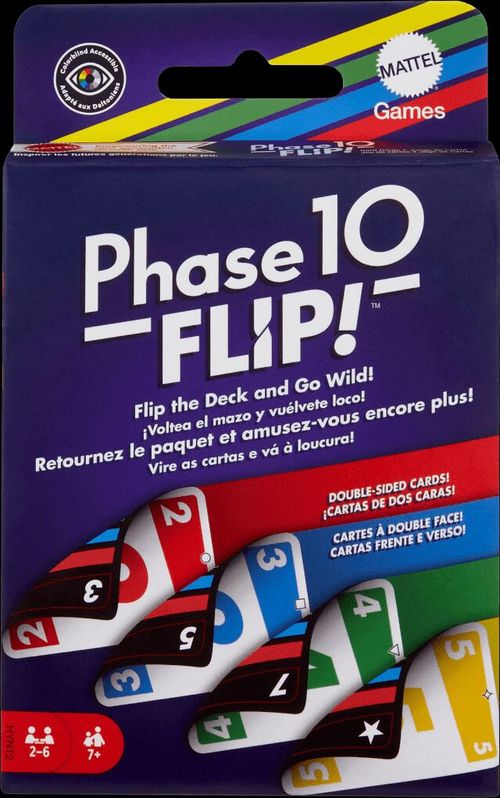
Phase 10 Flip!
Phase 10 Flip! Rulebook
Table of Contents
Table of Contents
Components
The game contains 112 cards as follows:
- 104 double-sided cards
- 8 Phase Reference cards
In a Nutshell
Phase 10 Flip plays like regular Phase 10, except there are two sides to the deck of cards: a "Color Side" and a "Wild Side." You start playing with the Color Side, but when someone discards a card with a FLIP symbol, flip over the draw pile, the discard pile, and the cards in everyone's hand. Now everyone must play with the Wild Side of the cards. On the Wild Side, each card can be any color you want. Once someone discards another card with a FLIP symbol, play goes back to the Color Side, and so on until someone completes their Phase and goes out. The race is on to complete all 10 Phases first!
Setup
Each player gets a Phase Reference card (which lists the 10 Phases). Set any extras aside.
Since the deck is two-sided, make sure all the Color Side cards (which each have a specific color) are facing one way and all the Wild Side cards (which can become any color) are facing the other way.
Shuffle the cards then deal 10 to each player, Color Side down. Hold the cards with the Color Side facing you and the Wild Side facing your opponents.
Place the remaining deck with the Color Side facedown to form a draw pile (the Wild Side cards will be facing UP).
Turn the top card of the draw pile over to start a discard pile (with the Color Side cards facing UP). If this card has a Flip symbol on it, ignore it (do not flip your cards).
The player to the left of the dealer goes first and play proceeds clockwise.
Let's Play
Each player's turn follows these four steps:
- Draw a card.
- Lay down a Phase (if possible).
- Play cards on completed Phases by "hitting" (if possible).
- End your turn by discarding one card (possibly triggering a FLIP).
We will look at each step in detail below.
Step 1: Draw a Card
On your turn, draw one card, either the top card from the draw pile or the top card from the discard pile, and add it to your hand. Make sure they are facing the same direction as the other cards in your hand. For example, if you are currently playing the Color Side, add new cards to your hand with the Color Side facing you.
Step 2: Lay Down a Phase
If you are able to make a Phase with the cards in your hand, lay the Phase down, faceup on the table. Each player can only make one Phase per round. A round ends when someone lays their last card.
During the first round, all players try to complete Phase 1.
What Is a Phase?
A Phase is a combination of cards made up of color runs or a combination of sets and color runs.
Definitions
SETS: A set is made of two or more cards with the same number, in any combination of colors. EXAMPLE: Phase 3 includes "1 set of 3", which could be any three 7s or any three 10s.
COLOR RUNS: A color run is made of two or more cards of the same color, numbered in consecutive order. EXAMPLE: Part of Phase 4 is "1 color run of 3", which could be a red 4, 5, 6.
These are the ten Phases in order:
- 2 color runs of 2
- 1 color run of 2 + 1 set of 2
- 1 color run of 2 + 1 set of 3
- 1 color run of 3 + 1 set of 2
- 1 color run of 4 + 1 set of 2
- 2 color runs of 3
- 1 color run of 3 + 1 set of 3
- 1 color run of 5 + 1 set of 2
- 1 color run of 2 + 1 set of 4
- 1 color run of 3 + 2 sets of 2
Making a Phase
- Phases must be made IN ORDER, from 1 to 10.
- You can only make one Phase per round.
- You must have the whole Phase in hand before laying it down.
- You may not remove a card from a Phase once it has been laid down.
- You receive credit for making a Phase as soon as you lay it down (you do not need to "go out" by getting rid of all your cards to advance to the next Phase).
- If you fail to make a Phase before the round ends, you must try to make the same Phase again in the next round. As a result, players may not all be working on the same Phase in the same round.
EXAMPLE: You are trying to make Phase 8. You have a red 3 and blue 3 as well as a green 6, 7, 8 and 9, then you draw a green 5. You now have "1 color run of 5 + 1 set of 2" and may lay it down. In the next round, you will begin working on Phase 9.
Special Action Symbols
Flip Symbol
When you discard a card with this symbol, everything flips to the opposite side (Color Side flips to the Wild Side and vice versa). Once the card has been played, flip over the discard pile (the card just played will now be on the bottom), then the draw pile, then everyone's hands (DO NOT flip over any completed Phases). This new side will remain in play until another card with a Flip symbol is discarded, changing it again.
Star Symbol
A Star symbol may represent any number you want. If this symbol appears on the Color Side of a card, you may choose the card's number but not its color. If it appears on the Wild Side of the card, the card may represent any number and any color you want. If the Star symbol is replaced with a number on the Wild Side of a card, then you can only choose that card's color.
Card illustrations, captioned: "Choose the card's number" (Color Side Star card); "Choose both the card's color and number" (Wild Side Star card); "Choose the card's color" (Wild Side card with a number).
EXAMPLE: While playing on the Color Side of the cards, a player wants to make a red color run of 3, but only has a red 4 and 6. The player uses a red Star card as a red 5 to complete the run. They could not use a blue Star card because Color Side cards with Star symbols cannot change their color.
When completing a Phase, players can use as many Star cards as they want, as long as they use at least one numbered card.
Step 3: Hitting
After making a Phase, you must try to get rid of any cards that remain in your hand so you can go out and win the round (see GOING OUT below). Hitting is how you do this. As soon as you have made your Phase, you may "hit" by putting a card or cards from your hand directly on any matching Phase that has been laid down.
- Before you can make a hit, your own Phase must already be laid down.
- You may hit only during your turn.
- You may make as many hits as possible, playing multiple cards from your hand on multiple Phases.
- You may hit your own cards, another player's cards, or both, as long as the cards you play properly fit with the cards already laid down.
- You may hit Wild Side Phases with Color Side cards, and you may hit Color Side Phases with Wild Side cards.
- If a Color Side card (which has a specific color) is added to a color run of Wild Side cards, the run becomes that color and can only accept cards of that color going forward.
EXAMPLE: You may add one or more 4s to any player's set of 4s. You may add a red 2 to any player's red color run of 3, 4, 5, 6. You could also add a red 7 and an 8 to this run. You could add a Wild Side Star card to a 6, 7, 8 in a color run of Wild Side cards, but if you add a Color Side green 9 to it, that run would become green and could only be hit with green cards or Wild Side cards after that.
Step 4: Discard One Card to End Your Turn
End your turn by discarding one of your cards faceup onto the top of the discard pile. If the card you discard has a Flip symbol, you must FLIP over the draw pile, the discard pile and all players' hands.
Going Out (Ending the Round)
After laying down a Phase, players try to "go out" as soon as possible. Going out ends the round for everyone. To go out, you must get rid of all your remaining cards by hitting on existing Phases, discarding your last card onto the discard pile, or a combination of both. The player to go out first wins the round. The winner of the round, and any other players who also completed their Phase, will advance to their next Phase on the next round. Players total the cards left in their hands (the fewer cards left in your hand, the better!).
Remember, if you did not complete the Phase before another player went out, you must work on the same Phase again during the next round.
Scoring
The winner of the round scores zero (players want to get the lowest score). All remaining players score points against them for any cards still in their hands, as follows:
- 5 points for each card numbered 1-9
- 10 points for each card numbered 10-12
- 20 points for each card with a Star symbol
Only the cards in a player's hand are scored, not cards already laid down, and only the side currently being played. After the scores are recorded, the player to the left of the dealer becomes the new dealer. All cards are gathered and shuffled (after making sure they are all facing the same way), and a new round begins.
Winning the Game
The first player to complete Phase 10 at the end of a round is the winner. If two or more players complete their 10th Phase in the same round, then the player with the fewest total points is the winner. In the event of a tie, the players that tied replay the 10th Phase. The first one to go out is the winner.
Variations
- The players play 10 rounds. All players advance to the next Phase each time, whether they complete the current Phase or not. Thus, in round one, players try for Phase 1, then in round two they all try for Phase 2, etc. After ten rounds, the player with the lowest total score is the winner.
- Players decide how many Phases must be completed to win (e.g. five Phases or seven Phases). The number of Phases to be completed must be decided before play starts. All other rules remain the same. This variation allows for a shorter version.
For Colorblind Players
Special graphic symbols have been added to each card to help identify the color(s) on that card. This will allow players with ANY form of color blindness to easily play!
- Circle = Red
- Four-point star = Yellow
- Downward triangle = Green
- Square = Blue