Petteia
Petteia Rulebook
Table of Contents
Table of Contents
Equipment
- One 8x12 board (an uncheckered grid of spaces of the most common size)
- Two sets of 24 identical pieces called stones (similar to Go stones, conventionally black and white but this is a modern usage)
- One pyramidal piece in each of the 2 colors used (comparable in size to the other stones but taller and so resembling extant pieces)
- One 4-sided die (numbered 1 through 4, the knuckle-bone of a sheep is traditionally used and a replica could be used)
General Rules
Since these games represent stages in the evolution of a single game, a number of rules are shared and so apply to all games. For convenience, these are listed here.
Set-up
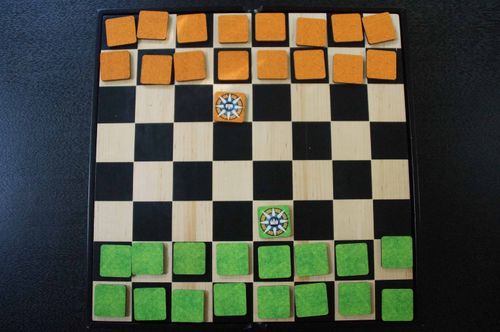
The board is always placed between the two players with the long side of the board facing the players. As stated in each individual game below, each player initially fills either the one row or two rows nearest. Each row will accommodate exactly 12 pieces each. If the pyramidal piece is used, it is placed on the next row adjacent to the initial placement of other pieces and occupies the leftward center square.
Common rules of play
-
The object of each game and the specific equipment used is listed under each individual game.
-
All games are strictly two player games. Turns alternate. Players decide randomly which player moves first unless otherwise stated.
-
Except for the pyramidal piece, all pieces are referred to as stones. The pyramid-shaped piece is called a leader. Stones and leaders are together called pieces.
-
No two pieces can ever occupy the same space, whether the two pieces belong to the same or different players.
-
A player must move exactly one piece on a turn if that player has a legal move. A player who does not have a legal move loses immediately.
-
All pieces move one or more spaces as desired in a continuous horizontal or vertical (not diagonal) line, similar to a rook in standard chess. A piece cannot jump over another piece nor land on the same square as another piece. No piece can change direction during a move.
-
An opponent’s stones can be captured via custodial capture. To capture a piece in this manner, a player must move a piece onto a space vertically or horizontally (but not diagonally) immediately adjacent to one of the opponent’s pieces such that one of the player’s own pieces is immediately on the other side of the opponent’s piece. Thus, the two pieces sandwich the captured piece so that before the captured piece is removed from the board all three pieces form a short line of immediately adjacent pieces either horizontally or vertically.
-
More than one stone can be captured simultaneously in this manner if the piece moved performs custodial capture (as just described) on more than one side.
-
A piece is free to move between two of an opponent’s pieces without being captured.
-
Capture is not normally compulsory. Those games which are exceptions state so explicitly.
Common optional rules
Any or all of these can be used with each game.
- In a game won by capture of stones, capture is compulsory so that a player must capture a piece if able, although a player can always freely choose which piece to capture where an option exists.
- Before a turn, a player rolls the die. No piece can move more than the number of spaces rolled. This rule was typically associated with gambling or divining using what was otherwise a game of skill.
- In a gambling version of each game, when a capture is made, for each piece captured, a player rolls the die. The player whose piece was captured pays the other payer the number of some small coins rolled. Gambling in this fashion was common in the ancient world.
- A piece belonging to the opponent occupying a corner space can be captured by moving a piece into a position so that both spaces adjacent to the opponent’s piece in the corner are occupied by a piece belonging to the capturing player.
Simple Petteia
Equipment: Each player uses 12 stones which are initially placed one in each space of the row along the side of the board nearest to that player.
Object: The first player to capture 7 stones wins.
Other rules specific to the game: If due to board position no further captures can be made but both players have a legal move, the player who has captured more pieces wins. If the number of pieces captured by each player is the same, the game becomes a draw.
Example 1: Both players have pieces positioned in the middle of the board so that the opponent’s pieces cannot pass. Yet sufficient space exists behind the pieces blocking the middle so that neither player is unable to move. Then the game would be decided by the number of pieces already captured.