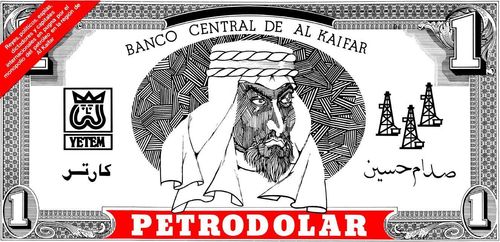
Petrodólar
Petrodólar Rulebook
Table of Contents
Table of Contents
- Components
- International Incident Cards (Cartas de Incidentes Internacionales)
- Preparation (Preparativos)
- Placement and Movement (Colocación y movimiento)
- Earnings (Ganancias)
- Start of the Game (Comienzo del juego)
- Play Sequence (Desarrollo del juego)
- Rulers (Gobernantes)
- Attacks (Ataques)
- Secret Agents (Agentes secretos)
- Oil Tankers (Buques petroleros)
- Earnings (continued)
- Pipelines (Oleoductos)
- International Incident Cards, Drawing
- The Survivor Wins (Gana el que sobrevive)
Components
Board. Represents a region rich in oil called Al Kaifar, made up of 8 countries: 4 coastal countries with moderate oil production (2 towers); one country that dominates the canal joining both seas and has one tower; and 3 inland countries with high oil production (4 towers). [Figure 1 on page 4 shows a detail of the board: a country circle with its markers, the red capital dot, towers, tankers and a dashed pipeline, with the caption below.]
Pieces (Fichas). There are four sets of pieces. Each set has a distinctive colour and is made up of several heads of state (2 kings, 2 politicians, 1 dictator and 1 sheik) and one secret agent. The pieces are the following icons:
- King (Rey)
- Politician (Político)
- Dictator (Dictador)
- Sheik (Sheik)
- Secret Agent (Agente Secreto)
- Pipeline (Oleoducto)
- Oil Tanker (Buque Petrolero)
The sheet also contains 16 oil tankers and 12 pipelines. To use them, press each piece out of the sheet and insert it into the matching plastic base, which is found in the box for each colour. Each colour is kept in its own box when the game ends. The oil tankers and pipelines are used without bases.
Cards and money (Cartas y dinero). The sheets contain the International Incident Cards, which are cut out and form a deck, and two bundles of bills of 10 and 50 million. When the game ends, these components are kept in the places assigned to them in the box.
International Incident Cards (Cartas de Incidentes Internacionales)
- International Monetary Fund loan approved. Receive 30 million from the Bank.
- International Monetary Fund loan approved. Receive 40 million from the Bank.
- International Monetary Fund loan approved. Receive 50 million from the Bank.
- International Monetary Fund loan approved. Receive 60 million from the Bank.
- An oil tanker is shipwrecked. Remove one of your oil tankers from the board.
- An oil tanker is shipwrecked. Remove one of your oil tankers from the board.
- An oil tanker is shipwrecked. Remove one of your oil tankers from the board.
- An oil tanker is shipwrecked. Remove one of your oil tankers from the board.
- A dictator is assassinated. Remove your dictator from the board.
- A politician loses the elections. Remove one of your politicians from the board.
- A sheik dies in an ambush. Remove your sheik from the board.
- A king is deposed. Remove one of your kings from the board.
- A politician wins the elections. One of your politicians may move up to 7 spaces without paying, exempt from Incident Cards and from barriers created by Secret Agents. IT CANNOT PASS ANOTHER RULER.
- A rebellion succeeds. Your sheik may move up to 7 spaces without paying, exempt from Incident Cards and from barriers created by Secret Agents. IT CANNOT PASS ANOTHER RULER.
- The subjects support the King. One of your kings may move up to 7 spaces without paying, exempt from Incident Cards and from barriers created by Secret Agents. IT CANNOT PASS ANOTHER RULER.
- A DICTATOR PREPARES an offensive. Your dictator may move up to 7 spaces without paying, exempt from Incident Cards and from barriers created by Secret Agents. IT CANNOT PASS ANOTHER RULER.
Preparation (Preparativos)
Each player takes the set of pieces of one colour (2 kings, 2 politicians, 1 dictator, 1 sheik and 1 secret agent). A banker is named, who gives each player money to the value of 70 million and also one oil tanker.
The deck of International Incident Cards is shuffled and placed face down in the space shown on the board.
A pipeline is placed across the border between Dabash and Qafar.
The player to start is chosen. Play then passes to the left, and so on.
Placement and Movement (Colocación y movimiento)
In Petrodólar each player controls a group of pieces (several rulers and one secret agent). This means that they may place them on certain spaces of the board, and then move them from one space to another. Placing or moving the secret agent costs nothing, but placing or moving a ruler costs money.
Each time a piece is placed on the board it must be placed on the capital (red dot) of a country, and then it may move from marker to marker. Placing a ruler costs the same as moving it one space, and each ruler has its own cost:
- Placing or moving one space to a king costs 20 million.
- Placing or moving one space to a politician costs 20 million.
- Placing or moving one space to a dictator costs 10 million.
- Placing or moving one space to a sheik costs 10 million.
This means that if a player moves 5 spaces with one of his kings or politicians, it costs 100 million, which must be paid to the bank. Moving 5 spaces with his dictator or his sheik costs 50 million.
Earnings (Ganancias)
As has just been said, placing or moving rulers costs money, but it is also through them that players obtain their earnings.
When a player has one of his rulers placed in the capital (red dot) of a country, then he controls that country.
To obtain earnings a player must control one or more countries and at the same time have oil tankers for the transport of the oil. A tanker carries the oil of a single tower. Therefore, to make full use of the towers of a coastal country, the player must have 2 tankers. If this player places a pipeline linking it with an inland country that he also controls, then to receive additional earnings from the new towers he must acquire more tankers.
Earnings also depend on which ruler controls the country:
- If it is a king or a politician, it receives 20 million per tower.
- If it is a dictator or a sheik, it receives 10 million per tower.
Start of the Game (Comienzo del juego)
At the start all countries are unoccupied. The first player must do the following:
- Place one of his rulers, whichever he wishes, in the capital of the country he wishes to occupy (it is recommended to begin by occupying a coastal country). The player must pay the bank 10 or 20 million, according to the ruler he places.
- Place his secret agent beside his ruler (both are then in the capital of the country). This costs nothing.
Now, if he wishes (but he is not obliged to), he may place his oil tanker on the coast, next to his capital. Otherwise, the tanker remains on the high seas (at the edge of the board). The other players play in a similar way.
Play Sequence (Desarrollo del juego)
After the opening move, each player on his turn must carry out the following, in the order indicated:
- Claim his earnings from the bank.
- Move his secret agent 4 spaces. (The secret agent always moves 4 spaces.)
- Place or move one of his rulers. (Paying the bank the corresponding sum.)
Then, if he wishes, he may buy or sell or move one oil tanker, and buy and place a pipeline. (At most, one tanker and one pipeline per turn.)
Rulers (Gobernantes)
The placing of rulers does not happen only in the opening move; it is done throughout the whole game. Whenever there is a capital that is not occupied by another ruler (neither his own nor another player's), the player whose turn it is may, if he wishes, take one of his rulers who are outside the board and place it in that capital. It does no harm if a secret agent, his own or another's, is already there. Of course, the player must pay the bank the cost of placing that ruler. If the player places a ruler, he may not do any other thing on that turn with the rulers.
The player who, on his turn, does not place a ruler (because he cannot or does not want to) is obliged to move one. He may only move one ruler, unless an International Incident Card instructs otherwise. If one of these cards indicates that a ruler is to be moved or removed, the player involved may not move or place any other ruler in the same turn.
Rulers move from marker to marker around the circle of each country. They may move in either direction, but they may not change direction within the same turn.
[Figure 1: the board detail described above.] Movement is made from marker to marker, and one may pass to a neighbouring country through the facing arrows.
Rulers may pass from one country to another wherever the arrows face each other.
When a ruler moves, the player must pay the bank its cost for each space advanced.
A ruler may not pass a "?" space in a single turn; it must always stop on it. The player then takes the top International Incident Card and follows its instructions. (If the ruler remains on the "?" space for another turn, it does not take a card again; it takes one only when it arrives. The ruler may leave the "?" space on the following turn.) Once carried out, the International Incident Card is returned to the bottom of the deck.
A ruler may not pass or stop on the same space as another ruler, neither its own nor another player's. (The only exception is described under Attacks.)
A ruler may only be removed from the board when its player is eliminated, by instruction of an International Incident Card, or when it is attacked. (See Attacks.)
Attacks (Ataques)
To attack, the player moves one of his rulers toward a capital that is occupied by an enemy ruler. This can only be done if the attacked ruler has a different name from the attacker (that is, a king cannot attack another king). The attacked ruler leaves the board. (It may return to the board whenever its player wishes and is able to place it in an unoccupied capital. Of course, the player must pay for each new placement.)
In all other respects an attacking move is like the movement of any ruler, and the player must pay the cost to the bank.
The only case in which a ruler may be moved onto the same space as another ruler is an attacking move, which occurs only in the capital and against a ruler of a different name.
Secret Agents (Agentes secretos)
On his opening turn, each player places his secret agent in the same capital as his ruler.
From then on, on his turn the player must move his secret agent 4 spaces, in any direction (but without changing direction within the same turn). Placing the secret agent and its subsequent movements cost nothing.
A secret agent may pass over a "?" space, and it stops there only when that is the end of its 4-space movement. In that case it takes an International Incident Card. If the card orders the player to move or remove a ruler, the player must do so, and in that turn he may not do anything else.
A ruler may not pass a secret agent of an enemy, but it may occupy the same space as an enemy secret agent without passing it.
A secret agent may not attack any other piece, and even if it is in a capital it does not control the country. The secret agent remains on the board for as long as its player stays in the game.
Remember that no enemy ruler can pass a secret agent in a single move, so the secret agent's usefulness is to block the enemy's advance.
Oil Tankers (Buques petroleros)
Each player receives one oil tanker free at the start of the game. Each additional tanker costs 50 million. A player may buy and place, move or sell only one tanker per turn. Tankers may be resold to the International Monetary Fund (the bank) for 30 million each.
When bought, an oil tanker may be placed on the high seas (at the edge of the board), or placed immediately next to the coast of a country the player owns. Of course, it only earns if it is next to the coast. If a country the player owns is about to fall into the hands of another player, the player may then move only one tanker per turn from the coast out to the high seas; in this way, even if the country falls, the tanker remains his.
To move a tanker from the coast of one country to the coast of another takes 2 turns. First it must be taken out to the high seas, and then, on the following turn or a later one, placed next to the coast of the country one wants.
An oil tanker can only be taken from a sea to the one on the other side of the board by making it cross the canal. This can only be done if the owner of the oil also controls Dabash, or if Dabash is [illegible: photograph blurred; probably "sin dueño", unowned]. Crossing the canal costs no extra time: if we have a tanker on the high seas, we can in a single turn cross it through the canal and place it on a coast on the other side of the board.
Earnings (continued)
This heading appears a second time in the leaflet, in the tanker section.
Each oil tanker must be paired with a tower to earn. When the tanker is taken to the high seas it earns nothing. As already said, the earnings depend on the type of ruler that controls the country.
Figure 2. In drawing A, a king controls a coastal country of 2 towers, but as it has only one tanker, it receives 20 million in earnings.
[Figure 2 shows, in drawing A, a ruler circle beside a coastal country with a single tanker on the coast.]
In drawing B, the coastal country of 2 towers is controlled by a politician. As it has 2 tankers, both towers earn for it, totalling 40 million.
In C, there are three tankers on the coast, but as there are only two towers, the earnings are for the two towers which, in proportion to [sic] the dictator, earn a total of 20 million.
Pipelines (Oleoductos)
At the start of the game a pipeline is placed connecting Dabash with Qafar, at no cost. All the other pipelines that players want to place are bought from the bank for 30 million each. A player may buy only one pipeline per turn, which he places immediately on any border he wishes. Once placed, the pipeline stays in the same position on the board until the end of the game, regardless of any change of ownership of the countries it connects.
When a player controls two countries at the same time, one coastal and one neighbouring, linked by a pipeline, he receives earnings from the towers of those countries, always in accordance with the number of tankers he has on the coast.
Figure 3. The player receives 60 million. He controls two countries connected by a pipeline and has 3 tankers. As those 3 tankers would earn for him from 3 towers, he chooses to exploit the towers of the country controlled by the politician, which brings him more benefit than the sheik.
International Incident Cards, Drawing
Heading supplied by the transcriber; the leaflet gives this rule without a heading, under the text that repeats "Cartas de Incidentes Internacionales".
Each time a ruler or a secret agent ends its movement on a "?" space, the player takes the card from the top of the deck and follows its instructions. The card is then returned to the bottom of the deck.
The Survivor Wins (Gana el que sobrevive)
A player is eliminated from the game when he has no more cash and no earnings, and is therefore unable to move a ruler. In such a situation he may still try his luck: since on the turn one must move the secret agent first (which costs nothing), the player facing elimination may make this move. If his secret agent ends on a "?" space, he takes an International Incident Card as usual. If the card is favourable (giving him money or allowing him to move a ruler at no cost), he survives. If it is not favourable, he is eliminated and must remove his pieces from the board.