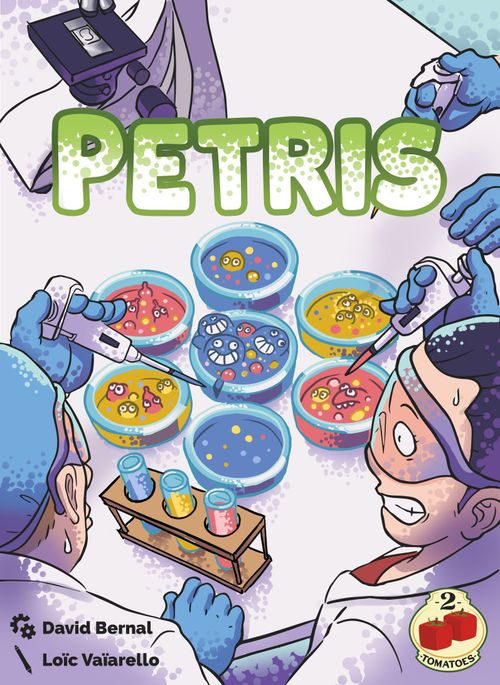
Petris
Petris Rulebook
Table of Contents
Table of Contents
Game Components
- 10 Petri dishes (from now on, dishes)
- 20 Bacteria tokens per player (from now on, bacteria)
- 3 Sarcina tokens per player (from now on, sarcina)
- 1 Turn marker
- 1 Contamination token per player
- 2 Turn boards
- 1 Contamination board
Games with 2 Players
Game Setup
- Create a playing area with 7 dishes. These will represent the shared culture.
- Each player takes the bacteria and the sarcina of their chosen colour (red or blue) and places them in their supply.
- Place the contamination board beside the playing area. Each player places their contamination token on the starting position of the contamination track.
- Place the turn board for 2 players (marked with the 2-player icon) beside the playing area, and place the turn marker on the starting position of the turn track.
- Each player places a bacteria from their supply on the dish closest to their supply.
How to Play
As indicated on the turn board, 2 rounds will be played. In each round there are 6 propagation phases per player (move the bacteria), 4 binary fission phases (bacteria reproduce) and 2 contamination phases (players score).
(Propagation phase icons: a blue bacteria and a red sarcina.)
Propagation Phase
In each propagation phase, the active player must make a valid propagation. To do so, the player will choose a dish containing at least one of their bacteria. From that dish, they will be able to move any number of their bacteria to one or more adjacent dishes, distributing those bacteria as they wish, but always according to the following three rules:
- No dish can ever contain the same number of bacteria from each player.
- No dish can ever contain more than 5 bacteria of either player.
- The player shall always move at least 1 bacteria.
WARNING: If a player can't make a valid propagation, that player immediately loses the game.
If after a propagation a dish contains 5 bacteria from the same player, return the bacteria to their owner's supply and replace them with a sarcina from their supply. Sarcina can never be eliminated nor moved and are always equivalent to 5 bacteria. Therefore, a player won't be able to move any bacteria to a dish containing one of their own sarcina.
WARNING: If a player must place a sarcina and they don't have any left in their supply, that player immediately loses the game.
Once the player has made their propagation, advance the turn marker.
Example: In this example, the blue player decides to propagate from the central dish: they move 2 bacteria to the lower-left adjacent dish and 1 bacteria to the lower-right adjacent dish. They also choose to leave 1 bacteria on the dish from where they propagated.
Binary Fission Phase
(Binary fission phase icon: two merging bacteria.)
On each binary fission phase, the players check the bacteria in the dishes.
For each dish:
- If it contains bacteria from only one player, these will reproduce and the player places one bacteria in the dish from their reserve. This may result in the emergence of a sarcina and will be treated in the same way as explained earlier.
- If it contains bacteria from both players, nothing occurs.
Once the binary fission is over, advance the turn marker.
Contamination Phase
(Contamination phase icon: a biohazard symbol followed by a bacterium and an exclamation mark.)
On each contamination phase, the players first effectuate a binary fission phase, following the rules explained earlier. Then, instead of advancing the turn marker, for each dish that contains at least one bacteria of each player: The player with more bacteria in that dish will score a contamination point. To score, they move their contamination token 1 space along the contamination track, which could cause the end of the game (see End of the Game).
Once the contamination is complete, advance the turn marker, giving way to the next propagation phase or ending the game.
Example: In this example, the red player scores 2 contamination points, since they have more bacteria than the blue player in 2 dishes. Likewise, the blue player scores 2 points via the other 2 dishes.
End of the Game
The end of the game may occur in four ways:
- If, during their turn, a player can't make a valid propagation (because they don't have any bacteria to move or because they can't move them to any dish), they will immediately lose the game.
- If, during any propagation or binary fision phase, a player must place a sarcina and they don't have any left in their supply, that player immediately loses the game.
- If, during any contamination phase, a player moves their contamination token to the last space on the contamination track, that player immediately loses the game. This represents that the bacteria from the first player have gotten out of control and have destroyed the shared culture. In the event that both players get to the last space on the contamination track in the same contamination phase, the player with fewer tokens (bacteria and sarcina) in the dishes wins. If the tie stands, the player with fewer sarcina in the dishes wins. If the tie still stands, play again!
- If after the final contamination phase no player has won the game, the player with the least advanced token on the contamination track wins. If there was a tie, this would break as previously mentioned.
Advanced 2-Player Mode
This advanced mode only changes the number of points scored during the first 3 contamination phases. For each dish that contains at least one bacteria of each player:
- In the 1st contamination phase, the player with majority of bacteria scores 3 contamination points (instead of 1).
- In the 2nd and 3rd contamination phases, the player with majority of bacteria scores 2 contamination points (instead of 1).
Games with 3 Players
When playing with 3 players, the game can be played by combining the normal rules with the changes listed below.
Changes to the Game Setup
- There will be a new layout of the playing area, using all 10 dishes.
- Each player takes the bacteria and the sarcina of their chosen colour (red, blue or yellow) and places them on their supply.
- Place the turn board for 3 players (marked with the 3-player icon) beside the playing area, and then place the turn marker on the starting position of the turn track.
Changes in How to Play
As indicated on the board, 2 rounds will be played. In each round, there are 6 propagation phases per player, 3 binary fission phases and 3 contamination phases.
In each contamination phase, for each dish that contains at least one bacteria from 2 or more players: The player with the most bacteria on that dish will score 1 contamination point for each opponent who has at least one bacteria on that dish.
Changes to the End of the Game
The game ends inmediately when one of players fulfills one of the four end game triggers. From among the other two players, the player with the least advanced token on the contamination track will win the game. If there is a tie, proceed as explained in the 2-player tie-breakers.