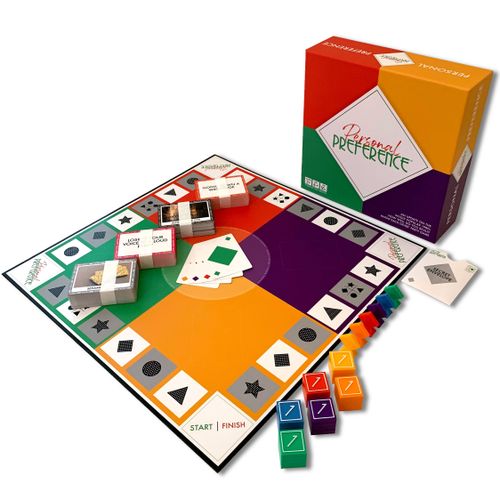
Personal Preference
Personal Preference Rulebook
Table of Contents
Table of Contents
How to Play
The Main Idea
The main idea in playing PERSONAL PREFERENCE is to guess how other players rank four subjects in order of their personal preference. The more accurately you guess, the faster you move around the gameboard to win.
What You Need
- 4 Boxes of Category Cards
- 4 Movement Pieces
- 16 Preference Tokens (4 of each colour)
- 4 Colour-coded Preference Cards
- Secret Envelope
- Gameboard
You will also need four or more people (also see "Games with Two or Three Players"). Set up teams of two or more players each. It usually helps if teammates know each other better than they know their opponents.
How to Start
Each team selects a Movement Piece and four Preference Tokens of the same colour. All Movement Pieces start on "Start/Finish" and move clockwise around the gameboard. It is OK to have two or more Movement Pieces occupying the same space during the game.
To get started, the player to the left of the host is designated "IT" for the first round. If you are "IT", draw four cards from the category of your choice, placing one card on each of the four coloured sections on the gameboard.
If any Category Card is totally unfamiliar to the player who is "IT", that card can be placed back in the box and a new card drawn.
When you're "IT", and your Movement Piece is on "Start/Finish" or one of the other three corner squares, it is up to you and your teammate(s) to select the category of your choice. Otherwise, you must draw your four cards from the box indicated by the symbol under your Movement Piece. There are symbols for "FOOD & DRINK", "ACTIVITIES", "PEOPLE", and "POTPOURRI", and a corresponding box of cards for each. The four-part symbol (a combined symbol of the four) requires you to draw one Category Card from each of the four boxes.
How to Rank Your Preferences
Once the Category Cards are placed on the gameboard, the person who is "IT" ranks those cards from their most to least favourite. There is no advantage to bluffing as you will only mislead your own teammate(s) when they guess your preferences.
You rank your order of preferences by using the four colour-coded Preference Cards. Each Preference Card matches a colour of one section of the gameboard and now represents the Category Card you have placed there. For example, if the Category Card you placed on the red section depicts "Brussels Sprouts", then the red Preference Card now represents Brussels Sprouts. If you choose to rank Brussels Sprouts as your most preferred subject, place the red Category Card on top, and so on. When you have the four Preference Cards in order, place them in the Secret Envelope.
While ranking your preferences, do not consult with your teammate(s) nor explain your reasoning; keep it secret. Also do not change your ranking after discussion and guessing has begun. Just sit back and eavesdrop as everyone tries to analyze your personal preferences.
How Other Players Guess Your Preferences
Now each team, including your own teammate(s), tries to guess your preferences, based on their own perceptions of you. Each team should openly discuss their guesses before making them final. If you are "IT", naturally you are not allowed to comment or react in any way as the guesses are discussed and made — even (or especially!) while your own teammate(s) is guessing.
Each team indicates its guesses by placing its coloured Preference Tokens on the coloured gameboard sections in the order of preference guessed. For example, if a team feels the person's first preference is the subject in the red section, their Preference Token bearing #1 is placed there, and so on for tokens #2, #3 and #4. Keep all Preference Tokens outside the gameboard's center circle, unless you are really sure and wish to "DOUBLE" by placing it within the doubling circle (see "SCORING").
The order in which the teams make their guesses is determined by the following:
The player to the left of the person who is "IT" and his or her teammate(s) ordinarily go first, followed by the next player to the left and his or her teammate(s), and so on, except that...
A) No team takes more than one turn guessing, and...
B) The team in last place on the gameboard is entitled to "PASS" until all other teams have placed their Preference Tokens, and...
C) When you are "IT", your teammate or teammates go last, regardless of seating, unless the last placed team has passed its turn.
The Envelope, Please
When you are "IT", you reveal your own personal preferences after all teams have played their Preference Tokens. Your preferences are revealed one by one, beginning with your most preferred subject. As you reveal your preferences, you should discuss them, clarifying or explaining why you chose as you did. Pause after revealing each preference, to give all teams the chance to advance their Movement Pieces (see "Scoring" below).
Scoring
As choices are revealed, each team advances around the gameboard for each preference ranking that was guessed correctly. If the guess was not DOUBLED (see "Doubling" below), the guessing team moves forward one space for each correct guess, and is not penalized for incorrect guesses.
Doubling
If a team is especially confident, they may DOUBLE a guess by placing their Preference Token on the part of the coloured gameboard section that is within the shaded "doubling circle". A team may DOUBLE any number of guesses, from none to all four. For correctly DOUBLED guesses, the team advances two spaces, rather than just one, but if they're wrong they move backwards one space.
After the rankings have been revealed and the Movement Pieces moved to their new positions, the round is over. Place the used Category Cards at the back of the boxes they were drawn from, and pass the Preference Cards and Secret Envelope to the next player on the left. That player is "IT" for the next round.
Remember: If you are "IT", your Movement Piece indicates the category to be played next.
Who Wins?
The game is over at the end of any round where Movement Pieces for one or more teams land on or pass the "FINISH" square. If more than one team reaches the "FINISH" square in the same round, the one farthest ahead wins. If there is a tie, play continues until the tie is broken.
Planning Ahead
The Category Cards have been designed with black symbols on one side and dark gray symbols on the other. This has been done to allow players who wish to play with new category cards every time to play the "black" cards in each box first, and then play all the "gray" cards.
After both sides have been used, the Category Cards can be shuffled, so that they will be drawn in a new sequence in subsequent games. In this way, the combinations are virtually endless — making each round unique even if you have played with the same Category Cards many times.
Games with Two or Three Players
Two or three players can play PERSONAL PREFERENCE, with minor modifications. Rather than forming teams, each player acts independently, doing everything a team would do. However, a player does not advance when he or she is "IT". Remember, bluffing is not part of the game.