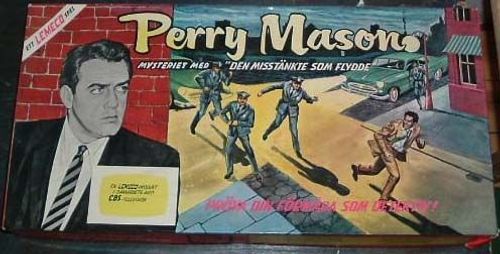
Perry Mason Game: Case of the Missing Suspect
Perry Mason Game: Case of the Missing Suspect Rulebook
Table of Contents
Table of Contents
- Game Implements
- Rules
- Start of Play
- How to Play
- Moves on the Board
- Picking Up a Detective Case
- Collecting Clues
- How to Draw Clue Cards
- "Question Witness" Cards
- Questioning Witness at Inquest Spots
- Checking Suspects on the Board (How to use your Suspect Check List)
- Picking Up a New Detective Case
- Solving a Detective Case
- Capturing a Suspect and Bringing Him to Trial
- Example of a Solved Detective Case
- Winner
- Explanation of Question Witness Chart
- Playing Hints
Game Implements
- Dice and dice cup
- 28 Clue Cards
- 8 Detective Case Cards (separate all cards gently)
- One "Question Witness" Chart
- 6 plastic cars in 6 colors
- 7 plastic Suspect tops and 7 Suspect bases, numbered 3, 4, 5, 6, 7, 8 and 9 (break these off gently from the plastic runner)
- Suspect Check List pad
For 2 to 6 players.
Rules
Read the Rules through briefly to get a general idea of how the game is played. Then read them carefully once more before playing.
Diagram: a Suspect Base, plus a Suspect Top, equals a Suspect Ready for Playing.
Start of Play
Each player throws the die once. The "detective" who throws the highest number is the Dealer. He shuffles the plastic Suspect bases face down on the table and fits the Suspect tops onto them, without allowing anyone, including himself, to discover the numbers on the bases. He then places the Suspects on any 7 "S" spots on the board (leaving one "S" uncovered). Now he shuffles the Clue Cards and places them face down in a drawing pile. He also shuffles the Detective Case Cards and places them face down on the table.
Each player takes a "car" and places it at the Courthouse to start. Dealer plays first, then the order of play goes clockwise around the table.
How to Play
Moves on the Board
Notice that the Playing Board is an aerial view of the city. On his turn, each player or "detective" throws a single die once, and drives his car around the city streets from DOT to DOT, moving as many DOTS as the number on the die indicates. He may drive from DOT to DOT, in any direction, on one turn; but he must follow the connecting lines between DOTS, and not jump over houses, parks, etc. He may not re-trace his path on the same turn. Two cars may not rest together on any DOT except the large black Tunnel Dots.
It's important when hunting Suspects to get about the city quickly. When a detective's car enters a large black Tunnel Dot, he may, if he wishes, jump to ANY OTHER TUNNEL DOT on the board on the same turn. His car remains on the second Tunnel Dot until his next turn.
Picking Up a Detective Case
After leaving the Courthouse by any one of the 4 exits, the detective "drives" to the nearest Perry Mason OFFICE to pick up a detective case. His car does not have to enter the Office by exact count. The detective immediately draws a Detective Case card. (Cases are lettered A, B, C, D, as shown on cards.) His car remains at the Office until his next turn.
Collecting Clues
Each Detective Case Card lists 4 DIFFERENT CLUES, which pertain to that case. A detective, in order to solve his case, needs to collect ONLY THREE of these Clues. Each of these Clues will be on a separate CLUE CARD in the deck. When he holds 3 correct Clue Cards, the detective adds up the numbers opposite each Clue, and thus gets the number of the "Missing Suspect" that he must capture and bring in to trial.
NOTE: Each Clue Card has TWO DIFFERENT CLUES printed on it. Each Clue belongs to a DIFFERENT Detective Case. Ignore the second Clue on the card if the first Clue belongs to your case.
How to Draw Clue Cards
Some of the Dots on the city streets are RED. When a detective's car stops by direct count on a RED DOT, the player may pick up a Clue Card. However, a player may keep no more than THREE CLUE CARDS at one time in his hand. This means that if he draws a fourth Clue Card during the game, he must discard one from his hand. He places it face down at the bottom of the drawing pile of Clue Cards.
"Question Witness" Cards
Some of the Clue Cards say "Question Witness." When a player draws such a card, he at once throws the die. Then he consults the QUESTION WITNESS CHART. Under the letter of his case (A, B, C, etc.), he looks up the number thrown on the die. (See explanation of Question Witness Chart below.)
Questioning Witness at Inquest Spots
There are 4 "Inquest" spots on the board. A detective may drive his car to any Inquest spot and "question witnesses at the Coroner's Inquest," as in a real police case. Exact count is not necessary to enter the Inquest spot. The player throws the die once, and consults the QUESTION WITNESS CHART, then follows the same procedure outlined below. He must leave the Inquest spot on his next turn; he cannot return to it until his second turn to play.
Checking Suspects on the Board (How to use your Suspect Check List)
From the very beginning of the game, it is good strategy to check on Suspect numbers as you travel about the city. To check a Suspect's number, a player's car may enter any "S" spot on the board. (Exact count is not necessary.) The player turns over the Suspect and secretly records its number on his Suspect Check List. He then replaces the Suspect. His car remains on the "S" spot until his next turn.
Picking Up a New Detective Case
If a player holds several Clue Cards unrelated to his Detective Case Card he may decide to work on a new case. He drives to the nearest Perry Mason OFFICE and enters it (exact count not necessary). He may draw a new Detective Case Card immediately. He replaces his first Detective Case Card, face down, at the bottom of the deck. His car remains at the Office until his next turn.
Solving a Detective Case
As soon as a detective holds ANY THREE of the four Clues given on his Detective Case Card, he has "solved" his case correctly. Now he may add up the numbers printed opposite each one of the three Clues he has collected. This will give him the number of his "Missing Suspect." He must capture the Suspect with this number, and bring him in to the Courthouse for trial.
Capturing a Suspect and Bringing Him to Trial
To capture his Suspect, a detective's car must enter the "S" spot on the board where that Suspect is "hiding." Exact count is not necessary. The player affixes the Suspect to the top of his car, and waits on the "S" spot until his next turn. Then he drives to the Courthouse as fast as he can, to bring his Suspect to trial.
Example of a Solved Detective Case
Illustration: Case Card H, "Case of the Canary Diamonds," with its Clue Cards: Overnight Case (1), Missing Gems (3), Face at the Window (3), and Hidden Gun.
A detective drew Case H, "The Case of the Canary Diamonds." Four Clues were listed on his Case Card: OVERNIGHT CASE, FACE AT THE WINDOW, MISSING GEMS, and HIDDEN GUN. He collected three of these Clues on 3 different Clue Cards: Overnight Case (1); Missing Gems (3); and Face at the Window (3); which added up to the number 7 (1+3+3=7). His Missing Suspect is, therefore, Suspect #7. He checked his Suspect Check List and discovered that the "red" Suspect is #7. He proceeded at once to "drive" to red Suspect's "hideout" on the board, and capture him.
Winner
The first detective who brings in his Suspect to the Courthouse for trial, is the winner. He must enter the Courthouse, by any one of the four entrances, by exact count (counting the Courthouse as the last space of his move). Now he must turn over his three Clue Cards and his Detective Case Card, to prove to the other players he has solved his detective case correctly, and captured the right Suspect.
Explanation of Question Witness Chart
Gap in the source: the Question Witness Chart is a separate game component, and its lettered results table (case letters A, B, C, etc., against the number thrown on the die) is not printed on the six scanned rules sheets. The table is not reproduced here. The explanation of each result follows, as printed.
Look under your Detective Case letter (A, B, C, etc.) and look up the number thrown on the die.
Lying Witness: Your witness is uncooperative. No information.
Check Suspect: On this turn, drive your car to ANY Suspect on the board and check his number. Write it down on your Suspect Check List without letting other detectives see it. Replace the Suspect on the "S" spot. Your car remains here until your next turn.
Ask for Clue: Other detectives must cooperate with you. Ask any player for ONE CLUE-BY NAME. Ex: "Do you have a Bloody Ice Pick Clue"? If the other player has such a Clue Card in his hand he must trade with you.
Trade Clues: You may ask any other player to trade a Clue Card with you, sight unseen. He must exchange a Clue Card with you when asked. Neither of you may mention the Clue Cards by name.
Ask for Suspect Number: You may point to any Suspect on the board, and ask one player to give you that Suspect's number. If he knows it, he must write it on a slip of paper and pass it to you without the other players seeing it. If he doesn't know it, he says, "Sorry, Mr. Mason, I have not checked that Suspect."
Pick Up New Clue: You've got a "break" on your case. Draw a new Clue Card. NOTE: If it is another "Question Witness" Card, throw the die and consult the QUESTION WITNESS CHART again.
Note: Each time a player draws a "Question Witness" card, it must be returned face down to the bottom of the Clue Card deck.
NOTE: In this game of suspense, several detectives may be after the SAME SUSPECT, i.e., with the same number. If you think another detective is after the same Suspect, try to collect a different set of three Clues, to solve your case. Only one different Clue will give you a Suspect with a different number. You may then go after this second Suspect, and try to bring him in to the Courthouse ahead of the other player.
Another thing that may happen in this fast-paced game is that a player who has captured his Suspect and is on his way to the Courthouse, may be forced to trade a Clue with another player. He thus loses one of the three Clue Cards necessary to solve his case. He must at once, on his next turn, return his captured Suspect to the "S" spot on which he captured him; and his car must remain there until another turn. Then he must collect another Clue Card with which to solve his case correctly. Or, if he prefers, he may drive to a Perry Mason OFFICE and pick up a new case.
Playing Hints
Never reveal a Suspect's number to other players until you must. On your way around the city, from the very start of the game, check on Suspect numbers and write them down on your Suspect Check List. It will help you capture your Suspect quickly. If your case seems difficult to solve, drive to the nearest Perry Mason OFFICE and draw a new case. Take advantage of the 4 "Inquest" spots on the board to question witnesses. Trade clues with other detectives as often as possible (try to remember what clues they have asked for in the past). Watch other detectives and see who may beat you to solving a case; then try to trade clues with him, just as he is on his way to the Courthouse.