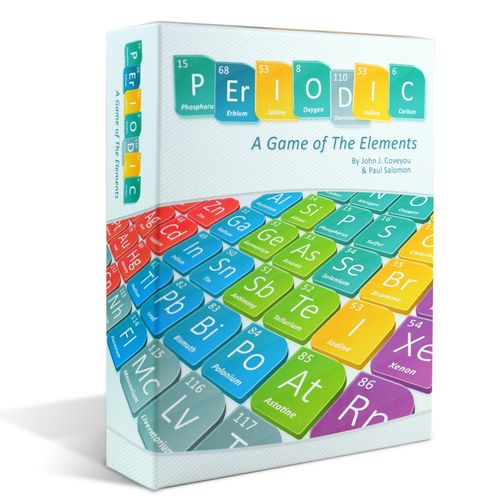
Periodic: A Game of The Elements
Periodic: A Game of The Elements Rulebook
Table of Contents
Table of Contents
Components
32 Goal Cards
- 9 green
- 9 blue
- 7 purple
- 7 pink
8 Element Group Cards
- 1 for each Element Group
12 Agenda Cards
11 Goal Markers
- 2 green
- 3 blue
- 3 purple
- 3 pink
28 Lab Tokens
- 12 3-point
- 10 5-point
- 6 15-point
Player Pieces
30 Research Cubes
- 6 pink, 6 orange, 6 green, 6 blue, 6 purple
5 Erlenmeyer Flasks
- 1 pink, 1 orange, 1 green, 1 blue, 1 purple
5 Microscopes (Element Group Markers)
- 1 pink, 1 orange, 1 green, 1 blue, 1 purple
5 Discs (Academic Track Markers)
- 1 pink, 1 orange, 1 green, 1 blue, 1 purple
12 Award Tiles
- 3 +3 Spaces
- 3 Free Trend
- 3 Move To
- 3 Take 2 Energy
24 Energy Tokens
1 Periodic Table Game Board
Game Setup
-
Place the game board face-up in the center of the play area.
-
Separate the Goal Cards by color, and place a stack of 6 (at random) green Goal Cards facedown above the board. Do the same with 6 blue, 5 purple and 5 pink Goal Cards. Flip the top card of each stack faceup.
-
Place the three "+3 Spaces" Award Tiles above the green Goal Cards, the "Take 2 Energy" Tiles above blue Goal cards, the "Free Trend" above the purple, and the "Move To" above the pink.
-
Place 1 green Goal Marker on each of the elements on the game board that match the elements shown on the faceup green Goal Card. Repeat this for the blue, purple and pink Goal Cards.
-
Place the Lab Tokens to the left of the Goal Cards.
-
Shuffle the Element Group Cards and place four of them faceup in a half circle along the left side of the board, and the remaining four faceup in a half circle along the right side of the board. These cards create a circular track, starting at the bottom-left of the game board.
-
Place 1 Energy Token on each of the Periodic Trend spots located at the bottom of the board.
-
Have each player choose a color and give them 1 Flask, 1 Microscope, 1 Disc, and 6 Research Cubes of that color.
-
The player who most recently touched calcium carbonate (chalk, seashells, etc) is the first player. Going clockwise, the first, second and third players should each place their Disc on the "0" level of the Academic Track (horizontal track below the periodic table). The fourth and fifth players should place their Discs on the "2" level.
-
Distribute Energy Tokens as follows: the first player gets 3, the second player gets 4, the third gets 5, THEN the fourth player gets 3 and fifth gets 4.
You are now ready to play!
Setup for a 3 Player Game
The rulebook includes a diagram of the 3-player setup: the game board in the center with a Periodic Table of Elements label, Element Group Cards arranged in a semi-circle on each side (Alkali Metals, Alkaline Earth Metals, Halogens, Metalloids on the left; Transition Metals, Noble Gases, Nonmetals, Post-Transition Metals on the right), the four Goal Card stacks (worth 6, 7, 8, and 10 points respectively for green, blue, purple, and pink) with their Award Tiles above them, and the three players' Flasks, Microscopes and Discs positioned per the setup steps above.
Gameplay
In Periodic, players compete to research elements and advance along the Academic Track by strategically activating periodic trends to move their Flask across the periodic table. On their turn, a player chooses between either spending energy to make multiple movements (in the hopes of researching multiple elements) or gaining energy but taking only a single movement.
Periodic is played in turns, starting with the first player and continuing clockwise around the table.
A turn consists of two main parts:
Activate Periodic Trend(s) a. Spend or Gain Energy Token(s) in order to Move Your Flask b. Research Elements
Refresh After Your Turn a. Refresh Completed Goal Cards b. Advance Markers on Tracks
1. Activate Periodic Trends
There are five spots at the bottom of the game board representing 5 periodic trends. The primary way a player moves their Flask across the periodic table (on the game board) is by activating one or more of these periodic trends.
After activating a periodic trend, a player moves their Flask from 1 to 5 spaces (the number of spaces is chosen by that player) across the periodic table from their starting position in the direction(s) allowed by the periodic trend they've activated. A player researches an element by ending their movement on an element containing a Goal Marker. Any number of players may occupy a single element.
a. Spend or Gain Energy Token(s) in order to Move Your Flask
There are two different ways a player can Activate a Trend in order to move their Flask: Spend Energy Tokens to activate multiple trends or Gain Energy Tokens but activate only one trend.
Spend Energy Token(s)
If a player chooses to "Spend", they pay Energy Tokens to activate multiple periodic trends. To activate the first periodic trend, a player places 1 Energy Token on the periodic trend they wish to activate. That player then moves their Flask across the periodic table 1 to 5 spaces in the direction indicated by the periodic trend they activated. For each additional trend a player wishes to activate, they pay 2 Energy Tokens onto their desired periodic trend.
Players may activate any number of periodic trends, and/or activate the same trend multiple times, so long as they have the Energy Tokens to pay for it.
Gain Energy Token(s)
If a player chooses to "Gain", they collect all the Energy Tokens accumulated on a single periodic trend.
Then, that player moves their Flask across the periodic table 1 to 5 spaces in the direction indicated by the periodic trend from which they collected the Energy Tokens. This is the only periodic trend a player may activate on this turn, unless they use an Award Tile(s).
If there are 0 Energy Tokens on the periodic trend a player wishes to activate, they may take 1 Energy Token from the player with the most Energy Tokens. If multiple players are tied for most, the active player chooses. (In a 2 player game, take the Energy Token from the box instead).
The Five Periodic Trends - Movement Directions
Increase or Decrease Atomic Number – allows a player to move their Flask EITHER left OR right according to the Atomic Number. This is the only trend that allows a player to jump from the far right edge of the periodic table to the far left edge (or vice versa) as long as they move according to the Atomic Number.
For example, if a player starts on Na (Sodium, Atomic No. 11) they may move to Ne (Neon, Atomic No. 10) by moving 1 space to the left. Activating this trend would allow a player to move from Na to any of the following elements: C, N, O, F, Ne, Mg, Al, Si, P, or S.
Increase Ionization Energy – allows a player to move their Flask up and/or right. This means a player may move up, right, or any combination of up and right.
For example, if a player starts on Na (Sodium, Atomic No. 11), they may move to N (Nitrogen, Atomic No. 7), by moving 4 spaces to the right (Mg to Al are adjacent for the purpose of movement) and 1 space up. Activating this trend would allow a player to move from Na to any of the following elements: H, He, Li, Be, B, C, N, Mg, Al, Si, P, or S.
Increase Atomic Radii – allows a player to move their Flask down and/or left. This means a player may move down, left, or any combination of down and left.
For example, if a player starts on S (Sulfur Atomic No. 16), they may move to Pb (Lead, Atomic No. 82) by moving 3 spaces down, and then 2 spaces to the left. Activating this trend would allow a player to move from S to any of the following elements: Na, Mg, Al, Si, P, Ca, Zn, Ga, Ge, As, Se, In, Sn, Sb, Te, Pb, Bi, Po, Mc, or Lv.
Increase Atomic Mass – allows a player to move their Flask down and/or right. This means a player may move down, right, or any combination of down and right.
For example, if a player starts on Be (Beryllium, Atomic No. 4), they may move to Ge (Germanium, Atomic No. 32) by moving 1 space to the right, 2 spaces down, then 1 space to the right. Activating this trend would allow a player to move from Be to any of the following elements: B, C, N, O, F, Mg, Al, Si, P, S, Ca, Sc, Ti, V, Ga, Ge, As, Sr, Y, Zr, In, Sn, Ba, Hf, Tl, or Ra.
Decrease Atomic Mass – allows a player to move their Flask up and/or left. This means a player may move up, left, or any combination of up and left.
For example, if a player starts on Al (Aluminium, Atomic No. 13) they may move to H (Hydrogen, Atomic No. 1) by moving 2 spaces to the left, then 2 spaces up. Activating this trend would allow a player to move from Al to any of the following elements: H, Li, Be, B, Na, or Mg.
Movement from Ba (Barium, Atomic No. 56) to Hf (Hafnium, Atomic No. 72) or from Ra (Radium, Atomic No. 88) to Rf (Rutherfordium, Atomic No. 104) is one space.
To move diagonally, a player must move two spaces (for example, up and then right). A player may not move diagonally in one move.
b. Research Elements
Each time a player activates a trend and moves their Flask, they may research an element by ending their movement on an element with a Goal Marker. This is the primary way that players score points.
In order to research an element, a player must activate a periodic trend that will allow them to end their movement on an element shown on a faceup Goal Card (which should be marked with a Goal Marker). A player may only research one element per movement, at the end of the movement. (They may move and research multiple times per turn, if they are Spending Energy to activate multiple trends.)
When a player finishes moving their Flask onto an element with a Goal Marker, they place one of their Research Cubes on the Goal Card showing that element. If more than one Goal Card shows the same element, the player must choose one to research (they could return to the element on a future turn). A player can research an element that already has another player's Research Cube, but a player can never research an element that already has their own Research Cube. If a player has run out of Research Cubes, they may not research again until a Goal Card is completed and their Cubes are returned.
2. Refresh After Your Turn
After a player completes their final movement, they should check to see if they need to Refresh Completed Goal Cards or Advance Markers on Tracks.
a. Refresh Completed Goals Cards
If a single player has Research Cubes on every element of a single Goal Card, then that Goal Card is complete. (It's possible for a player to complete multiple Goal Cards in a single turn.) For any completed Goal Card(s) do the following:
i. Completing the Goal: Take the Goal Card and Award
The player who completed the Goal Card will take the Goal Card itself (they worth points, as shown in the lower right corner) as well as the top Award Tile from the stack above that Goal Card (if any are available).
ii. Aiding in Research: Take Lab Tokens (Points)
Each other player who had one or more Research Cubes on the completed Goal Card takes back their Research Cubes and the following Lab Tokens:
- A player with 1 Research Cube on the completed Goal Card takes a 3 point Lab Token.
- A player with 2 Research Cubes on the completed Goal Card takes a 5 point Lab Token.
iii. Flip a New Goal Card
For each completed Goal Card, flip the next card in the stack faceup. Place a Goal Marker on each of the elements on the game board that match the elements shown on the new Goal Card. All other Goal Cards that were not completed that turn remain unchanged for the next player's turn.
b. Advance Markers on Tracks
i. Advancing On the Element Group Track
The periodic table is divided into groups of elements. These groups are represented in the game by Element Group Cards, which are arranged in a semi-circle along the sides of the game board, making the Element Group Track. Players track their progress by advancing their Microscope clockwise along this track from card to card.
When a player ends their turn with their Flask on any element that is part of the element group shown on their next Element Group Card, they will advance their Microscope clockwise along the track, to that next Element Group Card.
For example, if a player ends their last Flask movement on Arsenic (which is part of the group Metalloids), and the next card (going clockwise) on the Element Group Track is Metalloids, that player advances their Microscope to the Metalloids Element Group Card.
ii. Advancing On the Academic Track
The Academic Track is the horizontal track below the periodic table. Each time a player advances their Microscope to the next Element Group Card, they must also move their Disc one level to the right along the Academic Track. In this way, the Academic Track tallies the number of points each player will score at the end of the game from advancing along the Element Group Track.
The final (rightmost) level on the Academic Track may only contain one Disc, so only the first player to advance through all 8 Element Group Cards can reach it. The level directly to the left may only contain 2 Discs at any time, and the level to the left of that may only contain 3 Discs at any time. If a level contains the maximum number of Discs, opponents may not advance their Discs into that level.
Now the active player's turn is over and the player to their left may take their turn. The final round of the game is triggered if one stack of Goal Cards is depleted (see Ending the Game). Replenish empty stacks with Goal Cards from the box so there are always four available.
Award Tiles
Award Tiles are benefits given to players for completing Goal Cards (see Completing the Goal: Take the Goal Card and Award). A player may use any number of their Award Tiles during their turn (regardless of whether they Spend or Gain for their action), to take the one-time bonus ability specified on that Tile. Once an Award Tile has been used, place it back in the box.
+3 Spaces – Use this tile when activating a periodic trend to move your Flask an additional 1, 2, or 3 spaces (following the same direction rules of the trend activated).
Move To – Use this tile during your turn to move your Flask to any element within the Element Group shown on the back of the Award Tile.
Take 2 Energy – Use this tile at the beginning of your turn to take 2 Energy Tokens total from one or two periodic trends. This Award Tile does not allow you to activate the periodic trend from which the Energy was taken. After spending this tile, take your turn as usual, either Gaining or Spending.
Free Trend – Use this tile at any time during your turn, to activate the periodic trend indicated on the Award Tile for free.
Award Tile Movement: The "Move To" and "Free Trend" Award Tiles provide extra ways to move during your turn. These do not cost energy, do not count as normal activations, and allow you to Research the element you land on.
Goal Cards
The Goal Cards above the game board show the elements that are available to be researched. A Goal Marker is placed on the periodic table for each element shown on the Goal Cards, making the elements available to be researched more visible to all players.
Multiple players may research the same elements on a single Goal Card, but once a single player has researched all the elements on a Goal Card, that card is complete and players should follow the instructions in Refresh After Your Turn.
Agenda Cards
Each Agenda Card lists a unique combination of 1-2 possible objectives, that, if achieved, award additional bonus points to that player at the end of the game. A player does not need to complete both objectives, but may score points for either or both of the objectives listed on their Agenda Card.
Each Goal Card a player completes may count toward only 1 objective on their Agenda Card. Points from Agenda Cards are awarded during Final Scoring.
Objectives
+1 point for each level on the Academic Track above 0 Count the number of levels you advanced your Disc beyond 0 along the Academic Track and gain 1 point for each level.
+1 point for every Goal Card you complete Count the number of Goal Cards you completed and gain 1 point for each.
+2 points for every blue (or purple, or pink) Goal Card you complete (rules are the same for Agenda Cards referring to blue, purple, or pink Goal Cards) Count the number of the specified Goal Cards you completed, and gain 2 points for each.
+5 points for each pair of blue + purple Goal Cards you complete (rules are the same for Agenda Cards referring to blue + pink or purple + pink Goal Cards) Count the number of pairs of the specified Goal Cards you completed, and gain 5 points for each pair.
+9 points for each set of three Goal Cards of different colors you complete Count the number of sets of 3 Goal Cards you completed (each set of 3 must have no more than 1 card from each color) and gain 9 points for each set.
Score a number of points equal to 3X the lowest of these:
- Each level on the Academic Track above 0, or
- Total Goal Cards you complete
Count the number of levels you advanced your Disc along the Academic Track, then, count the number of Goal Cards you completed. Take the lower number of the two, multiply it by 3, and gain that number of points.
Ending the Game
The final round of the game is triggered when one of the following conditions is met:
- One stack of Goal Cards is depleted.
- Two players advance to the two rightmost (23 and 28) levels on the Academic Track.
When one of these conditions is satisfied, each player (excluding the player who triggered end game) takes one final turn. Then, move to Final Scoring.
If the final round is triggered by a depleted Goal Card stack
During Refresh After Your Turn, replenish any depleted Goal Card stack(s) with additional Goal Cards (of the correct color) from the box so there are always four Goal Cards available.
Final Scoring
To determine their final score, each player should add up any points earned throughout the game.
- Points from Goal Cards and Lab Tokens
- Points from the Academic Track
- Points from Research Cubes on incomplete Goal Cards Each player with a Research Cube(s) remaining on any incomplete Goal Card(s) is awarded Lab Tokens as if the Goal Card was completed.
- Points from Agenda Cards.
The player with the most points wins!
If there is a tie, then the tied player at the right-most level on the Academic Track wins the tie. If players are still tied, then the tied player with the most Energy Tokens wins the tie.