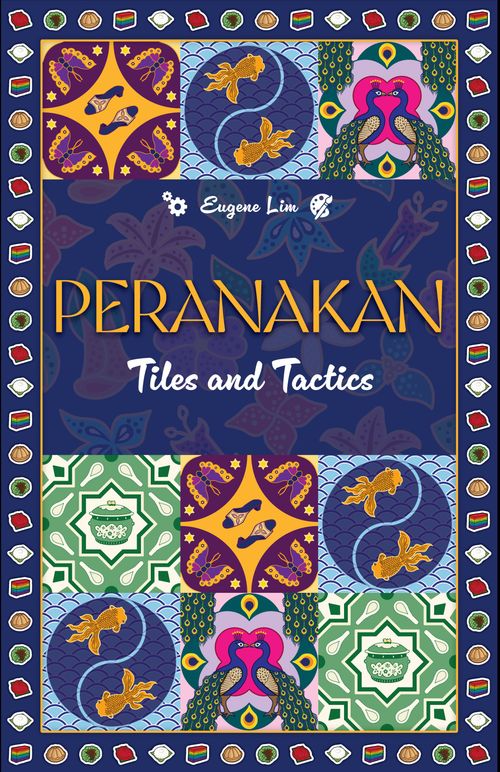
Peranakan: Tiles and Tactics
Peranakan: Tiles and Tactics Rulebook
Table of Contents
Table of Contents
Game Objective
The player who collects the most sets of Kueh wins!
1 set of Kueh = 1 Kueh of each of the 4 types (shown in the rulebook as one of each Kueh icon: +1 +1 +1 +1).
Components
- 1 Game Board (Neoprene Mat)
- 40 Tiles (4 patterns, 10 of each pattern): Ceramics Tile, Butterfly Tile, Goldfish Tile, Peacock Tile
- 20 Nyonyas (5 colours, 4 of each colour)
- 15 Babas (5 colours, 3 of each colour)
- 88 Kueh (4 types, 22 of each type)
Setup
A. Roll out the Game Board in a central location.
B. Shuffle all 40 Tiles and place them in a single deck, face-up.
C. Place the top 4 Tiles from the deck onto the 4 spaces next to it.
D. Place all Kueh onto their respective spaces, as indicated on the Game Board.
E. Give each player Nyonyas and Babas based on player count:
- 2 players: 4 Nyonyas and 3 Babas.
- 3 players: 3 Nyonyas and 2 Babas.
- 4 players: 2 Nyonyas and 2 Babas.
- 5 players: 2 Nyonyas and 1 Baba.
(Illustrative setup for 3 players.)
How to Play
Players take turns to play, in clockwise order. The player who most recently ate Kueh starts first. If none of the players have eaten Kueh before, then the person reading this rulebook starts first (but promise me you'll try some Kueh right after this game!).
1. Choose 1 Tile and Collect 1 Kueh
Choose 1 of the 5 face-up Tiles (either the top tile of the deck or 1 of the 4 tiles next to it) and take 1 Kueh from the supply that is directly next to the tile you chose. If you chose the tile on the final spot, furthest away from the deck, take any 1 Kueh of your choice (represented by the rainbow "wild" Kueh icon).
Example: If you choose the Goldfish Tile, collect 1 of the Kueh next to it. If you choose this Peacock Tile (on the final spot), collect any 1 Kueh.
2. Place Tile on the Game Board
Place your chosen Tile on any empty space, or a space with at most 1 existing tile (see "Stacking").
3. [Optional] Place Nyonya or Baba
You MAY also place 1 Nyonya or 1 Baba on the Tile you just added to the Game Board. Nyonyas and Babas help you collect Kueh (you also collect 1 Kueh every turn in Step 1).
4. [Situational] Collect Kueh
Check if any Nyonyas or Babas are due to collect Kueh. The current active player collects their Kueh first, followed by the next player in clockwise order, and so on.
5. Replenish Peranakan Tiles
Slide all remaining tiles down to fill any empty slot(s), then replenish with a new tile from the top of the Deck.
Nyonya
Each Nyonya collects her Kueh when both the horizontal and vertical lines she is standing on are totally filled with other Tiles. From those two lines, look at all Tiles with the same Pattern (Goldfish, Peacock, Ceramics, or Butterfly) as the Nyonya's Tile. That Nyonya collects ALL Kueh shown on those Tiles.
Example: Green places this Ceramics Tile and adds a Nyonya onto it. Since her two lines are not totally filled with tiles, this Green Nyonya stays there until the two remaining spots have tiles, before collecting her Kueh.
Example: Pink places this Butterfly Tile and adds a Nyonya onto it. Since the horizontal and vertical lines are completely filled with tiles, this Pink Nyonya immediately collects her Kueh.
"Wild" - take any 1 Kueh.
Baba
Each Baba collects his Kueh when the tile he is standing on is totally surrounded by other tiles. Look at all surrounding Tiles with the same Pattern as the Baba's Tile. That Baba collects ALL Kueh shown on those Tiles.
Example: Yellow places this Peacock Tile and adds a Baba onto it. Since this Yellow Baba is not fully surrounded by Tiles, he stays there until the 3 remaining spots have tiles, before collecting his Kueh.
Example: Pink places this Goldfish Tile and adds their Baba onto it. Since this Pink Baba is totally surrounded by Tiles, he immediately collects his Kueh.
After a Nyonya or Baba collects their Kueh, they are removed from the game. All tiles remain on the board, and any subsequent Nyonyas or Babas may still collect Kueh from those tiles.
If a Nyonya or Baba is supposed to collect Kueh but there are no more of those Kueh in the supply, they do not get to collect those Kueh.
Stacking
When placing a Tile onto the Game Board in Step 2, players may stack that Tile on top of an existing Tile to override it entirely.
(The printed rulebook says "Step 3" here; tile placement is Step 2.)
Each Tile may only be stacked ONCE. After a Tile has been stacked, players may no longer place Tiles on that space.
Any Nyonyas or Babas standing on the existing Tile will now stand on the stacked Tile. They will collect Kueh with reference to the stacked Tile's Pattern. A player may stack any Tile, no matter who placed the existing Tile, or whose Nyonya or Baba was standing on it.
As a result of stacking, a single space may have up to 2 Nyonyas and/or Babas standing on it. Both Nyonyas and/or Babas will collect their Kuehs fully, according to Step 4.
Endgame
There are 3 ways the game may end:
- There are no more Tiles in the deck. (Do not play the final 4 Tiles next to the deck once it's empty.)
- There are no more Kueh in all 4 Kueh supplies.
- All players' Nyonyas and Babas have collected their Kueh.
Whichever of these 3 happen first, that triggers the end of the game.
The Game Board being totally filled with Tiles DOES NOT end the game. Players can still stack Tiles.
At the end of the game, the player with the most sets of Kueh wins! 1 set of Kueh = 1 Kueh of each of the 4 types.
Tiebreaker
In the event of a tie (i.e. multiple players have the same number of sets of Kueh), the player with more Kueh wins the game. If there still is a tie, all tied players share the victory.
Peranakan Culture
With the root word anak (child), Peranakan is an adjective meaning "born of". The term suggests someone who is locally born but carries heritage from somewhere else -- a beautiful fusion of cultures.
In Peranakan Chinese communities, "Nyonya" refers to the women and "Baba" to the men.
Kueh shown in the game: Rainbow Lapis, Tutu Kueh, Ondeh Ondeh, Kueh Bahulu, Ang Ku Kueh.
Peranakan Tiles
- Peacock Tile - "Love": The peacock is a symbol of beauty, status, elegance and pride in Peranakan culture.
- Ceramics Tile - "Home": Peranakan ceramics are celebrated for their vibrant, intricate designs, often used in household items like bowls, plates, and vases.
- Butterfly Tile - "Beauty": This tile celebrates the exquisite craftsmanship of Peranakan kasut manek (beaded slippers).
- Goldfish Tile - "Abundance": Goldfish are a symbol of prosperity, abundance, and good fortune in Peranakan culture.