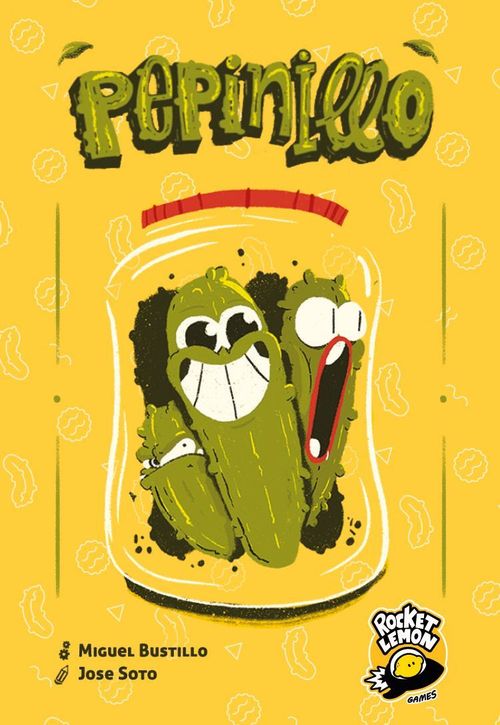
Pepinillo
Pepinillo Rulebook
Table of Contents
Table of Contents
Components
18 cards (15 pickle cards and 3 category cards).
Object of the Game
The participants create a fluid chain of syllables that follow one another without stopping. If someone makes a mistake, they are penalized. The player with the fewest pickles at the end of the game is the winner.
Setup
Select one of the 8 game modes. Place face up in the centre of the table the three special pickle cards that determine the game mode, and form a face-down deck with the 12 remaining pickle cards. Finally, choose one of the category cards (Food, Objects, Places, Living Beings, Hobbies or Multi-theme) and leave it face up on the table.
Game Modes (3 special pickle cards)
- Pickle in salad (healthy starter for the first games): Cards 1, 6 and 11
- Fried pickle (snack for casual games): Cards 2, 7 and 12
- Pickle in vinegar (tasty pickles to enjoy): Cards 5, 8 and 13
- Spicy pickle (for crazy games and large groups): Cards 1, 8 and 14
- Pickle skewer with anchovy (tapa for large groups): Cards 2, 6 and 8
- Pickle skewer with pepper (another tapa for large groups): Cards 1, 7 and 9
- Sweet and sour pickle (ideal for expert players): Cards 4, 8 and 9
- Stuffed pickle (perfect to share between 2 players): Cards 3, 5 and 10
For games with the youngest children you can play with only the first two special cards of each mode. You can also create your own modes by combining 3 or more special cards to your liking!
Round Play
The player who likes pickles least starts. In following rounds, the player who lost the previous round starts.
Each game is played with one of the category cards. Before starting each round, the starting player must choose the word to be played with. It may be the same as in the previous round or a new one, but always from the same category. To do so, they may consult the selected category card, which contains 4-syllable words belonging to the same group. For example, in the FOOD category there are words such as "Pepinillo", "Berenjena", "Espinaca", "Remolacha"...
In the first games it is recommended to play without the category card, that is, without changing the word and using the word "Pepinillo" in every round.
When the round begins, the player must say the first syllable of the word chosen for that round, in the case of "Pepinillo", "pe-".
Next, clockwise, it is the turn of the next player, who continues the word with the syllable "pi-". Then it is another player's turn ("ni-") and so on. Once the word is complete, the next player starts the word again ("pe-").
Special Pickle Cards
Once the word has been said completely one time (never before!), the players may introduce the effects of the special cards. In each game, 3 special cards are selected which can be activated with specific gestures. On their turn, the player decides whether to activate one (only one) of the special cards, but it is not mandatory to do so.
These cards have different effects, explained at the end of this rulebook: changing the direction of the syllable chain, repeating a syllable, skipping a player... When a player decides to activate a special card, they must make the gesture at the same time as they say the syllable that corresponds to them, and the effect of the special card applies to the next player.
End of Round and Game
The round ends when a player makes a mistake: hesitates, takes too long to say the syllable, says an incorrect syllable, activates an action card before the word has been said completely once, performs the effect of a special card when it does not apply... If a player makes a mistake but nobody notices the error, the round continues.
The participants choose one of 2 possible ways of scoring:
- By number of pickles: The player who made the mistake draws a card from the pickle deck and keeps it as a penalty. The game ends when 12 rounds have been played. At the end of the game, the players turn over their penalty cards and count the pickles they have accumulated (shown at the top left of the card). The player with the fewest pickles is the winner. In case of a tie, the victory is shared.
- Elimination (recommended for large groups): When a player makes a mistake they are eliminated from the game. The last player remaining in the game is the winner.
Example of a Round
Pickle in salad mode. Start of round: WHOLE WORD, then the syllables:
PE PI NI LLO | PE PE PE PO NI LLO LLO PO
Pickle skewer with anchovy mode. Start of round: WHOLE WORD, then the syllables:
PE PI NI LLO | PE PO PE PI I LLO PE PE
Effects of the Special Pickle Cards
- The next player has to repeat what was said by the player who made the gesture.
- The next player restarts the chain with the first syllable of the word.
- The next player has to say any syllable of the word except the one they would have to say.
- The next player has to say the previous syllable instead of the next one. For example, with the word "pepinillo", if a player made the gesture on the syllable "pe-", the next would have to say "llo" instead of "pi-".
- The next player says their syllable with the vowel A. For example, "pa-" instead of "pe-".
- The next player says their syllable with the vowel O. For example, "po-" instead of "pe-".
- The next player says their syllable with the vowel U. For example, "pu-" instead of "pe-".
- The next player says only the vowel of their syllable. For example, "e-" instead of "pe-".
- The next player says their syllable in a high-pitched (shrill) tone.
- The next player says their syllable whispering.
- Change of direction.
- The next player is skipped.
- The next player is whoever is pointed at.
- The next player has to get up from the chair and remain standing while the game continues. This participant will only sit down again if the preceding player later claps again. This gesture will sometimes mean standing up and other times sitting down.
- This card is blank so you can invent your own rules!