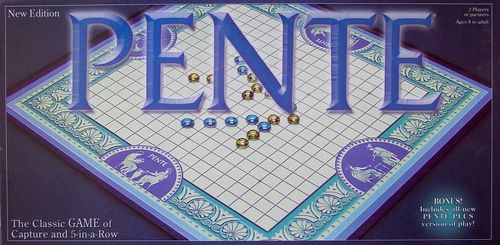
Pente
Pente Rulebook
Table of Contents
Table of Contents
- Equipment
- Object of the Game
- A Brief Description of Gameplay
- Etiquette
- Basic Rules for Two Players
- Five in a Row
- Advanced Variations for Two Players
- Rules for Three or More Players
- Basic Rules for Four Players
- Points Pente® for Two Players
- Team Pente® for Four Players
- Points Pente® for Three or Four Players
- Questions and Answers
Equipment
Roll-up vinyl PENTE® board, four bags of PENTE® stones (one color per player), four drawstring stone storage bags, storage tube and rules.
Object of the Game
There are two ways to win PENTE®. Win by getting five (or more) stones in a row, either horizontally, vertically, or diagonally, with no empty points in between. Or, win by capturing five (or more) pairs of your opponents' stones.
A Brief Description of Gameplay
Choose from the basic or advance variations of PENTE®. Start with the board completely clear of stones. The first player (chosen by chance) begins the game by playing one stone on the center point. Thereafter players take turns playing their stones, one at a time, on any empty intersection. The stones are played on the intersections of the lines (including the edge of the board), rather than in the squares. A move is completed when the stone is released. Once played, a stone cannot be moved again, except when removed by a capture. The players take turns adding new stones to the board, building up their positions, until one player wins.
Etiquette
It is a customary, but not mandatory, refinement of this game to announce "three" or "tria" when moving to make an open three; also to call "four" or "tessera" when making four-in-a-row. This is so that your opponent will not forget to stop the formation of an open four or five. The idea is not to win because of your opponent's blunder or oversight, but to win in spite of his or her seeing every threat. Pointing out your opponent's errant move also demonstrates your own confidence and mastery of play.
Basic Rules for Two Players
Captures
Whenever your opponent has two stones (and only two), which are adjacent, those stones are vulnerable to capture. The pair can be captured by bracketing its two ends with your own stones. Example: Green plays on this point indicated by the arrow, bracketing Blue's pair of stones. The pair is thus captured and removed from the board, leaving the final position as shown (a "before" and "after" diagram illustrates the capture).
Captures can be made along diagonal as well as horizontal and vertical lines. All four stones involved must be consecutive and in a straight line. As soon as the capturing play is made, the captured stones are removed from the grid and placed in view along the border so that both players can see how many stones have been taken.
Moving Into A Captured Position
A stone may legally be played onto any empty intersection, even if that point has been previously occupied, and even if it forms a pair between two enemy stones. Thus, Blue's move in the diagram above is safe and no stones are removed from the board.
Multiple Captures
It is legal to capture two or more pairs with a single move. Example: Green's move brackets and captures two separate pairs of Blue's stones.
Five in a Row
The five-in-a-row must be consecutive and in a straight line to win, as shown. It may run in any direction—horizontally, vertically, or diagonally. It need not be exactly five—six or more stones in a row win as well.
Playing Hint: If you obtain the advantage of having an unblocked four-in-a-row, called "tessera", you have practically won the game. Whichever end your opponent blocks you can play on the other end and achieve the winning five-in-a-row.
Therefore, if your opponent has an open three, as shown, one end of the three would be blocked immediately to prevent the formation of the deadly tessera.
This axiom, that you must block an open three, applies unless you have a better move (see left)—like a move to make four, or a good capture on this move or the next that will remove stones from the row or pose a superior threat. Even if the three stones are not adjacent, they must still be blocked to stop the win. The three white circles in the diagram below are all possible blocking moves.
Advanced Variations for Two Players
The game of PENTE® is readily adaptable to a wide range of tastes. After you've become comfortable with basic PENTE®, try one of the intriguing game modifications listed here.
Tournament Rule
As players increase their skill, the advantage of moving first in basic PENTE® becomes more and more significant. Therefore, the following modification has been introduced for use in tournaments or other serious games: The first player's second move must be at least three spaces from the center point. This neutralizes the advantage of the first player by imposing a slight positional constraint upon him or her. A square can be drawn between the four inner "stars" on the board. The first player's second move must be on or outside the perimeter of this square. No other restrictions are imposed on either player.
Rules for Three or More Players
Mixed Captures
Since many multi-player variations use stones of more than two colors, a new type of capture is possible: to capture a pair of stones of two different colors. The bracketing stones must be of one color. In the diagram, Green captures a Blue and Amber stone.
Basic Rules for Four Players
You can play Partners with two teams of two players. Players alternate turns, using the same rules as in Basic Two-Player PENTE®.
Points Pente® for Two Players
This variation introduces a certain element of "risk" into the game and provides a new way of keeping score, which more accurately determines the relative strengths of the players. The rules and strategy of POINTS are the same for basic PENTE®.
Although each game is still won by getting five-in-a-row or five captures, an additional objective is to win by as many points as possible. The first player to score a designated number of points (usually 21 to 50), over a series of games, wins the match.
Scoring Points: When the game is over, points are counted and scored as follows.
- The player, if any, who got five-in-a-row receives 5 points as a bonus.
- Each player receives 1 point for each capture he or she made.
- Each player receives 1 point for each four-in-a-row he or she has still remaining on the board. Four-in-a-row is 4 stones, consecutively and in a straight line. Any that were wiped out during the game do not count.
Playing with points introduces new strategies into the game by challenging both players to take calculated risks in order to gain as many points as possible. For instance, if one player accumulates an overwhelming advantage, such as an unblocked four, he or she may prefer to delay making the winning move for a while in an attempt to gain even more points.
Handicaps: Playing Points allows for an easy handicapping. For example, in a match to 21, a veteran player may give an intermediate player an edge of 5 or 10 points—thus evening the contest.
Team Pente® for Four Players
Stones: One color per player (four colors in all).
Object of the Game: One Team wins when:
- One player gets five (or more) of his or her own stones in a row, just as in basic-two player Pente®, or
- The team captures 10 (or more) stones from their opponents.
How to Play: The players split up into two teams, with team members sitting opposite each other. The first player moves onto the center point. Thereafter the players take turns, in a clockwise direction, placing their stones as in basic Pente®. Each player controls different colored stones and cooperates with his or her partner for a team win. During the game it is not legal to discuss specific strategy with your partner.
Captures: Normal captures and mixed captures are allowed. It is legal to capture your partner's stones. However, only those stones taken from your opponents count toward the winning total. You may not capture your own stones.
Points Pente® for Three or Four Players
When not playing a team game, each extra player makes it more and more difficult for an individual player to get five-in-a-row, since there are more players to block each threat. Therefore, this variation requires only four-in-a-row to win, giving each player a better chance of success and keeping the games fast-paced.
Stones: One color per player (three or four colors in all).
Object of the Game: To win the match by being the first player to score a designated number of points (usually 21) over a series of games. A game ends when a player makes four-in-a-row or 4 captures.
Captures: Normal captures and mixed captures are allowed.
How to Play: The first player moves onto the center point. Thereafter the players take turns, in a clockwise direction, placing their stones as in basic Pente®.
Scoring: When the game is over, the points are counted and scored as follows:
- The player, if any, who gets four-in-a-row receives 10 points as a bonus.
- Each player receives 1 point for each capture he or she made.
- Each player receives 1 point for each three-in-a-row (tria) he or she still has remaining on the board.
The strategy in this variation is different from basic Pente® in that players can put too many winning threats on the board at one time. Here, unlike basic Pente®, playing too aggressively can backfire and throw the game open to end suddenly and with unexpected results.
Questions and Answers
Does six-in-a-row also win? Yes, six or more stones in a row wins the game as well as five.
Can a stone be played on the edge of the board? Yes, you may play on the very edge of the grid; and also inside the four hemispheres, each of which covers three "invisible" intersections that can be used.
Can I break up a five-in-a-row by capturing one of its stones? No, when a player gets five-in-a-row, he or she wins immediately. It does not matter if the opponent can "capture across" for the winning five-in-a-row, even if that would be his or her fifth capture.
What happens if I form a pair between two enemy stones: Are they captured? No, you cannot "capture yourself" by moving into a captured position. Instead, the pair remains on the board.
After making a capturing move, do I have the option of leaving the captured stones on the board? No. Captured stones must be removed. However, if all players overlook that a move is a capture only to realize it later in the game, the "captured" stones remain on the board.
What happens if the position gets disrupted? Move carefully! The player who drops the pieces and disturbs the board automatically loses!
Who moves first? The first player has a slight advantage. Therefore some method of chance should be used to decide who plays first in the first game. In following games, the loser of the last game moves first. The advantage of the first move can be eliminated by using the Tournament Rule (See Advanced Variations for Two Players).