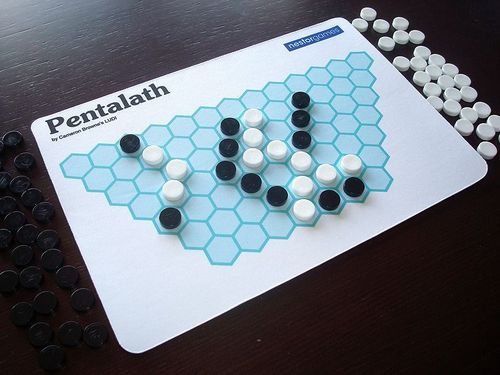
Pentalath
Pentalath Rulebook
Table of Contents
Equipment
The board is a trapezium tiled by hexagons. There are seven cells on the short sides, giving a total of 70 cells. Each player, White and Black, has 40 discs of their colour.
Objective
To make a line of 5 pieces of your colour (or more).
Play
The board starts empty. White plays first.
Players take turns placing a piece of their colour on an empty cell.
Passing is not allowed.
Capture
After each move, enemy pieces with no freedom are captured and removed from the board. A piece has freedom if the group it belongs to touches an empty cell.
For example, the black group in the diagram has one freedom marked f. If White plays there with move 1, then the black group has no remaining freedoms and is captured.
No suicide: It is not allowed to place a piece in a space without freedom, unless that move captures enemy pieces to create freedom.
Move 1 in the diagram shows an example of a move capturing enemy pieces to create its own freedom. The white piece 1 is totally surrounded when played, but it captures the black group to clear space around it as part of the move.
Notes
There is no ko rule (a special rule required in Go to avoid repetitions) as the hexagonal grid avoids ko cycles. This is because there are no diagonals on the hexagonal grid.
It is more difficult to capture pieces than in Go, as each cell has six potential escape routes rather than four. However, the "no pass" rule means that freedoms will eventually fill up and captures will inevitably occur. The "no suicide" rule stops players burning unwanted moves, to guarantee that this happens.
The trapezoidal board shape means that there are two types of corners: obtuse and acute. Each has its own tactical plays.
Strategy
The main strategy is to isolate enemy groups that are blocking you, in order to remove the blockage.
The 5-in-a-row objective means that ladders require special care. Consider the example in the diagram, with Black to play (left).
In order to save this group, Black must play the ladder shown with moves 1 to 5 (middle). If White is careless and makes the obvious move a, then Black can play b next turn to make a line of 5. White must play b, allowing Black to escape with move 7, and the game continues (right).
Pentalath is a connection game at heart; it is all about connecting your smaller groups to create larger safe groups. Any unsafe groups that the opponent can isolate can be captured to unblock space under their control.
Make moves that achieve multiple purposes where possible. For example, a move that extends a line (or threatens to) while capturing an enemy group (or threatening to) will probably be a good move.
Three Players
Pentalath can be played with three colours using the same rules. The example in the diagram shows a black group with a single freedom that can be captured by white or red. An expansion kit of 30 red pieces is available.
History
Pentalath was invented in 2007 by a computer programme called Ludi. Of the 19 games that Ludi invented, this was the game most preferred by both Ludi and human testers. It was originally called Ndengrod but was renamed to Pentalath, to highlight its relationship to sister game Yavalath (also available from nestorgames).