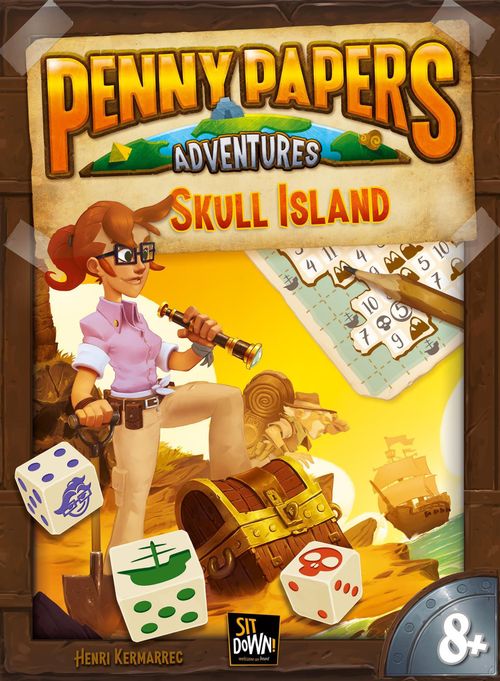
Penny Papers Adventures: Skull Island
Penny Papers Adventures: Skull Island Rulebook
Table of Contents
Table of Contents
Concept of the Penny Papers Adventures Series
Equipped with a pencil (not included) and an Adventure sheet, all players use the same result from a die roll to explore a location more thoroughly than the other contestants. Each player attempts to place the numbers in their grid the best, and to make wise use of special powers to score the most stars. Everyone plays at the same time!
Setup
Materials included: 3 dice and 100 two-sided Adventure sheets (the back offers a different island).
Each player grabs a pencil and an Adventure sheet (everyone uses the same side), on which they jot their initials in the upper-left corner. Place the three dice in the middle of the play area, so everyone can see them.
Gameplay
Someone (it doesn't matter who) rolls all three dice.
If no special face is rolled, each player must use the numbers indicated by the dice to write a number in any single empty island space of their grid adjacent to a number or a boat. If there are no empty island spaces adjacent to a number or boat, write the number in any empty island space of your choice. Exception: The first space you fill this way will instead be any island space adjacent to the sea: This is where Penny Papers lands. NOTE: You are not allowed to write a number on a mountain or in the sea.
The number you write can be the number from just one of the dice, or the sum of any two of the dice, or the sum of all three – your choice!
After everyone has filled a space in their grid (and maybe found a treasure; see below), roll the dice again to start the next turn.
Example
The dice rolled 2, 3, and 5. Each player can choose any one of the following numbers to write in their grid: 2, 3, 5, 7 (2+5), 8 (3+5), or 10 (2+3+5).
Finding Treasures to Score Stars
To find a treasure, you must reveal its location on the map by placing numbers just right.
You can pinpoint a treasure's location by finding four numbers of the same value (see the worked example below), with one pair in the same column, and the other pair in the same row. The intersection of the line between the horizontal pair and the line between the vertical pair reveals the location of the treasure. Draw a circle in the space with the treasure. It doesn't matter whether it is empty, or contains a number, a mountain, or a Danger symbol; however, you cannot find any treasures in the water. NOTE: If it is a danger and is not overcome by the end of the game, that treasure will be worthless (see below)!
Next, write the number you used to discover the treasure in one of the treasure spaces at the bottom of your sheet; this number is also how many stars the treasure is worth (e.g. four 7s reveal a treasure worth 7 stars).
NOTE: There can only be one treasure in each space, and each treasure you discover must use a different number.
Special Faces
Navigation (Dakota Smith's ability) — When this symbol is rolled, each player may choose to draw a boat in any empty sea space, instead of writing a number in an island space of their grid.
Penny Papers — When this symbol is rolled, each player writes a number of their choice from 1 to 15 in their grid. If the Navigation symbol was also rolled on another die, each player must choose which symbol to use.
Danger — When this symbol is rolled, ignore both of the other dice! Everyone does the following: Put your sheet in the middle of the table, take another sheet at random, then draw a skull on this sheet in any empty island space of your choice (it does not need to be adjacent to anything else) and mark one of the five little bubbles to the right of the grid; finally, return the sheet to its owner (look at the initials in the upper-left corner of the sheet).
After all 5 bubbles have been marked, ignore any further Danger symbols that are rolled.
Dangers
This symbol represents the deadly dangers and traps of which Penny Papers & Dakota Smith must be wary during their expedition.
Drawing a skull in an opponent's grid not only makes the space unusable, but it also makes them lose a number of stars at the end of the game equal to the smallest adjacent number. Furthermore, it nullifies any treasure that would be found in that space. Unless…
Our heroes can overcome these dangers! To do so, simply write the number 9 (according to the normal rules) in a space adjacent to a danger. Then you can cross out the danger, and it will earn you a number of stars at the end of the game equal to the smallest adjacent number.
You are welcome to write a 9 before you need it to "protect" certain spaces. Even if you place a 9 adjacent to a danger, you are not required to cross it out immediately; by waiting, you could trick your opponents into placing future dangers poorly, but you might trick yourself, too! Finally, the same 9 can overcome several dangers.
Boats
This symbol represents Dakota Smith, who gives Penny directions along the coast of the island.
A boat can stand in for a missing number when finding a treasure. In fact, the same boat can help you find multiple treasures (of different values, of course); however, you can use no more than two boats at a time to find a treasure: One to replace a number in a vertical pair, and one to replace a number in a horizontal pair.
End of the Game & Counting Your Stars
The game ends when someone has found their fifth treasure, or when someone has filled every island space.
Finish the round in progress. Then, each player counts their stars in the following fashion, writing their subtotals in the spaces provided at the bottom and right of their Adventure sheet:
- Each treasure's star value is the same as the number used to find it.
- Each danger overcome (crossed out) earns stars equal to the smallest adjacent number; each danger not overcome (not crossed out) loses you stars equal to the smallest adjacent number.
The player who has scored the most stars wins the game.
In a tie, the tied player who found the single most valuable treasure wins. If there is still a tie, the tied players share the victory.
Clarifications
Adjacent — In this game, "adjacent" always means orthogonally or diagonally adjacent (i.e. in one of the 8 surrounding spaces).
Strikethroughs & Scribbles — You are not allowed to strike through or erase a space of your grid: Everything you write is permanent, so think carefully before making your marks! However, if someone notices a violation of the rules, you may use a proper strikethrough to correct the mistake.
Where Do I Write What? — Numbers and Danger symbols must always be written in empty island spaces (devoid of numbers, Danger symbols, and mountains); only boats can be drawn in the water, and only there.
Worked Example
Treasures. Henri has successfully found a treasure using four 4s (indicated in green). At the intersection between these four numbers, he draws a circle in the space (which in this case is a mountain). Because he has found the 4-star treasure, he writes a 4 in a treasure chest at the bottom of his sheet. He will not be allowed to find another 4-star treasure, but he will earn 4 stars at the end of the game for this treasure.
Later, he finds the 1-star treasure (orange), using a boat to stand in for the fourth number. He circles the space (which in this case is empty, so he could still write in it later), and he writes a 1 in a treasure chest at the bottom of his sheet.
Using a boat to stand in for the fourth number, he finds the 9-star treasure (purple). He writes the 9 at the bottom of his sheet.
Using two boats, he is able to find the 7-star treasure (pink).
Finally, using one of those two boats again, he discovers the 10-star treasure (blue), ending the game. Unfortunately, there is a danger in the 10-star treasure's space. Fortunately, there is already an adjacent 9, so the danger is overcome (crossed out); therefore, he will earn the stars for this treasure after all.
Dangers. Three dangers appeared during this game, so Henri marked three skulls at the right of his sheet.
He did not overcome the first danger in the upper-left portion of the island, so he loses stars equal to the smallest adjacent number. Thus, he writes −1 in the first skull space.
He overcame the second danger near the middle of the island, because it is adjacent to a 9, so he gains stars equal to the smallest adjacent number. He writes +4 in the second skull space.
He failed to overcome the third danger, and unfortunately the smallest adjacent number is 7. He writes −7 in the third skull space.
Henri totals the values of the treasures he discovered (4+1+9+7+10=31 stars) and the stars gained and lost from dangers (−1+4−7=−4 stars). He finishes the game with 27 stars.
Solo Adventure
Play alone and try to achieve the highest score to determine your adventurer level!
The solitaire mode of Penny Papers Adventures: Skull Island follows all the normal rules of the game, with one exception: When a danger is rolled, you must place it on an island space adjacent to the space you filled in the previous turn. If this is not possible, you can place the danger in an empty island space of your choice.
Once your game has ended, evaluate your success level according to how high your score was, as follows:
- Tourist — 0 to 59 stars
- Pathfinder — 60 to 74 stars
- Voyager — 75 to 89 stars
- Explorer — 90 stars or more