Penguin Panic: The Great Icescape
Penguin Panic: The Great Icescape Rulebook
Table of Contents
Table of Contents
Components
- 5 Fish tokens: 1 each of 5 player colors, used to keep track of how many fish each player has.
- 50 Penguins in 5 different colors (there is no relationship between player colors and penguin colors)
- 1 Cloth case
- 1 Game Board with 5 circles, a fish track, and special ability track.
- 4 regular 6-sided dice: "Influence" dice they are called.
- 5 Turn Order Markers: 1 for each of the 5 player colors (round disks)
- 5 Bribery Markers: 1 for each of the 5 player colors (round disks)
- 1 rulebook
The Game Board
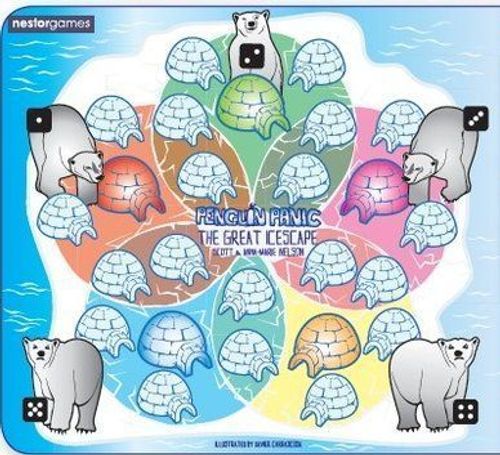
The game board depicts the prison yard, the fish track (0–10), and the 7-space turn order/special ability track. Each of the 5 polar bear guards is stationed next to a circle which they are in charge of watching. Inside each circle are seven igloos where a penguin may be placed when it enters the yard. Each igloo may only ever hold one penguin. The center igloo of each circle is colored to signify it has a special effect, which will be explained in greater detail later in these rules.
Setup
- Place the board in the center of the table, in reach of all players.
- Give each player 1 turn order marker, 1 bribery marker, and a fish marker of the same color. (In a two-player game, each player will also use a second bribery marker of another color.)
- Each player gains 5 fish, indicated by stacking each player's fish marker of their chosen color on the 5 space of the fish track.
- Have each player place their turn order marker in the cloth case, and randomly draw each of the turn order markers from the case and place them in the order drawn on the turn order track.
- Put all the penguins into the cloth case.
- Randomly draw one penguin and place it on each of the 5 central spaces and the color igloo spaces on the board, placing a total of 10 for the initial seeding of the game board. This initial seeding is performed only once, at this point in setup, during the entire game; see Figure 1.
Figure 1 – Placement of penguins during the initial seeding of the setup. This seeding only happens in the setup, and only once in the entire game.
The Dice
The influence dice have the numbers 1–6 on them. These numbers correspond to one of the five circles on the board, plus a six which corresponds to no circle, except through a special ability.
Winning Condition
The game ends immediately when there are not enough penguins to fill the line in round setup, at which time the collection of freed penguins will be scored. They are grouped into multicolor groups, and the larger the group, the better:
| Penguin groups | 1 | 2 | 3 | 4 | 5 |
|---|---|---|---|---|---|
| Different colors | 1 | 2 | 3 | 4 | 5 |
| Points | 1 | 3 | 6 | 10 | 15 |
The printed table shows a picture of a penguin group for each column, one penguin of each color in the group. The rows above give the number of different colors and the points for each group.
Game Play
Each round is played in phases.
- Prepare the penguins to be placed in the prison yard.
- Bribe the guards.
- Take turns placing penguins in the yard:
- a. Roll dice and place a penguin
- b. Gain fish
- c. Check for completed circles
- d. End of turn
- End of round
- Check for end of game
Each phase is performed before the other phase takes place; the main part of the game play will revolve around the placing of penguins; the other phases will be performed only once a round.
1. Prepare the Penguins
This phase is performed once at the beginning of each round. One player draws penguins from the case, one at a time, and places them in a line along the bottom of the board until there are 12 penguins in the line, in the exact order drawn. The first penguin drawn from the case is in the front of the line. These are the only penguins that will be available to be placed during the entire round.
2. Bribe the Guards
Bribing the guards happens only once per round by each player, but will affect the entire round with the special abilities that the players claim for the round.
- First, slide the turn order markers off the edge of the turn order track so that they show the current turn order but leave room for placement when the turn order spaces are chosen during this phase.
- In turn order (lowest numbered space first: 1 before 2, before 3, etc.), each player chooses a special ability. The player pays fish, by moving their fish marker down in quantity on the fish track, to take the special ability of their choice. The highest-numbered empty space costs nothing (for the first player, that's Space 7); the second-highest-numbered empty space costs 1 fish; the third-highest-numbered empty space costs 2 fish, and so on. Place the turn order markers on the turn order numbers when chosen. Note: This fee (0–6) has nothing to do with the fish penalty (-4, -3, -2, or -1) associated with the ability.
- After all players have chosen a turn order / ability, in the new turn order, each player places their bribery marker on the polar bear guard of their choice. Each polar bear may only be chosen by one player each round and thus may never have more than one bribery marker on it. When a circle becomes full of penguins, the player whose marker is on that circle's bear will get a penguin as a reward.
NOTE: In a two-player game, after both players have chosen their polar bear, each player in turn order chooses a second polar bear to bribe and places their remaining bribery marker on it. Also, each numbered special ability space costs 2 fish to skip over instead of 1.
Example: Jim, Joe and Danielle are playing a three player game. At the start of the game, Joe (green) gets first pick, which means that he can choose from any of the seven special ability spaces. He believes the #7 special ability space will help him the most and so he picks it and pays no fish because it is the highest numbered empty space. Danielle (purple) has the option of picking up the #6 special ability space for free (it is the highest available space for her), however she decides the #5 ability will help her more so she picks it and pays 1 fish. Jim (blue) chooses the #6 ability for free. Danielle places her bribery token on the polar bear in Circle 4. Jim places his bribery token on the polar bear in Circle 5; Joe on the polar bear in Circle 3.
3. Take Turns Placing Penguins
This phase will be repeated until all 12 penguins that were drawn this round have been placed. Players will take turns placing penguins in the yard until all the penguins in the line are placed. Several things may happen depending on where the player places their penguin. Play happens in the turn order shown on the turn order track, 1–7. Each player completes all of the following on their turn before the next player may go: roll the dice, place a penguin, gain fish, and check for completed circles.
a. Roll Dice and Place a Penguin
On a player's turn, he or she is required to roll 2 dice. The player then picks up the first penguin in the penguin line and plays it in the circle indicated by the number on one of the dice they rolled. The penguin may be placed on any empty igloo in the circle of that chosen number. A player may spend 3 fish before rolling in order to roll one additional die; thus, combined with Special Ability 6, it's possible to roll a maximum of 4 dice. If a player rolls all 6s, he or she may reroll all dice; otherwise any 6 rolled is a dead number and cannot be used (except with Special Ability #1).
b. Gain Fish
When a penguin is placed on the board, fish are awarded to the player who placed it. The amount of fish awarded depends on the number of linked or chained penguins of the same color. Count the number of penguins of the same color that are linked, subtract any penguins of that color that are on a colored igloo, and subtract the amount indicated on the player's special ability space. The resulting number is the amount of fish the player gains (move player's fish marker down the fish track, max. 10 fish). The player is never required to lose fish from their supply if the result is negative. Note: The center space between all of the circles is never used, so links cannot be made through that space; however, they can be made around it. See Figure 2.
Figure 2 – This picture shows the center area that is not used during the game, and thus, no links can be connected through it; however, around it is OK.
Note: The polar bears do not block any links; they are just surly, bribable decorations. So, in the illustration below, if the top purple and blue penguin were the same color, they would be considered linked, despite the polar bear between them.
c. Check for Completed Circles
Completing a circle: If a circle is completely filled, meaning there are no empty igloos in the circle, penguins must be removed from the yard. The color of penguins with the majority in the completed circle is removed from the board. One of the removed penguins escapes, and is given to the player whose bribery marker is on the guard for that circle. The rest of the removed penguins are placed back in the cloth case. In the event that there is a tie for the majority between two different colors of penguins, the player whose bribery marker is on the guard for that circle chooses the color to be removed. If there is no bribery marker for the completed circle, the player who placed that penguin chooses which color is removed, placing all but 1 into the case, with the other 1 left outside the case [in solitary confinement or eaten].
Figure 3 – Completing a circle: no empty igloos in the circle.
Multiple completed circles: When two circles are completed at the same time, both circles must be checked. If neither of the completed circles has a bribery marker, the current player decides which majorities are removed and in which order the circles are checked. All other ties are broken in turn order, meaning the player who is earlier in the turn order has their completed circle checked first. This continues until there are no more completed circles.
Note: Removing penguins from one circle may cause the second circle to no longer be complete, in which case nothing happens after the first circle is dealt with.
d. End of Turn
The next player may now take their turn.
4. End of Round
After the last penguin in line has been placed, the player whose turn it is finishes the effects of playing the penguin, and then the current round ends. Begin a new round as stated above with preparing the penguins.
5. Check Winning Conditions
The game ends immediately when the case is empty of penguins, and more are needed to fill the line.
Score your escaped penguins by multicolored sets:
- 5 colors of penguins: 15 points;
- 4 colors of penguins: 10 points;
- 3 colors of penguins: 6 points;
- 2 colors of penguins: 3 points;
- leftover (same-color) penguins: 1 point each.
Ties are broken by total number of penguins: highest wins; further ties are broken by turn order track.
E.g. a player with 2 green penguins and 1 red penguin would score 4 points; 1 set of green/red (3) and 1 single green set (1). A more complex example is illustrated below.
Figure 5 – In the example below the current player, Anna, is now taking the front penguin, which happens to be purple, and is going to place it in Circle 1. She doesn't have control of this area, but notices the chain of purple penguins, and sees it as a good way to gain fish. She gains 6 fish in this placement minus her ability penalty and any colored igloos in the chain; because she has the 1st special ability on the turn order track (-4 fish), she only gains 1 fish since the colored igloo doesn't count in the chain. Her turn is not yet over. This placement also completes an area in which the player who has control of the 1st area will gain a family member needed for the escape plan. Bob (blue) is the lucky player in this example and will take a purple penguin to his side for his escape plan, placing the other purple penguins located within Circle 1 into the black case. This ends Anna's turn. Too bad Anna didn't roll a 2 or she could've played this turn much better and not helped Bob as much as she did.
Figure 6 – The blue player is taking his turn. He rolls a 1 and a 3; playing on the 3 gains him nothing since he has his bribery marker over the polar bear guard who is in charge of Circle 1. He plays on Circle 1, taking the first penguin in the line, which happens to be purple. He places the purple penguin into Circle 1 in the only free igloo space. This triggers a few events. First, the blue player gains fish according to the amount of penguins of the same color as the penguin he just played that are chained or linked throughout the board. In this case, 1 fish would be gained (minus any that are subtracted due to the ability that player had taken), since no penguins that are colored purple are next to the placed penguin. The blue player has a penalty of -4 fish for his ability, so no fish are gained (negative totals are ignored: Players never have to pay fish due to a placement). Next, circles that have been filled must be checked. The blue player has control of a circle that has been completely filled. The blue player will take one of his choice of purple, red, or green, because they all tie for the majority in Circle 1. Depending on which color penguin the Blue player takes, it may affect whether the Purple player will also get to take any penguins this turn, since both circles were filled by the one placement.
Appendix
Special Ability / Turn Order Spaces
| Space | Penalty | Special ability |
|---|---|---|
| 1 | -4 fish | Rolled 6s allow placement in any area. |
| 2 | -3 fish | Choose a penguin to place from anywhere in the line. |
| 3 | -2 fish | Take a penguin from the back or the front of the line. |
| 4 | -1 fish | Take 2 penguins and swap their places on the line or on the board.* |
| 5 | -2 fish | May take from the case 0–5 penguins to add to the end of the line.* (This means more than twelve turns occur this round if the chosen number is above 0.) |
| 6 | -1 fish | Use 3 dice instead of 2 on your turn. |
| 7 | -1 fish | An additional die costs you only 2 fish instead of 3 fish. |
* Abilities 4 and 5: one time only per round.