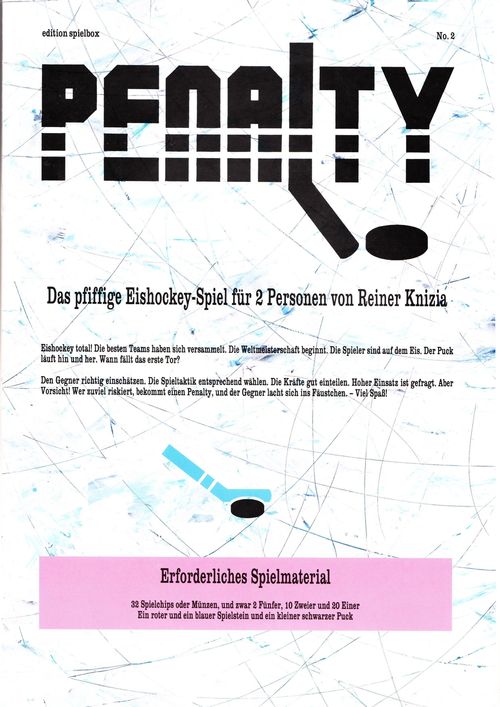
Penalty
Penalty Rulebook
Table of Contents
Table of Contents
Game Flow
One player chooses the red marker and the other the blue marker. The markers show the score. At the start, both markers are placed on the score fields marked 0. The score is 0:0.
The game is played over three periods (Drittel). At the start of each period, each player receives 16 chips: one five, five twos and ten ones. The chips are taken into the left hand. The black puck is placed on the middle field of the game board.
Duels
Each period consists of several duels (Zweikämpfe), which are fought one after another. For each duel, both players take a number of their chips from the left hand into the right fist. An empty fist is also allowed.
Both fists are then opened at the same time. Each player names the total value of the chips in their fist. The player with the higher total in their fist may move the puck one field toward the opponent's goal. If the totals are tied (Patt), the puck simply stays where it is.
Example: The player with a total of 6 wins the duel and moves the puck.
The players lay the chips they used face up in front of them. For the rest of the period, these chips may not be used again. They do, however, show which chips a player still has available.
Goals
If the puck is moved out of the middle field of the game board, it is then in front of the opponent's goal. If the attacking player also wins the next duel, they score a goal. They may then advance their marker one score field. The score is now 1:0.
After every goal, the puck returns to the middle field of the game board.
Penalty
The game gets a special whistle through the Penalty rule. Under this rule, only the number of chips chosen plays a role, not their value. If a player has at least three more chips of any value in their fist than the other player in a duel, they commit a foul. Regardless of the value of the chips, the other player may then move the puck. The chips used are placed face up again.
Example: The player with four chips commits a foul and loses the duel.
End of a Period and End of the Game
If a player has no chips left after a duel, they must say so aloud. The other player then counts how many fields the puck must still be moved to score a goal. (If the preceding duel led to a goal, the puck starts again from the middle field, and two moves are needed.) If the player has the corresponding number of chips of any value, they may credit themselves with one final goal. The period then ends.
It is expressly permitted for a player to take all remaining chips into the fist at once in order to end a period. Both that duel and the opponent's remaining chips may still lead to a goal in this case.
The player who has scored more goals in total after the third period wins the game.