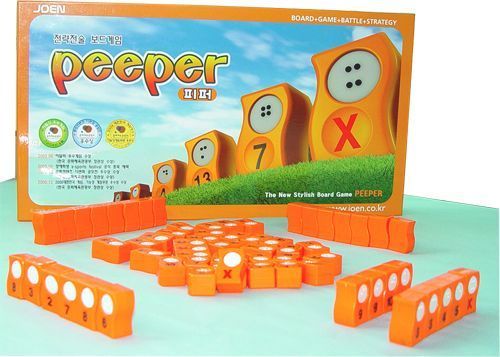
Peeper
Peeper Rulebook
Table of Contents
Table of Contents
Components
- 64 tiles:
- 4× tiles numbered 1–15 (one of the 1 tiles is marked: 1)
- 4× X tiles
Goal
Each player starts the game with 100 points. Keep as many of your 100 points as possible, by purging tiles from your hand each round.
Gameplay
General rules
The X tiles are wild, and can represent any value from 1–16 — yes, sixteen. Thus, a solitary X is considered to be higher than any single number tile.
Peeper is what is known as a climbing game or a ladder game, the concept of which is that someone plays a pattern (takes one step up a ladder), then other players play identical but ever higher patterns (climbing up the same-sized rungs on the ladder). As with many climbing games, players may play special patterns, called bombs, to transform the rest of the climb up the current ladder. In climbing games, the standard short-term goal is emptying your hand. In Peeper, the only scoring is based on the tiles you still have in your hand when someone has emptied theirs.
If you have fewer than five tiles when it is your turn, you must inform the other players of how many tiles you have left. (Remember that Peeper is designed to be playable by people who can't just look at the number of tiles you have. If everyone can count everyone's tiles, you can forgo this rule.)
Deal players' hands
Turn all the tiles face-down, and mix them. Each player takes a specific number of tiles (Don't let anyone else see your tiles' faces), depending on the number of players:
- 2–4 players: 16 tiles each
- 5 players: 12 tiles each
- 6 players: 10 tiles each
Set any leftover tiles aside, unseen. You will mix them back in with the rest when setting up the next hand.
Play
The player with the marked 1 starts the round, or hand; if nobody has the 1, each player looks at one of the leftover tiles, and the one with the highest-numbered leftover starts.
The start player leads the trick by playing a valid pattern (see below) face-up, then subsequent players in clockwise order either pass or play the same pattern with a higher value. If everyone else passes after someone's play, then that player — the last one who played — may choose any valid pattern from her hand, and play it face-up for people to follow. These tricks continue until someone plays her last tile, which interrupts the current trick, and ends the hand. At this point, scoring occurs (see below).
Valid Patterns
| Pattern | Description | X as wild | Play example |
|---|---|---|---|
| Single | 1-of-a-kind | X can be used as a wild | 1, 4, 6, 10, X |
| Pair | 2-of-a-kind | X can be used as a wild | 22, 55, 11 11, 12 X, 14 14 |
| Straight of three or more tiles | e.g. 3, 4, 5, 6, 7 | X can be used as a wild | 1234, 3456, 9 X 11 X |
| Straight pairs of three or more values | e.g. 6, 6, 7, 7, 8, 8 | X can be used as a wild | 334455, 778X99 |
| Bomb | 3-of-a-kind | X cannot be used as a wild, but it can be part of an X bomb: XXX | 111, 666, 777, XXX |
| Big bomb | 4-of-a-kind | X cannot be used as a wild, but it can be part of a big X bomb: XXXX |
When following a pattern, your play must match the pattern exactly. For example, if I lead with a straight of 4 tiles, you can't play a straight of 5 tiles; you can only follow with a straight of 4 tiles, covering a higher range of 4 values. So, normally, the pattern the first player plays is followed until nobody can (or wants to) play a higher version of that same pattern. You are welcome to pass, whether it is because you can't play, or just don't want to; also, you are completely allowed to jump back in and play later in the same trick. Usually this simply allows other players to empty their hands more, but you may have strategic reasons for doing so; either way, the choice is yours!
Example: Amy leads with straight pairs: 1 1 2 2 3 3 4 4. Brittany has 4 X 5 5 6 6 7 7 in her hand, but she has better uses in mind for the X, and she actually has all four 5s; she passes, confident she can rid her hand of these tiles in a more powerful way. Chris plays 11 X 12 X 13 13 14 14. David passes. Amy passes. Brittany realizes she has 13 13 14 14 15 15 X X, and decides to play it, fearing the hand will end sooner than she'd hoped, and wanting to take the lead. Chris, David, and Amy all pass. Brittany leads with a new pattern.
Bombs are not only valid patterns, but can also be used to change the current pattern to bomb, or big bomb. A bomb of 1 1 1 beats any single, pair, straight, or straight pairs, and as with any other pattern, a bomb can be followed by a bomb of a higher value. Similarly, a big bomb of 1 1 1 1 beats any single, pair, straight, straight pairs, or bomb.
Example: Brittany leads with a pair: 3 3. Chris plays 6 6. David plays 7 7. Amy plays 15 15, trying to stop everyone's slow purge of tiles; she is also hoping to lead the next trick. Brittany passes; she is hoping to time a surprise attack just right to take the lead. Chris plays a bomb: 8 8 8, with a serious look of satisfaction. David looks even more satisfied in following the bomb with 9 9 9. Amy passes. Just the moment Brittany wanted: She plays a big bomb of 5 5 5 5. Chris, David, and Amy all pass, grumbling. Brittany leads with a new pattern.
There are two other special plays you can make, and you can make them regardless of turn order. If someone plays a single, and you have a pair of that same value, you can call "mine", and play the pair to win the trick; however, if someone plays mine, and you have the fourth tile of that value, you can call "return", and play that fourth tile to win the trick. The only thing that can beat a mine is a return. In climbing games, bleeding off singles is usually a slightly boring necessity; mine and return make it a riskier, more suspenseful prospect.
Valid Disruptive Patterns
| Pattern | Description | X as wild | Play example |
|---|---|---|---|
| Mine | 2-more-of-a-kind | X cannot be used as a wild, but it can be part of an X mine: XX | 1 [skipped] [skipped] "Mine!" 1 1 |
| Mine | 2-more-of-a-kind | X cannot be used as a wild, but it can be part of an X mine: XX | X [skipped] "Mine!" X X |
| Return | 4th-of-a-kind | X cannot be used as a wild, but it can be used as an X return | 10 [skipped] "Mine!" 10 10 [skipped] "Return!" 10 |
| Return | 4th-of-a-kind | X cannot be used as a wild, but it can be used as an X return | X [skipped] [skipped] "Mine!" X X "Return!" X |
Example: Brittany leads with a single: that lone 4. She knows this is safe, because Amy played the other two earlier. Chris is less attentive when he plays his 10. Brittany shouts, "Mine!" and plays 10 10. Note that she did this out of turn, and quite legally. Amy (also legally out of turn) quietly declares, "Return," puts down the fourth 10, and leads with a new pattern. There is no answer for a return, so Amy didn't need to wait for people to pass.
Scoring
As soon as someone has emptied her hand — Don't even finish the trick! — scoring occurs. Each player loses 1 point for each tile she has left. The original rules fail to explain what ends the game, but I would suggest that the game ends when someone has lost all their points, at which point the player with the most points wins. In the event of a tie for the win, only those players play one more hand. Everyone excluded from this round is automatically ranked below the tied players, no matter how many points the tied players lose in this tie-breaker round.
If the game has not ended after scoring, mix the remainder of your hands with the discards and any tiles set aside, and start a new round.
Chance Variant
At the start of a hand, after you look at all your tiles, you may proclaim, "Chance!" if you think you have a high chance of emptying your hand first. This means that you will lead, rather than the player with the marked 1. This also allows the other players to collude against you. The scoring at the end of the hand is as follows:
- If you win, +30 points for you, and the other players get −10 points each.
- If you lose, −30 points for you, and the other players get +10 points each.
If someone called, "Chance!" then you may answer with, "Double-Chance!" if you think you can empty your hand before the chance player. In this situation, only the two of you will play, and the other players will simply be spectators for the hand. The scoring at the end of the hand is as follows:
- If the chance player wins, +30 points for her.
- If the chance player loses, −50 points for her.
- Each spectator gets +10 points.
The original rules are very terse, but it certainly seems that there is no risk of the double-chance player losing points; however, if the double-chance player doesn't have a strong chance to beat the chance player, he might be better off scheming with the other players, rather than relegating them to spectating — and guaranteeing them +10 points each. Either way, if the chance player wins, she gets +30 points. If you have a very strong hand, though, you could make her get −50 for losing, instead of −30!