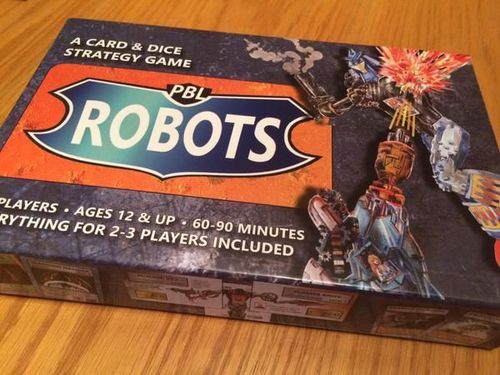
PBL Robots
PBL Robots Rulebook
Table of Contents
Table of Contents
Components
- 100 Card Base Set (orange)
- 10 Starter Pilots (black)
- 3 Base Robots (die cut)
- 6 Red Mini Dice (8mm)
- 6 Blue Mini Dice (8mm)
- 1 Twenty Sided Die
- 2 Control Panels
Types of Cards
Pilots (10 Starter / 5 Expert)
Each ROBOT has a single pilot. The Starter Pilot is chosen at the beginning of the game, as described below. During game play, you may replace your Starter Pilot with an Expert Pilot. Each pilot has a different set of abilities – basic attack and defense strength, Critical Form (see page 4) attack and defense strength, and speed. During a game you will acquire Pilot Points, allowing you to play Expert Pilots from your hand (see Expert Pilots on Page 3). Expert Pilots can increase both your attack and defense strength and/or add special powers.
Armor (38)
Seven different armor types exist: head, left arm, right arm, leg, left shoulder, right shoulder, and interchangeable pod armor. Your starting robot begins with Level 0 base armor on all four limbs. Armors upgrade by stacking onto the armor below. Armors upgrade in order from Level 1 to Level 3, but you may always stack the same, or lesser level on an armor. Construction pods may be played on any level as a bridge to the next level. Shoulder armors do not have levels and may always be played on an active corresponding shoulder.
Hangars (10)
Hangars hold crew and storage bombs. In addition, some add attack and defense strength to your ROBOT, while others perform special abilities when played. Different hangars work for different strategies.
Crew (26)
Crew members perform specific jobs which help you manage your ROBOT and resources. You may have one Skill 1 sidekick crew member to start, but in order to expand your crew, you must have open hangar space.
Actions (21)
Unlike all other cards, which can only be played during your turn, action cards can be played at any time. They can have a major impact on the game. Action cards range in capacity from boosting attack or defense, to helping you upgrade or dismantle ROBOTS.
Other Game Versions
Included in pages 2–4 are the rules for a standard game. Page 5 includes rule varieties and gameplay modes that accommodate new players, shorter games, younger players, and multi-player. Celebrity modes can customize your experience and Mortal/Blind modes can alter the difficulty. League play and tournaments are great for larger groups. FAQ and the most current rules for all modes can be found at: www.robotcardgame.com
Traditional Game
Age: 12+ · Players: 2–3 · Time: 90 (version 1.3)
Objective
Your goal is to use your ROBOT to TERMINATE your opponent's ROBOT by blowing off all four of its limbs, which include the head, left arm, right arm, and the legs (shoulder weapons are not considered a limb and do not need to be destroyed to win).
Getting Started
Each player selects one of the three base ROBOT cards (with the rectangular pilot pit in the center): Crystal, Obsidian, or Solar. Shuffle the full 100-card deck and deal each player five cards ("the Inheritance") to start your deck. You may look through your cards now, and at any time during the draft, but do not show them to other players, unless specifically required.
Selecting a Starter Pilot
One player shuffles the deck of ten black Starter Pilot cards and flips three pilots face up ("the Talent Pool") to choose from. Each player rolls the twenty side die, and the player with the higher roll chooses a Starter Pilot from among the three Starter Pilots. Then the other player chooses from the remaining two Starter Pilots.
The unselected pilot returns to the black deck, which now becomes the 8-card blow-off deck. For three-player games, the talent pool will consist of 4 starter pilots. Once selected, each player puts their starter pilot into the cockpit of their base ROBOT. Slide the pilot under the base ROBOT card so that the pilot and their stats show in the window (printed as: "You should see the pilot and their stats in the window").
The Draft
Quick Play Draft (also good for first time players)
If this is one of your first times playing or if you want a quicker game, you can skip the draft portion of the game and just deal 40 cards to each player (30 each if a three-player game) and put the remaining cards aside, becoming the shop deck.
Regular Play Draft
Now that each player has a starter pilot and an inheritance, shuffle the deck of orange cards. For a two-player game, deal 15 cards to the side (5 cards in a three-player game), which becomes the shop deck. Once each player is ready, the remaining 75 cards (80 cards in a three-player game) become the draft deck, and then, as seen below in Image A, five cards are laid out face down in a row, next to the draft deck. These five piles will grow during the draft.
Image A (as printed): five face-down piles, labeled Pile 1 through Pile 5, laid out in a row next to the draft deck; the Inheritance cards sit beside the board and the shop deck is set aside.
The player who drafted their Starter Pilot last, drafts first. The first player to draft looks at Pile 1 (the closest pile to the draft deck) and determines whether or not to add the entire contents of Pile 1 to their deck, or to put Pile 1 back down and then look at Pile 2. The player can continue to look through the piles in succession (Piles 1, 2, 3, 4, and 5) until they decide to keep one. If the player gets to Pile 5 they must take that pile. A player may not go back and look at piles they did not choose in the round. After the player chooses a pile, one card is added to each of the five piles from the draft deck, including the empty space where a pile was just chosen. The next player then follows the same process, always starting with Pile 1. Late in the draft, the piles can get very large.
In two-player games there are exactly 15 draft rounds (one player drafting 8 piles and another drafting 7), while in three-player games there are 16 draft rounds (two players drafting 5 piles and one player drafting 6 piles). Once there are no cards left in the draft pile to restock the draft, the draft is over. The remaining cards in the four unpicked piles are added to the shop deck, which is then shuffled and set to the side. Remember that it is common for some decks to be smaller or larger than others, which may play into your strategy.
Opening Hands
Each player shuffles their entire deck and deals themselves two separate hands of five cards from their deck. Players will look at both five-card hands, and decide which one to keep as their starting hand. The other hand goes to the bottom of their deck. Once each player has selected their 5-card hand, apply any Starter Pilot bonuses (e.g., D-Rock Kingston allow you to draw one additional card to start the game).
Game Play
General Rules of Play:
- The player whose Starter Pilot has the highest speed goes first.
- Make one 'MOVE' per turn, if able. Or pass the turn.
- Some crew members can be discarded for an effect. Discarding crew may only be done on your turn. This does not count as a 'MOVE'.
- Action cards can be played any time, during any players' turn. Playing an action card does not count as a 'MOVE'. Action cards must be resolved before anything else can happen (even before another action).
- You may not have more than 10 cards in hand at any time. Any time you have more than 10 cards you must immediately select and discard cards into your scrap heap until you have 10.
- During combat any card in your hand can be discarded as a bomb (for attack) or a shield (for defense). Discard a card in your hand facedown into your discard pile, for one additional 6-sided die roll.
- At the end of your turn, draw one card. Another player may interrupt you by playing an action at the end of your turn. Drawing your card signifies your turn is over.
The Moves
What can I do on my turn?
- BUILD – Armor / Crew / Hangar / Expert Pilot.
or
- ATTACK – Declare attacking limb and armor you are targeting, then roll the dice.
Build
1.1 Upgrade Armor
Limb Armor
Your ROBOT has four upgradable limbs: head, right arm, left arm, and legs. Each limb armor has a level – 1, 2, or 3 – that increase the strength of the corresponding limb. All limbs on the base robots start at Level 0. You may use your 'MOVE' to upgrade your ROBOT's armor to one level above the current armor's level. All upgrades stack directly on top of the previous armor. For instance, you could play a Level 1 left arm on top of your base level 0 left arm giving it new attack and defense strength and/or abilities. A Level 2 armor can be played on a Level 1, and a Level 3 armor can be played on a Level 2. Some armor may give you a bonus when you play it that will allow you to do different things. You may always 'upgrade' an equal or lesser level armor on a current limb.
Shoulder Armor
Left and Right Shoulder armor are special add-ons to your ROBOT with unique abilities. Shoulder armor do not have a level and can be played as your 'MOVE' as long as you have an active head armor and/or an active corresponding arm. For example: a left shoulder armor could not be played if your ROBOT has its head and left arm blown off. Once built, a shoulder armor will remain even if the head and corresponding arm is destroyed. Shoulder armor cannot attack and has zero defense. If attacked, shoulder armor would use the base defense of your ROBOT (Pilot + Hangar + Crew defense).
Construction Pods
The construction pods can be played on any active limb to act as one level higher than the armor it is upgrading. These armors are considered a Level 1, 2 and 3 while in your hand or deck, and serve as a tool to upgrade to higher level armor. Pods cannot attack.
Regeneration Pod
The regeneration pod can be played by replacing any blow off card, and turning a dead limb into a level 0 armor. The blow-off card returns to the blow-off deck but all previous armor upgrades remain underneath the pod. Pods cannot attack.
Counters
Some armors/pilots/crew will require dice or counters to keep track of changing values. If a card with a counter has another card played on top of it, or it is removed in any way, the counter resets or disappears.
1.2 Play a Crew Member
Crew can give attack and defense boosts to your ROBOT, while others perform special abilities when played or discarded. Each crew member has a skill – 1, 2, or 3. Unlike armor and hangars, crew members play side by side. When hiring crew members, the first must be a Skill 1. A Skill 2 crew member can be played if you have a Skill 1 in play and have an open hangar space. A Skill 3 crew member can be played if you have a Skill 2 in play and have an open hangar space. You may always play a crew member of equal or lesser skill as long as you have open hangar space. When you play a crew member follow the text on the card, and/or apply any stat bonuses.
Sidekick
If you do not have a hangar in play you can play one Skill 1 crew member as your sidekick, but this is the only crew member you can have if you do not have a hangar. Once you add a hangar, if you have a sidekick he/she immediately enters the hangar and you no longer have a sidekick slot for as long as you have a hangar.
Discarding Crew
Crew members cannot be discarded unless specified on the card. Crew members with discardable abilities can only be done on your turn (unless otherwise specified).
1.3 Build a Hangar
Hangars hold crew and/or storage bombs and some hangars give attack and defense boosts to your ROBOT, while others perform special abilities when played. The amount of space in each hangar is indicated by gray boxes at the bottom of each card. Each player starts out with no hangar and will only have one active hangar in play at any time. Like armor, hangars must start at Level 1 and may upgrade by stacking to Level 2 and then Level 3 during a game. You may always build an equal or lesser Level hangar on your current hangar.
Storage Bombs
Storage bombs can only be added using certain cards with abilities that allow you to roll a die and then add that die to your current hangar. Storage bombs can be used during attack or defense like a bomb or shield to add the value to your total. Both crew and storage bombs take up space and you can run out of space quickly. Storage bombs must be used to be removed.
Transfers
If you upgrade to a new hangar the crew and storage bombs transfer to the new hangar. If a hangar is destroyed the hangar beneath is the new active hangar. If the new hangar has less space than the old one you will have to discard crew members or remove storage bombs to comply with the new hangar. If you no longer have a hangar at all only one crew member may remain as your sidekick (see 1.2 Sidekick).
1.4 Play an Expert Pilot
When you accumulate enough Pilot Points (the number of armor cards, blow offs and actions attached to your robot), you may replace your Starter Pilot with an Expert (or Legendary) Pilot. Also see Page 4 to read about the starter Pilots Critical Forms. See image below for example of counting Pilot Points.
Counting Pilot Points (example as printed): COUNT ALL CARDS ATTACHED TO YOUR ROBOT. Remember to also count blow offs, certain action cards, and shoulder weapons. Level 3 armor, Level 2 armor and Level 1 armor = 3 Pilot Points. Blow off and Level 1 armor = 2 Pilot Points. Level 1 armor = 1 Pilot Point. TOTAL PILOT POINTS = 6.
Attack
Declaring
Declare an attack by stating which limb/armor you are attacking to, and which limb you are attacking from, for example: "I am attacking your head, with my left arm". If an opponent plays an action in response to your declared attack, you may then re-choose your move and/or declare a new attack. You may declare an attack from a limb even if your attack strength is 0 (you just roll 'nothing', but the defender must still roll their defense). Shoulder armors do not attack, but may be the target of an attack.
Combat (Rolling the Dice)
The attacker counts up all red numbers from their base strength (pilot's attack strength + crew bonus + hangar bonus) and adds them to their attacking armor's attack strength. This determines how many 6-sided dice they will roll on offense. At the same time, the defender counts up all blue numbers from their base strength (pilot's defense strength + crew bonus + hangar bonus) and adds them to the defending armor's defense. This determines how many dice they will roll on defense.
Initial Attack/Defense
The attacker rolls first, and the defender rolls second. These rolls are called the 'initial attack/defense'. In the 'initial attack' both rolls are separate but both are considered the current roll. Add up all the values of the attack roll and then add up the values of the defense roll. The higher total roll determines the success or failure of the attack. However, PBL ROBOTS pilots are so fast that, before final resolution of combat, each player can increase the strength of their attack or defense in different ways:
Bombs and Shields
Each card in a player's hand, if discarded, is worth one additional 6-sided die roll during a battle. After the 'initial attack' (see Sample Combat below), the player who has the lesser value decides if they want to add one or more bombs, by discarding cards from their hand face down on their discard pile. In exchange for discarding cards, roll the number of dice equal to the number of cards discarded. Any player with the lesser total value can repeat this process. There is no limit to the number of bombs or shields a player may use in any battle, until they run out of cards in their hand.
Actions, Crew, and Storage Bombs
During any attack, actions may be played to affect the values, add dice, change the defending armor, or have other effects that change the outcome of the battle. Certain crew members can also be discarded during battle to add bonuses to attack or defense. Hangars may also be holding storage bombs that can be used during any attack or defense by adding the predetermined value to the current total.
Outcome
Combat is over when the player with the lesser value concedes. In the case of a tie, the attacking player's value is considered the lesser value. If the defender's total dice roll is equal to or higher, they have successfully defended the attack. If the attacker's total dice roll is higher, the defender declares the targeted limb/armor as blown off. The defender takes a blow-off card from the black deck and places it over the blown-off armor which indicates this as a 'dead limb'. Leave all upgraded armor beneath the blown-off limb because they still count towards Pilot Points. The blow-off card also adds an additional Pilot Point to that ROBOT. Shoulder armors, when destroyed, are discarded.
Sample Combat
As printed: Lori attacks from the right arm, targeting Jay's left arm.
- Lori will roll 3 attack dice (pilot attack + armor attack). Brobadd X attack is +1; Plasma Cannon's attack is +2.
- Jay will roll 5 defense dice (pilot defense + armor defense + hangar bonus). Sara "Dippity's" defense is +2; Multi Fire Arm's defense is +2; Shell Hangar (Level 2) hangar bonus is +1.
The Shop Is Open
At any point in the game, if a player goes to draw a card but there are no cards in their deck, the Shop is Open! Shuffle your discard pile and give yourself a new draw deck. Then take the Shop Deck (make sure it is shuffled) which has been set aside since the draft and turn five cards face up in a row, to become the Shop. The player that opened the Shop must draw their first card from the 5 revealed cards. Once Shop opens all of the cards in the shop row are an extension of all player's decks. All players may now take one of the face-up cards from the Shop instead of from their draw deck. Cards that allow you to search your deck for a specific card may now also allow you to take a qualifying card from the shop row.
If the shop has already been open (due to another player running out of cards or from the action card "Shop is Open") the shop only refills the empty slots to a maximum of five cards (For example: if the shop has 3 face up cards remaining and the 'Shop is Open' again, only 2 cards are added to the shop.)
Critical Form
Critical Form is a bonus for Starter Pilots that comes into play when a ROBOT is down to only one active limb (shoulder armor does not apply). If your ROBOT is down to one active limb, slide your pilot into its Critical Form (located on the top right corner of each Starter Pilot) which may increase the pilot's stats. If the pilot gets a Critical Form bonus, (which appears in the now visible star burst in the bottom left corner) apply that bonus immediately. If you regenerate a limb, return your pilot to his/her normal form. A pilot's Critical Form bonus can activate multiple times if limbs are regenerated during the game. Expert and Legendary Pilots do not usually have a Critical Form.
Ending the Game
The winner of PBL ROBOTS is the player who has an active limb(s) remaining on their ROBOT after all other ROBOTS have been terminated by losing all four limbs.
Glossary
- Active Armor: The current armor your ROBOT has for each limb and/or shoulder.
- Base Stats: The total count of + red/+blue numbers on your active pilot, crew and hangars (does not include armor).
- Blast: Discard ability of an active crew member for a specific effect.
- Blow-Off Deck: The back of the Starter pilots are used as a "BLOW OFF" when a limb is destroyed. Stack one of the black cards on any destroyed limb.
- Blown-Up Armor: The active armor that is destroyed in an attack. This does NOT include armors that are sent back to the hand, discarded, or put back into the deck.
- Critical Form: When a ROBOT has only one remaining limb.
- Current Roll: The last set of dice that were rolled by any player (both the initial attack/defense rolls are simultaneously but separately considered the most current roll).
- Dead Limb: A limb that has been BLOWN UP.
- Inheritance: The 5 random cards each player starts the game with. This is not the opening hand.
- Initial Attack/Defense: The first roll of the attack and defense in combat. The red/blue numbers of the armor+base stats (see above) are added to determine the initial attack dice rolled. The actions, bombs, and shields are considered separately.
- Pick: Search ability of certain crew members from your hand for an armor that corresponds with the crew member you discarded from hand.
Game Modes
Standard Game Variations
Series Play
Best of three (first player to win two) game series using the same drafted deck and starter pilots. Each game restarts with the same starter pilots and all orange cards returned to each player's deck and reshuffled. All cards acquired during the game from the shop or Action cards remain in each player's deck. The player who lost the previous game, starts the current game regardless of the speed of the pilot. Looking for a bigger challenge? Try a five game series.
Celebrity Games
A celebrity game is the same as a standard game except both players agree to a crew member's effect for the duration of the game. Prior to the game, agree upon a crew member to be the 'celebrity' and put that card face up on the table. Discuss how the rules will work with your opponent (usually discard effects do not apply.)
Here are some Celebrity suggestions:
- Pelpe Derdae – Instant Hangars
- Caldera Sen – Bigger Robots
- Segheo – Aggressive Shoot Out
- Sienne Woodin – Discardable Crew Members
- Douglas Graven – Draw More Cards
- Curse of Threes – Draw Less Cards
Looking for even more celebrity options? Try using multiple crew members effects. Or try flipping a random celebrity from the top of the deck before drafting. Tell us your favorite Celebrity set-ups!
Three Pilot Rotation
If you enjoy the best of three game series, you may want to spice it up by trying a three pilot rotation. For this variation flip over 7 cards (instead of 3) for the starter pilot talent pool. Each player will take turns drafting 3 pilots. Return the last pilot to the blow off pile like normal. Complete the standard draft phase. When both players are done drafting flip all of your pilots face down and each player will select their pilots face down, and reveal them at the same time. Repeat this process from the remaining two pilots for game 2, and in this mode the pilot with the fastest speed will start game 2 (instead of loser goes first). You can also try a 5 pilot rotation if you really want to have a donnybrook.
Challenge Games
For more of a chess match style game players can customize their inheritance and start the game by playing all inheritance cards. First, roll the dice to see who goes first. The first player looks through all the orange cards and selects any card to play. Action cards or any other cards that cannot be immediately played cannot be selected. Each player will take turns selecting playable cards until each player has selected and played five cards. The draft and the game can continue on as normal. Challenge games can also be played by skipping the draft and instead setting aside a 20 card shop deck, and using the remaining cards as a community deck, both players drawing from the same deck.
Three Player Games
Standard Rules apply to three player games, with a few additional rules. A player may not be attacked in two consecutive turns by two different players (however the same player may attack a player twice, by using Elvin Racers or Final Blow). Strike effects, like Yot-Z Bazooka, can be done to any player regardless of if they were attacked the previous turn. During combat, a player who is not involved in the battle can use Action cards, to assist another player. A player who is not involved in combat cannot use bombs/shields to help out an opponent.
Declaring a winner in 3-player games can be as simple as last Robot standing, however it can be beneficial to also apply a time limit or tie breaker rule. A time limit would trigger as soon as one player is eliminated and the remaining players have 15 minutes to determine a winner, or a certain amount of turns. In time limit games, it is important to keep track of how many successful blow offs each player has accomplished during the game which can determine the winner if time expires. For shorter three player games, you could play to a set number of blow offs. The first player to blow off the required amount of limbs wins the game.
Bombs/Shields Variations
- Predetermination: All bombs/shields must be predetermined before initial attack/defense with the attacker declaring his attack and stating the amount of bombs that will be used. The defender would then declare shields and both players will only roll once to determine the outcome. Action cards and BLAST effects can still be played as normal. This variation increases the impact of luck in the die rolls and emphasizes dramatic moments.
- Maximum Limit: You can declare a maximum amount of bombs/shield allowed per combat. Setting a limit of one or two bombs/shields per combat can be preferable for some players.
- No Bombs/Shields: Playing without bombs/shield can encourage players to build more and have more cards in hand after attacks. This variation increases the impact of luck in the die rolls, shortens the attack phases, and emphasizes dramatic moments.
Two vs Two Modes
Pilot and Gunner
In this format teams of two players work together during the draft to build their deck. After the deck is built, one player secretly looks at the top 5 cards of their deck and may put it in any order at any time. The other player draws from the deck like normal and plays a standard game without talking to their partner. This mode is also great for new players who can stack the deck and be learning the game without actually controlling the robot or getting involved in combat.
Two Robots / 4 Hands
In this format teams of two players work together during the draft to build their deck and will share one robot. Each player will deal themselves two hands of 5 cards and select a starting hand. The players on a team may converse and share card information but will take turns independently. Each player may only play cards from their own hand on their turn, but may play actions or use bombs/shields on any player's turn. This mode is also excellent for teaching new players how to play.
League Play
Tournaments
Setting up brackets for any amount of players is a fun way to play competitive PBL ROBOTS. It is a good idea for all players have similar experience levels. Playing preliminary league games and keeping stats is a good way for players to gain experience and determine ranks for the tournament.
Keeper Leagues
Another fun way for a dedicated group of players (typically 4-8 players) is a keeper league format. Randomly determine who will select first and they may select any non-Action card to be a keeper, and then each other player will do the same until each player has selected 5 cards. Use a round robin style (meaning the last person to pick in Round 1, will be the first to pick in Round 2, etc). Each player will write their selected five cards and will start with those 5 keeper cards as their inheritance for each match. Keeper cards from all players do not appear in the draft, but do not set aside 15 cards for the shop (only use the undrafted piles as the shop). After playing a certain number of league games each player can exchange 1 keeper card if desired.
Salary Drafts
Players who want another level of league play, are salary drafts which are similar to Keeper League except each player has a set amount of money to spend to bid on non-Action cards as their keepers. A maximum of 5 keeper cards and a minimum of one keeper card can be purchased per player and after each season players can fire certain cards to bid on new cards. League GMs can also make bonuses available for bid, for example: starting hand size +1, max hand size +1, reduce deck size by 3 cards.