Pazaak
Pazaak Rulebook
Table of Contents
Table of Contents
Setup
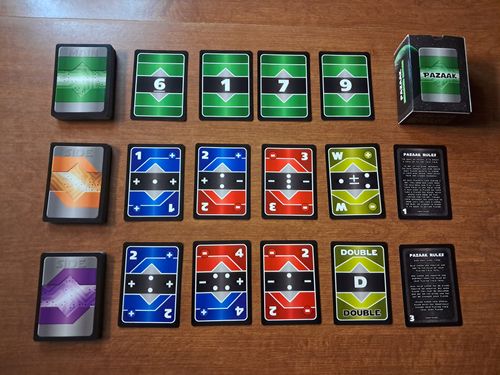
Pazaak is a two-player game that uses a Pazaak deck with a 40-card main dealer deck (called the table deck) and two 43-card decks (one for each player). The game must be played using this special 126-card Pazaak deck.
The game is played on a special Pazaak table, with nine card slots for each player's cards. As play continues and cards are played from the table deck or the players' hands, these slots are filled. In each set, each player may play a maximum of nine cards.
The goal of the game is to be the first to win three games (known as sets) and thus a match. The player who comes closest to 20 without going over wins a set. A set in which the players tie is not counted.
The table deck is composed of four sets of cards numbered 1–10. Each player chooses ten cards from their forty-three-card deck, to use as their side deck for the match.
Before play begins, one player shuffles the table deck. Then each player shuffles their side deck and draws four cards from it, making up their hand. These four cards must suffice for the entire match. Each player then draws a card from the table deck, with the highest card deciding who plays first, then these two cards are discarded.
Playing a Set
To start, the first player draws a card from the main deck and places it face-up in front of them, then chooses to either place a card from their hand face-up in front of them, stand, or do nothing. In either case, the player's turn ends and play passes to the second player, who repeats the procedure.
Players continue to alternate turns until both players choose to stand, or until one player ends a turn with a total greater than 20 (a 'bust'). You only lose if you are over 20 at the end of your turn. A player can draw a card from the main deck that puts them over 20, then play a negative card from the hand that brings the total back under 20.
If a player stands, they may not draw again or play any more cards until the end of the set. The opponent, however, can continue playing cards, until they stand or go bust. Getting cards with a sum total of 20 or filling all nine slots in the table with cards automatically causes a player to stand.
A +/- card played from the hand must be declared as a positive or negative when played. Once played it cannot be changed.
Ending a Set
The winner of the set becomes the first player for the next set. In the case of a tie, whoever was not first player for the tied set is the first player for the next set.