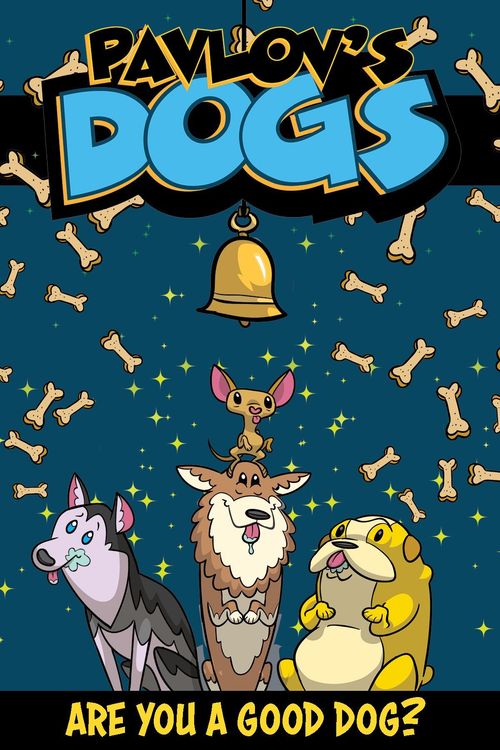
Pavlov's Dogs
Pavlov's Dogs Rulebook
Table of Contents
Table of Contents
Components
- 36 Test cards
- 24 Bones
- 40 Dogtor Rule cards
- 1 Dogtor Test folder
Setup
Give each player 3 bones.
Separate the 40 DOGTOR cards into 8 piles by dog in order from Easy to Very Hard (2 piles of each level).
Choose your difficulty level. The group decides their level prior to starting the game.
- A PUPPY - 3 tests (Easiest)
- A DOG - 5 tests (Normal)
- A WOLF - 8 tests (Challenging)
Draw DOGTOR RULE cards equal to the number of tests that you have chosen to play without looking at them. Place the rule cards into the Dogtor folder face down.
Choose 1 player to start as the Dogtor running the test. Give them the DOGTOR FOLDER and the TEST DECK. This player will choose 1 rule to flip face up. This will be the rule for the first test. They will then deal 5 test cards to each player in the test. Keep these cards FACE DOWN.
Decks
The Test Deck
There are 6 Bell cards which are valued at ZERO (0) and are all WHITE.
There are 30 commands distributed among 3 suits (BLUE, YELLOW, and BROWN). These command cards are valued 1, 2, 3, 4, or 5. Commands include: SIT, SPEAK, FETCH, SHAKE, BEG, and ROLLOVER.
The Dogtor's Rules Decks
Each of the Dogtors have created rules to test the dogs. Each Dogtor has 5 different rules that may end up being used in a test (but each Dogtor will only have 1 rule per test - preventing us from having any contradictory rules). A Dogtor's rule could:
- Change the value of a command card. Example: Bells count as 10.
- Add a physical action to perform when a specific card is played. Example: Mime Begging when a BEG card is played.
- Add a verbal response to say when a specific card is played. Example: Say the name of BLUE cards.
- Modify the order of play. Example: Reverse the order of play when ROLL is played.
| DOGTOR | DIFFICULTY | AREA OF STUDY | Named After |
|---|---|---|---|
| Mamie P. Bark | EASY | Puppy Identity | Mamie Phipps Clark |
| Abby Maslow | EASY | Doggy Needs | Abraham Maslow |
| Immanuel Mutt | MEDIUM | Good Dog Ethics | Immanuel Kant |
| John B. Wagson | MEDIUM | Dog Stimulus | John B. Watson |
| Sigmund Fetch | HARD | Big Dog Ego | Sigmund Freud |
| Maggie Washpaw | HARD | Canine Motor Theory | Margaret Washburn |
Overview
Players are dogs working together to complete a series of tests which will test their memory and recall skills. Each round one player acts as the Dogtor to ensure the dogs are following the rules. Will you be able to pass all your tests in this fast, engaging co-op?
How to Play
The Test
The first test will have 1 Dogtor Rule that all the dogs in the test MUST follow. Each consecutive test adds another test rule. In between tests all test rules are shown to the players and then hidden again at the start of the new test.
Very Important! There cannot be 2 rules from the same Dogtor in any test.
Taking the Test
The Dogtor shuffles the test deck and deals out 5 cards to each player face down. Players should not look at their cards. Each player should keep their cards in a pile. The rest of the deck is set aside.
The starting player will flip the top card of their hand face up to the center of the table and announce the total VALUE of the test. If they played a BLUE FETCH FIVE, they would say "Five". The Dogtor would say GOOD DOG. This is the end of their turn.
The player to their left will now complete the same actions as Player 1. If player 2 played a YELLOW BEG THREE, they would say "Eight" since the total was 5 and they have added 3 to it.
However, there will be Rules from the Dogtors which will give the players conditions that must be followed during their turn of the test.
If Immanuel Mutt's rule SAY THE NAME OF ALL BLUE CARDS was part of this test Player 1 would have to say "Fetch Five" instead of just Five in order to be correct and a good dog.
If Mamie Bark's rule MIME BEGGING WHEN BEG IS PLAYED is included in this test Player 2 would have to physically mime a begging action while stating "Eight" in order to be correct.
Being a Good Dog
When a dog is correct the Dogtor will say "GOOD DOG". This signifies that they were correct and that the next player may now go.
Being a Bad Dog
When a dog is incorrect the Dogtor will say "BAD DOG" and tell them what they did incorrectly. At this time the player who was wrong will lose a bone. The Dogtor will clear the played cards, and set the value to 0. They will let the next player know it is their turn.
VERY IMPORTANT! When any dog runs out of bones the game ends immediately!
Clarifications
The LAST thing that a player should do is say the new VALUE of the dogpile. All other rules should be done first - so it should be "Fetch
If a rule is in place that changes the direction of play and someone makes a mistake the play CONTINUES in the whatever direction it was going when test value is reset to zero. For example, if play was moving counterclockwise based on the changed direction rule it will continue in a counterclockwise direction.
If a rule is in place that would skip a player and that player makes a mistake, forgetting that they should be skipped, play will start with the player who SHOULD have gone next when the test value is reset to zero.
Being the Dogtor
Each test (round) one player will take on the role of the Dogtor and watch to ensure that the other dogs are following the rules. They will tell each dog if they were a GOOD DOG or BAD DOG. If the player is a GOOD DOG that signifies the player was correct, and play can continue but if they are a BAD DOG that player was incorrect and loses 1 bone. Then the test value resets to zero.
Remember! There cannot be 2 rules from the same Dogtor in any test.
Ending the Test
Once all players have played all their test cards the test is over (this round of play).
The current Dogtor will pass the Dogtor folder to the player to their left and give them the test deck. The new Dogtor will deal out 5 test cards to each player. The new Dogtor will choose a new rule to reveal and show it to everyone, along with ALL the previous test rules as a reminder to the dogs (players) being tested.
During this time ALL players may freely redistribute their bones, as long as every player has at least 1 bone, and no players has more than 3 bones (including the Dogtor).
Once everyone is ready the Dogtor will hide the rules from everyone's view and tell the player to their left to start the test. To make it clear, when the DOGTOR is ready, they should loudly say "BEGIN." Once the TEST begins, the players are no longer allowed to say what the "rules" are.
Ending the Game
Pavlov's Dogs ends when you Pass or Fail.
Pass
ALL players succeed by completing the number of tests in the level they chose to play on (Puppy, Dog, or Wolf). The group's score is the total number of bones left at the end of game.
| Players | A+ | A | B+ | B | C |
|---|---|---|---|---|---|
| 2 | 6 | 5 | 4 | 3 | 2 |
| 3 | 9 | 7 | 6 | 5 | 3 |
| 4 | 12 | 10 | 8 | 6 | 4 |
| 5 | 15 | 12 | 10 | 7 | 5 |
| 6 | 18 |
Fail
ALL players lose when one player is out of bones. Try to make it further in the test next time (or reduce the difficulty)!
Variant: Team Versus
Pavlov's Dogs can also be played in teams. Setup and gameplay are the same as in a standard game of Pavlov's Dogs BUT you are two teams competing against each other for the best test score.
In this version only 4 tests will be administered, and each team's score will be based on the total number of bones left. If one team has a player run out of bones, they fail, and the other teams wins.
How to Play the Team Versus Variant
Split into 2 teams and assign one player on each team to be the Dogtor for the starting test. The 2 Dogtors will each take a DIFFERENT rule from the same level Dogtor (Easy, Medium, Hard, or Very Hard). They may take their rule from the same pile or from 2 different piles of the same level.
Example: Team A draws a rule from Collie Jung and Team B draws a rule from Bark F. Skinner.
After both Dogtors share this rule with their teams they will place the rule card into the corresponding slot for that level on their side of the folder. Team A will be on the left and Team B on the right.
When both teams are ready the Dogtors will start the test.
Taking the Test (Team Versus)
Each dog is dealt 5 cards just as in the standard version of Pavlov's Dogs and follows the same rules. See page X.
Ending the Test (Team Versus)
Once all players have played all their test cards the test is over.
Each team will elect a new player to be the Dogtor and will change seats (taking bones with them) so that both team Dogtors are sitting next to each other.
The new Dogtors will deal out 5 test cards to each player on their team. Then, the new Dogtors will each choose a new rule from the same level Dogtor and reveal it. They will also show everyone on their team ALL the previous test rules again.
During this time ALL players may redistribute their bones amongst players on their team, making sure that every player has at least 1 bone (including the Dogtor).
Once everyone is ready the Dogtors will place the rules into the corresponding slot in the folder and start the test.
Ending the Game (Team Versus)
Play continues through 4 rounds BUT could end earlier if one team has a player that runs out of bones.
If one team runs out of bones before the end of the 4th round their team loses and the other team automatically wins.
If both teams make it through all 4 tests the winning team is determined by the number of bones left at the end of the game. In case of tie, everyone should celebrate because you are all GOOD DOGS!!!
The More You Know
Classic Conditioning
Pavlov called dogs' anticipatory salivation "psychic secretion". Putting these informal observations to an experimental test, Pavlov presented a stimulus (e.g. the sound of a metronome & bell) and then gave the dog food; after a few repetitions, the dogs started to salivate in response to the stimulus (bell).
Meet the Real Doctors
- Ivan Pavlov - Winner of the 1904 Nobel Prize in Medicine, Ivan Pavlov is one of the most important psychologists of all time. Pavlov's principles of classical conditioning have been found to operate across a variety of behavior therapies and in experimental and clinical settings, such as educational classrooms and even reducing phobias with systematic desensitization.
- Sigmund Freud - The founder of psychoanalysis, a clinical method for treating psychopathology through dialogue between a patient and a psychoanalyst. Most notably known for developing free association, transference, dream analysis, the idea of the unconscious in which he developed a model of psychic structure comprising id, ego and super-ego.
- Carl Jung - The founder of analytical psychology. Created some of the best known psychological concepts, including synchronicity, archetypal phenomena, the collective unconscious, the psychological complex, and extraversion and introversion.
- Margaret Washburn - Best known for her experimental work in animal behavior and motor theory development. She was the first woman to be granted a PhD in psychology in 1894.
- BF Skinner - The Skinner principle of reinforcement. To strengthen behavior, Skinner used operant conditioning, and invented the operant conditioning chamber known as a Skinner Box.
- Mamie Phipps Clark - Social psychologist and civil rights activist. Mamie Phipps Clark's experimental work with preschool children was used as key evidence in the landmark Brown v. the Board Education ruling.
- John B Watson - Established the psychological school of behaviorism. Through his behaviorist approach, Watson conducted research on animal behavior, child rearing, and advertising.
- Abraham Maslow - Best known for creating Maslow's hierarchy of needs, a theory of psychological health predicated on fulfilling innate human needs in priority, culminating in self-actualization.
Editor's notes on the BETA text: the source prints "philosphier" (corrected here to "philosopher"); the source's order-of-play example says "ROLL" while the command card is "ROLLOVER", transcribed as printed; the Team Versus section refers to "page X", printed as-is.