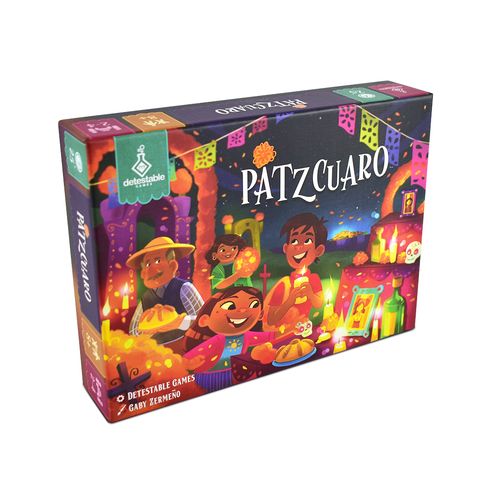
Pátzcuaro
Pátzcuaro Rulebook
Table of Contents
Table of Contents
Components
- 4 Player Tokens
- 4 Player Cards
- 57 Altar Cards
- 1 First Player Card
- 15 Objective Cards
- 1 Scorepad
- 1 Pátzcuaro Tile
- 4 Shop Tiles
Set Up
- Place the Pátzcuaro tile upright in the playing area.
- Shuffle the 4 Shop tiles (choosing a random side and orientation for each tile) and place them forming a line to the right of the Pátzcuaro tile.
- 2a. In a 2-player game, return the last Shop tile to the box. It won't be used in this game.
- Shuffle the Altar cards and deal 6 to each player.
- Place 1 Altar card above and below each Shop tile. Form a deck with the remaining Altar cards, accessible to all players.
- Deal 1 Player card (altar side face up) to each player, and give them the Player token of the same color.
- Give the First Player card to the most festive person. This will be the first player.
- In turn order, each Player places their Player token on the top Action space of the Pátzcuaro Altar tile as shown.
- Shuffle the Objective cards with 1, 2, and 3 petals separately. Reveal 1 of each and place them near the central area. Return the remaining Objective cards to the box.
How to Play
In the game, players build their own altar by forming a pyramid with Altar cards. The base can contain up to 4 cards, the second level up to 3, and the third level up to 2.
Starting with the first player and proceeding clockwise, each player takes a turn. This continues until a player completes their altar or the Altar deck runs out.
There is an Action space at the top and bottom of each tile in the center of the play area and, together, they form a circular path (rondel) that your Player token will travel on. Therefore, Action spaces on the same edge (leftmost or rightmost) are considered adjacent to each other.
On your turn, you must move your token 1, 2, or 3 spaces clockwise, following the path. Once you finish moving, you must take the action(s) of the last space you landed on. These actions may let you trade the cards in your hand or place them into your altar, among other benefits (see "Actions" on pages 5–6).
Once per game, if you don't want to, or can't, take all of the actions of the space, you may flip your Player card, draw 2 cards from the deck, and end your turn instead. If you can't take all of the actions of the space you landed on and you have already flipped your Player card, you must move to any of the other 2 Action spaces where you can take actions. If unable, you may move to any of the 3 Action spaces and draw 1 card.
When moving, you must ignore spaces containing other Player tokens. Skipping these spaces doesn't use up any of your movement. You can't end your movement in the same space as another Player token.
Example: The Blue player decides to move his token 2 spaces. He ignores the White player's space and takes the action of the space on which he ended his movement.
Actions
Trading
- Reveal 1 or more Altar cards from your hand and place them on the space you're taking the action(s) from. The card(s) that you reveal must fulfill the requirement shown by the space.
- Take all of the other cards that were already on the space into your hand. During the game, each Shop tile space always has at least 1 Altar card.
Altar
Place 1 Altar card from your hand to your Altar. You can place Altar cards to the second or third levels as long as each card on those levels has a base formed by 2 other Altar cards below it.
Altar Card
Draw 1 Altar card from the deck into your hand.
Revealing Cards
Reveal 1 Altar card from the deck and place it on a Shop space that is in the direction indicated by the arrow. Pátzcuaro should never have Altar cards on any of its spaces as they aren't considered Shop spaces.
Exclusive Action for Other Players
In turn order, the benefit shown next to this icon is given to each other player (not you). This action is part of the active player's turn.
Example of Altar Action: This altar has 3 cards in the first level and 1 in the second level. The green spaces are valid card placement spaces, while the red ones are invalid in the altar's current state.
Other Icons
- Numbered ticket (1, 2, 3): Indicates the order in which the actions of the space must be taken.
- Card split into four colors: A card of any color.
- Slash (/): Choose one option.
- Skull with dots: A card of any color that contains at least 1 of the indicated item.
- Three dots: A card of any color containing exactly the indicated number of items.
- Not-equal sign with split card: A card of a different color than the top card on that space.
- X with spiral: A card of any color that does not have the indicated item.
- Colored card (pink/green/purple/orange): A card of the indicated color — Flower (pink), Vase (green), Cross (purple), Hummingbird (yellow).
Item Icons
- Candlelight
- Sugar Skull
- Cempasuchil Flower
- Lollipop
- Portrait
- Spinning Top
- Liquor Bottle
- Bread of the dead
Example of how to resolve this space: First you must reveal and place a pink and a green card from your hand in this space. Then take all the other cards in that space that were there already. Finally you resolve the second action, draw a card from the Altar deck to your hand.
End of Game and Scoring
The end of the game is triggered as soon as a player completes their altar or the deck runs out. Then, the rest of the players (excluding whoever triggered the end of the game) may place 1 Altar card from their hands to their altars.
Add up points for each of your altar's level as follows:
- For the first level, choose 3 item types and gain 1 point for each item of the chosen types that you have in that level.
- For the second level, choose 2 item types and gain 2 points for each item of the chosen types that you have in that level.
- For the third level, choose 1 item type and gain 3 points for each item of the chosen type that you have in that level.
- Check the Objective cards. All players gain points as indicated by each card.
- Finally, if you flipped your Player card, lose 5 points.
The player with the highest score wins. In case of a tie, the player with the least amount of items wins. If the tie persists, the player farthest from the first player wins.
Game scoring example: In the third level, 5 portraits are scored. 5 items, 3 points each: 15 points. In the second level, 5 lollipops and 2 breads are scored. 7 items, 2 points each: 14 points. In the first level, 4 candles, 3 bottles and 3 flowers are scored. 10 items, 1 point each: 10 points. The One Petal Objective gives 5 points per set, 4 sets are scored: 20 points. The Two Petal Objective gives 6 points per set, 1 set is scored: 6 points. The Three Petal Objective gives only 4 points as only 1 level requirement was fulfilled. Total score: 69 points.
Objective Cards
One Petal - Items
Gain 5 points for each item set shown that is in your altar.
Two Petals - Color
A. Gain the indicated points for each card set shown that is in your altar. B. Lose 3 points per yellow card in your altar. C. If your altar doesn't have any yellow cards, gain 8 points.
Three Petals - Altar
Gain points depending on how many levels of your altar meet the indicated requirement. Fulfilling a single level gets you 4 points; fulfilling two levels gets you 7 points; fulfilling all levels gets you 12 points. A single card may fulfill both, an item requirement and a color requirement.