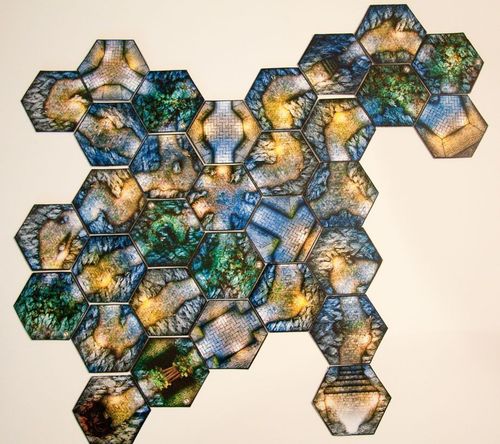
Patrol: Lost!
Patrol: Lost! Rulebook
Table of Contents
Table of Contents
Components
The game is made up of a relatively small set of components, as listed below.
Dice
You will need at least 3 standard six-sided dice, but 6 would be better.
Good Guys
You will need 5 markers or pawns to act as Good Guys. These can be counters, but it will look better if you use figures, such as those you can buy from "WargamesFoundary.com" or perhaps some paper figures such as those found at "JuniorGeneral.org" and "OneMonk.com".
You'll need three types of figure:
- Standard Good Guy: you'll need three of these. As an example of a standard Good Guy, if you were playing a zombie survival version of the game, this would be the family man armed with a cricket bat.
- Close Combat Specialist: you'll only need one of these. Once again, if you're playing zombie survival, this would be the guy with the chainsaw.
- Ranged Combat Specialist: in the zombie survival game this would be the guy with the shotgun.
Bad Guys
You'll need 18 Bad Guys, all of them the same. These are best represented as counters, rather than the figures used for Good Guys, because you'll find yourself stacking these up on the hexes/tiles.
Of course you could just use pennies but that's a little boring. The game is more enjoyable if the counters are faced with appropriate images, such as zombies, crazed loons or jungle monsters. If you can find magazines with appropriate pictures you can cut them out and stick them to cardboard to create your counters.
Terrain Tiles
The game board is built up as you play, and it is made up of 30 hexagon tiles of various types. Each hexagon shows the paths along which the Good Guys can move.
The hexagon art should be appropriate to the theme. So they should show such things as the back streets of Mogadishu, the dark cavern walls of the Hatred caves or the jungle paths of Voodoo island.
The manual describes each tile type in the text below, in the order it is printed. The manual's tile illustrations are not reproduced here. Editor's note: the tile illustrations and their count lines are laid out in two columns in the source PDF, so the pairing of a count sentence with a particular tile illustration is read from the printed order; check it against the manual's pictures if in doubt. Obvious typos in the source ("your" for "you're" in the zombie-survival sentence, "if the total if less") are corrected in the wording here, and the tile-type names are not given in the manual, so none are supplied.
The Start tile has exits out of all sides of the hexagon. This is where the Good Guys will be starting. You only need 1 of these.
The End tile, only has one entrance. This will represent the destination to which the Good Guys are heading. So it could be a rescue helicopter, the Stadium in Mogadishu or the exit from the Hatred caves. You only need 1 of these.
The next hex is a path that crosses the hex with a slight curve, you'll need 6 of these.
The next tile is a similar pathway tile, but it branches in three directions, you'll need 4 of these.
The next tile also has three exits, but it also contains a hazard that will slow down the Good Guys. You only need 1 of these.
The next tile is very simple, the pathway passes straight across it. You'll need 7 of these.
The next hex is a curve with a hazard. You'll need just 2 of these.
The next tile is a tight corner, two exits that run through adjacent sides. You'll need 4 of these.
The next tile type is a straight path across the hex, two exits, but with hazards. You'll need 2 of these.
Next is a Dead End hex. Similar to the End hex in that it only has one exit (entrance), but this will be a dead end. You only need 1 of these.
The last tile you need is a sharp corner two exits, with a hazard. You only need 1 of these.
Game Rules
The following are the basic, or core, rules of the game.
Setting Up
Place the Start Tile in the centre of the table. Set aside the End Tile, then shuffle the remaining tiles and place them aside face down. You will be drawing from this pile of tiles to build up the map as you play.
One player takes the Bad Guys counters and the other the Good Guys pawns or figures.
The Good Guys player places all of his pawns on the Start tile.
The Bad Guys player lays out all of the tiles that the Good Guys pawns can see, as described in "Placing Paths".
Once you've done these things you're ready to start playing the game.
Turn Sequence
A game turn is made up of 6 phases as listed below.
- The Good Guys player carries out his chosen actions.
- The Bad Guys player must remove certain tiles.
- The Bad Guys player places paths.
- The Bad Guys player carries out their chosen actions.
- The Bad Guys player attacks the Good Guys.
- The players ensure they haven't put too many of their pieces on any tile.
Good Guy Actions
Each Good Guy can do two actions each turn, although you may choose to do only one or even none at all. Do all of the actions for a single Good Guy before moving onto the next.
There are two types of action and the Good Guy may do one type of action twice, or one of each, entirely at the Good Guy player's discretion.
The first type of action is to move the Good Guy into an adjacent hex along one of the paths marked on the hex. The Good Guy may not move off of the path, or off a hex onto the open table.
When the Good Guy starts on a Hazard hex you are not able to just move him as an action. To move him you must first roll a die. If you roll 1, 2 or 3 you may move the Good Guy as normal. If you roll 4, 5 or 6 then the hazard has slowed your Good Guy down and your action is wasted.
Hazards can be anything appropriate to the theme. Perhaps the Good Guy is pinned down under heavy fire, or simply stuck in thick mud.
The other action a Good Guy can do is to attack Bad Guys. They can only attack Bad Guys on the same hex as the Good Guy. Good Guys roll 3 dice, or 6 dice for the Ranged Combat Specialist. Each six rolled counts as a hit and you remove one Bad Guy for each hit. Any hits above the number of Bad Guys in the hex are wasted.
Removing Tiles
During this phase the Bad Guy player checks to see if any of the tiles can be removed from play.
You can't remove any tiles the Good Guys can see from where they are, or that they could see should they move one or two hexes. If you suspect that you can remove a tile, imagine moving the Good Guys up to two tiles towards it; could they see it at any point? The Good Guys have a line of sight along any pathway until it reaches a curve.
When a tile is removed, it is discarded and will not come back into play. Any Bad Guys on a removed tile are returned to the Bad Guy player's pool of available Bad Guys.
Placing Paths
Doing this is quite simple. Look at each Good Guy pawn and the tile it is on; there are pathways leading from that tile.
The Good Guy can look along these paths until they reach a curve or a turn. If any of the paths don't lead to a tile, you need to extend the path as far as the Good Guy can see. For instance, on the Start tile at the beginning of the game there are six paths that the Good Guys can see down, but there are no tiles so they all need to be extended.
So start drawing tiles one at a time and placing them so that you build the pathways that can be seen by the pawn.
Complete one pathway before moving onto the next. When you place a tile you're not allowed to deliberately block a path by running into another tile where the paths don't align, but you can place them that way if you have no other choice.
You may not place the End tile until all of the other tiles have been used.
Bad Guy Actions
There are three types of action that the Bad Guy player can do and the Bad Guy player gets to do three actions. He can do three of the same type of action, three different types of action or any combination.
The first is to place new Bad Guys on the board. Any tile that leads off into the unknown (where there is no tile) is eligible for you to place two Bad Guys there. Dead ends and the End tile are not eligible.
The second type of action is to add two Bad Guys to any tile that already has a Bad Guy on it, but you may not bring the number of Bad Guys in the tile above six.
The last type of action is to move Bad Guys. Bad Guys do not have to move along pathways; they can move from any tile to any adjacent tile. They can not move off of the tiles.
A Bad Guy on his own may not be moved. When a group of Bad Guys are moved from one tile to another you must discard one Bad Guy back to your pool of Available Bad Guys. Bad Guys are not affected by Hazard tiles.
Bad Guy Attacks
During this phase, any Bad Guys in the same tile as a Good Guy may attack the Good Guys.
The Bad Guy player rolls a single die, and may add 1 to the score if the die roll matches the number of Bad Guys in that tile. If the total is less than the number of Bad Guys then the final score is equal to the number of Bad Guys.
The Good Guy player now rolls two dice and ignores the lower result. Add 1 to the score if the tile contains the Close Combat Specialist. If the Ranged Combat Specialist is on another tile but has a line of sight to the combat, add 1 to the result.
Having worked out the totals, the higher total is the winner.
If the Good Guys win, remove one Bad Guy to the Bad Guy player's pool and the Good Guy player chooses an adjacent tile to move the remaining Bad Guys to.
If both sides have the same score, the Bad Guys player moves the Good Guys to an adjacent tile along one of the pathways.
If the Bad Guys win, then remove one Good Guy permanently, any remaining Good Guys are moved to an adjacent tile along a pathway, the Bad Guy player chooses which one.
Clear up
In this final phase of the turn you ensure that you do not have too many Good Guys or Bad Guys on any tile.
The Bad Guys have a maximum limit of 6 for any tile. If there are any more Bad Guys on the tile they are removed back to the Bad Guy player's pool.
All tiles except the Start tile have a limit of 3 Good Guys. If there are any more Good Guys on a tile than are allowed, they are removed from play, just as if killed by the Bad Guys.
Winning Conditions
The Bad Guys win if they kill all of the Good Guys.
The Good Guys win if they end a turn with 1 or more Good Guys on the End tile.
Licensing
This game system and rules are in the Public Domain.