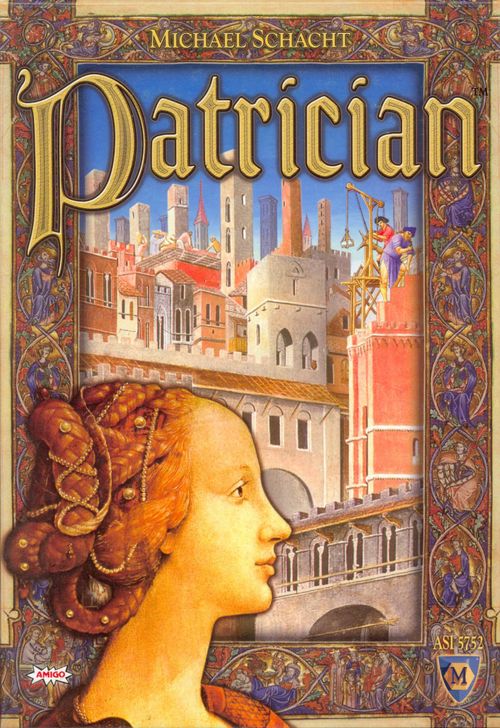
Patrician
Patrician Rulebook
Table of Contents
Table of Contents
Components
- 1 double-sided game board (front side for 2 to 4 players - without Pistoia; back side for 5 players - with Pistoia)
- 149 floors in 5 colors (39 in black, 39 in white, 29 in red, 21 in yellow, and 21 in blue)
- 20 fame tiles (two per city color/coat of arms)
- 55 building cards in 10 city colors/coats of arms:
- 7 cards from Bologna
- 7 cards from Firenze
- 4 cards from Ferrara
- 5 cards from Lucca
- 5 cards from Siena
- 5 cards from Milano
- 4 cards from Parma
- 7 cards from Pistoia
- 7 cards from Roma
- 4 cards from Verona
Card symbols
Each building card shows:
- A starting-card symbol (an asterisk) in the upper right corner on some cards.
- A city coat of arms, showing which city the card belongs to. A card may show one or two coats of arms.
- A patrician head, shown on some cards.
- A special-action symbol, shown on some cards.
Setup
With 2, 3, or 4 players, the 7 building cards bearing the orange coat of arms of the city of Pistoia, and the two matching fame tiles, are not needed and go back in the box. Lay out the game board. If 5 people are playing, the side with Pistoia must be face up; for any other number of players, use the side of the board without Pistoia.
Place the fame tiles, in the colors and coats of arms of the cities, number-side up on the two round spaces of their matching city.
Separate the building cards that show the starting-card symbol (asterisk) in the upper right corner from the rest of the cards and shuffle them. Each player is dealt 3 of these cards face down, which they take into their hand. The remaining starting-card-symbol cards are shuffled together with the rest of the building cards (the ones without the symbol) to form a face-down draw pile next to the game board. Now place one card face up from the draw pile onto each space bearing a city's name.
Depending on the number of players, the game is played with certain colors. Each player receives the floors of one color and lays them out as an open supply in front of them:
- With 2 players: 39 pieces in black or white.
- With 3 players: 29 pieces in black, white, or red.
- With 4 or 5 players: 21 pieces in any of the available colors.
Return any surplus floors to the box. Note: the colors of the cities and the players' colors are independent of one another.
A starting player is determined by lot.
Sequence of Play
The starting player begins the game, then play continues clockwise. On a player's turn, they carry out the following actions in exactly this order:
- Play a building card
- Build floor(s)
- Carry out a special action, if applicable
- Draw a building card
- Replenish the building card
Then it is the next player's turn.
1. Play a building card
The player plays one of the 3 building cards from their hand face up in front of themself. If a card is already lying in front of them, they place the new card on top of the previously played one. Over time this forms a stack of building cards in front of each player. A player may look through the cards in their own stack at any time.
2. Build floor(s)
For each city coat of arms shown on the played building card, the player now places one floor from their supply into the matching city. The two building plots of a city are always available for building - at the start of the game these are recognizable by their light-colored squares.
If a plot already has a floor built on it, another floor may be placed on top of it, forming a tower. If a player has played a building card with 2 city coats of arms, they may choose whether to place both floors on one tower, or one floor each on both towers/plots of that city.
The number of floors called for by the building cards is shown in each city (see the Roman numeral above the coat of arms) and is either 9, 7, or 5 - i.e., in a city marked "VII," a total of exactly 7 floors (distributed across two towers) will be built over the course of the game.
Exception: each tower must consist of at least one floor. If the last floor in a city is being built and one plot is still empty, that floor must be built on the empty plot.
3. Carry out a special action
If the played building card shows the special-action symbol, the player may relocate the topmost floor (of any player color) of a tower. The floor is placed on top of the other tower/plot of the same city. For the city in which the player wants to carry out the special action, the following conditions apply:
- It may not be the city in which the player has just built.
- The player must own at least one floor there.
- It must not yet have been scored (i.e., not all floors there have been built yet).
If a player cannot or does not want to relocate a floor, the special action is forfeited.
Example: Marianne (the red player) plays a Lucca card, builds a floor in Lucca, and wants to relocate a floor. She may not relocate in Parma, because she owns no floor there, and she may not relocate in Lucca, because she has just built there. She decides on Milano, since she currently does not hold the majority in the taller tower there. She relocates the topmost floor (black) from one tower to the other. Afterward, she has the most floors in the taller tower.
4. Draw a building card
The player takes into their hand the card lying next to the city in which they have just built. However, if their just-played card shows the symbol for taking a card from any city, the player may instead take a card from any city they choose. If a player builds in a city where no building card is currently laid out, they may choose a building card from any other city.
5. Replenish the building card
The top card from the draw pile must be placed face up onto the now-empty space of the city.
Special Situations
If the draw pile is used up, the "replenish" step is skipped. If there is no building card left on the game board at all, the "draw" step is also skipped.
Scoring a City
If - even during the course of the game - all the floors possible in a city have been built there, the city is scored immediately (the Roman numeral above the coat of arms equals the total number of floors in that city):
- The player with the most floors in the taller tower wins the more valuable fame tile displayed in that city.
- The player with the most floors in the shorter tower wins the remaining fame tile.
- All other players receive nothing.
If several players are tied for the most floors in a tower, the tie is won by whichever of them built the higher-positioned floor in that tower. Players place the fame tiles they have won face down in front of themselves. The towers remain standing until the end of the game. Note: a city that has already been scored can be recognized by the absence of its fame tiles.
End of Game
The game ends when no player has a building card left in hand. If the scoring of a city was forgotten, it is carried out now.
Each player then sorts the stack of cards lying in front of them by the patrician heads shown on them. For every 3 matching patrician heads, a player receives 6 fame points.
Each player adds up the fame points from their patrician heads and from the fame tiles they have won. The player with the highest score wins. If several players are tied for the highest score, the tie is won by whoever has more floors remaining in their supply. If there is still a tie, all the tied players are winners.
Example of final scoring
Marianne has received fame tiles worth 33 fame points.
She has played the following building cards showing patrician heads:
- 5 heads = 6 fame points
- 6 heads = 12 fame points
- 2 heads = 0 fame points
Together that makes 33 + 6 + 12 = 51 fame points.