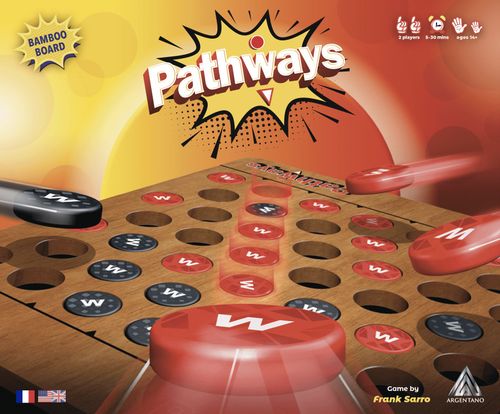
Pathways
Pathways Rulebook
Table of Contents
Table of Contents
Quick Start
Players take turns flicking their 12 disks from the starting (launch) area in front of them. The player with the most disks in the last row on the opposite side of the board is the winner!
Set up the game board on a level surface. You want the game board to be as flat as possible, though it can be laid on a thin tablecloth. The youngest player is the start player.
A disk must be flicked from a player's front launch area, and their finger must be off the disk before it crosses the launch line. Players take turns flicking one disk at a time. The flicking motion should be done with a finger in a fairly gentle, controlled manner, and players shouldn't use any kind of aid to push the disk.
A player is allowed to direct their disk to any place on the board (other than their own front row). They can hit any disk on the playing surface.
If a player flicks their disk, or if it lands in their own or the opposing starting launch area, that disk is removed from the game. There is one clarification to the rule above. If a disk lands halfway or more than halfway on the launch line, towards the centre of the board, it remains in play. If not, it is removed from the game.
You can only physically touch each of your own disks once directly. Disks on the board can be hit on the main play area by either player's disks.
Important Rules
A player cannot flick their disk or have it fall into their very front row, nearest their start area. This applies even if a disk drops into the first row from being hit by another disk. If this happens, the disk is removed and is considered out of play. Set it aside for the current game.
There are special "Disks Lifters" included in the game to help remove these from holes without disturbing the rest of the board.
If a disk falls into a hole and stands on end or at an angle so that the disk is mostly sitting in the hole, lay it flat. This counts as a valid shot, unless the disk is in your own front row (see rule above).
In the rare occurrence of a disk standing on its end on top of the board or leaning on another legal disk on the board, it is a valid shot and no attempt should be made manually to adjust the disk(s). These remain in active play and can be bumped normally by other disks.
Disks that are knocked off the board are considered out of play and are set aside for this round. Disks that balance on the two outside edges in the central area of the game board stay in play.
To clear the board for a new game, simply lift or tilt the board on the table and slide out the pieces.
Hints on Play
Use disks that fall into the holes to help create new pathways to use for your follow-up shots as you try to reach the opposite side of the board. If your opponent's disk is close to your side of the board, flick them to a less advantageous spot while improving your disk's placement.
Basic Scoring
At the end of the game, each player counts the number of their disks in the last row on the opposing side of the board. Whoever has the majority wins. In the event of a tie, replay your game.
Match Scoring and Game Play
We suggest playing a Match Game, described below, that takes about 30 minutes to complete.
The match win goes to the first player to reach 11 points. (This point threshold can be set to any amount agreed by each player in advance.) The included score card is set to 11 points, but the marker can be moved back to the bottom for a longer game.
Point Scoring in Match Games:
- Most in gets 2 points to winner only.
- Tie games, where each player gets at least one disk in: 1 point to each player.
- No score game, where neither player gets at least one in: 0 points are awarded.
- One player gets all seven disks in the opposing row: 4 points (a perfect game).
- Both players get all seven disks in the opposing row: 4 points each (a two-player perfect game).
In the case that two players reach the 11-point threshold at the same time due to tie game scoring, continue to play single games until there is a clear winner without a tie. To keep track of this, you can simply move the score markers down to the bottom of the scorecard and start up the track again.
Match game player order is determined as suggested above; the youngest player starts the match (this rule can be modified as agreed by each player in advance). After this, use the following rule for order of play:
- An individual game winner starts the next game in a round.
- In the result of a tie game (whether points are scored or not), change the rotation on the starting player for the next game in the match.
Example: Sarah won the first game of a match, so she will flick first in the follow-up game. In that next game, Sarah and her partner tie the game. For the very next game in their match, her partner will flick first. If they were to tie again, Sarah would again flick first in the next game.
Switch sides of the board and disks for your second match.
Double Row Scoring
These rules are to be played on the side of the board with the numbering in the back rows.
This mode makes it a little easier to score points while still maintaining a good competitive game. This can give the game more feeling of progression, and it also makes it easier for newer or younger players.
The main difference is you now score for the back two rows instead of just the back row in the primary game mode. See the illustrations below.
The game plays exactly the same way with all the same rules; the only difference is in the scoring.
Note the numbers printed on the backside of the board. The back row now scores 2 points for each of your disks, and you now score 1 point for each of your disks that land in the next closest row.
Example (see the board illustration in the rulebook): the red disks are scoring 4 points and the black disks are scoring 6 points.
The way the final tally is scored in this mode is to take the difference between the two scores. In the example above, the final tally would be 6 - 4 = 2 points. Black would record 2 points on the scoring dial.
In the case of a tie:
If both players end the game with the same number of points, there is obviously no difference in scoring. At this point, use the same rules in Point Scoring in Match Games to settle the tie.
Important note: Like the original rules, an opposing disk is not allowed in the opposing player's scoring row (or the row that scores 2 points on this side of the board). If this happens, it is an illegal shot and the disk is removed from play. However, this rule does not apply to the 1-point scoring row. Either player can land in this row, on either side of the board, without penalty.
Alternate Bonus Game: Three in a Row
Players use their 12 disks to try to get 3 of their own disks in a row. These disks must be set within the last 4 rows on the opposite side of the board. The disks can be in any configuration as long as they are in a direct line. (Yes, we tried 4 in a row, but it was just too difficult to accomplish!)
The entire other Pathways rule set applies to Three in a Row. Remember, your own disks cannot be placed or land in your front row. If your disk falls into these spots, they are removed from play.
Scoring is the same as the basic scoring in Pathways.