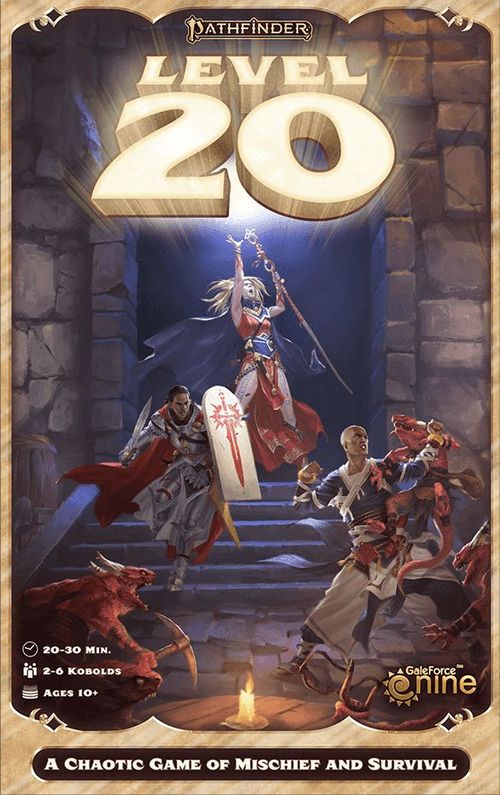
Pathfinder: Level 20
Pathfinder: Level 20 Rulebook
Table of Contents
Table of Contents
Components
- 1 Game Board. The kobold den where the game takes place, and the kobolds were hoping to live out their normal lives.
- 6 Kobold Standees. One standee for each player, representing their kobold in the den. The facing of the standee has no effect.
- 2 Fighter Standees. The 19th level fighter attempting to exterminate enough kobolds to hit level 20. The antagonist of the game. In a game with four or more players, there are two 19th level fighters to worry about! Each Fighter Standee has a front and a back. The side of the standee indicating the front of the fighter is the direction they are facing. When moving the fighter, facing matters! So players need to make sure that the fighter is facing in a horizontal or vertical direction, not diagonally.
- 1 First Player Token. Denotes the first player in the game.
- 8 Pride Tokens. There's no way that a group of kobolds could possibly do enough damage to a 19th level fighter to do any lasting injury. But, a fighter who has reached this level of experience has a certain amount of pride. If they lose all their pride, they become too embarrassed and will flee seeking easier prey to earn their last bit of XP. Once the last Pride Token is removed, the fighter runs away and one of the kobolds will be named the savior.
- 16 Junk Tokens. Piles of junk in the den where kobolds can find treasure they might be able to use to delay the fighter or make a last minute escape. The tokens have different artwork, but are all treated the same.
- 20 Obstacle Tokens. Represent various items (5 stalactite, 12 moss, 3 spoiled food) placed by the kobolds in an attempt to delay or injure the fighter.
- 28 Kobold Treasure Cards. Treasure that kobolds find under piles of junk in their den. They can use these cards to lay traps or perform quick escapes.
Setup
Important Note: The rules are written from the perspective of a game with 2–3 players. There are a few changes in a game with 4–6 players. These differences in the rules are called out using special text. Any rules specific to the game involving four or more players will be called out and written in this format.
-
Place the board in the center of the table.
-
Place the 16 Junk Tokens as shown in the diagram, right. All Junk Tokens work the same way, the specific artwork is not important.
-
Shuffle the deck of Kobold Treasure Cards and give each player two facedown cards. Place the remaining cards in a facedown deck next to the board.
-
Place five Pride Tokens next to the board where all the players can see them (which side doesn't matter).
If there are four or more players, place all eight Pride Tokens next to the board.
-
Place the 20 Obstacle Tokens and 6 Hidden Tokens within easy reach of all players.
-
Each player takes the following.
- The Kobold Standee of their choice.
- Three Ferocity Tokens.
-
The first player is the person who most recently acquired some treasured junk, they take the First Player Token. Play will proceed clockwise around the table from the first player.
-
Place the first player's Kobold Standee in the spot marked "1" on the board. Place the other Kobold Standees on the board in the numerically indicated spots based on their turn order.
-
Finally place the Fighter Standee at the illuminated den entrance. The starting facing for the fighter is indicated on the setup diagram.
If there are four or more players, place the second Fighter Standee at the darkened den entrance.
You are now ready to begin.
Setup Diagram (5-player game is shown). The printed diagram shows the board layout for a 5-player game, with the placement of the Junk Tokens and the numbered Kobold Standee spots.
Gameplay
Objective
The game ends when one of the two following conditions are met:
- The game ends when only one kobold remains. At that point, the fighter has received enough experience to hit level 20 and has no interest in wasting time on more vermin. The fighter leaves to begin their quest for divinity. The player who was not slain wins the game... until another fighter finds the den.
- Of course, the game could end if one of the kobolds makes the fighter run away. If the fighter loses their final Pride Token, they've had enough of the cursed kobolds and decide to show their bravery by running out of the den. In this case, whichever kobold dealt the final blow is named the savior and wins the game!
In a larger game, both fighters will run away when they lose their final Pride Token. The fighters share in their embarrassment and will swear each other to secrecy if they are forced to retreat.
Rounds
The game is played over a series of rounds with the following phases.
- Kobold Turn
- Fighter Activates
- First Player Token Rotates
1. Kobold Turn
Clearly, the kobolds want to stay away from the fighter. After all, what chance do lowly kobolds have against a 19th level warrior?! In order to do this, the kobolds need to be quick on their feet and use the obstacles in the kobold den to their advantage.
Each kobold gets a chance to move, starting with the first player and going clockwise around the table until each player has their turn. A player has two movement points on their turn. However, they can spend any number of Ferocity Tokens to gain additional movement points. They gain one movement point for each spent Ferocity Token. See "Ferocity Tokens" on page 7.
When moving, a kobold can enter any neighboring location for one movement point. Diagonal movement is allowed and they can run through spaces with other standees. The two staircases are also squares that may be entered.
Kobolds must end their movement in a space without any standees.
Truly daring kobolds can even run through the fighter's legs! That's the good thing about those big fighter types - they're slow to react. All that armor keeps them from moving too fast.
Junk Tokens
If a kobold enters a space with a Junk Token, they may spend a movement point to search through it. The kobold discards the Junk Token and chooses one of the following options:
- Gain a Kobold Treasure Card. The hand limit for Kobold Treasure Cards is three. If a kobold ever gains a fourth, they must immediately discard down to three.
- Gain two Ferocity Tokens. The maximum number of Ferocity Tokens a kobold can have is three. If they already have two Ferocity Tokens when searching a Junk Token for ferocity, they only gain one Ferocity Token.
A kobold can search multiple Junk Tokens in a single turn, provided they spend the necessary movement point each time.
Kobolds must spend all of their movement points. They cannot voluntarily give up movement points and they cannot end their movement on the same space where they started their turn.
Ferocity Tokens
A player can spend any number of Ferocity Tokens on their turn. There are two possible uses for Ferocity Tokens:
- Gain one movement point for each Ferocity Token used.
- Take cover, making it so that the fighter will not target the kobold. A kobold can do this in any square. While the kobold won't be targeted, the fighter will still kill the kobold if they enter the kobold's square. The kobold player places a Hidden Token next to their standee showing they cannot be targeted this turn. The token is removed at the start of the kobold player's next turn.
Sometimes, a kobold just needs to hide. That's how you get to be an old kobold, knowing how to bury yourself under rags and scraps of clothing! Of course, if the fighter steps on a kobold, it will still hurt. After all, those boots are heavy! And a quick panicked squeal might result in getting a sword to the gut.
Kobold Movement Example
The yellow Kobold spends 2 movement points to move 2 squares (1, 2), spending a Ferocity Token to gain 1 movement point and immediately using it to remove the Junk Token (3) and draw a Kobold Treasure Card.
2. Fighter Activates
The fighter is desperate to hit level 20 and will walk through almost anything in their blind quest to achieve this goal. Their dedication and single-mindedness could be admired, if it didn't involve the death of kobolds! Instead, you'll have to learn to be sneaky and take advantage of their predictability.
When there are two fighters, always activate the female fighter first. Both fighters follow the same activation rules.
Target a Kobold
The first step in determining the fighter's movement is to identify the target kobold. The target kobold is the closest kobold within the fighter's line of sight. The fighter can see anything in the 180 degree arc in front of them, including directly to their sides. In other words, if there was a line extending through the fighter's sides, anything on or in front of that line would be in the fighter's line of sight.
The closest kobold is defined as the kobold that the fighter needs to spend the fewest movement points to reach. Fighters must walk forward or diagonally forward. They cannot walk sideways. If a fighter needs to turn to reach a kobold, turning the fighter costs a movement point. If there's a tie between multiple kobolds, the fighter will chase whichever one of the tied kobolds that moved first this turn.
If the fighter can't see a kobold, they turn around 180 degrees (spending two movement points to do so) and then look for the closest kobold. If there are still no visible kobolds (e.g. they are all invisible), the fighter moves forward two spaces.
Fighters are obsessed and not very smart! As soon as some movement catches their attention, they need to chase after it!
When playing with two fighters, the second fighter will not target the same kobold as the first fighter. It has something to do with the fighter code or some such. Treat that kobold as if they were invisible and could not be selected as the target. However, if the second fighter happens to enter the space with the kobold, they will still slay the kobold. After all, fighters are nothing if not opportunistic.
Fighter's Line of Sight Example
The fighter standing at (1) can see kobolds in any of the squares outlined in white.
Fighter Moves
The fighter has four movement points on their turn. If the fighter needs to turn to reach the kobold, they will do so before taking any steps.
Each 90 degree turn requires one movement point. Then the fighter moves diagonally forward until they are in a straight line with the kobold. Then they march forward until they reach the kobold, a Stalactite Token, or they run out of movement points.
The fighter will blindly charge into obstacles if they can. Junk Tokens do not affect the fighter's movement. If they enter the space of any kobold, they slay it and that player is removed from the game. Remove that Kobold Standee from the board, and any Kobold Treasure Cards in their hand are discarded. This ends the fighter's movement, even if they were sliding in moss.
Fighters will not enter the space of another fighter. If one fighter's path causes them to bump into another fighter, they immediately end their turn and lose any additional movement points, even if they were sliding on moss.
Fighters are a predictable bunch, and it's easy enough for a smart kobold to know where a fighter will go. If you doubt this, just look at the following scrolls on pages 10–11. They clearly show exactly where the fighter will go! If only they weren't so fast, or tough, or strong...
3. First Player Token Rotates
At the end of every round, after the fighter moves, the First Player Token rotates one spot clockwise.
Defeated Kobolds
If the First Player Token would pass to a player who has already been defeated, the First Player Token continues to the next player in a clockwise direction until it is given to a player yet to be eliminated.
Remember that the game immediately ends when there is only one kobold remaining.
Appendix A: Fighter Examples
Example 1: The fighter chooses a target
Diagram: Example 1 shows the fighter, five spaces away from a red kobold, and a teal kobold within reach, with the fighter's movement numbered on the board.
The fighter is facing South, looking directly at the red kobold who is five spaces away. It would take the fighter five movement points to reach the red kobold. In order to reach the teal kobold, the fighter would have to turn 90 degrees to the West (one movement point), and then spend three movement points to reach the teal kobold. This means that the teal kobold will be the target since it will require fewer movement points to reach.
Then the fighter moves: First the fighter rotates 90 degrees. Then they move diagonally Southeast to get on the same line as the teal kobold. They spend two more movement points to advance in a straight line into the teal kobold's square. This will kill the kobold and eliminate that player from the game. Sadly for the teal kobold, they were just within reach of the fighter.
Example 2: Look for kobolds, then choose a target
Diagram: Example 2 (above and below) shows the fighter's position and movement, with the numbered squares marked on the board.
The blue kobold used a Ferocity Token to hide, so the fighter currently can't see any kobolds. Therefore, the first thing they do is turn around. This costs them two movement points and so they have two remaining.
Now that they are facing the opposite direction, the fighter can see both the white kobold and the yellow kobold. To reach the white kobold, the fighter would have to spend four movement points (moving Northwest diagonally twice, and then North twice). In order to reach the yellow kobold, the fighter would have to also spend four movement points (turn 90 degrees to the East, move Northeast once, then move East twice). These two kobolds are considered the same distance from the fighter. Remember that closeness is defined as the number of movement points it would cost the fighter to reach the kobold — not the number of squares of distance. The white kobold moved first this turn, so the fighter targets them.
Then the fighter moves: The fighter moves Northwest diagonally twice to position B, using up their remaining two movement points. This ends the fighter's turn.
Appendix B: Kobold Treasure Cards
Each player starts the game with two Kobold Treasure Cards and has the opportunity to gain more over the course of the game by searching junk piles. The maximum number of cards a player can have is three. If a player has three cards and wishes to search a junk pile, they draw a Kobold Treasure Card and then discard their card of choice.
Most Kobold Treasure Cards must be played on a player's turn. Playing a card does not cost any movement points. There's also no limit to the number of cards a player can play in a single turn. However, a player can never play a card that would place a token on top of one that already exists, including on top of an existing Junk Token.
Stalactite
Playing this card causes a stalactite to fall from the ceiling. The kobold chooses a square next to their current location as the target square. Place a Stalactite Token in that square. If the fighter is in that square, they lose a Pride Token and miss their next turn. The player still places a Stalactite Token under the fighter if the fighter is in that square.
Remember that a player cannot play a card that would place a token on top of one that already exists, so a Stalactite Card cannot be played to injure a fighter if the fighter is currently standing on top of any kind of token.
Diagram: Stalactite Example. The red kobold plays a Stalactite Card to place a Stalactite Token in one of the eight surrounding squares that does not already contain a token. Only the squares outlined in white are legal positions in this case (1). Of course they choose to drop it on the fighter's head and return 1 Pride Token to the box (2).
Stalactite Tokens limit the fighter's movement. If the fighter would step into a Stalactite Token, their movement ends instead. If the fighter ever ends their movement next to a Stalactite Token (or multiple), they will immediately hack the fallen rock to bits with their sword. Remove the Stalactite Token(s) from the board. The one exception to this rule is if they are standing on top of a Stalactite Token because they were just hit with a stalactite.
Kobolds can pass through Stalactite Tokens without any problems. They can even stop on a Stalactite Token and use it as protection from the fighter. It will not prevent them from being targeted, but the fighter cannot reach them. When the fighter destroys the Stalactite Token, the kobold survives! For now.
Sliding into Stalactites: If the fighter would slide into a Stalactite Token, it is considered a wall. The fighter loses a Pride token and then removes the Stalactite Token.
Spoiled Food
The player places a Spoiled Food Token in their current space. This has no effect on kobolds, but if the fighter enters a space containing a Spoiled Food Token, their turn immediately ends and they lose a Pride Token. Not only that, but they only have two movement points on their next turn. At the start of the fighter's next turn, remove the Spoiled Food Token as a reminder of their reduced speed.
Diagram: Spoiled Food Example. The white kobold expects the fighter to chase them, so they play a Spoiled Food Card to place a Spoiled Food Token in their current square.
Moss
The player places a Moss Token in their current space. This has no effect on kobolds, but if the fighter enters the space with the Moss Token, they lose the rest of their movement points. They move two more squares in the same direction they were moving when they entered the space with the Moss Token. If they cannot move a full two squares because they reach the edge of the board, they slam into the surface and lose a Pride Token.
Of course, if the fighter enters a space with a kobold, they grab on tight to keep from sliding any further. This stops their slide, but doesn't go too well for the kobold. Such a maneuver kills the kobold unlucky enough to be grabbed.
Keep in mind that if the fighter hits a second (or more) Moss, they slide an additional two squares. There is no limit to the number of times a fighter can chain Moss effects.
If the fighter loses their final Pride Token because they slipped on Moss and hit the wall, the kobold they were targeting is declared the kobold champion and wins the game!
Sliding into other fighters: If a fighter slides into another fighter, it stops their movement and they only lose a single Pride Token.
Diagram: Moss Example. Last to take a turn this round, the blue kobold expects the fighter to chase them. Sensing an opportunity, they play a Moss Card to place a token (1) and then move to the position shown (2). By moving into newly-placed Moss, the fighter would slide 2 squares in a straight line into the existing moss (3), then into the wall and lose 1 Pride! See Fighter Activates, page 8.
Rock Tunnel
This is the only card that a kobold can play when it isn't their turn. A kobold plays this card when a fighter enters their space. They immediately move one space in any direction, except the space the fighter moved from. Doing so avoids getting caught by the fighter! Not only that, but the fighter loses any remaining movement points as they search around for the kobold.
Of course, if the fighter was slipping on moss, they'll keep on sliding! Hopefully they'll slide into a wall when the kobold skirts away.
Diagram: Rock Tunnel Example. The fighter's movement will take them into the red kobold's square. By playing a Rock Tunnel Card, the kobold can safely escape to one of the seven squares outlined in white (1). See Fighter Activates, page 8.
Quick Reference
1. Kobold Turn (clockwise from first player)
- Use 2 Movement Points (MP).
- Spend Ferocity for +1 MP.
- Spend 1 MP to remove Junk:
- gain up to 2 Ferocity (max 3)
- or draw 1 Kobold Treasure (hand limit 3).
- Play any number of Kobold Treasure Cards from your hand.
2. Fighter Activates
- Spend up to 4 MP to move to the kobold that requires the fewest MP to reach. If tied, choose the kobold who went first.
- Each 90º turn costs 1 MP. If no kobolds can be seen, first spend 2 MP to turn 180º. If no kobolds can be seen after turning around, move forward 2 squares.
- Move diagonally first, then straight.
- When the fighter enters a square with a kobold, kill it and end movement.
3. First Player Token rotates
Kobold Treasure
- Stalactite (page 12)
- Place the token in an adjacent square. Kobolds ignore this token.
- If placed on top of a fighter, the fighter loses 1 Pride and skips their next turn.
- Fighters stop moving before they would step into this square.
- When a fighter's movement ends (by any means), they remove all adjacent Stalactite Tokens.
- Spoiled Food (page 13)
- Place the token in your square. Kobolds ignore this token.
- Fighters entering this square end their movement, remove the Spoiled Food Token, and lose 1 Pride. The fighter has two less movement points in their following turn.
- Moss (page 14)
- Place the token in your square. Kobolds ignore this token.
- Fighters entering this square end their movement and slide 2 squares along the same heading they entered from. This effect can chain. If a fighter slides into a square with a kobold, kill it and end the slide. If the fighter cannot complete a slide because of a wall or Stalactite Token, they lose 1 Pride.
- Moss tokens are never removed.
- Rock Tunnel (page 15)
- Play this card when a fighter enters your square.
- You are not defeated. Instead, move to any adjacent square other than the one the fighter just came from.
- The fighter's movement ends unless they were sliding.
You cannot place tokens on top of existing tokens, including junk!