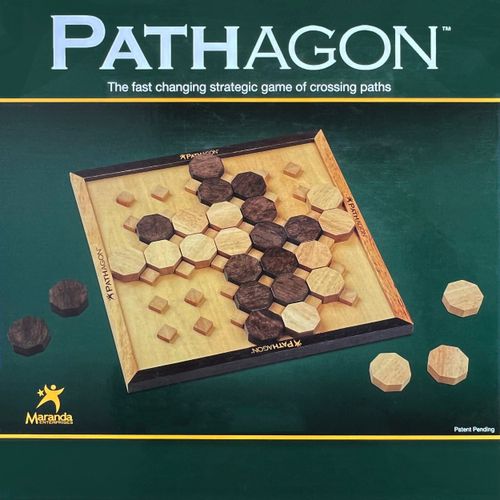
Pathagon
Pathagon Rulebook
Table of Contents
Table of Contents
Objective
To be the first player to complete a path connecting one edge of the game board to the opposite edge with game pieces of the same color. (See Figure 1.)
Figure 1 shows a winning path of dark game pieces between the dark edges of the game board (labelled DARK EDGE at top and bottom, LIGHT EDGE at left and right).
Set Up
Remove the game from the packaging. Players choose colors and gather the 14 octagon-shaped game pieces of their chosen color.
To Play
Players determine which player will play first. Starting with an empty game board, the first player will place a single game piece in any of the 49 positions on the game board. Players then alternate turns, with each player placing a single game piece on the board per turn. Play continues until one player has completed a path.
To qualify as a winning path, all pieces on the path:
- Must be the same color.
- Must be directly adjacent to one another with sides touching (pieces that are only connected to each other diagonally are not on the same path).
- Must connect the two opposing edge pieces of the same color. In Figure 1, the two dark edges of the game board are connected by a path of dark game pieces.
Note - Path does not have to be straight.
Trapping
A player can trap an opponent's game piece between two of their own pieces, remove it from the board and return it to their opponent. (See Figure 2.) In Figure 2, Player A has a game piece directly adjacent to Player B's. The space on the opposite side of Player B's piece is unoccupied. Player A may place a game piece in the unoccupied space and remove the "trapped" piece and return it to Player B. Player B must then use the next turn to return the game piece back to the board in any position except the space from which it was just removed. Once Player B has placed the game piece back on the game board, the space made empty by the trapping move may be used by either player.
Figure 2 (Trapping Move): Player A "traps" Player B's game piece and returns it to Player B.
Important rules about trapping
- A player can only trap one of their opponent's game pieces in each direction in a single move.
- Two adjacent game pieces of the same color cannot be trapped in the same row in the same direction.
- A player may "trap" more than one of their opponent's game pieces in a single turn, but the traps must be done in different directions, trapping only one game piece in each direction. (See Figure 3.)
- When more than one game piece is returned to a player during a single turn as the result of a multiple direction trap, only one piece can be returned to the game board during each turn.
Figure 3 (Multiple Trapping Move): Player A "traps" Player B's game pieces and returns them to Player B.
Moving Game Pieces
In some cases, one or both players may place all fourteen of their game pieces on the game board without completing a game winning path. When this occurs, play continues with players moving game pieces that are already on the game board. To move a game piece during a turn, the player simply picks up a game piece of their own color and moves it to another unoccupied spot on the game board. (See Figure 4.)
Figure 4 (Moving Game Pieces): a dark piece is "moved" from this spot to the position shown for the win.
Important rules about moving game pieces
- A player may not move a game piece unless all of their game pieces are already on the game board.
- Game pieces that are trapped and returned to a player must be returned back to the game board before pieces on the board can be moved.
- The same game piece may not be moved two turns in a row.
Winning
The first player to complete a path connecting one edge of the game board to the opposite edge with game pieces of the same color as the edges, is the winner.