Pass the Party Food
Pass the Party Food Rulebook
Table of Contents
Table of Contents
Game Contents
- 1 score board
- 4 player boards: Each player has their own board where they store the food tiles they have collected. At the top are plate spaces that you use to distribute food tiles each turn.
- 1 Ziggy board: Ziggy gets a food tile every turn and they are stored here. The top of the Ziggy board shows some diagrams that help you remember the rules.
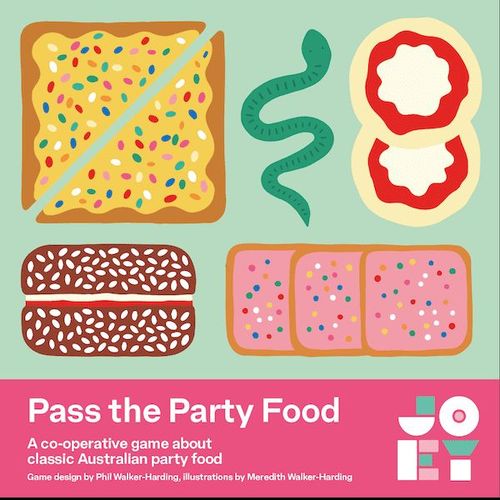
- 80 food tiles: Everyone is trying to collect sets of food tiles to score points. There are 20 green snakes, 20 biscuits (pink), 15 fairy bread (yellow), 15 pikelets (red) and 10 lamingtons (purple).
- 4 player pawns and 1 Ziggy pawn: These are used to mark how many points the players and Ziggy have on the score board.
- 8 swap tokens and 4 take tokens: The players can spend these tokens to take special actions.
- 1 drawstring bag: This is used to store the food tiles.
The score board is used to keep track of everyone's points. If you all make it to the birthday cake space without Ziggy catching you, you win the game!
Setting Up the Game
Connect the 2 pieces of the score board and place it in the middle of the table. Place the Ziggy board near the score board.
Each player chooses a colour and places the corresponding player board in front of them. In a 3 or 4 player game use the side with 3 plate spaces at the top. In a 2 player game, use the side with 2 plate spaces. Leave any unused player boards in the box.
Each player takes 2 swap tokens and 1 take token and places them face-up beside their player board. Leave any unused swap and take tokens in the box.
Each player takes the player pawn of their colour and puts it on the scoreboard on the space with the white pawn icon. Place the Ziggy pawn on the score board on the space with the grey dog paw icon.
Place all the food tiles in the bag. Give it a good shake. Each player starts with 2 food tiles, taking them randomly from the bag and placing them on their player board. Place your food tiles on the top-most spaces with the matching pictures.
Ziggy starts with 3 food tiles. Take 3 random tiles from the bag and place them on the Ziggy board. Place Ziggy's food tiles on the top-most spaces with the matching pictures. Ziggy may only start with at most 1 lamington tile on his board, so if you draw a second lamington return it to the bag and draw another tile.
During the game, the players will discard some food tiles. Discarded food tiles will be kept in a discard area beside the score board.
How to Use the Boards and Food Tiles
During the game, you will be collecting food tiles and storing them on your player board. Whenever you receive a food tile, place it on your board on a vacant space with the matching picture. You must place it on the top-most vacant space.
If you ever receive a food tile and you have no vacant space for it, you must instead place that tile in the discard area.
If there is ever a vacant gap in a column on your board, immediately slide the food tiles below the gap upwards so they fill it in.
You are trying to collect complete sets of food tiles. A complete set is either a full column of 4 of the same food tile, or a full row of 1 of each food tile.
When you have a complete set you can score it. To do this, take the food tiles that make the set from your board and put them in the discard area. The number of points a set is worth is listed at the end of its row or column. You then move your pawn this many spaces forward on the score board towards the birthday cake space.
The Ziggy board works in a similar way to the player boards. Every turn a food tile will be added to Ziggy's board, which represents food Ziggy has grabbed off the table. So follow the above rules when you place a tile on Ziggy's board, when there is no vacant space for it and when there are gaps.
Ziggy also scores complete sets of food. When there is a full row or column on the Ziggy board, discard the tiles in the full set and move the Ziggy pawn on the score board. Ziggy's board is different though. Ziggy only needs 3 food tiles to complete a column and scores more points for a complete row than the players do.
Playing the Game
This game is co-operative, which means all the players will either win together or lose together.
You win by getting every player's pawn to the birthday cake space on the score board. You lose if Ziggy catches any player on the score board, or if Ziggy makes it to the birthday cake space.
The oldest player takes the first turn of the game, and then the players take turns moving clockwise around the table until they win or lose.
On your turn, follow these steps in order:
- Draw a food tile for Ziggy
- Check if Ziggy scores a set of food tiles
- Draw and distribute 3 food tiles
- You may score a set of food tiles
- Check if Ziggy has caught you
Here is how each step works in detail.
1. Draw a food tile for Ziggy
The first thing you do on your turn is see what food tile Ziggy has grabbed. Take 1 random food tile from the bag and place it on the Ziggy board.
2. Check if Ziggy scores a set of food tiles
If there is now a complete set of food tiles on the Ziggy board, Ziggy will score it. Follow the rules for scoring a set on page 5 and move the Ziggy pawn on the score board. On the rare occasion that there is more than 1 complete set on Ziggy's board, you choose which 1 to score.
If the Ziggy pawn moves through a space with a lucky dip or lands directly on it, Ziggy gets a special bonus. Draw a random tile from the bag and place it on the Ziggy board. If this new tile means Ziggy has completed a new set of food, it is not scored until the next turn.
If the Ziggy pawn enters the birthday cake space, it stops moving immediately. Ziggy's behaviour is just too much, and you must stop the party to clean up after him. This means the game is over, and you have all lost!
3. Draw and distribute 3 food tiles
Next you must draw 3 random food tiles from the bag, one at a time. You will then distribute them, giving 1 to the player on your left, 1 to the player on your right and keeping 1 for yourself. Figure out which players need which food and try and give those tiles to them! Here's how it works in detail.
First, draw a food tile from the bag and place it on any of the 3 plate spaces at the top of your player board. Next, draw a second food tile from the bag and place it on either of your remaining vacant plate spaces. Then draw a third food tile from the bag and place it on your remaining vacant plate space.
Now you must distribute these 3 food tiles. Give the food tile on the left plate space to the player sitting to your left. They place it on their player board. Give the food tile on the right plate space to the player sitting to your right. They place it on their player board. Place the food tile in the centre plate space on your own player board. The order in which you distribute the tiles does not matter.
If you are playing with only 2 players, this step of your turn works a bit differently. The 2 player side of the player board has only 2 plate spaces and 1 'X' space. When drawing food tiles, you must place 1 of them on the 'X' space, just as you would on a plate space. When you distribute food tiles, you place the tile on the 'X' space in the discard area. Give the food tile on the left plate space to the other player. They place it on their player board. Place the food tile in the centre plate space on your own board.
4. You may score a set of food tiles
If there is now a complete set of food tiles on your player board, you may choose to score it. Follow the rules for scoring a set on page 5 and move your pawn on the score board.
If you move through a space with a lucky dip or you land directly on it, you get a special bonus. Draw a tile from the bag and place it on your player board. If this new tile means you have completed a new set of food, you have to wait until next turn to score it.
If you move onto the birthday cake space and have extra moves left, stop moving. You have made it to the end of the score board and have brought your team closer to winning! For the rest of the game you may no longer score a set of food tiles, but you do the other steps of your turn as usual.
5. Check to see if Ziggy has caught you
If Ziggy's pawn is now on the same space as your pawn, or ahead of your pawn, then you have been caught! Ziggy's behaviour is just too much, and you must stop the party to clean up after him. This means the game is over, and you have all lost!
Using Swap and Take Tokens
At any time on your turn, you may choose to use a swap or take token that you have face-up beside your player board. Each token gives you a one-use special action, as described below. Discuss with the other players when is the best time to use them!
After using a swap or take token, turn it face-down. It may not be used again. You may use any number of face-up tokens on your turn, and you may use them at different times on your turn.
Swap tokens let you swap a food tile with another player so you can complete sets faster. When you use a swap token, take any food tile from your player board and give it to any other player. They place it on their player board. Then that player must give you a food tile from their player board. You place it on your player board.
In order to swap with a player, they must have at least 1 food tile on their player board. The other player must agree to the swap. Only the player whose turn it is needs to use a face-up swap token to make a swap happen.
Take tokens let you take a food tile from Ziggy's board to slow Ziggy down. When you use a take token, take any food tile from the Ziggy board and place it on your own player board.
Important Rules
- If at any time the bag is empty, immediately take all the food tiles in the discard area and put them in the bag. Give it a good shake and continue playing.
- You can only score a set of food tiles on your own turn, even if you have a full set at another time.
- You may only score 1 set of your food tiles per turn.
- You can only get caught by Ziggy at the end of your own turn. It does not matter if he is on the same space or ahead of you at any other time.
- Any number of pawns may occupy the same space on the score board.
Winning the Game
If all the player pawns are on the birthday cake space of the score board, you all immediately win the game together! You all enjoy the party and even manage to calm Ziggy down. Congratulations!
Changing the Difficulty Level
If you would like to change the difficulty level of the game, simply change the number of food tiles you put on Ziggy's board during setup.
For an easy game, start with 0 tiles on Ziggy's board. For a difficult game, start with 6 tiles. Choose any number between 0 and 6 to find your preferred difficulty.
Remember, Ziggy may only start with at most 1 lamington tile on his board, so if you draw a second lamington return it to the bag and draw another tile.
If you choose to start with 4 or more tiles on Ziggy's board, you may fill a row or column during setup. If this happens, do not score the set until step 2 of the first player's turn. If you draw a food tile during setup for which there is no vacant space on Ziggy's board, return it to the bag and draw another tile.
Remembering the Steps of a Turn
The diagrams at the top of the Ziggy board illustrate the 5 steps you take on your turn. This can help you remember what they are. You can also refer to these diagrams when teaching the game to new players.
The first diagram represents steps 1 and 2. The second diagram represents steps 3 and 4, and the third diagram represents step 5. The take and swap tokens are a reminder that they can be used at any time on a player's turn.
About Classic Australian Party Food
There's a tradition of serving all sorts of fun party food at kids birthday parties in Australia. Here's a little bit about the food we included in the game.
- Green Snakes: Sweet and chewy jelly snakes are a popular sweet in Australia. They come in many colours.
- Hundreds and thousands biscuits: A vanilla biscuit topped with pink icing and coated with tiny round multicoloured sprinkles called 'hundreds and thousands.'
- Fairy Bread: Fairy Bread is white bread cut into triangles, spread with butter or margarine and topped with rainbow sprinkles. The name likely comes from Robert Louis Stevenson's 1885 poem titled 'Fairy Bread.'
- Lamingtons: Lamingtons are squares of butter cake or sponge cake coated in chocolate sauce and covered in desiccated coconut. Sometimes a lamington is split in two and sandwiched together with jam and cream. This popular treat is thought to be named after Lord Lamington, the Governor of Queensland from 1896 to 1901, or his wife Lady Lamington.
- Pikelets: Pikelets are like very small pancakes with a heavier texture. They are made with eggs, self-raising flour and milk and are served topped with jam and cream. The pikelet is believed to originate from Wales, where it was known as 'bara pyglyd,' which was later anglicised as 'pikelet.'