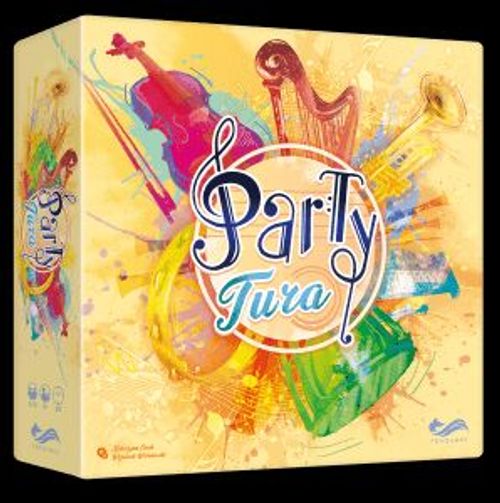
PARTYtura
PARTYtura Rulebook
Table of Contents
Table of Contents
Components
- 96 Instrument cards (2 sets of 12 cards for each of the 4 instruments)
- 42 Piece cards (14 cards for each game variant)
- 2 music stands
- 24 Hindrance cards (double-sided)
Assembling the Music Stands
Each stand consists of 3 pieces, which must be pushed out of the tray before the first game.
To assemble a stand:
- Bend all the pieces along the cut lines.
- Place piece A into the base marked with the letter B.
- Place piece C on top of piece A.
The pieces have alignment markers to help centre them.
Setup
The setup below applies to the cooperative variant for 3–5 players. Changes to setup for other player counts are described in the Variants section on page 7.
-
Choose one of the players to be the Conductor. The Conductor's task is to indicate to the other players, who will be the Musicians, how to play the drawn Piece.
-
The Conductor sets up a music stand in front of them and draws two random Piece cards for the appropriate number of players. The Conductor places them on the stand in random order. IMPORTANT: The Musicians must not be able to see what is on the drawn cards.
-
Each Musician takes 12 Instrument cards in a chosen colour (3 cards of each of the 4 types). Each symbol on a card is a different sound. The table on page 2 shows which instruments are used in play:
- 2 Musicians: violin and trumpet
- 3 Musicians: violin, trumpet and harp
- 4 Musicians: violin, trumpet, harp and drum
Players may lay these cards face up in front of them. This makes play easier.
-
Prepare any timer set to 90 seconds.
You are ready to play!
Playing the Game
Round Sequence
-
Rehearsal (Próba): During the Rehearsal, the Conductor agrees with the Musicians which gestures will be used to indicate the correct sounds.
NOTE: The Conductor may use the same gesture for all instruments, but only for one sound. Example: a clenched fist raised high may mean both a large filled trumpet and a large filled harp, depending on which Musician the Conductor points to.
Musicians may suggest solutions, but the Conductor has the final say. At the end of the Rehearsal, start the timer. The Concert begins!
-
Concert: During the Concert, the Conductor and the Musicians try to play the Piece as accurately as possible within the time limit. The Conductor makes the previously agreed gestures that correspond to the sounds on the Piece cards. The Musicians must read these gestures correctly and then place the matching Instrument cards on the table.
During the Concert, players may not talk to each other. The orchestra does not talk during concerts either. At the end of the Concert, players count the points they have earned (described in the Scoring section on page 6).
After the points are counted, the round is over. Players may play another round with the same group, or swap roles. The decision is theirs.
Cards and Gestures
There are three types of cards in PARTYtura: Piece cards, Instrument cards and Hindrance cards.
Piece Cards
A Piece card is divided into 4 bars (takty), which contain the notation of the sounds the Musicians should play, in the correct order, during the Concert. Piece cards are read from left to right. Each Concert consists of two randomly chosen Piece cards, which the Conductor places on their stand.
The front of a Piece card shows the sounds to be played. The back shows information about the number of players.
Instrument Cards
Each Musician has 4 types of Instrument cards (3 copies of each). They symbolise the sounds found in the successive bars of the Piece cards.
The table on page 4 shows example gestures the Conductor can use to indicate the appropriate sound to a Musician. The Conductor indicates an instrument by directing the gesture towards the appropriate Musician. For example, indicating the trumpeter with a raised, clenched fist may mean that they should lay down the card with the large filled trumpet symbol.
The gesture table on page 4 is pictorial. Its top row shows two conductor gestures (an arm raised high with the finger pointing up, and an arm extended out to the side). Its left column shows two hand signs (a clenched fist, and an open palm). Each cell shows a trumpet, either large or small. The text does not spell out the fill and size of each cell beyond the example above.
NOTE: If two or more Musicians play at the same moment in a Piece, the Conductor must indicate them simultaneously.
Laying Down Instrument Cards
During the Concert, cards that have already been laid down may not be moved. The Musician has played the sound, so even if they later realise they played it out of tune, they may not change it.
If several Musicians play at the same time (the vast majority of cases), they should place their cards in one column, and the cards for the next bar go to the right of them. If one Musician plays solo, they should place their card as the only card in its column, to clearly show that there was no other sound at that moment.
Instrument cards should be laid out so that the individual bars of the Piece are clearly separated from each other. They do not have to be laid out in exactly the same way as on the Piece card (details are in the Scoring section on page 6). This also makes scoring easier, because the played cards can be compared with the Piece on the Conductor's stand.
Hindrance Cards
After several games, we suggest adding Hindrance cards. They make play even more interesting!
In step 2 of setup, the Conductor draws one card from the Hindrance deck, then modifies the gestures they use so that they meet the requirements of the drawn card.
NOTE: If the word "tylko" ("only") appears on a Hindrance card, the Conductor must give gestures only in the way shown on the card. Otherwise, the Conductor must additionally use the hindrance shown on the card.
Example of a drawn card: "The Conductor must pretend to be a robot."
The illustration on page 5 also shows other sample cards with legible text: "The Conductor must pretend to swat away insects," and "The Conductor must play with their hair."
Any ambiguities in the wording of the cards should be agreed among the players. After all, the point is to have fun, not to carry out the instructions precisely. Remember, though, that as in real life, the final say belongs to the Conductor. There is no democracy in an orchestra.
Example of Play
During play with two Musicians, one of the Piece cards contains the arrangement of sounds shown alongside:
- Bar 1: The Conductor must make the gestures agreed earlier towards the violinist and the trumpeter at the same time, so that the Musicians understand they must play the cards with the large, unfilled symbols at the same moment.
- Bar 2: Now only the violin plays, so the Conductor must indicate the appropriate player in such a way that they lay down the card with the large filled violin symbol.
- Bar 3: Both Musicians must play together again, so the Conductor indicates both of them simultaneously, making the appropriate gestures.
- Bar 4: This sequence ends with the trumpet. After the Conductor's gesture, it must play the card with the small, unfilled trumpet symbol.
Scoring
A round ends after the whole Piece (8 bars) has been played, or when time runs out. Time is counted only during the Concert. The Rehearsal time is unlimited.
Players receive 1 point for each correctly played bar. Bars that are not played (because time ran out) give no points, and neither do bars played incorrectly. The maximum score is therefore 8 points.
Below is an example of scoring for one Piece in a three-player game. The points for each bar are shown under the bar, with a note explaining each result:
| Bar | Points | Note |
|---|---|---|
| 1 | 0 | The violins should be unfilled. |
| 2 | 1 | |
| 3 | 1 | The cards are placed in reverse of the order on the Piece card, but they are correct. |
| 4 | 1 | |
| 5 | 0 | The violinist did not lay down their card. |
| 6 | 0 | The violinist should not be playing at this moment. |
| 7 | 1 | |
| 8 | 0 | The players did not have time to play the last bar, because time ran out. |
In total, the players scored 4 points.
End of the Game
The game ends after the number of rounds agreed at the start of the game. You may agree to play as many rounds as there are players, so that every player gets to be the Conductor at least once. You may record your score to compare it with the points you earn in later games.
Variants
-
Team variant: Players split into two equal teams (if possible). Each team chooses a Conductor and prepares the game in the standard way. Each Conductor receives their own music stand, Piece cards and Hindrance card, independently of the other team. When both teams are ready (they have held a Rehearsal and agreed on their gestures), they start the Concert at the same time. When one team finishes its Piece, it announces the end of time, and the opposing team must immediately stop playing. The team that scored more points wins. Ties are decided in favour of the team that finished its Piece first.
-
Harder three-player variant: A game with two Musicians is somewhat easier than a game with a full orchestra. To raise the difficulty, we suggest using the cards for 3 Musicians during play. The two Musicians will then lay down the appropriate harp cards together.
-
Variant for younger players: When playing with younger players, you may skip one of the sound's parameters (size or fill). You may also use only one Piece card instead of two, and give up playing against the clock. It is also worth allowing the Conductor (especially if a younger player is the Conductor) to indicate one instrument at a time, and to separate the bars with, for example, a clap.
-
More Hindrance cards: If you want to set the difficulty even higher, you may use more than one Hindrance card per round. Some of them will exclude each other, in which case you must draw another Hindrance card.
-
Concert without preparation: To increase the Musicians' activity, you may skip the Rehearsal and start the Concert right after drawing the Hindrance card (and showing it to the Musicians).
-
Let the music play: If the Musicians wish, they may make sounds during play that imitate the instruments they are playing. This variant is especially recommended when playing with younger players.
Transcriber's note: The printed rulebook refers the setup changes for player counts other than 3–5 to this page. No separate setup for 6–10 players is printed beyond the team variant above, and none has been added here.