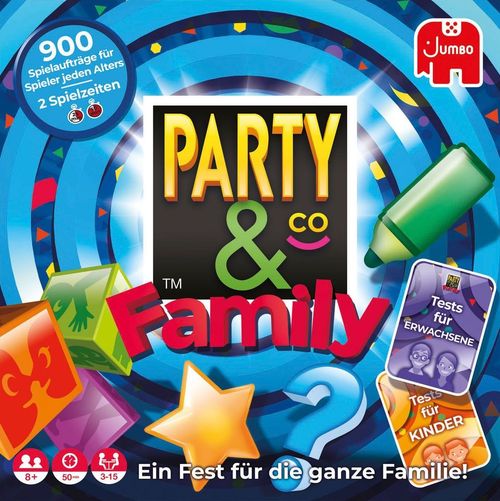
Party & Co Family
Party & Co Family Rulebook
Table of Contents
Table of Contents
1. Goal of the Game
The goal of the game is to be the first to reach the last space and complete the last task.
2. Setup
- The players form teams (at most three teams of two or more players). Teams may consist only of adults, only of children, or of adults and children together.
- The players decide which side of the game board they want to play:
- Long game: approximately 50 minutes.
- Short game: approximately 25 minutes.
- The cards for adults and children each have a light side and a dark side. The players decide which side will be played and set out the two card decks accordingly.
- Each team chooses a party figure in a colour of its choice and places it on the Start space.
- The team with the lowest combined age begins.
Components shown on the setup page:
- 60-second hourglass
- 30-second hourglass for challenges
- 150 double-sided cards for adults and children (900 tasks)
- 6 double-sided challenge cards (48 challenges)
- Dice
- 3 party dice
- 3 party figures
- Double-sided game board
- Double-sided dry-erase board and pen
3. The Game
Whenever a team is on turn, it first rolls the die, then moves its party figure to the matching space and carries out the task shown on that space. To do this, the hourglass is turned over. A description of all TASKS is printed on the back of these instructions.
-
If a child performs the task, the top card of the deck of cards for children is drawn.
-
If an adult performs the task, the top card of the deck of cards for adults is drawn.
-
If the players of the team perform the task successfully, they take a challenge card and continue playing. Because of the additional difficulty from the challenge, however, the next task is made harder.
-
If the players do NOT manage to perform the task well, the next team on turn plays. If the team has challenge cards, those cards are placed back under the card deck.
The Challenges
- Whenever a team has completed a task, it then draws a challenge card.
- On the next task, the challenge shown on the drawn card counts as an additional difficulty.
In this example, the team plays for the third time during its turn. It rolls the die and lands on the Mime space. That means the players must perform the task with the two additional mime difficulties printed on the challenge cards.
The example shows a Mime space with the challenge "Mime: Imitate a robot" — "Squint the whole time with your eyes." and "When imitating, move another player like a puppet."
4. End of the Game
When a team reaches the LAST SPACE, it must complete the last task to win. The team draws three challenge cards, and then the opposing players decide which of the four tasks the team must perform, in combination with the additional difficulties on the three challenge cards.
- If the players of the team complete the task, they have won.
- If they do not manage to complete the task, their turn ends. In the next round the team may try a different task, this time with two challenge cards instead of three: any one of the three challenge cards is set aside.
Note: the printed German text reads "Herausforderungsk-Karten" (a typo for "Herausforderungskarten"); it is translated here as challenge cards.
Party dice body-part pairs. The party dice must be clamped BETWEEN the body parts shown on each die. The rulebook prints these 16 pairs, each illustrated on a die face (listed here in the order of the printed grid, left to right, top to bottom; the pictures carry no numbers):
- Knee & Knee
- Nose & Nose
- Hip & Hip
- Nose & Head
- Hand & Ear
- Knee & Hand
- Hand & Calf
- Hand & Hip
- Head & Elbow
- Ear & Shoulder
- Elbow & Ear
- Knee & Calf
- Calf & Calf
- Hand & Back
- Head & Head
- Thumb & Nose
5. The Tasks (Die Aufgaben)
- QUESTIONS (Fragen): A player from another team reads the question aloud. The team whose turn it is must give ONE SINGLE ANSWER that all players on the team agree on.
- MIME (Pantomime): One of the players tries to act out what is written on the card, and the other players of his team must guess it. Noises and onomatopoeia related to the word being acted out are allowed.
- DRAWINGS (Zeichnungen): One of the players tries to draw what is on the card with simple drawings, and the other players of his team must guess it. The player may not say anything, make no noises, not gesture, and may not write letters or numbers.
- PARTY DICE (Partywürfel): Two players from the team stand up and throw the three party dice onto the floor. Before the hourglass runs out, they must clamp one party die between the two body parts shown on it and lift it up without letting the die fall. They must do the same with the second party die and then with the third party die.
- DIE (Würfel): Roll the die again.
6. Tips and Doubtful Cases
- In each round, a different player from the team should perform the task.
- Except for the task QUESTIONS, the players of a team may give as many answers as they like during the allotted time.
- For the task DRAWINGS, the white side of the dry-erase board must always be used, unless a challenge says that the drawing must be made within the dashed lines or on the back with a patterned background, to make guessing harder.
7. Variant: Single Players (maximum three players)
When the game is played not in teams but with individual players, the same rules apply, but the player whose turn it is needs the help of his right-hand neighbour to perform the task.
- If they complete the task, both players may roll the die and move their playing piece. The player whose turn it is then plays again with the help of the same player, but with a challenge.
- If the two players do not manage to complete the task, the next player is on turn.
- The player who reaches the last space first wins.