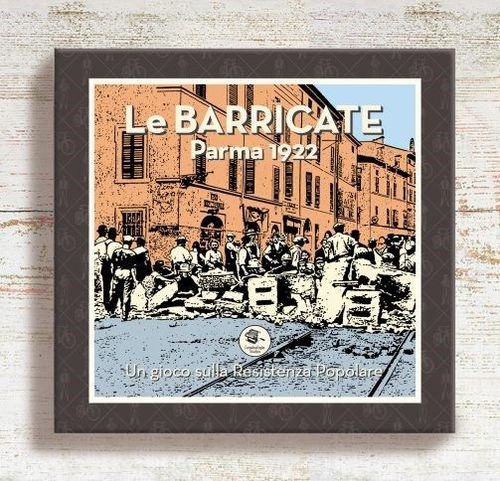
Le Barricate: Parma 1922
Le Barricate: Parma 1922 Rulebook
Table of Contents
Table of Contents
Game Components
- 20 FOOD resource tokens
- 18 BICYCLE resource tokens
- 16 FIRST AID KITS and MUNITIONS resource tokens
- 5 CIVIL tokens
- 8 INFO tokens
- 14 BLOCK tokens
- 27 BARRICADE (Barricate) tokens
- 9 BARRICADE SITES (luoghi delle barricate) tokens
- 25 identity cards (12 FASCISTS, 12 ARDITO, 1 ARMY/ESERCITO)
- 6 PHASE cards
- 8 SUMMARY cards
- 40 MISSION cards
- 40 EVENTS cards
- 8 character figures
- 1 game board
- 2 six-sided dice
Game Setup
- Divide all the tokens by type (Resources, Civils, Blocks and Barricades) and position them so that they can be reached by all players.
- Shuffle the deck of the Events and the deck of the Missions separately and put them face down, both reachable by all players.
- Put the Phase cards in chronological order and create a deck with Tuesday 1st August 1922 at the top and Sunday 6th August 1922 at the bottom.
- Place the 9 Barricade Sites tokens in the corresponding squares on the board. The Barricade tokens, during the game, will be placed under the Barricade Sites tokens so that they remain covered.
- Divide the Identity cards by faction and shuffle the two decks separately.
Identity deck composition:
| Deck | Contents |
|---|---|
| ARDITI deck | 1 fascists identity card, 2 arditi identity cards, 2 mission cards |
| FASCISTS deck | 2 fascists identity cards, 1 arditi identity card, 2 mission cards |
- For 3 and 4 players: 2 ARDITI decks and 2 FASCISTS decks.
- For 5 and 6 players: 3 ARDITI decks and 3 FASCISTS decks.
- For 7 and 8 players: 4 ARDITI decks and 4 FASCISTS decks.
For 2 players game read the variant at the end of the rules.
- Put the remaining identity cards back in the box without looking at them.
- Randomly distribute one of the decks to each player and put any remaining decks back in the box without looking at them and without showing them to other players.
Each deck will determine which side the player will be on: if s/he has a majority of Arditi cards (2 out of 3), s/he will be on the ARDITI side and will aim to build barricades (must then place the barricade token with the positive side up); if s/he has a majority of Fascists cards (2 out of 3), s/he will be on the FASCISTS side and will have to try to obstruct the construction of the barricades (must then place the barricade token with the negative side up).
How to Play
Each player chooses a character figure and the corresponding Summary card; then roll two dice to determine which will be his/her starting square: each number corresponds to a square on the board (2 to 12). Depending on the result, you will place your character on the corresponding square. The player with the highest score becomes the first player: in the event of a tie, the dice are rolled again. The game continues clockwise.
Each time the first player starts a new round, he or she must read aloud the PHASE card, starting with Tuesday 1 August. Each PHASE card on the one hand will state the historical context related to that day, and on the other hand it will state any changes to the rules to be applied until a new PHASE card is revealed. The game will end when the first player reads the 6th Phase card – Sunday 6th August 1922.
The game round consists of the following steps to be played in order:
1. Drawing a card from the Events deck
The current player draws a card from the EVENTS deck, reading the text aloud and immediately applying the effects described, after which he discards the card. If the text on the card reads 'keep this card', you may keep it in your hand. If the player has more than 3 cards, he will be forced to discard one of them. If the events deck runs out, shuffle the discarded cards to form a new deck.
2. Using an action point
Each player during his/her turn will have the opportunity to perform various actions within the game. These possibilities are called 'action points'. At the beginning of each turn, each player has 6 action points at his/her disposal, which s/he can decide to use to perform the following actions in any order or combination:
- Moving
- Playing a card
- Earning resources
- Questioning another player
- Blocking/unblocking a square
- Leaving the hospital/prison
- Completing a mission
- Building a barricade
- Persuading a civil
Once all available action points have been spent, the player passes the turn to the next player. It is not compulsory to spend all action points before passing the turn.
Moving
During his/her turn, the player may spend one or more action points to move from one square to another adjacent square. During the game some squares may be blocked (by a Block token or Barricade token), in which case crossing them will cost an additional action point.
E.g.: Mario is in the Ghiaia square and wants to reach Strada D'Azeglio but the Ponte di Mezzo square is blocked: instead of spending 2 action points, he will have to spend 3.
During the game it is also possible to take possession of transport resources: these will change the number of squares that can be travelled with a single movement action. For example, by discarding a BICYCLE resource for that turn the player will be able to move 2 squares with a single action point; by discarding a TRUCK card, s/he will be able to move 3 squares with a single action point for that turn.
Playing a card
During your turn you may play a card you have in your hand and apply its effects at a cost of one action point. You can take possession of cards useful in the game by drawing them from the EVENTS deck.
Earning resources
Within the game there are 4 different types of resources: BICYCLES, MUNITIONS, FOOD and FIRST AID KITS. Each is retrievable in specific squares (MECHANIC, ARMORY, BAKERY and HOSPITAL respectively) at the cost of one action point.
- MECHANIC. Roll a die. If you get:
- 1-2: you can exchange a FOOD resource for a BICYCLE resource.
- 3-4-5: you get one BICYCLE resource.
- 6: you get two BICYCLE resources.
- ARMORY. Roll a die. If you get:
- 1-2-3: you can exchange a BICYCLE resource for a MUNITIONS resource.
- 4-5-6: you get one MUNITIONS resource.
- HOSPITAL. Roll a die. If you get:
- 1-2: you can end your turn to get one FIRST AID KIT resource.
- 3-4: you get one FIRST AID KIT resource.
- 5-6: you get one FIRST AID KIT resource and an extra action point.
- BAKERY. Roll a die. If you get:
- 1-2: you get one FOOD resource.
- 3-4: you get two FOOD resources.
- 5-6: you get three FOOD resources.
By discarding a BICYCLE resource, you can move 2 squares by spending an action point. By discarding a MUNITION resource, you can remove a BLOCK token from the board. By discarding a FOOD resource, you may have an extra action point available for that turn. If you discard a FIRST AID KIT resource, you may re-roll any dice and consider the better result to be valid. Discarding a resource does NOT cost action points.
Resources can also be drawn from the Events pile: these count both as items for the mission and for the effect described on the card.
NOTE: resources are limited, if they are no longer available the player may not attempt to collect them.
Questioning another player
When a player stops on a square already occupied by another player, he may decide to question him by spending an action point and showing him one of his own identity cards. The questioned player must choose one of these options:
- Show one of one's own identity cards to the player interrogating him and see the opponent's identity card in turn.
- Surrender a resource in one's possession to the opponent to avoid being questioned.
It is not possible to show the same card twice to the same opponent in the course of the game: if this happens, the questioner may decide to ask to be shown a new card.
Blocking
To complete a Mission or to obstruct opponents, the player may attempt to block access to a square while standing on an adjacent square. You may spend 1 action point to attempt to block/unblock a square: roll a die and if the result is 5 or 6, the square is blocked/unblocked. Alternatively, you can spend 3 action points to block/unblock the square automatically. Similarly, if the player ends his/her move on a square adjacent to a blocked square, he may attempt to unblock it by rolling a die: if the result is 5 or 6, the square is unblocked. If the result is less, the square remains blocked. If the square is blocked, add a BLOCK token: until it is unblocked, you must spend an additional action point to cross it.
Hospital and prison
Some Event cards will force the player to be hospitalised or placed under arrest in the Prisons of San Francesco. If a player starts his/her turn hospitalised or under arrest, he may spend one action point to try to get out, rolling a die:
- With a result of 4, 5 or 6 the player is free to continue his/her turn normally.
Alternatively, you can spend 3 action points to leave the hospital and 4 action points to leave the prison.
Completing a mission
At the start of the game each player will receive two mission cards, to be completed in any order. Some missions require you to collect information at a particular location, to do this you must reach the square indicated in the mission and spend an action point in order to declare the mission accomplished. Indeed, if the conditions indicated by the mission are met it is possible to declare the mission accomplished by spending an action point and discarding any resources or information indicated on the card. As soon as the mission is completed, the player draws a new mission card. On completion of the mission, the player is entitled to take a BARRICADE token which he must immediately place under one of the BARRICADE SITES tokens, without spending action points and without showing the barricade token to other players. You may also spend an action point to discard one of your missions to draw another.
Mission card layout (as labelled on the printed diagram):
- Mission title
- Mission objective
- Mission reward
- Markers involved
Persuading a civil
During the game through the Event deck, CIVIL tokens may appear on the board; you may go to that same square to convince the CIVIL to take your side by spending one action point and discarding 3 of your resources. The CIVIL token, once convinced, is removed from the board and kept among your resources. At the end of the game, each CIVILIAN convinced to take sides will be worth 5 points.
Building barricades
Once you are in possession of a BARRICADE token, you must immediately place it (with the face of your side facing upwards: on the red side/positive barricade if you are part of the Arditi del Popolo and on the black side/negative barricade if you are part of the Fascists) on one of the dedicated areas of the board of your choice, underneath the BARRICADE SITES tokens placed previously, so that they are covered, so that other players cannot see whether the marker is positive or negative. During the game, as you add barricade tokens, you will create a stack: at the end of the game the team with the majority of tokens in each stack will score points from that barricade. As soon as even one barricade token is placed on a square, it is locked and cannot be unlocked until the end of the game. Placing a BARRICADE token does NOT cost an action point.
To place a Barricade token, choose the square you want to add it to, place it with the face representing your side up without looking at the others, and cover it with the BARRICADE SITES token.
End of the Game
When the last PHASE card is read (Sunday, 6 August 1922) the game will end. Balbo's men will withdraw and Picelli will allow the Army to enter Oltretorrente. All players reveal their side; in games with 3, 5 or 7 players the side with one player less will have the chance to place 2 additional BARRICADE tokens BEFORE checking the majorities of each place. Once any additional BARRICADE tokens have been placed, each stack of BARRICADE tokens is checked by counting how many face-up counters there are for each side and points are awarded to the respective teams as follows:
- Barricade with a majority of one side: 10 points.
- Empty barricade or tie: 0 points.
In addition, each CIVIL token recovered from the board counts 5 points for their team.
The team with the most points wins the game. In the event of a tie (and only then), the resources still held by the players are counted with the following values:
- Each FOOD resource: 1 point.
- Each BICYCLE and each FIRST AID KIT resource: 2 points.
- Each MUNITION resource: 3 points.
Variant for 2 Players
When playing with two players, the line-ups are known from the start of the game and there is no need to distribute IDENTITY cards. Once their role has been chosen, each player chooses 2 characters instead of 1 and the game begins as per the rules. Alternating, players take a full turn with each character figure.
Variant Regio Esercito (Army)
Once the game mechanics are understood, it is possible to include the Regio Esercito variant in 3-, 5- and 7-player games.
In this variant, one of the players at the table will play the role of the Army during the days of 1922: he will therefore have the aim of keeping the clash in balance, ensuring that it does not degenerate in either direction.
During the set up phase, create the identity decks according to:
| Deck | Contents |
|---|---|
| ARDITI deck | 1 FASCISTS identity card, 2 ARDITI identity cards, 2 mission cards |
| FASCISTS deck | 2 FASCISTS identity cards, 2 ARDITI identity cards, 2 mission cards |
| ARMY deck | 1 FASCISTS identity card, 1 ARDITI identity card, 1 ARMY identity card, 2 mission cards |
- For 3 players: 1 ARDITI deck, 1 FASCISTS deck, 1 ARMY deck.
- For 5 players: 2 ARDITI decks, 2 FASCISTS decks, 1 ARMY deck.
- For 7 players: 3 ARDITI decks, 3 FASCISTS decks, 1 ARMY deck.
The game is played normally as per the rules with the exception that the player with the Army role, when placing a BARRICADE token, may choose which side to place it on. At the end of the game, the player who has the Army role will not team up with any other player and will score points as follows:
- 10 points for each Barricade in a tie.
- 5 points for each empty Barricade.