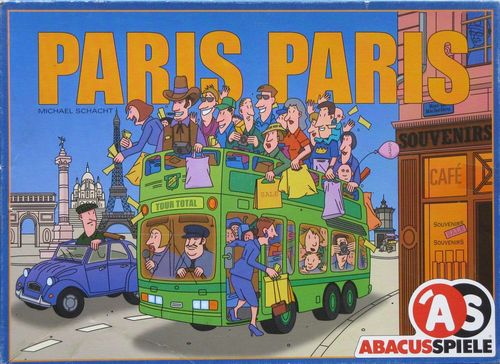
Paris Paris
Paris Paris Rulebook
Table of Contents
Table of Contents
Contents
- 1 game board
- 60 tiles with different stops
- 80 businesses in 4 colors
- 1 bag
- 1 bus
- 5 special route markers
Preparation
- Before the first game, carefully remove the game material from the frames. Assemble the bus by folding it and attaching the "wheels" to it.
- Place the game board in the middle of the table.
- Each player chooses a color and takes the businesses in that color. He places one of these on the zero space of the scoring track. This business serves as the player's scoring marker. The points are the earnings for the players.
- The players choose a starting player. He takes the bus to mark his status as starting player.
- Place the sack next to the game board.
- Turn the 60 tiles face down and shuffle them. Depending on the number of players, the players now build several face down stacks of tiles and place them in a row next to the board as shown below:
- with 2 players: 20 stacks of 3 tiles.
- with 3 players: 15 stacks of 4 tiles.
- with 4 players: 12 stacks of 5 tiles.
- Shuffle the 5 special route markers face down. Each player takes one, looks at it, but keeps it face down and secret from the other players during the game. He may, of course, look at his own marker during the game. Place the remaining special route markers face down back in the box so that none of the players can see them during the rest of the game.
- With 2 players, place one of the remaining markers face up next to the board and the other two face down in the box.
Playing the game
The players take turns in clockwise order.
The game is played over several rounds.
Each round contains of the following actions:
- Place tiles
- Open businesses
- Make money
- Discard remaining tile
- Pass the bus
1) Place tiles
The starting player takes a stack of tiles, turns them over, and puts each face up next to the corresponding bus stop on the board. If the other players want to help placing the tiles, they may.
Note: as there are several tiles for most bus stops, it can happen that there is more than one tile for a bus stop on the board.
2) Open businesses
The starting player chooses a tile and opens a business at this bus stop (A).
After opening the business, the player puts the tile back in the box face down (B). The next player in clockwise order chooses a tile, opens a business there, and puts the tile face down back in the box.
This continues until all players have taken a turn.
It is possible for several businesses to be opened at a single bus stop. See below under "Business takeover".
There are many bus stops where the two bus lines cross. A business at such a crossing, lies on two bus lines.
After each player has opened a business, there remains one unused tile. At this bus stop, players will earn money.
3) Make money - small tour
A business at the bus stop shown on the remaining tile earns his owner 1 point.
If there are several businesses, each scores 1 point.
Example: Only gray has a business at the bus stop shown on the remaining tile and earns 1 point. Violet earns nothing.
When there is no business at the stop shown on this tile, score the next closest business on this line.
If there are several businesses equally close, each scores 1 point.
Example: At the bus stop shown on the remaining tile, there is no business. As there are 2 equally close businesses on the line, each scores 1 point. Thus, gray scores 1+1=2 points. The violet business is further away and does not score.
If the bus stop shown on the remaining tile lies at the crossing of 2 bus lines and there is no business at the stop, the closest business score, which can be on both lines. If there are several businesses equally close, each scores 1 point.
Example: At the bus stop shown at the remaining tile, there is no business. As the bus stop is at a crossing, the next closest business can be on the blue or the grey line. Because gray and violet businesses are equally close, each score 1 point.
Note: at the beginning of the game when there are few businesses on the board, the next closest business can be far away from the bus stop. If there are no businesses on any line connected to the bus stop, no points are scored.
The players move their scoring markers on the scoring track to record their points. If a player scores more than 45 points, he continues past the starting point on the scoring track and notes the passing.
4) Discard remaining tile
Place the remaining tile face up on one of the empty spaces next to the scoring track (P). If there is already a tile of the same color as the remaining tile, there is a grand tour. If not, go directly to action 5).
Grand Tour
When the (background) color of the remaining tile matches that of a tile already lying next to the scoring track (P), there is a grand tour of the bus line matching the color of the tile.
The bus travels the colored route matching the tile, scoring points for owners of businesses along the route.
-
The starting player places the bus on the starting space for the bus line – the tip of the matching colored arrow.
-
He then drives the bus along this route to the end, stopping at the four bus stops that cross other lines. He does not stop at the three bus stops that do not cross other lines.
-
When the bus stops at a bus stop, the owner of each business at the crossing scores 1 point. If an owner of a business at the crossing has businesses at immediately adjacent bus stops, he scores 1 point for each of these.
Note: A bus stop at a crossing of two lines always has 3 or 4 immediately adjacent bus stops. All these must be checked for scoring businesses.
Note: If a player has no business at a crossing, he scores no points for businesses on immediately adjacent bus stops.
Example: The bus stops at the crossing shown. Gray and violet each score 1 point for their businesses at the crossing (A). Gray also has 2 businesses at immediately adjacent bus stops (B) and scores 1 additional point for each. The violet business at (C) is not at an immediately adjacent bus stop and scores no points. Yellow has 2 businesses on immediately adjacent bus stops (D), but has no business at the crossing and, thus, scores no points for them.
Note: If there are no businesses at a crossing, the bus may skip the crossing as no one will score for it.
-
After the bus has driven past all four crossings, the grand tour ends. The player removes both tiles (of the same color) that triggered the grand tour and places them face down in the box. See also "Tactical notes" below.
A small tour happens every round, but a grand tour only when triggered.
5) Pass the bus
Give the bus to your left neighbor. This is the new starting player and the new round begins with action 1).
Business takeover
As there are several tiles for most bus stops, business takeovers will happen often during the game.
- At each bus stop that is not at a crossing, there can be only 1 business.
- At each bus stop that is at a crossing, there can be 2 businesses.
When a player opens a business at a bus stop that already has the maximum number of allowed businesses, he removes one of the existing businesses.
The player placing his new business at a bus stop with two businesses decides which old business will be removed.
The player puts the old business in the sack.
Example: Gray opens a business (A) at a crossing. As 2 businesses are allowed there, the violet business remains. Violet opens a business (B) at a bus stop, that is not a crossing. As only 1 business is allowed there, the gray business is removed and placed in the sack. Violet opens a business (C) at a crossing that already has 2 businesses. One must be removed and violet chooses to remove the gray business, placing the piece in the sack.
The content of the sack is secret – no one is allowed to look in the sack until the end of the game.
With 2 players, the sack is not used. Players place removed businesses back in the supply of the player who owned the business.
Note: it is possible that a player must remove his own business. When this happens, the player puts the business back in his supply, not in the sack.
Note: It is possible for the same player to own both businesses at a crossing.
Game end
If, at the beginning of a round, all stacks have been used, it is time for the special tours.
The players turn over their secret special route markers. Starting with the starting player, each player takes the bus on a grand tour along the route matching his secret route marker. They are scored just as in a grand tour.
With 2 players, they also run a grand tour along the route matching the color of the special route marker placed face up next to the board at the beginning.
The game ends and the sack is scored. If one player has more businesses in the sack than the other players, he scores 1 point for each business he has in the sack. Otherwise, no player scores for the sack.
With 2 players, play without the sack – thus, there is no scoring for the sack at the end.
Winner
The player with the highest score wins. In case of a tie, the tied player with the fewest businesses on the game board wins.
Tactical notes
Pay close attention to which tile will be the one left over at the end of the round, so as to score points on a small tour and, sometimes, on a grand tour as well.
It is sometimes wise to choose a tile of little interest to you, but which will stop an opponent from triggering a grand tour.
A well-placed business can score points several times over during a single grand tour!
Tile distribution
The number of tiles in play for a bus stop depends on the type of stop, as shown below:
- 1 tile
- 2 tiles
- 3 tiles (crossing)
- 4 tiles (crossing)