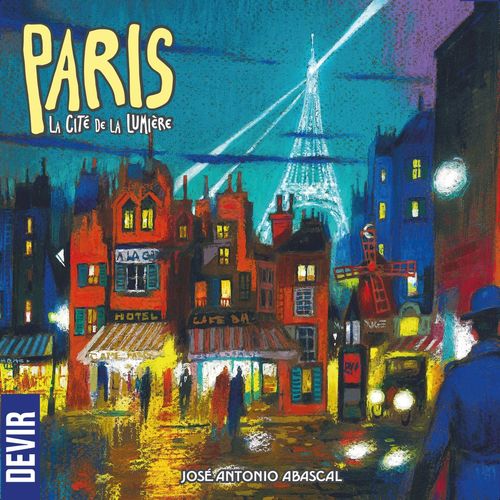
Paris: La Cité de la Lumière
Paris: La Cité de la Lumière Rulebook
Table of Contents
Table of Contents
Components
16 Squared Cobblestone Tiles
The bottom side of these tiles shows the color of the player who will use them (8 for each player). Each tile is divided into four spaces which can be the tile's color, the rival's color, or mixed-colors, or they can be Streetlight spaces.
Any space on a Cobblestone tile that does not have a game piece on top of it is considered a "free" space. Streetlight spaces on the Cobblestone tiles are also considered free spaces.
The spaces shown on a Cobblestone tile are: Streetlight space, Blue player space, Orange player space, and Mixed-colors space. Tile backs identify the Orange player tiles and the Blue player tiles.
12 Building Pieces
The Building pieces have different shapes and sizes, and will be placed on the Cobblestone tiles. The size of a building is determined by the number of spaces it takes up on the Cobblestone tiles. There are two size-3 buildings, four size-4 buildings, four size-5 buildings, and two size-6 buildings.
14 Chimneys
(7 of each color)
8 Action Tokens
(4 of each color)
12 Action Postcards
1 Game Board
(incorporated into the box)
9 Special Pieces
- 1 Painter pawn
- 1 Dancer pawn
- 1 mixed Cobblestone space
- 1 Fountain tile
- 1 Statue tile
- 1 Streetlight tile
- 1 Large Streetlight tile
- 1 Botanical Garden tile
- 1 Annex piece
Setting Up the Game
First, choose which eight Action cards you will use to play the game and place them around the board, face up. For your first few games, we recommend using those marked with a sun symbol. Place the special pieces together with their corresponding Action postcards. Leave the Building pieces to the side, within reach of both players.
Each player chooses a color (orange or blue) and takes the 8 cobblestone tiles, 7 chimneys, and 4 Action tokens of their color. Each player shuffles their Cobblestone tiles and places them face down in a pile. Then, draw the top tile from your pile and hold it in your hand so that your opponent cannot see it.
The player who lost the last game of PARIS starts the game. If it is the first game of the day, the last player who switched on the lights in any room plays first.
How to Play
Paris is played over two different phases.
In the first phase, the players take turns placing their Cobblestone tiles and taking Building pieces.
In the second phase, the players take turns placing their buildings on the board or carrying out the actions on the Action postcards, which may grant them advantages or victory points. Once the two phases have been completed, the buildings are scored according to their size and the number of streetlights that shine on them.
Let's take a look at the phases in greater detail:
Phase 1: Placing of Cobblestone Tiles and Awarding Buildings
The players alternate taking turns. During your turn, look at the Cobblestone tile you have in your hand and choose one of these two options:
-
PLACE YOUR COBBLESTONE TILE FACE UP on an empty square on the board and choose which way it faces. There are 16 squares on the board. Each Cobblestone tile must always be placed so that it fully occupies just one square. After placing the tile, draw the next tile from your pile and look at it without letting the other player see it.
-
ADD A BUILDING PIECE TO YOUR RESERVE, by placing it in front of you. Buildings are taken from the common pool during this phase, and can then be placed on the board in the next phase. It is a good idea to have at least 3 or 4 buildings in your reserve before the beginning of the second phase.
This phase ends when the last of the 16 Cobblestone tiles is placed on the board. The first player to place all 8 of their tiles can simply pass their turns and wait until the next phase, or, if they wish, continue taking Building pieces until the other player has placed all eight of their Cobblestone tiles.
Phase 2: Place Buildings and Take Actions
The first player to place all 8 Cobblestone tiles in Phase 1 will take the first turn in the second phase. Once again, the players alternate taking turns. On your turn you must choose one of these two options:
-
PLACE ONE OF THE BUILDINGS in your reserve on the Cobblestone tiles so that it occupies only free spaces of your color or free mixed-color spaces. Mixed-color spaces can be occupied by either player. Buildings can never be placed on Streetlight spaces. When you place a building on the board, put one of your chimneys on top of it to show who owns it.
-
ACTIVATE AN ACTION POSTCARD. Choose one of the face-up postcards next to the board. You may use the action shown on that postcard. Then, flip the card over and place one of your Action tokens on top of it to show that it has been used. No one can use this Action postcard again for the rest of the game. See the last page of this booklet for the specific rules for each of these actions.
Note: You may activate an Action postcard without performing its action. This may be a strategic move to limit your adversary's options.
The second phase of the game comes to an end when neither of the players can place any more buildings and all 8 Action tokens have been used.
Scoring
Once the second phase has been completed, each player adds up their victory points:
+ ILLUMINATED BUILDINGS. Each player multiplies the size of each of their buildings (the size is the number of spaces it occupies) by the number of Streetlights that cast light upon it. Each Streetlight illuminates the four spaces around it, but not those diagonal to it. Each Streetlight can illuminate two or more buildings, as long as it is adjacent to all of them. However, a Streetlight can only be counted once for each building, even if it lights up more than one space occupied by that building. A building that is not lit up by any Streetlights does not award any points.
+ LARGEST BUILDING GROUP. Each player determines the size of their largest single group of buildings. Buildings form a group if they are in contact with other buildings that belong to the same player, with at least one side of the spaces they occupy touching (diagonal contact does not count). You score 1 victory point for each space your largest group of buildings occupies (i.e., the total sum of all those buildings' sizes). It does not matter if the Buildings are illuminated by Streetlights or not.
- UNBUILT BUILDINGS. Each player loses 3 points for every Building piece that they reserved in the first phase but were not able to place on the board during the second phase.
+ ACTION POSTCARDS. Each player checks whether any of the Action postcards they marked with their Action tokens have the stamp symbol. If they do, those cards grant them additional victory points.
The player who gets the most points is the winner! If there is a tie, the player with the most visible free spaces of their color on the Cobblestone tiles wins.
Scoring Example
The ORANGE player scores:
- ILLUMINATED BUILDINGS. 6 points for Building A (1 Streetlight × size 6) + 21 points for Building B (3 Streetlights × size 7—thanks to the Annex) + 6 points for Building C (3 Streetlights × size 2). Total: 33 points.
- LARGEST BUILDING GROUP. The size of Buildings A+B+C. Total: 15 points.
- UNBUILT BUILDINGS. Two buildings were not placed, which would subtract 6 points. However, the player has used the Sacré-Coeur. Total: 0 points.
- ACTION CARDS. None are applicable. Total: 0 points.
GRAND TOTAL: 48 POINTS.
The BLUE player scores:
- ILLUMINATED BUILDINGS. 10 points for Building D (2 Streetlights × size 5) + 12 points for Building E (3 Streetlights × size 4) + 12 points for Building F (3 Streetlights × size 4) + 9 points for Building G (3 Streetlights × size 3) + 0 points for Building H (0 Streetlights × size 3). Total: 43 points.
- LARGEST BUILDING GROUP. The size of Building D+E+F. Total: 13 points.
- UNBUILT BUILDINGS. One building was not placed, so 3 points are subtracted. Total: -3 points.
- ACTION CARDS. The blue player gets 4 points for Le Peintre (I) since 2 Streetlights shine in his area. Total: 4 points.
GRAND TOTAL: 57 POINTS.
Action Postcards (First Games)
These eight cards are marked with a sun symbol and are the ones recommended for your first few games.
Levitation
Switch one of the Building pieces in your reserve for another one from the common pool. Immediately place the new building according to the normal rules.
Metropolitain
Place an Action token on this card (which counts as having already been used), but do not flip the card over yet. On any of your future turns, you may place a building so that it covers an empty Streetlight space, then flip over this card.
Jardin des Plantes
This piece has all the effects of a size 2 building. Place it on the board immediately so that it is occupying free Cobblestone spaces of your color or mixed-color spaces and place a chimney of your color on top of it.
Sacré Coeur
(marked with the stamp symbol)
The player who uses this card will not have any victory points subtracted at the end of the game for any buildings left over in their reserve.
Le Peintre
(marked with the stamp symbol)
Capturing the play of light as it falls on the buildings of Paris, this artist has dedicated himself to painting the shiny new face of the city on his canvases. Place the Painter piece on the board so that it occupies a free Cobblestone space of your color. At the end of the game, you will get 2 additional points for each Streetlight located in the area occupied by the painter. This area is defined by the edges of the board and the buildings. None of the game pieces besides these two things limit the area of the painter, such as Streetlights, the Fountain, the Dancer, or the Statue.
Chartier
Take the Mixed-color Cobblestone tile and add it to your supply. On any of your following turns, you may place this tile so that it covers a Cobblestone space of your opponent's color, and immediately place a building or Fountain piece on it.
Bouquinistes sur la Seine
Take the Annex piece and immediately place it on a Cobblestone space of your color, so that it touches one side of one of your buildings. It is an Annex that increases the size of that building by 1.
Lampadaire
Take the Streetlight tile and immediately place it on a Cobblestone space of your color.
Action Postcards (Optionals)
Moulin Rouge
(marked with the stamp symbol)
The presence of these famous Parisian dancers catches the eye of passers-by. Immediately place the Dancer piece on the board so that it occupies a Cobblestone space of your color. At the end of the game, you will receive 1 additional victory point for each free Cobblestone space in the area occupied by the Dancer (the space she occupies is considered to be free as well). Her area is defined by the edges of the board, the buildings, streetlights, and any other game piece that covers a Cobblestone space (such as a Streetlight or the Painter).
Fontaine des Mers
(marked with the stamp symbol)
Take the Fountain tile and immediately place it on a Cobblestone space of your color or mixed-colors. At the end of the game, you get 3 additional points for each of your buildings that is in contact with the sides of the Fountain.
Le Penseur
(marked with the stamp symbol)
Take the Statue tile and immediately place it on a Cobblestone space of your color, leaving at least one other free space in front of it so that people can admire it as they go by. At the end of the game, you get 2 points for each free Cobblestone space of your color that touches a side of the Statue and 1 point for each space that touches it diagonally. If the space in front of the statue is occupied, you receive no points for the Statue.
La Grande Lumière
Take the Large Streetlight and immediately place it on a Streetlight space. This Streetlight will light up all the spaces shown on the card. Buildings block the light from any other buildings that may be behind them. Any other pieces do not block the light.