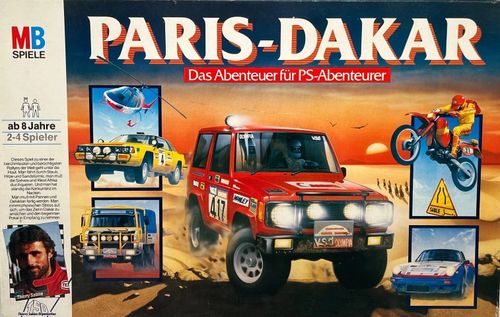
Paris-Dakar
Paris-Dakar Rulebook
Table of Contents
Table of Contents
- Contents of the Box
- Object of the Game
- The Game
- 8. Stage Towns (Villes-Étapes)
- 9. Compulsory Stops (Arrêts Obligatoires)
- 10. Mechanical Breakdown Cards (Cartes Panne Mécanique)
- 11. How to Call Mechanical Assistance (Comment appeler l'assistance mécanique)
- 12. How to Call Medical Assistance (Comment appeler l'assistance sanitaire)
- 13. Fuel Shortage (Panne d'essence)
- 14. Arrival at Dakar (L'arrivée à Dakar)
- 15. The Winner (Le vainqueur)
Contents of the Box
- 1 rally circuit
- 1 compass with arrow (2 parts)
- 12 Mechanical Breakdown cards (cartes de Panne Mécanique)
- 1 "Mechanical Assistance" card (carte "Assistance Mécanique")
- 1 "Medical Assistance" card (carte "Assistance Sanitaire")
- 4 competition vehicles
- 1 white tow truck (camion de dépannage blanc)
- 1 helicopter
- 40 coupons of 100 litres of fuel
- 50 coupons of 20 litres of fuel
- 4 road-books
Object of the Game
Reach the first Dakar and win the trophy.
Because of the secrecy essential to the interests of the Rally and its participants, this game was made from the route of the Dakar 85.
The Paris-Dakar race takes place in two stages:
- a preliminary stage, Paris-Sète
- the most important stage, Alger-Dakar.
In this game we revive only the second event, which takes place on African territory.
The Game
- Assemble the disc and the arrow as shown in Figure 1.
- Choose the player who will be the Directeur de la Course (Race Director). The Race Director has the task of managing the stock of fuel coupons (the Banque, or bank), and of making sure that all competitors respect the rules of the rally.
- Place the Mechanical Breakdown cards, the "Mechanical Assistance" card and the "Medical Assistance" card near the stock of coupons (the Banque), face up. Put the helicopter beside the Alger space and the tow truck on the Ouargla space.
- Give each player eight 100-litre fuel coupons and ten 20-litre fuel coupons (that is, 1,000 litres of fuel in total). Each player then chooses a vehicle and places it on the Alger space.
- Choose the player who starts. Play then continues clockwise.
- On your turn, spin the arrow and advance your vehicle by the number of spaces indicated. Each space represents 100 km. Then look in your road-book at what is indicated for your space and follow the instructions. The colour of the spaces has a meaning:
- Green kilometre marker = good news.
- Red kilometre marker = you have troubles!
- Black kilometre marker = stay where you are until your next turn.
- No more than two vehicles may occupy the same space. If the space you were to arrive on is occupied by two vehicles, stop on the previous space.
8. Stage Towns (Villes-Étapes)
Each time you pass through a town, or stop in a town, you must pay the Race Director the amount of fuel indicated in the road-book. This represents the quantity of fuel you have consumed to reach this stage of your journey (that is, 20 litres per 100 km).
9. Compulsory Stops (Arrêts Obligatoires)
You must stop (even if you have not played the total number of spaces indicated by the arrow):
a) On the "Poste de Contrôle" (Control Point) spaces, marked by the stopwatch symbol on the circuit: your turn is then over. If you forgot to stop, go back to the Control Point, and the Director will impose a fine of 200 litres of fuel.
b) On the halfway space (5,000 km): at this stage, give back all the fuel coupons you have left and receive 1,000 litres of fuel to fill your vehicle's tank, as at the start of the competition.
10. Mechanical Breakdown Cards (Cartes Panne Mécanique)
a) You have drawn a "Mechanical Breakdown" card: bad luck! A mechanical problem forces you to slow down. You must then wait until you have 3 "Mechanical Breakdown" cards to call "mechanical assistance" (see section 11). While waiting, on each turn you advance at reduced speed: you must subtract "1" from the number indicated by the arrow for each "Mechanical Breakdown" card in your possession (e.g., see below).
b) Another possibility: you may, if you wish, continue your race at the same pace and use the full number indicated on the arrow. But since your mechanical problem will make you consume more fuel, you must then give 20 litres of fuel per space and per card to the Race Director (in addition to the normal route instructions).
Examples
- The arrow shows 4 and you have 1 Mechanical Breakdown card: you may either advance 3 spaces, or pay 80 litres of fuel and advance 4 spaces.
- The arrow shows 4 and you have 2 Mechanical Breakdown cards: you may either advance 2 spaces, or pay 160 litres of fuel and advance 4 spaces.
If you have three Mechanical Breakdown cards, you must stop. Park your vehicle at the side of the track, near the space where you are, and call the tow truck (see below).
11. How to Call Mechanical Assistance (Comment appeler l'assistance mécanique)
If you must call mechanical assistance, take the "Mechanical Assistance" card and place it in front of you. Then place the tow truck on the town where the nearest Rescue Post (Poste de Secours) is: Ouargla, In Amguel, Dirkou, Gao, Kiffa or Sali-Portudal (all are marked on the circuit).
On your next turns, spin the arrow and advance the tow truck towards your vehicle. The tow truck may move in any direction. When it arrives on the space where you are (not necessarily by an exact count), hand the "Mechanical Assistance" card and the 3 Mechanical Breakdown cards to the Race Director (the Bank). Put the tow truck back on the nearest Rescue Post, then put your vehicle back on the track, ready to resume the race at your next turn, this time using the full number indicated by the arrow.
12. How to Call Medical Assistance (Comment appeler l'assistance sanitaire)
If you need the doctor, park your vehicle at the side of the track, near your space. Place the "Medical Assistance" card in front of you, face up. Choose the one of the two towns, Alger or Dakar, that is nearest to you, and place the helicopter there.
On your next turns, spin the arrow, counting each town as 1 unit. The printed diagram shows the route along the line ALGER, OUARGLA, EL GOLEA, KM 1200, KM 1300, with the note "Au secours!" (Help!) at the last space. The arcs above the route are numbered 1, 2 and 3, reaching KM 1300 at the third unit.
Example: you need assistance at kilometre marker 1300. You must obtain at least "3" in one or more turns for the helicopter to reach you. (Note: it is not necessary to obtain the exact number for the helicopter to stop on your space.)
When the helicopter arrives on your space, hand the "Medical Assistance" card back to the Race Director, put it back on Alger or Dakar, and put your vehicle back on the track. You are ready to restart at your next turn.
Important: Only the player in possession of the "Mechanical Assistance" card or the "Medical Assistance" card may call the tow truck or the helicopter. If another player also needs assistance, they must wait until the tow truck has reached a rescue post, or the helicopter has returned to Alger or Dakar.
Exception: If two players are on the same space and the first has already called "Assistance", the second player may take advantage of this assistance. He hands his "Mechanical Breakdown" card(s) to the Race Director and continues his race without any penalty.
13. Fuel Shortage (Panne d'essence)
If the number indicated by the arrow would take you through a town, or onto another space that requires an immediate payment of fuel, and you are unable to pay for it, you must stay where you are and park your vehicle at the side of the track. Then call the tow truck (see No. 11). When it arrives, spin the arrow and multiply the number it shows by 100 litres of fuel, which the Race Director will hand to you (Example: the arrow shows 3, so you receive 300 litres of fuel). Wait for your next turn before resuming the race.
14. Arrival at Dakar (L'arrivée à Dakar)
It is not necessary to arrive on the Dakar space by an exact count. However, make sure you still have at least 80 litres of fuel in coupons, because that is what you will have to pay for your final consumption. Otherwise, for the last time, call the tow truck (see No. 13, Fuel Shortage).
15. The Winner (Le vainqueur)
The first vehicle to arrive at Dakar is declared the winner of the rally and wins the trophy.