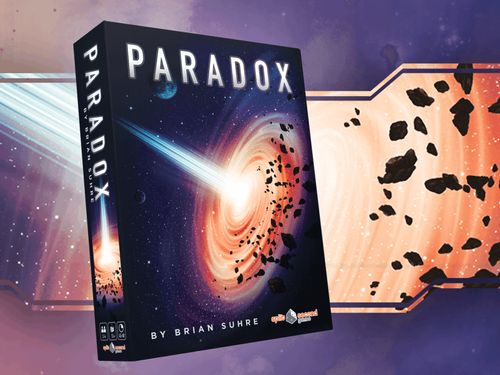
Paradox
Paradox Rulebook
Table of Contents
Table of Contents
Object of the Game
Players race against time to save the Timelines and Nexus Points of different Worlds by creating new Time Strands, repairing their connection to the spacetime continuum and protecting them from the fracturing powers of the Quake. The more a World's connection is repaired, the greater its value at game's end… if the World is not Fractured by the Quake. The player with the most VP after 12 turns wins the game and is recognized as a hero throughout the Multiverse.
Game Structure & Overview
There are twelve turns in each game of PARADOX, and each turn has the same three-phase structure: the WORMHOLE PHASE, the MATRIX PHASE, and the CLEANUP PHASE.
Wormhole Phase Overview
The Wormhole Phase represents locking onto broken parts of the spacetime continuum. The Wormhole has two sections: an Unstable section that will disappear at the end of the turn, and a Stable section that will become Unstable at the end of the turn. Players select a card from either section of the Wormhole and place it on their Player Mat; depending on the selected Timeline or Nexus card, the player has 2-4 turns to repair that connection.
Matrix Phase Overview
The Matrix Phase represents creating new Strands of time from elemental matter, using a 5x5 Matrix of energy. Players create Strands by exchanging two discs with the same symbol, in order to create rows or columns of 4-5 discs of the same color. Players use these Strands to repair connections to Timeline cards, to lock into a World's Nexus point, to stabilize Fractured Worlds, and to Shield Stable Worlds from the Quake. Any cards remaining on a Player Mat at the end of the Phase moves one space closer to being again Lost in time and discarded.
Cleanup Phase Overview
At the end of the Matrix Phase, the Chief Scientist is responsible for refilling the Wormhole, advancing the turn marker, and handing the Chief Scientist card to the next player.
At the end of twelve turns, players suffer penalties for any Fractured Worlds and score VPs for remaining Timeline and Nexus cards. The player with the highest score wins the game and is recognized as the scientist responsible for stopping the Quake.
Components
- Multiverse Board (1)
- Quake Marker (1)
- Turn Marker (1)
- Player Mats (4)
- Timeline Cards (45)
- Nexus Cards (15)
- Scenario Cards (5 Scenarios, 21 Cards)
- Research Goal Cards (11)
- Nebula Cards (3)
- Chief Scientist Card (1)
- World Discs (15)
- Energy Discs (135 + 15 spares)
- Trigger Discs (5)
- Alliance Tokens (5)
- Shield Tokens (15)
- 1 Drawstring Bag
Anatomy of the Timeline Card
A. The required resources to repair this timeline B. World's name, and its specific timeline C. Research Asset (See Appendix B)
Setup
-
Setup Multiverse Board:
- Set the Multiverse Board in the center of the table.
- Shuffle the World discs and randomly place them on the Multiverse board in the appropriate spaces.
- Place the orange Quake marker on the planet bordered in orange on the Multiverse board.
- Place the blue Turn Marker on Turn 1.
-
Select Scenario(s): This edition of PARADOX comes with five Scenarios, detailed in Appendix C. Exactly one Deck Scenario is required; all players decide which Deck Scenario they will use in this game. Additionally, all players decide which Triggered Scenario they will use in this game, if any, and follow the setup instructions for that Scenario.
-
Create Multiverse Deck: Shuffle together all Timeline, Nexus, and Nebula cards, along with the selected Deck Scenario.
-
Setup Energy Discs & Bag: Place sets of 15 Energy Discs (one of each symbol in five different colors) in the Matrix bag, based on the number of players:
Players Sets 2 Players 4 sets 3 Players 5 sets 4 Players
Training Mission
Training Missions occur when players decide, during Setup, to forego the use of Research Goals. This style of play streamlines the game, minimizes the risks of failure during the end-game, and provides players an opportunity to learn & understand the interactions of the three core systems of PARADOX (The Wormhole, the Matrix, and the Quake.)
Training Missions may use whatever Scenarios or additional components you like.
If this is your first game of PARADOX, we recommend playing through at least one Training Mission, using the Breakthrough Scenario.
Phase 1: Wormhole
The Wormhole represents an opening in the spacetime continuum where players are able to lock onto the broken Worlds affected by the Quake. Players draft Timeline, Nexus, and certain Scenario cards in order to repair Worlds and receive Scenario benefits.
At the start of the Wormhole Phase, the Chief Scientist draws four cards from the draw deck. These four cards are called the Research Hand.
Beginning with the player to the left of the Chief Scientist, select one card from either section of the Wormhole and place that card on the appropriate section of your Player Mat (e.g. A Past Timeline card starts on the Past space of the Player Mat. Scenario cards will specify their starting location.) Multiple cards are allowed to overlap on the Player Mat, but resources assigned to Timeline cards cannot be transferred to another card.
Additionally, if you select a Nexus card, a Shield Token is placed atop an Energy Disc in your Matrix as shown on the Nexus card (See Example 1, below).
Play proceeds to the left, with players selecting cards from the Wormhole in order.
Lastly, if you are the Chief Scientist, select either one card from your Research Hand, or up to two of the remaining cards from the Stable or Unstable Wormhole. Then place all remaining cards from the Research Hand face-down atop the Draw Pile.
Example 1: When you draft a Nexus, place a Shield token on the corresponding Energy Disc, as shown by the card.
For Two-Player Games
When playing with two players, the following change occurs in the Wormhole Phase: The Chief Scientist does not automatically draw a Research Hand at the beginning of this Phase. If they do not like any of the cards in the Wormhole, they may choose to draw a Research Hand of four cards as normal. However, if they choose to draw a Research Hand, they are committed to play a card from this hand. Play proceeds as normal.
Phase 2: Matrix
During the Matrix Phase, players manipulate their Matrix in order to form Time Strands (lines of same-colored discs), in order to gain the resources necessary to rescue Timelines and Worlds.
Matrix Actions
Starting with the player to the left of the Chief Scientist, each player takes two actions with their Matrix.
An action is defined as swapping any two discs in your Matrix – or between your Matrix and the Anomaly – as long as the symbols in the center of each disc match.
Discs with Shield Tokens cannot be swapped, as the Shield Token covers the symbol and prevents swapping and movement.
It is possible to create multiple Strands with one action, even intersecting Strands, but the Strands must be formed simultaneously on the same action. If multiple Strands are created on the same action, they are all resolved before taking the next action.
Refilling the Matrix
When you create a Strand, immediately remove all Energy Discs in the Strand from your Matrix. Claim its resources and then place the remaining discs from the Strand on the discard pile of the Player Mat.
Remaining discs in your Matrix drop to fill the lowest available space in their column. Draw new discs from the bag to refill the Matrix, left to right, bottom to top.
A disc covered by a Shield Token DOES NOT drop during a refill – any discs above the Nexus point remain in place, and new discs will fill any spaces beneath it.
Time Strands
A Strand is created when an action results in a row or column of at least 4 Energy Discs of the same color. Strands create the required resources to repair Worlds. You are not required to make a Strand with every action.
For a 4-disc Strand, you earn one disc as a resource of that color. For a 5-disc Strand, you earn two discs.
| Strand | Resources |
|---|---|
| 4-disc Time Strand | 1 Resource |
| 5-disc Time Strand | 2 Resources |
Strands resolve the instant they are formed. You can not, for example, make a 4-disc Strand with one action, and then take another action to expand it to a 5-disc Strand.
If you create a Strand on your first action, you will first allocate all earned resources, discard discs, and refill your Matrix BEFORE taking your second action. (Allocation of resources is discussed on the next page.)
Finally, if a Strand is created by a refill or drop, it does not automatically resolve. You may choose to spend one of your actions to resolve it and claim its resources, or you may leave it alone and make a different swap. (Note: this is the only time when a 4-disc Strand may be left unresolved in order to turn it into a 5-disc Strand on a later action.)
Allocating Strand Resources
As soon as you create a Time Strand, immediately allocate its resources to Timeline cards and/or Worlds. Unallocated resources cannot be saved for future actions and are discarded.
Repairing Timelines
You may use red, yellow, and blue resources from Strands to repair Timeline cards on your Player Mat. The required resources to repair a Timeline are shown in the upper left corner of each Timeline Card. As you acquire resources, place them on the Timeline Card(s) you are trying to repair.
Once a Timeline Card reaches its required number of resources, that Timeline is successfully repaired. Move all of those resource discs to your discard pile, remove the card from your Player Mat, and place the card in your score pile, face-down, to the left of the Player Mat.
Example: By placing 2 red resources on Alphoria's Present Timeline, it is repaired and moved to the score pile.
Quake Movement
When you repair a Timeline, advance the Quake Marker a number of spaces clockwise on the Multiverse board, based the type of Timeline card repaired:
| Timeline | Spaces |
|---|---|
| Past | 5 Spaces |
| Present | 3 Spaces |
| Future | 1 Space |
If multiple Timeline cards are repaired on the same action, advance the Quake by the sum of the Timelines' spaces (i.e not as separate movements).
Example: Because Alphoria's Present Timeline was repaired, the Quake Token moves 3 spaces clockwise.
Repairing & Shielding
You may use black and white resources from Strands to repair World discs (or to repair Past Timelines). Worlds can be repaired in two ways:
- If a World is Fractured (the planet is not visible), you may allocate one black/white resource to Stabilize the World, and flip the World disc to reveal the planet once more.
- If a World is Stable (the planet is visible), you may allocate one black/white resource to place a Shield token on that World. If the Quake lands on that World on a future turn, the Shield will absorb the damage and be discarded, leaving the World Stable.
You can Stabilize or Shield any World, even if the Quake is currently resting on that World. A World can have a maximum of one shield on it at any time.
Example: A player has made a 5-disc Strand of black, and is able to use the 2 resources to Stabilize, and then Shield Null Beta.
Fractured Worlds
When the Quake ends its movement on a given World disc, the Quake attempts to damage (or Fracture) that World:
- If the World is Stable, the Quake fractures that World. Flip this World disc to its Fractured side.
- If the World is already Fractured, do nothing. The World cannot be further damaged.
- If the World is Shielded (see below), the Quake breaks the Shield. Remove the Shield token from the affected World disc. The World disc remains Stable.
Example: Since the Quake landed on Null Beta, its disc is flipped to reveal its Fractured side.
Repairing Nexus Cards
Nexuses are repaired when a Strand that contains the Shield Token is created. That Nexus card is moved to the player's score pile to the left of their Player Mat, face-down. Remove the Shield Token and claim the Strand's resources.
The Quake DOES NOT MOVE when a Nexus card is repaired.
End of Turn and Lost Cards
You have a limited number of turns to repair Timeline and Nexus cards drafted from the Wormhole.
After spending all of your actions, shift all cards on your Player Mat one space to the right. Any card that moves from the Danger! space off the Player Mat before being resolved is Lost, and placed in the discard pile beside the Wormhole.
When a card is Lost, any resources that had been placed on the card are placed on the discard pile of the Player Mat. If a Nexus card is Lost, the Shield Token is also removed from the Matrix.
Returns all discs from your discard pile to the bag, and pass the bag to the next player. Play proceeds in clockwise order.
Example: At the end of this turn, Elysium's Past Timeline moves one space to the right. Faridae's Past, however, moves off of the Player Mat and is Lost, along with its resource.
Developer's Note: A Word on 'Locked Boards' — One of the constant challenges of match-x games is how to deal with the possibility of a 'locked board', a stalemate condition where no valid moves can be made.
Early in development, we had a Monte Carlo simulator program written specifically for PARADOX. We ran one million simulations and discovered that approximately 1:50,000 games could result in a 'locked board' at setup. However, over the four years of PARADOX development, no locked boards have been encountered.
In the rare event that it is impossible for you to make a Strand in 3 or fewer actions (other players may choose to confirm this), you may opt to return your Energy Discs to the bag and create a new 5x5 matrix.
Phase 3: Cleanup
If you are the Chief Scientist, do the following after your Matrix Phase:
- If there are any Nebula cards on top of the Anomaly, remove them from the game (i.e. do not place them in the discard pile).
- Remove any remaining cards from the Unstable Wormhole and place them in the discard pile.
- Move all remaining cards in the Stable Wormhole to the Unstable Wormhole.
- Draw cards from the deck to fill each section of the Wormhole to four cards, starting with the Stable Wormhole.
- If one or more Nebula cards appear in the Wormhole during this phase, immediately place them atop the Anomaly. The effects of the Nebula will take place in the next turn. It is possible for more than one Nebula card to appear in a given turn; place all Nebulas atop the Anomaly. Continue filling the Wormhole until each section has four cards.
- If there are not enough cards in the deck to refill the Wormhole, they shuffle the discard deck and create a fresh Timeline deck.
- Finally, advance the Turn Marker one space on the Turn Track and hand the Chief Scientist card to the player on your left.
Game End & Scoring
After 12 turns, the Quake loses its power and dissipates. The game ends and players each determine their final score.
Fractured Worlds at Game End
Any Worlds that remain Fractured are removed from existence. Remove Fractured World Discs from the Multiverse board for easier viewing.
If a player has cards from any Fractured Worlds in their score pile, they must discard ALL cards from each Fractured World before scoring.
If This Is a Training Mission: Instead of discarding all cards from Fractured Worlds in your score pile, you will instead choose and discard only one card from each Fractured World before scoring.
Scoring Worlds
Players sort their remaining cards by World and score based on the size of their sets. A set consists of up to 4 cards for any given World – Past, Present, Future, and Nexus. Any cards in your score pile from a given World count toward that World's set.
Score as follows:
| For Each World | VP |
|---|---|
| 1 card | 1 VP |
| 2 cards | 3 VP |
| 3 cards | 6 VP |
| 4 cards (3 Timelines + 1 Nexus) | 10 VP |
Example: The complete set for Alphoria. Past, Present, and Future Timelines and its Nexus.
Scoring Research Goals
For the first Research Goal, every card in the player's score pile that meets this criterion is worth an additional 1VP.
For the second Research Goal, every set of 2 cards that meet this criterion is worth an additional 3VP.
For the third Research Goal, every set of 3 cards that meet this criterion is worth an additional 6VP.
Example: Atomic Energy was the 2nd Research Goal in this game. For every 2 cards you have that contain the symbol for Atomic Energy, you would earn an additional 3VP.
Scoring Others
Depending on initial setup, players may have earned additional VP for active Alliances and resolved Scenarios. See Appendices A & C for more details.
Winner
The player with the most VP wins. If there is a tie, the player with the most cards in their score pile (after the Fractured World penalty) wins; if there is still a tie, the player with the most Nexus cards wins. If there is STILL a tie, all tied players rejoice in their shared victory and Multiverse-wide recognition as heroes.
Appendix A: Scenarios
There are two types of Scenarios to enhance your PARADOX game: Deck Scenarios and Triggered Scenarios. Each game of PARADOX requires exactly one Deck Scenario. A single Triggered Scenario is optional and can add even more flavor to your game.
Deck Scenarios are shuffled into the deck at setup and appear during gameplay in the Wormhole or Chief Scientist hand. Players may choose to draft these cards instead of Timeline or Nexus cards. When selected, the Deck Scenario card is placed on the appropriate slot of the Player Mat. Deck Scenario cards will be Lost if they are not resolved in time.
Triggered Scenarios sit beside the board at setup and appear when a set number of purple trigger discs are pulled from the bag: 3 discs for a 2p game, 4 discs for a 3-4p game. When that number of discs is reached, the Scenario is triggered -- the next card from that Scenario is shown, and a global gameplay change affects all players. This effect stays in play until another trigger event replaces it. Once a Triggered Scenario has occurred, all purple discs are returned to the bag and play proceeds as normal.
Deck Scenarios
Breakthrough (5 cards)
When a player drafts a Breakthrough from the Wormhole or Chief Scientist's hand, their science team reaches a "Eureka!" moment. On that turn, a player chooses between two rewards:
- The player gains one additional Matrix action this turn; or
- The player discards and refills an entire row or column of Energy Discs in their Matrix.
Breakthroughs start their movement on the Danger! space of a Player Mat. Breakthroughs advance like other Timeline cards and will be Lost if they are not resolved on the turn they are drafted.
The player may wait until the end of their second action before they must decide their reward. Once the player decides their reward, they remove their Breakthrough card from the game. If the player chooses no reward, they place the card in the discard pile beside the Wormhole.
If a player discards a row or column that contains a Shield Token, that Nexus cannot be repaired and the corresponding card on the Player Mat is immediately discarded without scoring.
Flare (6 cards)
When you draft a Flare from the Wormhole or Chief Scientist's hand, your team has found a pocket in the Quake that provides subtle echoes in time; you have a limited amount of time to benefit from that echo.
Flares start their movement on the Past space of a Player Mat. Flares advance like other Timeline cards and will be Lost if they are not fully resolved in time.
Each Flare has the same three benefits, resolved in order:
- Discard a single Energy Disc and refill.
- Discard a single row or column and refill.
- Place the Flare card in score pile.
These bonuses trigger in order as Time Strands of the necessary color are completed. When you make a Strand of the same color as the Flare's first benefit, you receive the listed benefit (after allocating resources & refilling as normal). Place one of the discarded Energy Discs from that Strand on the Flare to show you have completed this step. This enables you to attempt to earn the second benefit in the same manner, and then the third. If you can make all three Strands of the required colors before the Flare is Lost, return the Energy Discs to your discard pile and place the Flare in your score pile.
Each Flare in your score pile is worth 2VP at the end of the game; however, at any time during a future turn, you may discard a scored Flare from the game in exchange for an additional Matrix action. It is possible to discard multiple Flares from your score pile in a given turn.
Parallel Universe (5 cards)
When a player drafts a Parallel Universe from the Wormhole or Chief Scientist's hand, the team finds a parallel universe that could effectively duplicate as part of the existing spacetime continuum – if it can be patched in time.
Parallel Universes start their movement on the Present space of a Player Mat. Parallel Universes advance like other Timeline cards and will be Lost if they are not fully resolved in time.
Parallel Universe cards require 3 black or white resources. When successfully resolved, the player places the card in their score pile. At game's end, a Parallel Universe card can be used as a wild card in a World's set (e.g. act as a Past, Present, Future, or Nexus of a given World). Parallel Universes have no value outside of a World set. A World set cannot be expanded beyond its 4-card limit, and each World may only have one Parallel Universe connection.
Triggered Scenarios
Maelstrom (5 cards)
Shuffle the Maelstrom cards at the beginning of play. Place the Maelstrom deck beside the Wormhole.
When a Maelstrom is triggered, a small storm shields a piece of the Wormhole from the negative effects of the Quake. The player flips over the top card of the Timeline deck and sets it aside; then, if this card is a Timeline or Nexus card, they flip over the top card of the Maelstrom Scenario deck and places that card over the selected card, so that the card title and planetary system is exposed and viewable by all players.
Any player may spend resources as shown on the Maelstrom card to claim the Timeline or Nexus card shown and place it in their score pile. Once saved, remove the Maelstrom card from play. A Timeline or Nexus card scored in this manner DOES NOT MOVE the Quake.
Only one Maelstrom may be in play at a time; if another Maelstrom triggers while an unresolved Maelstrom is on the table, remove the unresolved Maelstrom card from play and place the Timeline or Nexus card in the discard pile, then prepare the new Maelstrom.
Matrix (3 cards)
Set the Matrix Scenario cards in a stack (Level 1 on top, then 2, then 3, all face-up) on the table beside the Research Goals. When the Matrix is triggered, the method by which Time Strands are formed changes. Move the top card to the bottom of the stack.
- Level 1: Columns/Rows: A vertical or horizontal 4-Strand creates one resource, and a 5-Strand creates two resources.
- Level 2: Boxes: A 2x2 box of the same color creates one resource, and a 2x3 box creates two resources.
- Level 3: Diagonals: A diagonal 4-Strand creates one resource, and a 5-Strand creates two resources.
This top-most Level card remains in effect until the Scenario triggers again. (This Scenario is not recommended for new PARADOX players.)
Appendix B: Research Goals
Quake research is an exercise in risk and reward. The additional time spent on research at the cost of protecting the Worlds themselves could be a planet's blessing… or its doom.
During setup, shuffle the 11 Research Goal cards and place one, face up, next to each of the three Research Goal spaces on the Multiverse Board. Research Goals come in four categories:
- Research Assets: There are five strategic resources spread throughout the Timelines of the 15 Worlds, shown in the upper-right corner of Timeline cards (9 for each symbol). Players can score additional points for protecting these valuable resources.
- Timeline/Nexus: Players score additional points for anchoring the past, present, future, and physical location of Worlds.
- Shields: Players score additional points by preparing for future Quakes.
- Secret Objective: When the Secret Objective is a Research Goal, players are dealt a personal Research Goal, face-down, and score additional points based on this goal.
At game's end, Research Goals score additional VP for players after individual World scoring. However, before World scoring, players must discard ALL Timeline and Nexus cards from Fractured Worlds. See Game End and Scoring for more details.
Appendix C: Alliances
Five science teams from other Worlds have offered their services to your teams; however, as money and other resources are limited, the Alliances are fickle by nature and will go where funding takes them.
During Setup, the five Alliance tokens are placed on the table beside the Wormhole.
To reach an Alliance, the player may spend one resource of any color and move that color's Alliance token to their play area. The player may use this Alliance token in a future turn as a single resource of this color:
- If used on a Timeline card, they place the token directly on the Timeline card. Once that card is resolved or Lost, the player returns the Alliance token to the table beside the Wormhole.
- If used to Repair or Shield a World, the player immediately returns the token to the table beside the Wormhole.
Another player may break an existing Alliance by spending a resource of the same color – the Alliance token then returns to the table beside the Wormhole (It is possible to spend 2 resources to break an existing Alliance and claim it for yourself.)
Alliances you control at the end of the game count as 1VP.
Appendix D: Variants
Take Your Child to Work Day
This play variant of the Training Mission is designed for play with young players and families. During setup, do not include either the World discs or the Quake. The Quake does not exist in this variant and therefore Worlds never fracture. Play proceeds otherwise as normal.
Speed Variant
When all players are familiar with gameplay, players may begin their Matrix Phase while other players are deciding their card(s) in the Wormhole Phase. This variant will speed gameplay, but all players need to understand the basic rules of play before introducing this variant.
Mad Scientist Variant
During setup, shuffle all Deck Scenarios together. Add 5 of these cards at random to the deck. Clearly, this variant introduces more chaos to your game.
Designer's Notes for New Players
The various strategies of PARADOX will become clearer as you play the game, but here are some tips I find useful to get started:
- We strongly recommend playing at least one Training Mission before playing a full game with Research Goals. Without understanding how the Wormhole, the Matrix, and the Quake interact, you play at a disadvantage. Playing the Training Mission first allows casual players to connect the systems more easily.
- Think about both discs you are moving during your actions, not just the one that creates the Strand. Placing Energy Discs in rows or columns with like colors will help you on future turns.
- Always look for opportunities to create more efficient Strands - for example, forming two separate Strands at once or "L" and "T" shaped Strands.
- Don't be afraid to create Strands to clear out useless discs and to fill your board with new Energy Discs when looking for a specific color or symbol.
- Always plan ahead. Anyone can make a 4-disc Strand, but setting up a 5-disc Strand or planning for future cards in the Wormhole will keep you ahead of other players.
- Once you have mastered the Matrix you can focus on what other people are drafting from the Wormhole and when the opportunity rises, you can work to prevent them from completing large sets of Timeline cards.
- Avoid analysis paralysis: While other players decide which Timelines to save, focus on your Matrix and find the patterns you need. While other players manipulate their matrices, focus on which emerging Timelines you should attempt to save.
Quick Reference Guide
Phase 1: Wormhole
- Select one card from the Wormhole and place it on your Player Mat in the appropriate slot.
- Chief Scientist may select up to two cards from the Wormhole, or one card from the Research Hand.
- Chief Scientist places Research Hand on top of draw pile.
Phase 2: Matrix
- Take two Matrix actions (exchange two discs with matching symbols)
- Two discs within your Matrix -or-
- One disc within your Matrix, and the Anomaly
- If a Strand is created:
- Remove all Strand discs from the Matrix
- 4-Strand = 1 resource, 5-Strand = 2 resources
- Use resources to repair Timeline cards and repair/shield Worlds
- Place remaining discs in discard pile on Player Mat
- Drop discs within grid (Nexus-blocked discs do not drop)
- Refill Matrix left to right, bottom to top
- If a Timeline is saved:
- Place discs from Timeline card in discard pile on Player Mat
- Move the Quake based on Timeline
- Place Timeline card face-down in score pile
- Move all cards on Player Mat one space to the right
- If cards are Lost
- Place discs from card(s) in discard pile on Player Mat
- Place card(s) in discard pile
- Place all discs from discard pile on Player Mat into energy bag
- Pass bag to next player
Phase 3: Cleanup (Chief Scientist Only)
- Remove active Nebula cards from the game
- Move cards from Unstable Wormhole to discard pile
- Move cards from Stable Wormhole to Unstable Wormhole
- Refill cards, beginning with Stable Wormhole
- New Nebulas revealed are placed atop the Anomaly
- Shuffle deck, if necessary
- Advance turn marker
- Hand the Chief Scientist card to the player on the left