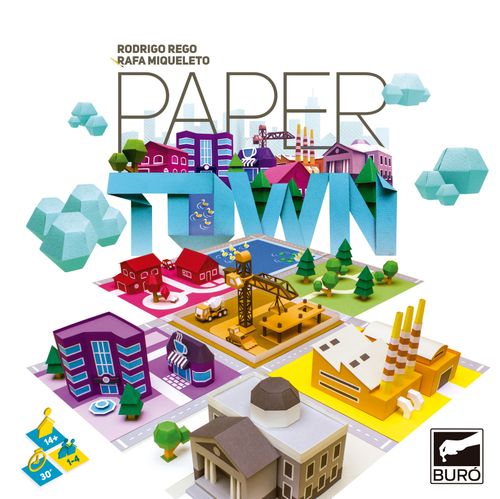
Papertown
Papertown Rulebook
Table of Contents
Table of Contents
Game Components
- 48 Population meeples (12 blue, 12 grey, 12 purple, 12 yellow)
- 42 Block tiles (7 commercial, 7 governmental, 7 residential, 7 industrial, 7 parks, 7 lakes)
- 20 Construction tiles
- 12 Great Structure tiles
Setup
A. Each player receives 2 Construction tiles that must remain face-up and visible to everyone, and 1 Great Structure tile, which only they can see and must be kept face-down.
B. Stack the remaining Construction tiles in a pile facing down, next to the game area. Do the same with the Great Structure tiles, in a separate stack.
C. Give each player a set of 12 Population meeples.
D. Take 3 random Block tiles and place them at the center of the game area, with its corners meeting exactly like in the image below. This is our lovely Papertown.
E. Take 3 random Block tiles and spread them next to the game area. This will be the bank area.
F. All other Block tiles must be stacked face-down next to the game area.
Game Overview and Objective
The players will take turns to build PAPERTOWN by placing Block tiles on the game area, in order to complete their Constructions and Great Structures objectives and place their Population meeples on the city.
Your goal is to place all of your Population meeples in Papertown before your opponents.
Gameplay
Before you start, decide who is going to be the first player. Then, the chosen person will have the following options in the beginning of their turn:
- Swap your Construction tiles;
- Swap your Great Structure tile;
- Buy a Block tile and place it in Papertown.
4.1. Swap Your Construction Tiles
If you choose to swap your Construction tiles, you must draw 2 tiles from the corresponding stack, facing down. and then choose which 2 to keep from all of the tiles now in your hand (recently bought and previously owned). Return those you don't want to the bottom of the corresponding stack. You must never own more than 2 Construction tiles by the end of your turn.
After buying a Construction tile, your turn is over and the player to your left begins their turn.
4.2. Swap Your Great Structure Tile
If you choose to swap your Great Structure tile, draw 2 tiles from the corresponding stack, facing down, then secretly pick one among all of the Great Structure tiles now in your hand (recently bought and previously owned) and return the other 2 to the bottom of the correponding stack. You must never own more than 1 Great Structure by the end of your turn.
After buying a Great Structure tile, your turn is over and the player to your left begins their turn.
4.3. Buy a Block Tile
If you choose to buy a Block tile, you may choose from those facing up in the bank area or directly from the Block stack.
To buy a Block from the bank area, just take whichever tile you want. Don't open a new Block on the bank.
If you prefer to buy an unrevealed Block, draw 2 tiles from the Block stack, facing down. Keep 1 and discard the other, facing up, on the bank area. It will remain available to be bought during the following turns.
The bank area, therefore, will always have a variable number of Block tiles available, and it may even be empty. In this case, the only possible option for buying a new Block is the Block tile stack.
After buying a Block tile, place it in Papertown. Your turn is over and the player to your left begins their turn.
4.4. Place a Block Tile in Papertown
After buying a Block, you have to place it in Papertown before the ending of your turn. When placing a Block, you must follow some placement rules:
- Never place a Block bordering another tile of the same kind. However, equal Blocks can be touching corners.
- The Block tile must always be connected to the others by their sides or by their corners.
- You can only place a Block tile on top of another Block tile if you are completing a Construction or a Great Structure. The Blocks on top may even be of the same kind as the one below.
- You cannot place a Block tile on top of a Construction or Great Structure tile.
If after placing your Block in Papertown you haven't completed a Construction or a Great Structure, your turn ends now. If you have completed a Construction or Great Structure, follow the steps on the next topic.
4.5. Completing a Construction or a Great Structure
- Construction completed!
- Place your Construction or Great Structure over any one of its Block tiles, to your preference. If there is a Population meeple on top of the chosen Block, return it to its owner, even if the owner is you.
- Place Population meeples on top of each Block within your Construction (3 meeples) or Great Structure (4 meeples). If there are meeples on top of those Blocks already, return them to their owners, even if their owner is you. There can only be one meeple per Block.
- Buy another Construction, if you have just completed a Construction, or another Great Structure, if you have just completed a Great Structure. Remember that you can never have more than two Constructions and one Great Structure with you by the end of your turn.
IMPORTANT! Only YOU can complete your Constructions and Great Structures. If, after buying a new Construction or Great Structure, you notice it is already completed on the game area, or if someone else accidentally completes it, that Construction or Great Structure won't be considered completed. You must be the one to place the finishing Block on top of it. Remember that it IS possible to place a Block on top of another Block of the same kind.
Examples of Constructions and Great Structures
A Construction is composed of 3 Block tiles. You complete it when you correctly connect the tiles in a row. Observe this "Gated Community" Construction. There are 4 ways to complete it. Look at the examples below.
Note that to be valid, the [Commercial-Residential-Park] sequence isn't altered (the Residential Block is always in the middle), even if it can be organised in many different ways.
However, in the examples on the right, the "Gated Community" is not completed because the tiles alter the [Commercial-Residential-Park] sequence.
A Great Structure is made of 4 Blocks in a diamond shape. Look at the Great Structure "Multinational Headquarters" below.
To be valid, the Great Structure needs to respect the positioning of the Block tiles. It can be inverted, but without changing the disposition of the Block tiles.
End of the Game
The game ends immediately when:
- A player places all 12 of their Population meeples in Papertown. The game ends, and that player is the winner of the game.
- At the end of a player's turn, there aren't any Block tiles left in the Block stack (even if there are tiles in the bank area). The game ends, and the player with the most Population meeples in Papertown is the winner. In case of a tie, the player who completed most Constructions and Great Structures wins. If the tie remains, the tied players share the victory.
Pairs Variant
Papertown allows you to play with four players competing amongst themselves, or in two pairs. For pairs game, all of the above rules remain, with the following exceptions:
- During the game setup, each player receives only 1 Construction instead of 2. Each player still gets 1 Great Structure that must remain hidden (from opponents and from their pair).
- Each duo receives 12 Population meeples. When completing Constructions or Great Structures, the paired players must use meeples from the same color set.
- You may complete your pair's Construction, but in this case you can only place 1 Population meeple instead of 3. The meeple must be placed on top of the Construction tile. If the other pair has any meeples on top of the Construction's other Blocks, they remain there and are not removed.
- You can't complete your pair's Great Structure, not even by accident.
- The first pair to place their 12 Population meeples wins.
We suggest that any kind of communication between the paired players is prohibited, to make the game even more interesting. But if your group doesn't enjoy this kind of restrictions, feel free to decide the level of liberty for communication between partners.
Solo Game
Papertown has a quick and extremely challenging solo mode.
7.1. Setup
A. Sort out 4 Block tiles of each kind (4 residential, 4 industrial, 4 commercial, 4 governmental, 4 parks e 4 lakes). Shuffle and assemble them facing down in a stack.
B. Draw 3 Block tiles from this stack and place them corner-to-corner at the center of the table.
C. Spread 3 other Block tiles in the bank area.
D. Take 3 Population meeples and put them in front of you. They will not be used in the same way as in a regular game.
E. Sort out, without looking at them, 3 Great Structures and 9 Construction tiles. Assemble them in a stack, intercalating, from top to bottom: 1 Great Structure, 3 Constructions, 1 Great Structure, 3 Constructions, 1 Great Structure, 3 Constructions. Open the first 3: these are the objectives possible to construct.
7.2. Objective
Your goal in this game is to complete the most Constructions and Great Structures you can using only the 24 Block tiles and 3 Population meeples available.
7.3. Your Turn
Your turn consists of choosing one of the 3 Blocks facing up and placing it in the game area, following the same placement rules of the regular game.
After doing so, reveal another tile of the Block stack, keeping the bank area always with 3 Block tiles facing up. In the solo mode, you cannot pick 2 facing down Blocks from the stack.
7.4. Population Meeples
Instead of taking 1 of the 3 revealed Blocks, you can spend 1 meeple to take any Block that is not in play (18 Block tiles are left out of the game). Place them following the regular placement rules.
You have only 3 meeples. After you spend them all, you cannot take any more out-of-play Blocks.
7.5. Completing Constructions and Great Structures
Put you completed Construction or Great Structure tile over one of the Blocks used to build them. You can choose which one. Reveal the next tile in the objective stack.
7.6. End of the Game
The game ends when there aren't any Blocks available to buy and no meeples left to spend.
7.7. Final Score
Each noncompleted Construction is worth 1 point, whether it's revealed or still on the stack. Each noncompleted Great Structure is worth 2 points.
The closer you get to 0, the better your performance.
7.8. Adjusting the Difficulty Level
The solo game setup provides a good challenge for experienced players. However, depending on how experienced you are, you can adjust the game difficulty by increasing the amount of meeples you get (making it easier) or decreasing it (making it harder).