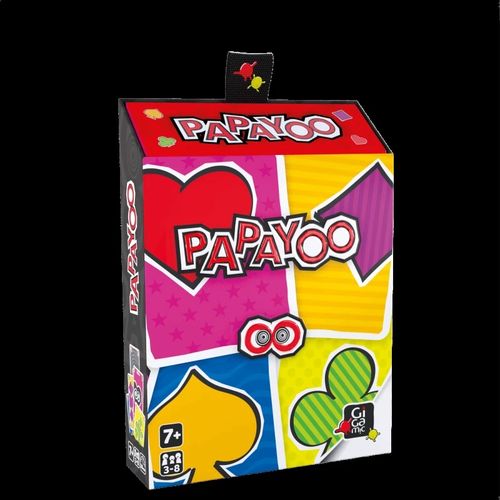
Papayoo
Papayoo Rulebook
Table of Contents
Table of Contents
Contents
- 40 cards, numbered 1-10, in 4 suits (spades, hearts, diamonds, and clubs)
- 20 Payoo cards, numbered 1-20 (black cards)
- One 8-sided Papayoo die
Goal of the Game
Your goal is to have the fewest total points at the end of the game. That means you'll need to avoid the cards that give you points!
Card values: At the end of each round, the players count the penalty points from the Payoo and Papayoo cards they have won in tricks.
- Each Payoo card scores its stated value (1-20 points).
- The Papayoo, which is determined at the start of the round, gives you 40 points.
- The other 39 cards score no points.
Setup
Shuffle all 60 cards together to form a deck.
Note: For 7 or 8 players, remove the 4 aces (spades, hearts, diamonds, clubs), so you are only playing with 56 cards.
1. Deal out the cards
The dealer changes at the start of each new round. They deal out the same number of cards to each player (see table below).
| Number of players | 3 | 4 | 5 | 6 | 7 | 8 |
|---|---|---|---|---|---|---|
| Number of cards per player | 20 | 15 | 12 | 10 | 8 | 7 |
| Number of cards to pass along | 5 | 5 | 4 | 3 | 3 | 3 |
2. Pass cards to the player on your left (surplus cards)
Once all the cards have been dealt, decide which of your cards you want to give to the player on your left (see table above). Place those cards face down in front of that player.
You must pass those cards to your opponent before you pick up your cards from the player on your right.
3. Determine the Papayoo
Once all players have passed their cards along, the dealer rolls the die to determine which number 7 card will be the Papayoo for this round.
For example, if the die lands on spades, the 7 of spades is the Papayoo and will score 40 points at the end of this round.
How to Play
At the start of the game, decide how many rounds you will play (5 rounds is a good length).
A round is made up of a series of tricks. Each player places down one card per trick, until everyone has played all their cards.
The dealer begins the first trick by placing a card of their choice face up in the center of the table.
Starting with the player on the dealer's left and continuing clockwise, each player must play a face-up card that matches the suit of the first card played in that trick. You do not have to play a higher-value card than your opponents if you would prefer not to.
Note: The Payoo cards are a 5th suit, and are played in the same way as hearts, diamonds, clubs and spades.
If you do not have a card of the trick suit in your hand, you can play any other card of your choice.
The player who played the highest card in the trick suit takes the cards from the center and starts a new round.
If no one can play a card that matches the trick suit, the player who started the round takes the cards.
Example: Chris starts the trick by playing the 2 of hearts. Paul must now play a heart, and so places down the 8 of hearts. Maria and John do not have any hearts, so discard a card each: Maria plays the 5 Payoo and John plays the 7 of spades, which is the Papayoo for this round. Paul takes all the cards.
Game End
Once you have played the final trick, count the point values on your cards.
As a reminder, each Payoo card gives you points equal to the number on the card, and the Papayoo gives you 40 points. (The total points for a round will be 250 points.)
Add your points to your points from the previous rounds.
The winner is the player with the fewest points at the end of the game.
Example: It's the end of the round, so Paul counts his points. He has 17 points from Payoo cards (12 + 5) and 40 points for the Papayoo (7 of spades). The other cards are not worth any points, so Paul gets 57 points.
Hint
It is often tempting to play a card lower than your previous opponents, to avoid winning a trick. However, it can be useful to know how to "take a few points" when the stakes are not that high, so you can get rid of your high cards and save your lower value cards to use in other rounds.