Panzerkampf: Armored Clash
Panzerkampf: Armored Clash Rulebook
Table of Contents
Table of Contents
1. Introduction
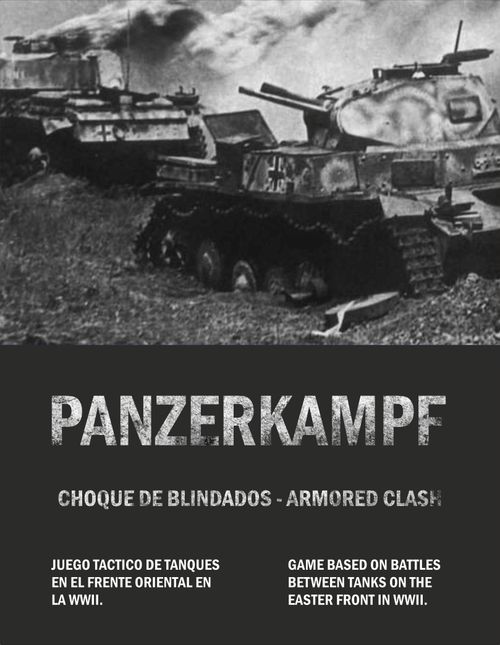
PANZERKAMPF is the first game in this tactical series, based on battles between tanks on the Eastern Front in WWII.
Understanding the strengths and weaknesses of your vehicle is essential if you are to act effectively and destroy or disable the enemy.
2. Game Components
The box for the basic game contains 6 resin tanks (1/150 scale; 3 medium tanks for each side), the cards for each vehicle type, an assortment of markers to be used during the game, templates with terrain obstacles, and four 6-sided dice of different colors.
Not included but required for play is a ruler (or preferably an extendable tape measure) for measuring distances.
3. Vehicle Cards
Each vehicle has a data card where its characteristics are depicted.
On this sample data card (Pzkpfw. IV F1, Medium Tank) we see:
- Image: a photo of the vehicle in question.
- Points Value: this reflects the value of the vehicle. This is relevant when either setting a value limit for battles or as victory points that are awarded to the opponent when they destroy the vehicle.
- Movement: the maximum number of movement units (MU's) that the vehicle can move in one turn.
- Vehicle Identification: indicates the tank model.
- Armor: indicates the millimeters (mm) of armor thickness on the mantlet, front, side, and rear.
- Primary Armament: identifies the tank's primary weapon.
- Penetration: is the penetration ability (in mm) of the main armament according to the distance to the target. There are 5 distance scales: D1 (very short), D2 (short), D3 (medium), D4 (long) and D5 (very long).
- Hit Roll Modifier: is the range-based modifier that must be applied to the die roll when determining hit attempts.
- Basic Damage Value: the number one must roll equal or less to on 2d6 in order to deal damage to the target. This varies depending on where the target is hit.
- Defensive Armor Modifier: some vehicles have better armor than others; the attacker has to add or subtract this modifier to their Basic Damage Value dice roll.
- Survival: the crew's saving throw value, shown in the upper right (see section 15).
The data card for the Pzkpfw. IV F1 reads as follows:
- Points Value: 20
- Movement: 2
- Survival: shown as "<3" in the card image (the rules text in section 15 gives "less than 4"; see the note there)
- Armor: Gun Mantlet 50 mm; Front 50 mm; Side 30 mm; Rear 20 mm
- Primary Armament: 7,5 cm KwK 37
- Penetration (mm): APCB: D1 45, D2 38, D3 35, D4 32, D5 30. HEAT: 45 at every distance.
- Modifier to Hit Roll: D1 0, D2 0, D3 +1, D4 +2, D5 +3
- Basic Damage Value: Front 5, Side 6, Rear 7
- Defensive Armor Modifier: Front 0, Side/Rear -2
The data card for the T34 41 (used in the examples below) reads:
- Armor: Gun Mantlet 52 mm; Front 52 mm; Side 45 mm; Rear 45 mm
- Defensive Armor Modifier: Front +1, Side/Rear 0
- Penetration (mm) for special ammunition: APCB: D1 80, D2 69, D3 59, D4 54, D5 48. APCR: D1 102, D2 92, D3 60, D4 -, D5 -
4. Play Area
The effectiveness of tank weaponry is largely dependent on the distance to the target. This is fundamental to how the game is played. In PANZERKAMPF there is no map. Instead, the game can be played in area of just about any size - the minimum recommended being 1m x 1m. Once the playing area has been defined, it must be divided into 5 equal segments (or distances): D1 (very short), D2 (short), D3 (medium), D4 (long) and D5 (very long). If the "map" is rectangular, these segments will be referenced on the longest side.
As we have said before, defining these distances is important because these range bands are what determine the effectiveness of vehicle armament when hitting enemy targets. The basic set incorporates some markers to define the interval of the distances.
Let's take as an example a map of 1m x 1m (the minimum recommended). As can be seen in this example, on the "map" each segment is 20 cm, thus completing the total length of 1 m.
Scenery you wish to use can be placed by any random method, both the samples provided in the basic set as well as any other samples players may want to include.
5. Sequence of Play
This consists of several phases to be completed in the following order:
a. Initiative Phase: each player rolls a 1d6. The player with the highest roll wins the initiative and moves second. The player who wins the initiative will have a -1 penalty for the next initiative roll (the penalties accumulate for as long as the player continues to retain the initiative, so after having the initiative twice in a row, the next roll will have a -2 modifier).
b. Repairs Phase: vehicles with a damaged gun or turret may attempt repairs. However, only one repair attempt is allowed per turn for each crew, so gun or turret, not both. However, veteran crews (see section 16) can re-roll one failed repair attempt per turn.
c. Movement Phase: the player who lost the initiative moves first followed by the player who won the initiative. Both players can use all, some, or none of permitted movement allowance of the vehicle in question.
d. Turret Movement Phase: once the two players have moved all their vehicles, they can alter the turret facing of their tanks.
e. Fire Phase: this phase is simultaneous for both players. Both make rolls to hit with firing vehicles and then to determine damage - if hits have occurred. (Exception: Optional Rules: Fire Initiative, section 12.)
6. Movement
There's a basic movement marker (MU) used in conjunction with the movement procedures.
In the basic game, only forests restrict movement. When a tank enters a forest it stops immediately. You then have to roll 1d6. On a "6" the vehicle is immobilized and cannot move again for the rest of the game; on a 1-5 the vehicle moves normally on the next turn. If your own scenery is being used, tanks can enter wooden houses, making the roll for immobilization as in the case of entering a forest. However, they cannot enter stone houses, bunkers, or marshes.
Each vehicle has a movement capacity depicted within an arrow on the upper portion of its card. In the case of this Pzkpfw IV the vehicle has a movement limit of "2".
In the example, we are going to use those 2 MUs. One movement marker is placed directly in front of the vehicle and the other one after it.
If the vehicle makes a 90º turn (either when stopped or in motion) it spends 1 MU. If stopped, turning 180º would expend 2 MUs. A stationary vehicle can always move backwards, but it can only move a maximum of 1 MU, whatever its movement capacity.
A moving vehicle that moves at up to its maximum speed (unless this is 1) without turning 90º or more, will not be able to stop in its next turn but must move at least 1 MU until it comes to a stop in a subsequent turn.
Vehicle movement can be reduced if a critical hit is received to its engine (see section 7, Fire Phase - Critical Hit).
Turret movement (Phase d) is resolved as follows. Once both players' vehicles have completed their movement, they can attempt to adjust their turrets.
A roll of 1d6 is made and the turret will move according to the result rolled. As can be seen, on a dice roll of 1-2, the turret will move up to 60º; 3-4 up to 120º; and 5-6 up to 180º. To visualise this better in game terms, you may wish to imagine these different arcs as the sides of a standard map hexagon.
The basic set contains a template to verify turret rotation.
In subsequent turns, if you want to adjust the turret, it will do so from the position it had at the time of the change, and not from any default forward-facing position.
7. Fire Phase
The combat system in PANZERKAMPF is very straightforward:
1º Impact: you make a roll to see if the enemy vehicle is hit. A roll of 2d6 is made and the result must be equal to or less than the required number, depending on the target's terrain:
| Terrain | Basic Impact Value |
|---|---|
| Clear | 9 |
| Woods | 7 |
| Hull Down (*) | 6 |
| Immobilization value in forests | 6 |
(*) The vehicle is considered to be "Hull Down" if 50% its hull is partially hidden by a house, wall, rocks/rubble, another vehicle, or something similar.
An important thing to keep in mind is that the vehicle's gun must face some part of the enemy vehicle in order to fire at it. There are no actual "Covered Arcs" here, unlike those found in other games. If a continuous straight line cannot be drawn from the gun muzzle to target, fire does not occur. The basic set contains a marker to determine in which zone the impact occurs.
To this roll a series of modifiers are applied - we will meet these in section 8: Fire Modifiers (Exception: a roll of double "1" cancels all modifiers and automatically hits the target).
A roll of double "6" in this phase damages the vehicle gun. [sic: the source sentence is incomplete here; the Gun Malfunction section and the note under it state that a double 6 on a roll to hit automatically damages the gun.]
2º Damage: roll the dice to see if damage is inflicted. Integral to this is determining if the shot hit the target's front, side, or rear.
| Basic Damage Value | Front | Side | Rear |
|---|---|---|---|
| (Pzkpfw. IV F1) | 5 | 6 | 7 |
A roll of 2d6 is made, and if the result is equal to or less than what is on the vehicle card, once the enemy vehicle's armor modifier (if any) has been applied, damage is dealt to it.
| Defensive Armor Modifier (T34 41) | Front | Side/Rear |
|---|---|---|
| +1 | 0 |
3º Damage Resolution: we will have to take into account the penetrative power of the firing cannon compared to the armor of the enemy vehicle. In order to destroy an enemy vehicle, once it has been hit and damage caused, the penetration value of the gun must be the same or higher than the target's armor.
As an example, let's say a Pzkpfw IV F1 shoots at a T34 41 at distance D1.
(Example 1 shows the Pzkpfw IV F1 shooting at the front of the T34 41 from 15 cm; Example 2 shows it shooting at the side or rear from 15 cm.) As we see in example 1, the Pzkpfw IV F1 cannot penetrate the frontal armor of the T34 41 at any distance, including D1 as in this case. The penetration of its gun is 45 mm and the frontal armor of the T34 is 52 mm. However, it could penetrate the armour in example 2 (if it shoots at the side or the rear) because the armor of the T34 in those areas is 45 mm.
In Example 2 the Russian tank would be destroyed as the hit penetrated the armor. In Example 1, although the vehicle is not destroyed (because the hit did not penetrate) there is still a chance of a critical hit. We will come to this section later.
Special Ammunition: there are some vehicles that have the ability to fire more than one type of ammunition. The normal ammunition was AP / APBCB, but some could also fire APCR ammunition, which had greater penetrative power.
The penetration table printed for the T34 41 example in this section reads: APCB: D1 80, D2 69, D3 59, D4 54, D5 48. APCR: D1 102, D2 92, D3 60, D4 -, D5 -.
This ammunition was quite scarce and to reflect that, when a player wants to use it, they must declare it before making the roll to hit.
Irrespective of whether the shot hits or misses, 2d6 are then rolled. On 1-6 the special ammunition is not depleted, but on 7-12 the vehicle is deemed to have expended its available stock and cannot fire special ammunition again for the rest of the game. The corresponding marker is placed (the "APCR Out" marker).
Critical Hit: in order for this to occur, the armor penetration of the firing gun must exceed by at least 50% the target vehicle's armor in the area where the target was hit. Referring to the previous example, the penetration of the Pzkpfw IV F1 is 45 mm and the frontal armor of the T34 is 52 mm - 50% of 52 mm would be 26mm. Thus, the Pzkpfw IV has a chance of causing a critical hit on the T34. If, however, the penetration figure had been below 26mm, there would be no chance of a critical hit.
It is important to bear in mind that in the case of a critical impact on the barrel, the armor of both the tank's mantlet and front must be combined before determining a damage chance. For example, in the case of the combat between the Pzkpfw IV and the T34, the German vehicle now hits the barrel of the Russian vehicle, but since the penetration of the Panzer IV is 45 mm and the sum of the mantlet and the front armour of the T34 is 104mm (52mm from the mantlet plus 52mm from the front armor), this hit would not do anything. The German vehicle has not reached 50% of the sum of the two relevant armor locations.
A critical hit can affect one of several different areas of the target vehicle. A roll of 1d6 is made to determine where the appropriate marker is placed:
| 1d6 | Damage |
|---|---|
| 1 | Gun |
| 2 | Turret |
| 3 | Hull |
| 4 | Engine |
| 5 | Track (chains) |
| 6 | No effect |
(*) Vehicles that are Hull Down ignore the results of a 4 and 5 for critical hit rolls (the hull is considered to be almost entirely hidden).
The effect of each result is:
Gun Malfunction: a marker is placed designating that the vehicle will not be able to fire until the gun is repaired. At the beginning of each subsequent turn, roll 1d6: on a 1 the gun is repaired and can be used normally again; a 6 indicates that the gun is permanently inoperable; 2-5 it is still not capable of being used but further repair attempts are still possible.
(*) a result of double 6 on a roll to hit also automatically damages the gun.
Turret Malfunction: a marker is placed designating that the crew will not be able to rotate the turret until it is repaired. At the beginning of each subsequent turn, roll 1d6: on a 1 the turret is repaired and can be used again normally; on a 6 the turret cannot rotate for the rest of the game; 2-5 it is still not capable of rotating but further repair attempts are still possible.
(*) turretless AFVs (like some assault guns and tank destroyers) do not suffer any form of turret malfunction and ignore this result.
Hull Damage: the body of the vehicle has been hit and the appropriate marker is placed. Vehicles can accumulate more than one such hit. For each hit to the hull that a vehicle has, the opponent will have an extra modifier of -1 to the damage roll.
Engine Hit: when a vehicle receives a hit on its engine, it reduces its movement by 1 MU. Each additional hit causes a further loss of 1 MU. Tanks reduced to 0 MU are permanently immobilized. Such damage cannot be repaired during the course of a game.
Track Hits: the vehicle is immobilized for the remainder of the game. You will be able to fire and rotate the turret if both are operational, but you will not be able to move. Track damage cannot be repaired during a game (Exception: Optional Rules - Game Events).
8. Fire Modifiers
Distance: in order to determine any range modifier for a combat, players must refer to the firing vehicle's card. Depending on the range the target is located at, there will either be no modifier or a number that must be added to the 2d6 roll. For example, with the Pzkpfw IV F1 ranges of D1 and D2 do not have modifiers, while D3, D4 and D5 require that the given modifiers are added to the hit roll.
| Modifier to Hit Roll (Pzkpfw. IV F1) | D1 | D2 | D3 | D4 | D5 |
|---|---|---|---|---|---|
| 0 | 0 | +1 | +2 | +3 |
Movement: in addition, if either the firing vehicle or its target (or both) had moved in the Movement Phase immediately prior to the current Fire Phase, add +1 for each MP used by one or the other. Moving shots and/or shots against moving targets were prone to a greater level of inaccuracy, hence the modifiers. In the starter set there are markers to place on tanks that have moved.
A light vehicle that is currently at its maximum speed also has an extra +1 to be hit, over and above any other movement modifiers to be applied.
For example, the Pzkpfw IV F1 is firing at a Russian T34 in open terrain at D3 (medium) range. The Russian vehicle has moved 3 MUs and the German 2 MUs. Being in open terrain a maximum final result of 9 is required on a 2d6 roll to achieve a hit. The German player rolls a 1 and a 5, to which must be added +1 (the German's gun modifier at D3) and then another +5 (+2 for the movement of the German vehicle and +3 for the movement of the Russian vehicle) for a final total of 12. Therefore, the shot misses.
9. Terrain Modifiers
Terrain does not offer fire modifiers. The ability to hit vehicles in various terrain is reflected in the Terrain Table found on Page 5 as part of the description of the Fire Phase (see the Basic Impact Value table in section 7).
10. Victory Conditions
Victory conditions can vary according to what the players select:
Turn Limit Victory Point Count: the number of turns to be played is determined by the mutual agreement of the players. At the end of the last turn, victory points for each side are counted and the player with the most points wins the game. For each enemy vehicle destroyed, its points value (as found on its card) is awarded to that player, while for each immobilized (not destroyed) vehicle, 5 points are added.
Annihilation: be the first to destroy all opposing vehicles - no turn limit.
Scenarios: players determine a winning objective/process within the scenario they have created.
In addition, players can mutually decide any other type of victory condition, based on whatever criteria they agree to work with.
11. Game Preparation
After choosing which side to play and how the game will be decided, both players decide, by whatever means suits them, where they will place any terrain from the starter set or from their own collections.
Tanks begin on the "home" edge of the playing surface that corresponds with the player who controls them. Play then begins with the opening phase of the first turn.
Optional Rules
12. Fire Initiative
If the players agree, this rule allows the player who won the initiative to fire first (and have any hit results applied) in the Fire Phase. This may prevent one or more of the other player's tanks from firing back.
13. AT/AQ/SPG Vehicles
These types of vehicles (anti-tank, assault guns and self propelled guns) were often employed in ambush roles whereby they remained stationary and concealed in order to fire more effectively.
To cater for this, if either one of both players is using such a vehicle, its location in forests or ruins is secretly noted. Once the vehicle has fired or moved in any way, it immediately loses its concealed status.
14. Random Events
The Starter Set contains a number of "Event" markers that can be used during gameplay. There are 11 different events, with twelve chits in total (the air attack provision having both a German and Russian marker). There are 2 markers per event and we have 24 in total.
At the start of the game, these markers are placed in a cup. Each time a player rolls a double for hit determination, they can choose to draw a marker from the cup. This is a blind draw, so no peeping!
Markers that display an exclamation mark must be applied immediately. Any others can be kept and used at any time the player wishes.
Events included are as follows:
-
Stuka / Sturmovik Air Attack: this takes effect immediately. On a roll of 7 or less, destroy a vehicle. If the plane drawn is of the same side as player who drew it, that player gets to choose which tank is destroyed. If the plane and the player are on opposing sides, the target is picked by the other player. For example: if a Stuka is drawn by the Russian player, it is the German player who determines its target.
Stukas and Sturmoviks can only attack tanks they can see, therefore they cannot attack tanks in forests nor any vehicle currently with ambush status.
-
Friendly Fire: this can only be played at the commencement of the Fire Phase. Play of this marker permits the player in question to adjust the turret of any one enemy tank so that its gun is pointed at a tank of that same side - if no other tank is in view, the turret is simply moved to whichever position the player using the marker chooses. The player whose tank it is cannot move the turret again until the next eligible phase.
If there is a friendly tank targeted, after adjusting the turret, roll a d6. On a 1-3 the crew of the firing tank realises their mistake just in time to avoid firing. On a 4-6 they fire at the friendly tank using normal combat resolution methods.
-
Shot Bounce: cancels the damage from one hit.
-
Gun Malfunction: used as soon as it is drawn. The player chooses an enemy tank and places the corresponding marker on it.
-
Ghost Panzer: must be used immediately. An enemy tank (chosen by the player who drew the marker) is relocated at its maximum speed by randomly determining which direction it moves using the turret turn template.
-
Rapid Fire: when played, this marker permits firing on the same target twice in the same Fire Phase. The option to use this marker must be declared immediately after the first fire resolution. You do not have to roll to hit the target again but go straight to damage resolution.
15. Crew Survival
Players may wish to arrange their games so that the story of their individual tank crews can carry on from battle to battle. More experienced crews will have better qualities when it comes to engaging enemy vehicles and thus surviving any ill fortune along the way.
When a vehicle is destroyed, roll 1d6 to see if the crew survives.
The survival value is reflected on the upper right of the vehicle card. In the case of Pzkpfw IV F1, you have to roll less than "4" on a 1d6 roll. [Note: the Pzkpfw. IV F1 card as printed in this edition shows the survival value as "<3", while this text says "less than 4". The text is transcribed as printed; the card value is the one shown on the card images.]
A crew that fails their saving throw dies and loses all achievements they had up to that point.
16. Crew Advancement
As briefly mentioned in section 15, this provision will occur in the case of playing campaigns or tournaments. Each player will see the evolution of his crew according to their achievements. These achievements are focused on destroying enemy vehicles.
Note: all crew advancement only applies from the beginning of the next game where that crew is used - not the game where the qualifying mark was attained.
There are 4 types of crew:
a. Rookie: a crew has no modifiers to add to the obtaining a hit, causing armour penetration, or the repair of guns or turrets.
b. Veteran: a crew becomes a veteran when it destroys 5 enemy vehicles. When it attains this state, it has a -1 bonus to any hit roll. In addition, they can re-roll one failed repair roll per turn.
c. Elite: a crew becomes elite when it destroys 15 enemy vehicles. When it attains this state, it has a -1 bonus to any hit roll and -1 on any ensuing damage roll. You can also subtract 1 from the repair roll for any one damaged component.
d. Ace: a crew becomes ace when it destroys 30 enemy vehicles. When it attains this state, it has a -2 bonus to any hit roll and a -2 bonus to any ensuing damage roll. You can also subtract 2 from the repair roll for any one damaged component.
Scenarios
17. Duel in the Steppe
(The printed heading reads "Duel in the Steepe"; corrected here to "Steppe". The scenario contents-page title is "Duelo en la estepa".)
South of Lwów, June 1941: It is the beginning of Operation Barbarossa, and in the endless combats that take place, two enemies face alone, a Panzer IV F1 and a T34 41.
Game Preparation: both players roll 1d6 and the winner has the initiative on the first game turn and chooses an edge of the board, where he deploys his tank, placing the opposing player on the opposite edge.
Victory Conditions: the player who destroys the enemy tank wins the game.
Scenery: each player alternately places the scenery that contains the Basic Set.
18. Race to Kiev
(The contents-page title is "Carrera a Kiev".)
June 1940, any tanks of 16th Panzer División fight with straggling enemy tanks of the 19th Armored Division, belonging to the Russian 22nd Army Corps, west of Dubno.
Game Preparation: the German player has the initiative in the first game turn and chooses the edge of the board where he will deploy his tanks. The Russian player deploys his vehicles on the opposite edge.
Victory Conditions: in this scenario, 3 Panzer IV F1 fights with 2 Russian T34 41s. The Germans win if they prevent the Russian tanks from leaving the board over the German edge.
Scenery: each player alternately places the scenery that contains the Basic Set.