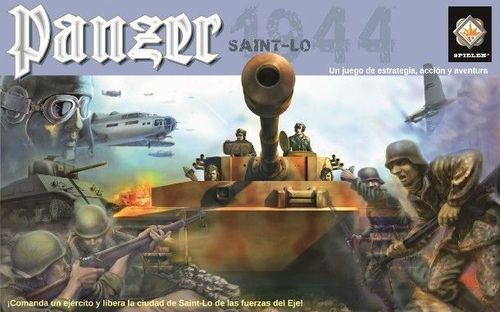
Panzer Saint-Lo 1944
Panzer Saint-Lo 1944 Rulebook
Table of Contents
Table of Contents
1. Introduction
The game recreates the battle of Saint-Lô, between the Allied (American) and Axis (German) armies in the city of Saint-Lô, France, during WWII, in July, 1944. Players will deploy their armies over enemy territory, with the goal of destroying the opponent's Command Posts, while avoiding the destruction of their own.
2. Game components
The game contains the following components:
- 1 Board
- 65 Allied units counters
- 65 Axis units counters
- 8 Allied Command Post counters
- 8 Axis Command Post counters
- 64 Supplies counters
- 24 Allied Battle Reports
- 24 Axis Battle Reports
- 10 Dices
- 1 Rulebook
2.1. The board
It represents the countryside surrounding the city of Saint-Lô, depicting towns, roads, forests, bridges and rivers. The board is divided in hexagonal spaces, in which units are placed.
2.2. Units
Units are counters representing an element of the army. In the game there are five types of units: infantry, tanks, artillery, aircraft and supply. All are described in detail in paragraph 7.
Each unit has the following statistics (figure 1): the name or type of weaponry, a flag identifying the army it belongs to, the supply cost of the unit and its attack, defense and mobility values. The last three depict the unit's abilities and will be explained next.
- Attack: is the ability to engage an enemy unit;
- Defense: is the ability to withstand the enemy unit's attack;
- Mobility: is the ability to move around the board.
Figure 1. Elements that comprise a unit.
2.3. Supplies
Supplies represent fuel and ammo consumed by units, and come in counters depicting amounts of 1, 5, and 10 (figure 2). Each time a unit moves or attacks, it consumes Supplies. Thus, during the game, players will have to acquire Supplies for themselves and use them rationally.
At the start of the player's turn, supply units will yield the Supplies needed to use units.
Fig. 2. Supplies counters.
2.4. Command posts
Each army has 8 Command Posts with different defense values (figure 3). These are placed in the board, in the hexes colored in yellow or red. Command Posts cannot attack or move, as they only represent the control of that particular position by a player. When a Command Post is destroyed, it cannot reenter in the game.
Fig. 3. Allied (left) and Axis (right) Command Posts.
2.5. Battle Reports
Battle Reports are cards that create circumstances or "events" that can favor the player or jeopardize the opponent (figure 4).
Each army has its own Battle Reports deck that is shuffled and placed face down to the side of the board. Battle Reports can be used at any time. Once played, they are placed into a discard pile.
Figure 4. Allied (left) and Axis (right) Battle Reports.
How Battle Reports are used in the game is covered in detail in paragraph 9.
3. Game objective
The objective of the game is to destroy four of the opponent's Command Posts. The player or team that fulfills that objective first will be the winner.
For a longer (and more challenging) game, players may establish that the game objective be to destroy 6 or all 8 Command Posts. In those cases, the duration of the game will be longer.
4. Game setup - for 2 players
-
Each player chooses an army: Allied or Axis. Players take their unit counters and Battle Reports.
-
Command Posts are placed in the board. The Axis player will place them in the red colored hexes, while the Allied player will place their own in the yellow ones, a single Command Post per hex.
-
Then players have to deploy (place) their units in the field (board). The Allied army will deploy its units in the northern part of the board, and the Axis army in the south (the split between both sectors is indicated in the board following a dashed line. See figure 5).
Within his sector, the player is allowed to place units in any hex. There can only be one unit in each hex. With the exception of aircraft units (V), the rest of the units cannot be placed over rivers or Command Posts. Once a counter is placed in the board, it cannot be moved to another hex.
If the player so wishes to, units can be placed face down, so the opponent can't see how his units are being distributed. In this case, all units are flipped face up once the placing of units is finished.
Fig. 5. The dotted line to the side of the board indicates the division of the battlefield into the northern sector (Allied territory) and southern sector (Axis territory).
-
Supplies counters are placed besides the board as a draw pile.
-
Each player shuffles his Battle Reports deck and places it face down somewhere handy; then takes 6 Battle Reports from the top of the deck to his hand without showing them.
Now everything is set to start the game. Roll dices to determine starting player. The game is played in turns.
5. Turn sequence
The turn comprises of four phases, happening in the following order:
- Phase 1 - Re-supplying
- Phase 2 - Receive a Battle Report
- Phase 3 - Movement and Attack
- Phase 4 - Reorganization
5.1. Phase 1 - Re-supplying
The player receives 1 Supply for each of his Supply units (S) deployed in the board.
5.2. Phase 2 - Receive a Battle Report
The player draws 1 Battle Report from his deck. You cannot hold more than 7 Battle Reports in your hand. If at any moment you hold 8 Battle Reports, discard one before continuing.
5.3. Phase 3 - Movement and Attack
In this phase, the player may move and attack with any of his units.
To use a unit, the player must pay 1 Supply to the common pool. This allows the player to move a unit, to attack, or to do both, in any order (move-attack or attack-move). After moving and/or attacking, the unit will be flipped face down in the hex it is placed, and cannot be used again for the remainder of the turn (rules for movement and attack are explained in detail over paragraph 6).
Some units have special characteristics, such as being able to move without paying supplies or without being flipped over when used. Check paragraph 7 for more about this.
The player may use up to 10 units in his turn, as long as those are not face down and has enough supplies to do so. If the player has 10 units face down, is out of supplies, or wishes not to use more units, phase 4 starts. But before doing so, flip back up all face down units in the same hex they are on.
5.4. Phase 4 - Reorganization
This phase is optional. When the player ends his movements and attacks, he may activate ("buy") units that are not in play, by paying as many Supplies as indicated by the unit cost. The player may only purchase units from his own army.
The activated unit enters the game in an hex adjacent to a Command Post of the player.
Normally, the player will not be able to accumulate enough Supplies to activate aircraft (V) or tank (T) units. Nonetheless, the player may acquire extra Supplies by deactivating units, which is explained in paragraph 8.
6. Movement and attack
Rules of movement and attack will be explained next.
6.1. Movement
Each unit may move once per turn, in any direction, as many hexes as its mobility stat indicates. If the player wishes, the unit may move less number of hexes or none at all (figure 6).
Figure 6. Allowed moves for an Infantry unit, with a mobility of 2.
A land unit cannot move into an hex occupied by another land unit or Command Post. Still, it may "jump" or move through other land units as long as they are from the same army (figure 7).
Figure 7. Allowed moves for an Infantry unit, in between friendly units and Command Posts.
Land units cannot "jump" over enemy land units (figure 8).
Figure 8. Allowed moves for an Infantry unit, in between enemy units and Command Posts.
Land units may not cross rivers; they must use the bridges (figure 9).
Figure 9. Allowed moves for an Infantry unit, in an area with rivers and bridges.
6.2. Attack
When two opposing units occupy adjacent hexes, the active player may attack. The player states "I'm attacking unit XXX" also pointing out which unit will be performing the attack. Then, the attacking player will roll as many dices as indicated by the attack stat of the attacking unit. The defender, in time, will roll as many dices as indicated in the defense stat of the unit under attack (figure 10). The attack will be resolved in this way:
Figure 10. Attack of a German Panzer IV Ausf. F/2 tank unit against an Allied M4A1 Sherman tank unit. The attack and defense values appear circled.
- If the higher roll of the attacker is greater than the higher roll of the defender, the unit under attack is destroyed and withdrawn from the board (figure 11).
Fig. 11.
- If the defender's higher roll is greater than the attacker's (figure 12), the unit under attack survives and continues in play (this does not imply that the attacking unit is removed from the board).
Fig. 12.
- In case of a tie, the attack is resolved by the next higher pair of rolls (figure 13).
Fig. 13.
Every time the rolls are tied, the attack is resolved by the next pair of higher dice rolls. Eventually, the player with most dices rolled will prevail (figure 14).
Fig. 14.
If players remain tied anyways, all dices are re-rolled.
Remember: after having moved, attacked, or both, with a unit, the player must flip the unit face down for the remainder of the turn.
7. Units types and stats
The source heading reads "Units types und stats"; it is corrected here.
There are five types of units, divided into land and air ones. Land units are: Infantry (F), Tanks (T), Artillery (A), and Supply (S). Air units are aircraft (V). Units are recognizable by the icon located in the upper right corner of the counter.
- F Infantry
- T Tanks
- A Artillery
- V Aircrafts
- S Supply
7.1. Infantry
Infantry is a combat unit with low attack, defense and mobility stats values. They may be soldiers on foot or motorized infantry (figure 15).
Figure 15. Infantry units: motorized infantry (left) and soldiers on foot (right).
Infantry comprised of soldiers on foot does not pay Supplies to move (this is indicated by an "x" below their mobility stat - see figure 15). Nonetheless, it does require Supplies to attack.
Infantry units cannot attack aircraft.
7.2. Tanks
Tanks are units with high attack and defense stats (figure 16). They allow for strong advancements to breach enemy lines.
Figure 16. Tank units.
Tank units cannot attack aircraft.
7.3. Artillery
Artillery units cannot attack by themselves, rather they "support" friendly units engaged in combat. When a land unit initiates an attack, it may call for "artillery support", in which case the attack value of the attacking unit is enhanced by the attack value of the supporting artillery unit/s.
Unlike other units, Artillery may attack from some hexes afar. This distance is called Range and it is indicated below the attack stat (figure 17).
Figure 17. Artillery unit. The Range indicates the maximum number of hexes from which the unit can support an attack.
When a land unit engages, it can call for support from one or more Artillery units, as long as the targeted unit is in the Artillery unit's Range (figure 18).
Figure 18. Infantry attack with Artillery support. Verify that the targeted unit is within the Artillery unit's range. Attack and defense stats involved appear circled; in this example, the resulting attack value is 2.
In that case, the attacking player states "I attack unit XXX with artillery support", pointing at the attacking unit and at the Artillery unit/s involved in the action. For each unit the player uses in the attack (the attacking land unit plus any supporting Artillery units), the attacker must spend 1 Supply, payable to the common pool. Next, the attacker will roll as many dice as the total attack stat of the attacking unit and the supporting Artillery unit/s added together.
When used as support units, Artillery units are not flipped over after the attack is resolved, for that reason, they can be called again in the same turn. Only if they move, they should be flipped face down for the remainder of the turn.
Artillery units cannot attack aircraft.
7.4. Aircrafts
Aircraft have a higher speed than the rest of the units and can roam freely along the board. Their movement is not restricted by the landscape, land units or Command Posts (P). Aircraft can also be placed over a (friendly or enemy) land unit or Command Post (figure 19). Even so, two aircraft units cannot occupy the same hex.
Figure 19. Air units can move over land units of any army and be placed in hexes occupied by them.
Aircraft can attack both land and other air units. They have two attack stats for that purpose: the value indicated above is the attack stat to engage air units, while the value indicated below is the attack stat to engage land units (figure 20).
Figure 20. Aircraft unit.
For an air unit to engage another air unit, they must be placed in adjacent hexes (figure 21).
Figure 21. Attack of an Allied P51 Mustang against a German Me Bf 109 unit. Attack and defense stats involved appear circled.
To attack a land unit, the Aircraft must be placed in the same hex as its target (figure 22).
Figure 22. Air attack against a land unit. Attack and defense stats involved appear circled. In this case, both units are in the same hex.
Aircraft units cannot destroy Command Posts, nor can they use artillery support.
7.5. Supplies
Supply units provide Supplies, required to activate the rest of the units. These vehicles have no attack capacity, so they should always be escorted (figure 23). Supply units are most vulnerable to air attacks.
Figure 23. Supply units.
Supply units can only be deployed and moved along roads or bridges.
8. Supplies for units swap
Another way to obtain Supplies is by deactivating (exchange) a unit for them. As seen in paragraph 2.2., each unit has a cost. When performing the swap, the player will take half the unit's cost in Supplies. The unit deactivated is removed from the board.
Players may perform this exchange of units for Supplies only in the reorganization phase of their turn.
When the cost of the deactivated unit/s totals an uneven number, Supplies gained are rounded down. For example, if a unit with a cost of 9 is swapped, the player will receive 4 Supplies. Now, if two units with a cost of 9 each are swapped, they will yield half of that 18 cost total, meaning 9 Supplies.
Swapping cannot be undone. If a unit was deactivated for Supplies, the player must pay the whole cost of the unit to deploy that unit again.
Supply units cannot be deactivated for Supplies.
9. Battle reports
Battle Reports onset events that favor the player or jeopardize the opponent's maneuvers. Events can be:
- Unique: they enhance or hinder the attack, defense or mobility stats of a single unit, or else, they grant it some special attribute until the end of the turn.
- General: they grant or remove attributes to a group or all units of an army, until the end of the turn.
- Supplies: they grant extra supplies for the player.
Battle Reports can be played at any moment during the game. To do so, the player will read the Battle Report out loud and the event will be fulfilled by all players. Once played, they are placed to a side of the deck, in a discard pile. If at any point the Battle Reports deck is exhausted, reshuffle the discard pile to build a new deck.
Unique and General events last only until the end of the turn.
Unique events will require a unit to be selected. For example: the "Ace of Tanks" Battle Report states: "The selected tank unit increases its attack by 2, until the end of the turn". The player plays this card during his turn, and chooses a tank unit over which the event will be onset. Once the player's turn is over, the effect is terminated and the unit returns to its original condition.
Both decks comprise of the same type and number of Battle Reports.
10. 4-Players variant
When playing with 4 people, assemble two teams of 2 players, and have each team control one army. Within each team, each player will control a certain type of unit:
- Player A: Infantry and Aircraft
- Player B: Artillery and Tanks
A player may not use his partner's units. Only Supply units are shared by both of them.
The game plays basically the same as with 2 players, with the following adjustments:
10.1. Game setup (paragraph 4)
Each player places their own units in the board, and 6 Battle Reports are dealt to each of them.
10.2. Turn sequence (paragraph 5)
Turns are played by teams. In each phase of the turn, bear these considerations in mind:
- Phase 1 - Re-supplying: Supplies gathered can be used by both team members.
- Phase 2 - Receive a Battle Report: Each player will receive a Battle Report (2 per team).
- Phase 3 - Movement and Attack: Team members will alternate their moves, a player at a time, until the maximum of 10 units is reached. If one of the team members cannot or wishes not to move any more, the other player may perform more of his own moves.
- Phase 4 - Reorganization: Any member of the team, or both, may take this action.
10.3. Artillery support (paragraph 7.3)
The player not controlling Artillery (Player A) may call for artillery support from his partner (Player B). Player B may refuse to support the attack, if he so chooses.
10.4. Battle reports (paragraph 9)
A player may use an event to benefit his partner directly.
Annex - Order of battle
The following tables indicate the number and type of units included in each army. The unit count varies slightly in its composition, with the purpose of simulating the actual Order of Battle of each side. This, nonetheless, does not affect the balance of the game, as it was conceived to give both players the same chances of winning.
Format: unit name - Attack/Defense/Mobility - quantity. For aircraft, the first attack value is the attack against air units; the value in parentheses is the attack against land units (paragraph 7.4).
US army (Allies)
- Infantry
- Infantry - 1/1/2 - 10
- Assault infantry - 2/1/2 - 5
- M5 - 1/2/4 - 8
- Artillery
- M2A1 105mm - 1/1/2 - 5
- M7 Priest - 1/2/4 - 2
- Tanks
- M5 Stuart - 2/3/4 - 2
- M4A1(76)W Sherman - 4/3/4 - 4
- M4A3(76)W Sherman - 4/4/4 - 3
- M4A3(76)W E8 HVSS - 4/4/4 - 2
- M4A3 E2 Jumbo - 3/6/3 - 3
- Aircraft
- P51 D Mustang - 2/3/9 - 4 (land attack 1)
- P47 N Thunderbolt - 3/3/9 - 3 (land attack 2)
- B24 Liberator - 1/2/7 - 2 (land attack 4)
- B17 B Flying Fortress - 1/2/7 - 2 (land attack 5)
- Supplies
- 6x6 GMC - 0/1/4 - 5
- Mack NO 6x6 - 0/1/4 - 5
German army (Axis)
- Infantry
- Infantry - 1/1/2 - 10
- Assault infantry - 2/1/2 - 5
- Sd. Kfz. 251 - 1/2/4 - 8
- Artillery
- Le sFH 18 105 mm - 1/1/2 - 5
- Wespe - 1/2/4 - 2
- Tanks
- Panzer III Ausf. L - 2/3/4 - 3
- Panzer IV Ausf. F/2 - 4/3/4 - 3
- Jagdpanzer IV / 48 - 4/4/4 - 3
- Panther Ausf. A - 4/5/4 - 3
- Tiger I - 5/5/4 - 2
- Aircraft
- Me Bf 109 F-2 - 2/3/9 - 4 (land attack 1)
- Focke Wulf 190 A-3 - 3/3/9 - 3 (land attack 2)
- Heinkel 111 H-1 - 1/2/7 - 2 (land attack 4)
- Heinkel 177 A-1 - 1/2/7 - 2 (land attack 5)
- Supplies
- Opel Blitz - 0/1/4 - 5
- Maultier 2t - 0/1/4 - 5