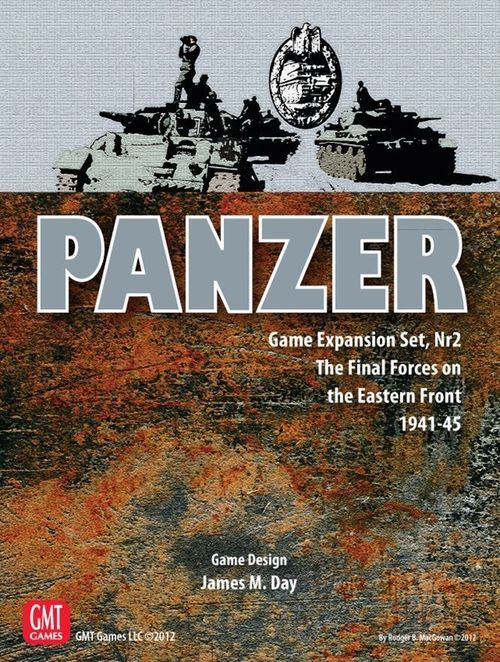
Panzer: Game Expansion Set, Nr 2 – The Final Forces on the Eastern Front 1941-44
Panzer: Game Expansion Set, Nr 2 – The Final Forces on the Eastern Front 1941-44 Rulebook
Table of Contents
Table of Contents
- Introduction
- Lend-Lease
- Lend-Lease Vehicle Notes
- TO&E: 18th Tank Corps, 1 July 1943
- TO&E: 1st Guards Mechanized Corps, early-1945
- Scenarios
- Scenario 18: Beginning of the End: Kursk, 12 July 1943
- Scenario 19: Battle of Brody Pt. 1: June 1941
- Scenario 20: Battle of Brody Pt. 2: June 1941
- Scenario 21: Pakfront: Kursk, 5 July 1943
- Scenario 22: The Rhino's Horn: Vitebsk, June 1944
- Scenario 23: The Cauldron: Southern Russia, late-1942
- Scenario 24: Operation Typhoon: Bryansk Pocket, October 1941
Introduction
Two Panzer TO&Es are presented for representative Soviet corps that fielded Lend-Lease equipment. The two corps summaries (pages 5 and 10) depict their various member formations and support formations. Note that only combat formations and the units they fielded are depicted. Support and administrative units and organizations are not included.
Over-Strength Formations have added one or more subordinate formations or combat units. These formations are depicted by a (+) following their name. Under-Strength Formations are missing one or more of their subordinate formations or combat units. These formations are depicted by a (-) following their name.
When designing a scenario, utilize the major formations to select the appropriate forces from the formations and support formations. Always keep in mind that formations were rarely at full-strength; losses, breakdowns and other forms of attrition typically kept formations understrength.
The corps summaries also list the typical formation grade for its formations and support formations. Keep in mind that this is an overall categorization. Some formations or support formations certainly could have possessed a higher grade while others possessed a lower grade.
Lend-Lease
During World War II, the allied nations supplied the Soviet Union with 12,415 tanks through the Lend-Lease Program. Of significant importance, these vehicles amounted to nearly 20% of all Soviet tank production. Of that total, 1,475 were lost at sea in the Arctic convoys. In addition, nearly 10,000 of all other types of armored vehicles were also supplied. These shipments accounted for 100% of the armored carriers employed by the Soviets since they did not produce any vehicles of that type during the war. In service, Lend-Lease tanks were fielded along with Soviet tanks; brigades and regiments typically fielded the same model.
A fact not as well known is that the allies also provided in excess of a 500,000 wheeled tactical vehicles. This total exceeded the entire Soviet production by nearly 150,000 vehicles, allowing Soviet factories to concentrate on the production of armored vehicles. It was these vehicles that really provided the critical mobility necessary for the tank and mechanized corps.
The cooling relations of post-war Europe prompted the Soviet Union to minimize the importance of the Lend-Lease Program on the ultimate outcome of the war in Eastern Europe. This political posturing belittled not only the quantities of equipment shipped, but also criticized the quality of tanks provided. While no one would question the inferiority of the Valentine, Matilda and Churchill as compared to the T-34, it must be noted that at the time of these shipments, these tanks were considered first-line units in the British Army. In addition, while nowhere near as technologically revolutionary as the T-34, the Sherman was far more robust and reliable than the Soviet design. In many post war encounters in the 1950s Korea War and during the various Arab-Israeli Wars up to the early 1970s, the Sherman consistently defeated the T-34 in these head-to-head tests of their mettle.
Lend-Lease Vehicle Notes
Valentine Infantry Tank: S-31A & S-32B. The Valentine was the most common Commonwealth tank supplied to the Soviets. In total, 3,782 of the various Marks were provided, equaling nearly 1/2 of all the Valentines produced by both Britain and Canada. All versions of the 2-pdr (pounder) and 6-pdr armed Valentines were shipped throughout the war, not ending until 1944. It was the most popular Commonwealth design, much preferred over the Matilda and Churchill due to its superior automotive performance.
The Valentine II (S-31A), typical of the 2-pdr armed versions, lacked a main gun HE shell; its GP firepower was provided by just its coaxial machinegun. Marks III, V, VI and VII featured a three-man turret which improved the distribution of labor responsibilities over the two-man turrets of the Marks II and IV. Marks VI and VII were the 2-pdr armed versions produced in Canada.
The Valentine VIII (S-32B) and IX featured the much more effective 6-pdr gun. Due to the limited size of the Valentine's turret, the crew was again reduced to two men to accommodate the larger weapon. In addition, the coaxial machinegun had to be deleted to save space. The Mark X retained the 6-pdr gun but also fitted an externally mounted coaxial machinegun.
The Valentine XI was the final production version. It mounted a British version of the 75mm gun (derived from the 6-pdr) along with a coaxial machinegun in a two-man turret.
Matilda II Infantry Tank: S-31B. The Matilda was the second most common British tank supplied to the Soviets; 1,084 were shipped. It was not as popular as the Valentine since it was slower, had less mobility, and performed poorly in heavy snow.
There were five models of the Matilda produced. With the exception of the Matilda III CS (3in howitzer), all of the other models mounted the 2-pdr gun. The various versions differed only in their automotive components including the AEC or Leyland diesel engines and gearbox configuration.
Churchill III Infantry Tank: S-32A. Only limited numbers of the 6-pdr armed version of the Churchill were supplied to the Soviets; in fact, just 301 tanks were shipped. In Soviet service, the Churchill was classified as a heavy tank. At Kursk, the 5th Guards Tank Army's only heavy tanks were the 35 Churchill IIIs fielded by its 18th Tank Corps' 36th Guards Heavy Tank Regiment (SF23, page 8). In any event, the Soviets considered the Churchill to be an inferior design and shipments were terminated after 1942.
Thirteen major models of the Churchill were produced throughout the war. In total, 5,640 vehicles were eventually built. Various armaments were fitted, including the 2-pdr, 6-pdr, 3in and 95mm howitzers, and both US and British versions of the 75mm gun. The Mark VII through the Mark XI also featured thicker armor.
Stuart III Light Tank: S-33A. Of the 1,676 Stuarts shipped to the Soviets, many were diesel-powered. The petrol engine versions suffered from the uneven quality of Soviet-produced petrol. While the Soviets considered its silhouette too high for a light tank, the Stuart was still markedly superior to the T-60 and was overall superior to the T-70. After production of the M3 Stuart was terminated, the Soviets refused any further light tank shipments, declining both the M5A1 Stuart and M24 Chaffee, in favor of the Sherman.
The most widely used American light tank, the M3 Stuart was produced in three major models up until late 1943, totaling 13,859 vehicles. The M3A2 was projected as the designation for welded versions of the M3A1, but was not officially utilized.
In British service there were five designations: Stuart I (M3, 7-cylinder radial petrol engine), Stuart II (M3, 9-cylinder radial diesel engine), Stuart III (M3A1, 7-cylinder radial petrol engine), Stuart IV (M3A1, 9-cylinder radial diesel engine), and the Stuart V (M3A3, 7-cylinder radial petrol engine).
M3 Lee Medium Tank: S-33B. Most of the 1,386 M3 Lees shipped to the Soviets were either the M3A3 or M3A5 diesel-powered versions. It was considered an obsolete design from the onset due to its hull-mounted, limited-traverse 75mm gun. The Soviets also disliked its somewhat high silhouette, and also felt it was underpowered and found its rubber-metal tracks prone to high breakdowns on the mostly unimproved Soviet roads. In Soviet service it was unflatteringly dubbed "A Coffin for Seven Brothers." In spite of this fact, or as dictated by expediency, the M3 Lee was still used in greater numbers by the Soviets than either the US or British Forces.
Six different models of the M3 Lee were produced up until late 1942, totaling 6,258 vehicles. The original M3 model, with the 9-cylinder Wright radial petrol engine, amounted to nearly 80% of the vehicles produced.
The M3 was also fielded under the 'Grant' nickname in British service. The Grant I was an M3 with a turret designed to British requirements, while the Grant II was the designation for the final M3A5 model fitted with the original US produced turret.
M4 Sherman III Medium Tank: S-34A & S-34B. By far the most respected Lend-Lease tank in Soviet service, the diesel-powered Sherman III was also the most numerically significant with a total of 4,102 shipped. They were equally divided between the 75mm (2,007) and 76mm (2,095) armed versions. The Sherman was widely fielded by Soviet forces during the later stages of the war. The tank brigades and regiments of some tank and mechanized corps, like the 1st Guard Mechanized Corps in 1945 (page 10), were equipped entirely with Sherman tanks.
The 49,234 Shermans produced throughout the war were divided among six major models mounting 75mm (68%), 76mm (22%) and 105mm (10%) guns. Only the M4 (British Sherman I) and the M4A3 (British Sherman IV) mounted the 105mm howitzer.
The Sherman was also widely modified as dictated by battlefield requirements. Two of the most notable were the M4A3E2 Sherman Jumbo, a heavily armored assault tank, and the Sherman Firefly which mounted the hard-hitting British-designed 17-pdr (76mm) gun.
In British service there were six designations: Sherman I (M4, 9-cylinder radial petrol engine), Sherman II (M4A1, 9-cylinder radial petrol engine), Sherman III (M4A2, 12-cylinder diesel engine), Sherman IV (M4A3, 8-cylinder petrol engine), Sherman V (M4A4, 30-cylinder multi-bank petrol engine), and the Sherman VII (M4A6, 9-cylinder radial diesel engine). The Sherman VI had been reserved for the M4A5 Sherman which was the designation allocated but not used for the Canadian-built Ram.
To designate weapon options beyond the basic 75mm, the British added a suffix: 'A' - US 76mm, 'B' - 105mm, and 'C' - 17-pdr. Therefore, the Sherman VC Firefly was an M4A4 Sherman armed with the 17-pdr gun; it was the most widespread version of the Sherman Firefly.
M3A1 Scout Car: S-15A. Developed by the White Motor Company to meet the US Army's requirement for a high-speed scout vehicle, the White Scout Car was based on one of the company's lines of commercial trucks. It shared a number of features with the M2-M3 series of halftracks. It had seating for six along with ample storage. Its passenger compartment was not fitted with doors, requiring its passengers to climb over the sides to enter and exit. The M3A1 was the up-armored version of the original production vehicle, the M3.
A total of 3,340 were shipped. The Soviets utilized them as scout, liaison, radio control vehicles and command cars. They served in many reconnaissance units replacing the BA-64 M43 Armored Car.
Halftracks: S-15B M2 APC, S-16A M17 MGMC, and S-27B SU-57 M43. With over 41,000 units produced, the M2 through M9 series of halftracks played a significant role for all of the allied forces. The US shipped 2,928 halftracks of various types to the Soviet Union. These included troop carriers, which were used mainly as command vehicles, and the various gun armed versions. These later types proved to be the most popular with the Soviet Forces. In fact, the multi-gun armed vehicles represented the only substantial number of armored anti-aircraft vehicles fielded by the Soviets.
The most numerically significant halftrack provided was the T-48; known as the SU-57 M43 in Soviet service. At 650 units shipped, the US released nearly the entire production run of the 57mm armed anti-tank vehicle for Lend-Lease service.
TO&E: 18th Tank Corps, 1 July 1943
Corps organization (page 5): 18th Tank Corps HQ (XXX) with SF21 (110th, 170th and 181st Tank Brigades), SF22 (32nd Motorized Rifle Brigade), SF23 (36th Guards Heavy Tank Regiment (+)), SF124 (52nd Motorcycle Battalion), SF125 (1000th Anti-Tank Regiment), SF126 (736th Anti-Tank Battalion), SF127 (1694th Anti-Aircraft Regiment) and SF128 (115th Sapper Battalion).
Notes (page 5):
- The 18th Tank Corps was formed in June 1942. It was initially fielded as part of the 5th Tank Army in the Bryansk Front. After suffering heavy losses, it was withdrawn for refit. It next saw action during Operation Saturn with the 1st Guards Army. It was virtually destroyed and was withdrawn into STAVKA reserve during the Spring of 1943. At the start of the Kursk Offensive, 1 July 1943, it was part of the Steppe Front reserves. On 6 July 1943 the 18th Tank Corps was transferred to the 5th Guards Tank Army's right flank where it was engaged in the massive tank battle at Prokhorovka. By the close of action, the 18th had lost more than a third of its tanks.
- Gun and howitzer artillery assets were fielded within the brigades as brigade level assets. In addition, the 18th Tank Corps fielded a heavy mortar regiment. These artillery assets are represented as organic and attached batteries in the tank and motorized infantry brigades.
- Formation grade would be Regulars. Units from the 36th Guards Heavy Tank Regiment (SF23) would be Seasoned. Units from 52nd Motorcycle Battalion may be Seasoned.
Diagram note: the diagrams on pages 6-8 are drawn with connector lines that run across page breaks. Each formation below is listed with the units shown under it. The page 7 left-column units are attributed to SF22 by unit type (motorized rifle brigade organization), and the page 7 right-column battalions are attributed to SF22 as drawn. Counts in parentheses are numbers of that unit in its parent.
SF21: 110th, 170th & 181st Tank Brigades
Brigade HQ: (1) RHQ Infantry Squad [S-8A], (1) Medium Truck [S-5B1], (3) Rifle Squad [S-8A], (3) Medium Truck [S-5B1], (3) T-34/76 M42 [S-10A], (1) FO Section [S-8A], (1) Light Truck [S-5B1].
- (1) Organic Artillery: (1) Medium Battery [S-7A] or (2) Medium Battery [S-7A]
- (1) Armored Car Platoon: (3) Recon BA-64B M43 [S-14B]
- (1) Anti-Aircraft Battery — Battery HQ: (1) CHQ Infantry 1/2 Squad [S-8A], (1) Light Truck [S-5B1]
- (2) Anti-Aircraft Platoon: (2) 37mm M39 AAG [S-19A], (2) Medium Truck [S-5B1]
- (1) Tank Battalion — Battalion HQ: (1) BHQ T-34/76 M42 [S-10A]
- (2) Tank Company — Company HQ: (1) CHQ T-34/76 M42 [S-10A]
- (3) Tank Platoon: (3) T-34/76 M42 [S-10A]
- (2) Tank Company — Company HQ: (1) CHQ T-34/76 M42 [S-10A]
- (1) Tank Battalion — Battalion HQ: (1) BHQ T-34/76 M42 [S-10A]
- (1) Tank Company — Company HQ: (1) CHQ T-34/76 M42 [S-10A]
- (3) Tank Platoon: (3) T-34/76 M42 [S-10A]
- (2) Lt. Tank Company — Company HQ: (1) CHQ T-70 M42 [S-1A]
- (3) Lt. Tank Platoon: (3) T-70 M42 [S-1A]
- (1) Tank Company — Company HQ: (1) CHQ T-34/76 M42 [S-10A]
SF22: 32nd Motorized Rifle Brigade
Brigade HQ: (1) RHQ Infantry Squad [S-8A], (1) M2 APC [S-15B], (3) Rifle Squad [S-8A], (3) M2 APC [S-15B], (1) T-34/76 M42 [S-10A], (1) FO Section [S-8A], (1) Light Truck [S-5B1].
- (1) Organic Artillery: (1) Medium Battery [S-7A] or (2) Medium Battery [S-7A]
- (1) Attached Artillery: (2) Medium Battery [S-7A], (3) Light Battery [S-7A]
- (2) Mortar Platoon: (3) BM41 Section [S-8A], (3) Light Truck [S-5B1]
- (1) Reconnaissance Company — Company HQ: (1) CHQ Recon Infantry 1/2 Squad [S-8A], (1) Recon M2 APC [S-15B], (1) Recon BA-64B M43 [S-14B]
- (2) Armored Car Platoon: (3) Recon BA-64B M43 [S-14B]
- (1) Recon Motorcycle Platoon: (3) Recon SMG Motorcycle Squad [S-8A]
- (3) Reconnaissance Platoon: (3) Recon Rifle Squad [S-8A], (3) Recon M2 APC [S-15B]
- (1) Anti-Aircraft Battery — Battery HQ: (1) CHQ Infantry 1/2 Squad [S-8A], (1) Light Truck [S-5B1]
- (2) Anti-Aircraft Platoon: (3) 12.7mm AAMG [S-30B], (3) Light Truck [S-5B1]
- (1) Anti-Tank Rifle Company — Company HQ: (1) CHQ Infantry 1/2 Squad [S-8A], (1) Light Truck [S-5B1]
- (3) Anti-Tank Rifle Platoon: (4) PTRD-41 ATR Section [S-8A], (4) Light Truck [S-5B1]
- (1) Submachinegun Company — Company HQ: (1) CHQ Infantry 1/2 Squad [S-8A], (1) Light Truck [S-5B1]
- (3) SMG Platoon: (3) SMG Squad [S-8A], (3) Medium Truck [S-5B1]
- (1) Sapper Company — Company HQ: (1) CHQ Infantry 1/2 Squad [S-8A], (1) Light Truck [S-5B1]
- (3) Sapper Platoon: (3) Engineer Rifle Squad [S-8A], (3) Medium Truck [S-5B1]
- (3) Motorized Rifle Battalion — Battalion HQ: (1) BHQ Infantry Squad [S-8A], (1) Medium Truck [S-5B1], (1) Rifle Squad [S-8A], (1) Medium Truck [S-5B1]
Notes (SF22 and SF21, page 6):
- The 18th Tank Corps fielded three tank brigades, the 110th, 170th and 181st.
- The 18th Tank Corps fielded a single motor rifle brigade, the 32nd.
- Organic Artillery limited to a total of 9 Medium Batteries between the three tank brigades and the single motorized rifle brigade.
Diagram ambiguity: the page 7 right column begins with a Sapper Platoon whose parent header is not printed in the continuation; it is listed here as drawn.
- (3) Sapper Platoon: (3) Engineer Rifle Squad [S-8A], (3) Medium Truck [S-5B1]
SF23: 36th Guards Heavy Tank Regiment (+)
Regiment HQ: (1) RHQ Infantry Squad [S-8A], (1) Medium Truck [S-5B1], (1) Rifle Squad [S-8A], (1) Medium Truck [S-5B1].
- (1) Reconnaissance Platoon: (3) Recon BA-64B M43 [S-14B]
- (7) Heavy Tank Company — Company HQ: (1) CHQ Churchill III [S-32A]
- (2) Heavy Tank Platoon: (2) Churchill III [S-32A]
- (2) Submachinegun Company — Company HQ: (1) CHQ Infantry 1/2 Squad [S-8A], (1) Light Truck [S-5B1]
- (3) SMG Platoon: (3) SMG Squad [S-8A], (3) Medium Truck [S-5B1]
- (1) Sapper Company — Company HQ: (1) CHQ Infantry 1/2 Squad [S-8A], (1) Light Truck [S-5B1]
- (3) Sapper Platoon: (3) Engineer Rifle Squad [S-8A], (3) Medium Truck [S-5B1]
Notes: The 18th Tank Corps fielded a single guards heavy tank regiment, the 36th Guards.
SF124: 52nd Motorcycle Battalion
Battalion HQ: (1) BHQ Recon Infantry Squad [S-8A], (1) Medium Truck [S-5B1], (1) Recon Rifle Squad [S-8A], (1) Medium Truck [S-5B1], (1) Engineer Recon Rifle Squad [S-8A], (1) Medium Truck [S-5B1].
- (1) Mortar Platoon: (2) Recon BM41 Mortar Section [S-8B], (2) Light Truck [S-5B1]
- (2) Motorcycle Company — Company HQ: (1) CHQ Recon Infantry Motorcycle 1/2 Squad [S-8A]
- (2) Motorcycle Platoon: (3) Recon Rifle Motorcycle Squad [S-8A]
- (1) Motorcycle Platoon: (3) Recon SMG Motorcycle Squad [S-8A]
- (1) Motor Rifle Company — Company HQ: (1) CHQ Recon Infantry 1/2 Squad [S-8A], (1) Light Truck [S-5B1]
- (3) Motor Rifle Platoon: (3) Recon Rifle Squad [S-8A], (3) Medium Truck [S-5B1]
Notes: The 18th Tank Corps fielded a single motorcycle battalion, the 52nd.
SF125: 1000th Anti-Tank Regiment
Battalion HQ: (1) RHQ Infantry Squad [S-8A], (1) Medium Truck [S-5B1], (1) Rifle Squad [S-8A], (1) Medium Truck [S-5B1].
- (6) Anti-Tank Battery — Battery HQ: (1) CHQ Infantry 1/2 Squad [S-8A], (1) Light Truck [S-5B1]
- (2) Anti-Tank Platoon: (2) 76.2mm M39 ATG [S-6B], (2) Medium Truck [S-5B1]
Notes: The 18th Tank Corps fielded a single anti-tank regiment, the 1000th.
SF126: 736th Anti-Tank Battalion
Battalion HQ: (1) BHQ Infantry Squad [S-8A], (1) Medium Truck [S-5B1], (1) Rifle Squad [S-8A], (1) Medium Truck [S-5B1].
- (3) Anti-Tank Battery — Battery HQ: (1) CHQ Infantry 1/2 Squad [S-8A], (1) Light Truck [S-5B1]
- (2) Anti-Tank Platoon: (2) 85mm M39 A/ATG [S-19B], (2) Medium Truck [S-5B1]
Notes: The 18th Tank Corps fielded a single anti-tank battalion, the 736th.
SF127: 1694th Anti-Aircraft Regiment
Regiment HQ: (1) RHQ Infantry Squad [S-8A], (1) Medium Truck [S-5B1], (1) Rifle Squad [S-8A], (1) Medium Truck [S-5B1].
- (4) Anti-Aircraft Battery — Company HQ: (1) CHQ Infantry 1/2 Squad [S-8A], (1) Light Truck [S-5B1]
- (2) Anti-Aircraft Platoon: (2) 37mm M39 AAG [S-19A], (2) Medium Truck [S-5B1]
- (1) AAMG Battery — Company HQ: (1) CHQ Infantry 1/2 Squad [S-8A], (1) Light Truck [S-5B1]
- (4) AAMG Platoon: (2) 12.7mm AAMG [S-30B], (2) Light Truck [S-5B1]
Notes: The 18th Tank Corps fielded a single anti-aircraft regiment, the 1694th.
SF128: 115th Sapper Battalion
Battalion HQ: (1) BHQ Infantry Squad [S-8A], (1) Medium Truck [S-5B1], (1) Rifle Squad [S-8A], (1) Medium Truck [S-5B1].
- (2) Sapper Company — Company HQ: (1) CHQ Infantry 1/2 Squad [S-8A], (1) Light Truck [S-5B1]
- (3) Sapper Platoon: (2) Engineer Rifle Squad [S-8A], (2) Medium Truck [S-5B1], (1) Engineer SMG Squad [S-8A], (1) Medium Truck [S-5B1]
Notes: The 18th Tank Corps fielded a single sapper battalion, the 115th.
TO&E: 1st Guards Mechanized Corps, early-1945
Corps organization (page 10): 1st Guards Mechanized Corps HQ (XXX) with SF24 (1st, 2nd and 3rd Guards Mechanized Brigades), SF25 (9th Guards Tank Brigade), SF26 (382nd Guards SU Regiment), SF129 (11th Guards Motorcycle Battalion), SF27 (1453rd and 1821st SU Regiments), SF130 (54th Guards Sapper Battalion), SF131 (1699th Anti-Aircraft Regiment) and SF132 (407th Guards Mortar Battalion).
Notes (page 10):
- The 1st Guards Mechanized Corps was formed in November 1942 from the 1st Guards Rifle Division. It saw action in December 1942 with the 3rd Guards Army south of Stalingrad. After refitting during the spring of 1943, it was fielded as part of the Southwestern Front forces southeast of Belgorod near the Kursk salient. It then spent the first three months of 1944 in STAVKA reserve before moving to the Kharkov Military District for the remainder of the year. At the beginning of 1945, it was transferred to the 3rd Ukrainian Front. At that point, all of its T-34/85 M44s were replaced with Sherman III tanks. It then raced across Hungary and into Austria where it participated in the capture of Vienna. It ended the war as part of the 4th Guards Army near Vienna.
- Gun and howitzer artillery assets were fielded within the brigades as brigade level assets. In addition, the 1st Guards Mechanized Corps fielded a heavy mortar regiment. These artillery assets are represented as organic and attached batteries in the tank and mechanized infantry brigades. It also fielded the 407th Guards Mortar Battalion (SF132), which was actually rocket artillery.
- Formation grade would be Veteran. Initially, some Sherman III units may be Seasoned before becoming fully acclimated to the new tanks. Some units from the 11th Guards Motorcycle Battalion may be Elite.
SF24: 1st, 2nd & 3rd Guards Mechanized Brigades
Brigade HQ: (1) RHQ Infantry Squad [S-8A], (1) M2 APC [S-15B], (3) Rifle Squad [S-8A], (3) M2 APC [S-15B], (1) Sherman III (75) [S-34A], (1) FO Section [S-8A], (1) Light Truck [S-5B1].
- (1) Organic Artillery: (1) Medium Battery [S-7A] or (2) Medium Battery [S-7A]
- (1) Attached Artillery: (2) Medium Battery [S-7A], (3) Light Battery [S-7A]
- (2) Mortar Platoon: (3) BM41 Section [S-8A], (3) Light Truck [S-5B1]
- (1) Reconnaissance Company — Company HQ: (1) CHQ Recon Infantry 1/2 Squad [S-8A], (1) Recon M2 APC [S-15B], (1) Recon BA-64B M43 [S-14B]
- (2) Armored Car Platoon: (3) Recon BA-64B M43 [S-14B]
- (1) Recon Motorcycle Platoon: (3) Recon SMG Motorcycle Squad [S-8A]
- (3) Reconnaissance Platoon: (3) Recon Rifle Squad [S-8A], (3) Recon M2 APC [S-15B]
- (1) Anti-Aircraft Battery — Battery HQ: (1) CHQ Infantry 1/2 Squad [S-8A], (1) Light Truck [S-5B1]
- (2) Anti-Aircraft Platoon: (3) 12.7mm AAMG [S-30B], (3) Light Truck [S-5B1]
- (1) Submachinegun Company — Company HQ: (1) CHQ Infantry 1/2 Squad [S-8A], (1) Light Truck [S-5B1]
- (3) SMG Platoon: (3) SMG Squad [S-8A], (3) Medium Truck [S-5B1]
- (1) Sapper Company — Company HQ: (1) CHQ Infantry 1/2 Squad [S-8A], (1) Light Truck [S-5B1]
- (3) Sapper Platoon: (3) Engineer Rifle Squad [S-8A], (3) Medium Truck [S-5B1] (the platoon's box is printed at the top of the page 11 right column)
- (3) Motorized Rifle Battalion — Battalion HQ: (1) BHQ Infantry Squad [S-8A], (1) Medium Truck [S-5B1], (1) Rifle Squad [S-8A], (1) Medium Truck [S-5B1]
- (1) Mortar Platoon: (3) BM41 Mortar Section [S-8A], (3) Light Truck [S-5B1]
- (1) Sapper Platoon: (3) Engineer Rifle Squad [S-8A], (3) Medium Truck [S-5B1]
Notes (SF24, page 12):
- The 1st Guards Mechanized Corps fielded three guards mechanized brigades, the 1st, 2nd and 3rd.
- Organic Artillery limited to a total of 9 Medium Batteries between the three guards mechanized brigades and the single guards tank brigade.
- One-third of the rifle squads in motor rifle companies carry M1 Bazookas.
SF25: 9th Guards Tank Brigade
Brigade HQ: (1) RHQ Infantry Squad [S-8A], (1) M2 APC [S-15B], (3) Rifle Squad [S-8A], (3) M2 APC [S-15B], (2) Sherman III (75) [S-34A], (1) FO Section [S-8A], (1) Light Truck [S-5B1].
- (1) Organic Artillery: (1) Medium Battery [S-7A] or (2) Medium Battery [S-7A]
- (1) Reconnaissance Platoon: (3) Recon BA-64B M43 [S-14B], (1) Recon Rifle Squad [S-8A], (1) Recon M2 APC [S-15B]
- (1) Sapper Platoon: (3) Engineer Rifle Squad [S-8A], (3) M2 APC [S-15B]
- (1) Anti-Tank Battery — Battery HQ: (1) CHQ Infantry 1/2 Squad [S-8A], (1) Light Truck [S-5B1]
- (2) Anti-Tank Platoon: (2) 76.2mm M39 ATG [S-6B], (2) Medium Truck [S-5B1] (this platoon is printed at the top of the page 12 right column; its battery is listed here as the nearest battery header)
Notes (SF25, page 13):
- The 1st Guards Mechanized Corps fielded a single guards tank brigade, the 9th.
- Organic Artillery limited to a total of 9 Medium Batteries between the three guards mechanized brigades and the single guards tank brigade.
- One-third of the rifle squads in motor rifle companies carry M1 Bazookas.
SF26: 382nd Guards SU Regiment
Regiment HQ: (1) RHQ Infantry Squad [S-8A], (1) M2 APC [S-15B], (1) T-34/76 M43 [S-1B], (1) Rifle Squad [S-8A], (1) M2 APC [S-15B].
- (1) Reconnaissance Platoon: (3) Recon BA-64B M43 [S-14B]
- (3) SU Battery — Battery HQ: (1) CHQ SU-100 M44 [S-4B]
- (2) SU Platoon: (3) SU-100 M44 [S-4B]
- (1) Submachinegun Company — Battery HQ: (1) CHQ Infantry 1/2 Squad [S-8A], (1) Light Truck [S-5B1]
- (3) SMG Platoon: (3) SMG Squad [S-8A], (3) Medium Truck [S-5B1]
Notes (SF26, page 13): The 1st Guards Mechanized Corps fielded a single guards SU regiment, the 382nd.
SF27: 1453rd & 1821st SU Regiments
Regiment HQ: (1) RHQ Infantry Squad [S-8A], (1) M2 APC [S-15B], (1) T-34/76 M43 [S-1B], (1) Rifle Squad [S-8A], (1) M2 APC [S-15B].
- (1) Reconnaissance Platoon: (3) Recon BA-64B M43 [S-14B]
- (3) SU Battery — Battery HQ: (1) CHQ SU-85 M43 [S-4A]
- (2) SU Platoon: (3) SU-85 M43 [S-4A]
- (1) Submachinegun Company — Battery HQ: (1) CHQ Infantry 1/2 Squad [S-8A], (1) Light Truck [S-5B1]
- (3) SMG Platoon: (3) SMG Squad [S-8A], (3) Medium Truck [S-5B1]
Notes (SF27, page 13): The 1st Guards Mechanized Corps fielded a two SU regiments [sic], the 1453rd and 1821st.
SF129: 11th Guards Motorcycle Battalion
Battalion HQ: (1) BHQ Recon Infantry Squad [S-8A], (1) Medium Truck [S-5B1], (1) Recon Rifle Squad [S-8A], (1) Medium Truck [S-5B1], (1) Engineer Recon Rifle Squad [S-8A], (1) Medium Truck [S-5B1].
- (1) Mortar Platoon: (2) Recon BM41 Mortar Section [S-8A], (2) Light Truck [S-5B1]
- (2) Motorcycle Company — Company HQ: (1) CHQ Recon Infantry Motorcycle 1/2 Squad [S-8A]
- (2) Recon Motorcycle Platoon: (3) Recon Rifle Motorcycle Squad [S-8A]
- (1) Recon Motorcycle Platoon: (3) Recon SMG Motorcycle Squad [S-8A]
- (1) Motor Rifle Company — Company HQ: (1) CHQ Recon Infantry 1/2 Squad [S-8A], (1) Light Truck [S-5B1]
- (3) Motor Rifle Platoon: (3) Recon Rifle Squad [S-8A], (3) Medium Truck [S-5B1]
- (1) Tank Company — Company HQ: (1) CHQ Recon T-34/76 M43 [S-1B]
- (3) Tank Platoon: (3) Recon T-34/76 M43 [S-1B]
Notes (SF129, page 14): The 1st Guards Mechanized Corps fielded a single guards motorcycle battalion, the 11th.
SF130: 54th Guards Sapper Battalion
Battalion HQ: (1) BHQ Infantry Squad [S-8A], (1) Medium Truck [S-5B1], (1) Rifle Squad [S-8A], (1) Medium Truck [S-5B1].
- (2) Sapper Company — Company HQ: (1) CHQ Infantry 1/2 Squad [S-8A], (1) Light Truck [S-5B1]
- (3) Sapper Platoon: (2) Engineer Rifle Squad [S-8A], (2) Medium Truck [S-5B1], (1) Engineer SMG Squad [S-8A], (1) Medium Truck [S-5B1]
Notes (SF130): The 1st Guards Mechanized Corps fielded a single guards sapper battalion, the 54th.
SF131: 1699th Anti-Aircraft Regiment
Regiment HQ: (1) RHQ Infantry Squad [S-8A], (1) Medium Truck [S-5B1], (1) Rifle Squad [S-8A], (1) Medium Truck [S44] (unit code as printed).
- (6) Anti-Aircraft Battery — Company HQ: (1) CHQ Infantry 1/2 Squad [S-8A]
- (2) Anti-Aircraft Platoon: (2) 37mm M39 AAG [S-19A], (2) Medium Truck [S-5B1]
- (1) AAMG Battery — Company HQ: (1) CHQ Infantry 1/2 Squad [S-8A], (1) Light Truck [S-5B1]
- (4) AAMG Platoon: (2) 12.7mm AAMG [S-30B], (2) Light Truck [S-5B1]
Notes (SF131, page 14): The 1st Guards Mechanized Corps fielded a single anti-aircraft regiment, the 1699th.
SF132: 407th Guards Mortar Battalion
- (2) Organic Heavy Battery [S-7A]
Notes (SF132, page 14):
- The 1st Guards Mechanized Corps fielded a single guards mortar battalion, the 407th.
- These batteries may be assigned to any formation.
Scenarios
Each scenario below follows the book's layout: Situation, Map, Setup, Special Conditions and Victory Conditions, followed by the Order of Battle from the force sheets printed in the book. Several scenarios say "Requires Panzer Expansions #1 & #2" and reference base game rule numbers (7.1, 7.2, 7.52 and 7.53).
Scenario 18: Beginning of the End: Kursk, 12 July 1943
Situation: After rolling over the Soviet 6th Tank Corps, the 3rd Panzer Division moved into a defensive position on the western flank of the Grossdeutschland Panzergrenadier Division. At the same time, the Soviet 1st Tank and 6th Guards Armies were advancing to cut off the German forces advancing on Prokhorovka.
At daybreak on 12 July, the Soviet 10th Tank Corps moved out against the 3rd Panzer Division's positions in the Bereavka area. Throughout the day, the German forces were forced to fall back. Even after launching a series of counterattacks, they were not able to regain any of the lost ground. By the end of the day, the Soviet forces had advanced well over 14km, threatening to turn the flank of the entire XLVIII Panzer Corps.
Map: Utilize maps 9 and 10. (Soviet Edge is on map 10; German Edge is on map 9.)
Setup
| Force | Setup |
|---|---|
| Conditions | Normal visibility. No adverse terrain. |
| German | Holding Force sets up first anywhere on maps 9 and/or 10 at least 6 hexes from the Soviet edge. |
| German | Leg and towed units may setup inside any building hex. |
| German | All objective building hexes in Nytsil are under German control at the start of the scenario whether occupied or unoccupied. |
| Soviet | Force enters the mapboard on turn 1 anywhere along the Soviet edge. |
| Soviet | If entering on a Path hex, units may do so at the Path movement rate. |
| German | Relief Force has the potential of arriving starting on Turn 6 based on the arrival table. Before the Initiative Phase of turn 6, and each turn thereafter as necessary, the German Force rolls (100). If the result falls within the listed range for that turn, any unit from the Relief Force may move on during the Movement Phase of that turn or the Movement Phase of any turn thereafter. |
| German | A second roll (100) is required to determine where the Relief Force enters. It must enter on the indicated Entry hex or adjacent to that hex. If entering on the Entry hex, units may do so at the Path movement rate. |
Special Conditions
- When determining the Initiative, the German Force applies a -40 DRM up until the Relief Force arrives. On that turn and all subsequent turns no Force Grade modifiers apply.
- The stream is impassable except at the bridge. The Soviet T-40 M40 amphibious tanks may cross at any stream hex (7.34).
- The Soviet Force may plot Planned Artillery Fire to arrive on turn 2 or any subsequent turn.
- The German Force may plot 2 Pre-Registered Points for its Organic Medium Battery.
- If special ammo types are available, utilize Ammo Limits.
- If Morale Rules (7.1) are in effect, the Soviet Force utilizes the listed point information and adds the additional forces; the German Force utilizes the alternate point information. Utilize the alternative VPs.
- Only the German Force may employ the Hidden Unit Rules (7.2). A maximum of 5 Hidden Unit Markers may deploy.
- If the Command Span Rules (7.52) are in effect, all CHQs have a Command Span of 10 hexes.
- Requires Panzer Expansions #1 & #2.
Victory Conditions
| Item | Condition |
|---|---|
| Length | 22 turns |
| 865/1,000 VPs | To the force that controls Nytsil on map 9. To control Nytsil, a force must occupy or be the last to occupy at least 7 of the 11 building hexes (or remaining rubble hexes) for a full turn. If a building hex is on fire, a force must occupy an adjacent hex. If neither side meets this requirement, these VPs are not awarded. |
| VP Adjustment | Potential German VP Adjustment based on the Relief Force's initial turn of arrival. |
| Unit VPs | For elimination, knock out or brew up. |
| 175/200 VPs | Required victory margin. |
Order of Battle: Scenario 18
Force sheets are read from the page 16 and 17 images. Columns: unit, counter ID (as printed), combat values as printed (partly obscured on some counters by the CHQ marker), quantity, and points (the second number is the Relief Force or alternate value where printed).
Soviet Force: Elements of the 186th Tank Brigade, Seasoned [1,580/1,760]
| Unit | Counter ID | Values | Qty | Points |
|---|---|---|---|---|
| Artillery, Medium, Organic | S-7A | x1 | 54 |
Tank Company (+): Seasoned, Excellent, 16(13) [960]
| Unit | Counter ID | Values | Qty | Points |
|---|---|---|---|---|
| T-34/76 M42 (CHQ) | S-10A 213 | 6T 8-12 | x1 | 93 |
| T-34/76 M42 | S-10A 213 | 6T 8-12 | x3 | 62 |
| T-34/76 M42 | S-10A 213 | 6T 8-12 | x3 | 62 |
| T-34/76 M42 | S-10A 213 | 6T 8-12 | x3 | 62 |
| T-34/76 M41 | S-9B 203 | 6T 8-12 | x3 | 60 |
Motorized Rifle Company (Mixed): Seasoned, Excellent, 15, CP-9 [566]
| Unit | Counter ID | Values | Qty | Points |
|---|---|---|---|---|
| Infantry (CHQ) | (30) | x1 | 24 | |
| Truck, Light | S-5B1 176 | x1 | 6 | |
| Rifle | (30) | x3 | 26 | |
| Truck, Medium | S-5B1 176 | x3 | 9 | |
| Rifle | (30) | x3 | 26 | |
[Additional] Tank Company (+): Seasoned, Excellent, 19(16), CP-11 [1,140]
| Unit | Counter ID | Values | Qty | Points |
|---|---|---|---|---|
| T-34/76 M41 | S-9B 202 | 6T 8-12 | x3 | 60 |
German Force: Elements of Kampfgruppe Schmidt, Veteran [1,879/2,235]
| Unit | Counter ID | Values | Qty | Points |
|---|---|---|---|---|
| Artillery, Medium, Organic | G-7A | x1 | 54/54 |
Holding Force [729/871]
Panzergrenadier Company (-): Seasoned, Superior, 10, CP-6 [267/316]
| Unit | Counter ID | Values | Qty | Points |
|---|---|---|---|---|
| Infantry (CHQ) | (30) | x1 | 24/28 | |
| Rifle | (30) | x3 | 27/32 | |
| Rifle | (30) | x3 | 27/32 | |
| Rifle | (30) | x3 | 27/32 |
Panzerjäger Company (Mixed): Veteran, Fair, 9, CP-4 [462/555]
| Unit | Counter ID | Values | Qty | Points |
|---|---|---|---|---|
| Marder III (CHQ) | G-13B 308 | 4T 6-9 -5 | x1 | 70/84 |
| Marder III | G-13B 308 | 4T 6-9 -5 | x3 | 46/56 |
| StuG IIIF | G-15A 322 | 4T 6-9 -5 | x3 | 66/79 |
| 5cm PaK 38 (Seasoned) | G-32A 518 | 1L 0 | x2 | 28/33 |
Relief Force [1,096/1,081]
Panzer Company (Mixed): Veteran, Outstanding, 16, CP-11 [1,096/1,310]
| Unit | Counter ID | Values | Qty | Points |
|---|---|---|---|---|
| Pz IVF2 (CHQ) | G-12A 234 | 4T 6-9 -5 | x2 | 106/127 |
| Pz IVF2 | G-12A 234 | 4T 6-9 -5 | x4 | 70/84 |
| Pz IVF2 | G-12A 234 | 4T 6-9 -5 | x4 | 70/84 |
| Pz IIIJ | G-38B 378 | 4T 6-9 -5 | x3 | 54/64 |
| Pz IIIJ | G-38B 378 | 4T 6-9 -5 | x3 | 54/64 |
Relief Force Arrival (German Force)
| Turn | Range | VP Adjustment | Entry Hex | Range |
|---|---|---|---|---|
| 6-7 | 01-10 | -280/-335 | 9A5 | 01-20 |
| 8-9 | 01-20 | -190/-225 | 9F10 | 21-40 |
| 10-11 | 01-40 | No adjustment | 9Q10 | 41-60 |
| 12-13 | 01-60 | +190/+225 | 9BB10 | 61-80 |
| 14-15 | 01-80 | +280/+335 | 9GG5 | 81-00 |
Scenario 19: Battle of Brody Pt. 1: June 1941
Situation: Operation Barbarossa was the code name for Germany's invasion of the Soviet Union. Over 4.5 million troops invaded the Soviet Union on 22 June 1941 along a front over 2,900 km long. It marked the greatest invasion in the history of warfare.
The Battle of Brody was the largest armored engagement of the invasion. It remained the largest tank battle of the war until surpassed by Kursk over two years later. The battle found Panzer Group 1's III and XLVIII Corps engaged with five Mechanized Corps from the Soviet 5th and 6th Armies.
While the Soviets lost ground and suffered heavy losses in tanks and troops they succeeded in inflicting serious losses on the invading German forces.
Scenarios 19 and 20 may be linked together and played as a mini-campaign. In that case, utilize only the Victory Conditions from Scenario 20.
Map: Utilize maps 3 and 4. (German Edge is the top edge of map 3; Soviet Edge is the bottom edge of map 4.)
Setup
| Force | Setup |
|---|---|
| Conditions | Normal visibility. No adverse terrain. |
| Soviet | Force sets up first anywhere on map 3 and/or map 4 at least 6 hexes from the German edge. |
| Soviet | Leg and towed units may setup in any Building or Heavy Woods hex. |
| German | Force enters the mapboard on turn 1 anywhere along the German edge. |
| German | If entering on a Path hex, units may do so at the Path movement rate. |
Special Conditions
- When determining the Initiative, the Soviet and German Forces apply -20 and +20 DRMs, respectively.
- If special ammo types are available, utilize Ammo Limits.
- If Morale Rules (7.1) are in effect, the Soviet Force adds the additional forces; both Forces utilize the alternative point information. Utilize the alternative VPs.
- Only the Soviet Force may employ the Hidden Unit Rules (7.2). A maximum of 6 Hidden Unit Markers may deploy.
- If the Command Span Rules (7.52) are in effect, the Soviet Tank CHQs have a Command Span of 9 hexes; the Anti-Tank Battery CHQ is 8 hexes. The German CHQs have a command span of 10 hexes.
- Requires Panzer Expansions #1 & #2.
Victory Conditions
| Item | Condition |
|---|---|
| Length | 15 turns |
| Unit VPs | To the German Force for all combat units that exit from the Soviet Edge. |
| 200/235 VPs | To the Soviet Force if fewer than 8 German combat units exit from the Soviet Edge. |
| Unit VPs | For elimination, knock out or brew up. |
| 100/110 VPs | Required victory margin. |
Order of Battle: Scenario 19
Soviet Force: Elements of the 133rd Tank Regiment, Regulars [623/589] (from page 19)
1st Light Tank Company: Regulars, Adequate, 10 [231]
| Unit | Counter ID | Values | Qty | Points |
|---|---|---|---|---|
| T-26S M37 (CHQ) | S-24A 344 | 2T 4-7 -10 | x1 | 33/26 |
| T-26S M37 | S-24A 344 | 2T 4-7 -10 | x3 | 22/17 |
| T-26S M37 | S-24A 344 | 2T 4-7 -10 | x3 | 22/17 |
| T-26S M37 | S-24A 344 | 2T 4-7 -10 | x3 | 22/17 |
2nd Light Tank Company: Regulars, Adequate, 10, CP-5 [256/202]
| Unit | Counter ID | Values | Qty | Points |
|---|---|---|---|---|
| BT-7 M37 (CHQ) | S-22B 321 | 7T 10-12 +15 | x1 | 36/28 |
| BT-7 M37 | S-22B 321 | 7T 10-12 +15 | x3 | 24/19 |
| BT-7 M37 | S-22B 321 | 7T 10-12 +15 | x3 | 24/19 |
| BT-7 M37 | S-22B 321 | 7T 10-12 +15 | x2 | 24/19 |
| BT-7A M37 | S-23A 324 | 7T 10-12 +15 | x1 | 28/22 |
Anti-Tank Battery (+): Green, Fair, 9, CP-4 [136/96]
| Unit | Counter ID | Values | Qty | Points |
|---|---|---|---|---|
| Infantry (CHQ) | (30) | x1 | 12/8 | |
| 45mm M37 | S-14B 273 | 1L 0 | x2 | 11/8 |
| 45mm M37 | S-14B 273 | 1L 0 | x2 | 11/8 |
| 76.2mm M36 | S-17B 282 | 1L 0 | x2 | 20/14 |
| 76.2mm M36 | S-17B 212 | 1L 0 | x2 | 20/14 |
[Additional] 1st Light Tank Company: Regulars, Adequate, 13, CP-7 [/291]
| Unit | Counter ID | Values | Qty | Points |
|---|---|---|---|---|
| T-28 M34 | S-24B 350 | 4T 5-8 | x3 | /20 |
German Force: Elements of Kampfgruppe Schröder, Veteran [1,349/1,576] (from page 20)
Panzer Company (Mixed): Veteran, Outstanding, 22, CP-15 [1,003/1,202]
| Unit | Counter ID | Values | Qty | Points |
|---|---|---|---|---|
| Pz IIIG (CHQ) | G-10A 254 | 4T 6-9 -5 | x2 | 68/82 |
| Pz IIIG | G-10A 254 | 4T 6-9 -5 | x5 | 45/54 |
| Pz IIIG | G-10A 254 | 4T 6-9 -5 | x5 | 45/54 |
| Pz IIIF | G-38A 566 | 4T 6-9 -5 | x3 | 39/47 |
| Pz 38(t)C | G-36B 548 | 4T 6-9 -5 | x3 | 36/43 |
Panzergrenadier Company (gepanzert) (-): Veteran, Superior, 14, CP-9 [346/374]
| Unit | Counter ID | Values | Qty | Points |
|---|---|---|---|---|
| Infantry (CHQ) | (30) | x1 | 28/31 | |
| SPW 251/1 (CHQ) | G-5A 189 | 4H 9-12 -10 | x1 | 18/19 |
| Rifle | (30) | x3 | 32/35 | |
| SPW 251/1 | G-5A 189 | 4H 9-12 -10 | x3 | 18/19 |
| Rifle | (30) | x3 | 32/35 |
Scenario 20: Battle of Brody Pt. 2: June 1941
Situation: Scenario 20 continues the action between Panzer Group 1 and the Soviet 5th and 6th Armies at Brody. After passing through the first line of Soviet Forces, the Germans are attempting to secure a key bridgehead.
Scenarios 19 and 20 may be linked together and played as a mini-campaign. In that case, utilize only the Victory Conditions from Scenario 20.
Map: Utilize maps 3, 8 and 12. (German Edge is on the west side of map 8; Soviet Edge is on the east side of map 12.)
Setup
| Force | Setup |
|---|---|
| Conditions | Normal visibility. No adverse terrain. |
| Soviet | Force sets up first anywhere on maps 3, 8 and/or 12 at least 6 hexes from the German edge. |
| Soviet | Leg and towed units may setup inside any building or Heavy Woods hex. |
| Soviet | All objective bridge hexes are under Soviet control at the start of the scenario whether occupied or unoccupied. |
| German | Force enters the mapboard on turn 1 anywhere along the German edge. |
| German | If entering on a Path hex, units may do so at the Path movement rate. |
Special Conditions
- When determining the Initiative, the Soviet and German Forces apply -20 and +20 DRMs, respectively.
- The stream on map 8 is passable throughout its length.
- The stream on map 12 is impassable except at the bridges.
- Stone Building hex 12Q4 is 3 stories high. Stone Buildings hexes 12O9, 12P10 and 12R10 are 2 stories high.
- If special ammo types are available, utilize Ammo Limits.
- If Morale Rules (7.1) are in effect, the Soviet Force adds the additional forces; both Forces utilize the alternative point information. Utilize the alternative VPs.
- Only the Soviet Force may employ the Hidden Unit Rules (7.2). A maximum of 6 Hidden Unit Markers may deploy.
- If the Command Span Rules (7.52) are in effect, the Soviet Motorized Rifle CHQ has a Command Span of 9 hexes; the Anti-Tank Battery CHQ is 8 hexes. As a recon formation, the Armored Car Company is exempt. The German CHQs have a command span of 10 hexes.
- Requires Panzer Expansions #1 & #2.
Victory Conditions
| Item | Condition |
|---|---|
| Length | 20 turns |
| 440/480 VPs | To the force that controls 4 of the 6 Bridge hexes in Baragrad on map 12: 12F9, 12N8, 12Q7, 12Q8, 12T8 or 12BB7. To control a Bridge hex, a force must occupy or be the last to occupy it for a full turn. If neither side meets this requirement, these VPs are not awarded. |
| Unit VPs | For elimination, knock out or brew up. |
| 90/95 VPs | Required victory margin. |
Order of Battle: Scenario 20
Soviet Force: Elements of the 711th Motorized Rifle Regiment, Regulars [687/651] (from page 22)
Armored Car Company (Mixed): Seasoned, Excellent, 8(8) [339]
| Unit | Counter ID | Values | Qty | Points |
|---|---|---|---|---|
| BA-10 M38 (CHQ, Recon) | S-29A 295 | 4W 8-12 -10 | x1 | 56/56 |
| BA-10 M38 (Recon) | S-29A 295 | 4W 8-12 -10 | x4 | 37/37 |
| BT-7 M37 (Recon) | S-22B 321 | 7T 10-12 +15 | x3 | 45/45 |
Motorized Rifle Company (-): Regulars, Adequate, 11, CP-6 [200/159]
| Unit | Counter ID | Values | Qty | Points |
|---|---|---|---|---|
| Infantry (CHQ) | (30) | x1 | 19/15 | |
| Rifle | (30) | x3 | 20/16 | |
| Rifle | (30) | x3 | 20/16 | |
| 50mm (mortar) | (55) | x1 | 16/13 | |
| 50mm (mortar) | (65) | x1 | 19/15 |
Anti-Tank Battery: Green, Fair, 11, CP-5 [148/108]
| Unit | Counter ID | Values | Qty | Points |
|---|---|---|---|---|
| Infantry (CHQ) | (30) | x1 | 12/8 | |
| Truck, Light | S-5B1 176 | x1 | 6/6 | |
| 45mm M37 | S-16B 273 | 1L 0 | x2 | 11/8 |
| Komsomolyets | S-29B 400 | 5T 6-9 +15 | x2 | 7/4 |
| 45mm M37 | S-16B 273 | 1L 0 | x2 | 11/8 |
[Additional] Armored Car Company (Mixed): Seasoned, Excellent, 9(9), CP-5 [/384]
| Unit | Counter ID | Values | Qty | Points |
|---|---|---|---|---|
| BT-7 M37 (Recon) | S-22B 321 | 7T 10-12 +15 | x1 | /45 |
German Force: Elements of Kampfgruppe Schröder, Veteran [1,086/1,267] (from page 23)
Utilize only those units that successfully exited the map from Scenario 19: Battle of Brody Part 1. The German Force retains the force structure as described in Scenario 19. If this scenario is played as a stand-alone action, utilize the units listed below as the German Force. This force is based on the assumption that the German Force was victorious in Scenario 19.
Panzer Company (Mixed): Veteran, Outstanding, 17, CP-12 [790/947]
| Unit | Counter ID | Values | Qty | Points |
|---|---|---|---|---|
| Pz IIIG (CHQ) | G-10A 254 | 4T 6-9 -5 | x2 | 68/82 |
| Pz IIIG | G-10A 254 | 4T 6-9 -5 | x4 | 45/54 |
| Pz IIIG | G-10A 254 | 4T 6-9 -5 | x4 | 45/54 |
| Pz IIIF | G-38A 566 | 4T 6-9 -5 | x2 | 39/47 |
| Pz 38(t)C | G-36B 548 | 4T 6-9 -5 | x2 | 36/43 |
Panzergrenadier Company (gepanzert) (-): Veteran, Superior, 12, CP-7 [296/320]
| Unit | Counter ID | Values | Qty | Points |
|---|---|---|---|---|
| Infantry (CHQ) | (30) | x1 | 28/31 | |
| SPW 251/1 (CHQ) | G-5A 189 | 4H 9-12 -10 | x1 | 18/19 |
| Rifle | (30) | x3 | 32/35 | |
| SPW 251/1 | G-5A 189 | 4H 9-12 -10 | x3 | 18/19 |
| Rifle | (30) | x2 | 32/35 |
Scenario 21: Pakfront: Kursk, 5 July 1943
Situation: As the German 9th Army's XXIII Corps' 78th and 216th Infantry Divisions launched a diversionary attack along the eastern flank, at 0530 hours both the XLI and XLVII Panzer Corps moved forward with the main attack in the Podolyan-Alexandrovka sectors of the northern salient. Of the three panzer and five infantry divisions in the initial wave, the 20th Panzer Division anchored the XLVII Panzer Corps' northwest sector. The Soviet defenses facing it were secured by the 15th Rifle Division along with attached units from the 13th Army.
Supported by devastating artillery barrages and aircraft, the 20th Panzer Division broke through the 15th Infantry Division's forward defenses by 0900 hours. Divisional armor and infantry elements advanced well over 5 km and captured the village of Bobrik. Their initial thrust was not stopped until reinforcements from the Soviet 6th Guards Rifle Division were committed later that day.
Map: Utilize maps 3, 4, 5 and 10. (German Edge is the west edge of map 3; Soviet Edge is the east edge of map 5.)
Setup
| Force | Setup |
|---|---|
| Conditions | Normal visibility. No adverse terrain. Place 10 Ditch counters in hexes 4L1, 4L7-4L10, 5V1 and 5V7-5V10. |
| Soviet | Force sets up first anywhere on maps 3, 4, 5 and/or 10 at least 10 hexes from the German edge. |
| Soviet | Place the 4 Improved Positions, 4 Block and 4 Wire counters anywhere within the Soviet setup area. Leg and towed units may set up in an Improved Position. Vehicles may not set up in or occupy an Improved Position. |
| Soviet | Leg and towed units may setup inside any building or Heavy Woods hex. |
| German | Force sets up second anywhere on maps 3 and/or 10 no more than 5 hexes from the German edge. |
Special Conditions
- When determining the Initiative, the German Force applies a +20 DRM just in those cases where it won the Initiative the previous turn. Otherwise, no Force Grade modifiers apply.
- The Soviet Force may plot Planned Artillery Fire to arrive on turn 5 or any subsequent turn.
- The Soviet Force may plot 2 Pre-Registered Points for just its Organic Light Battery.
- The German Force may plot 2 Pre-Registered Points for its Organic Heavy Battery.
- The Soviet BHQ and FO each automatically receives a unique command. They are not considered part of the Rifle Company or the Anti-Tank Battery. They are not counted as losses for Morale purposes.
- If special ammo types are available, utilize Ammo Limits.
- If Morale Rules (7.1) are in effect, the Soviet Force utilizes the listed point information and adds the additional forces; the German Force utilizes the alternative point information. Utilize the alternative VPs.
- Only the Soviet Force may employ the Hidden Unit Rules (7.2). A maximum of 6 Hidden Unit Markers may deploy.
- If the Command Span Rules (7.53) are in effect, the Soviet Rifle CHQ has a Command Span of 8 hexes; the Anti-Tank Battery is 10 hexes. The Soviet BHQ is 15 hexes. The German Panzer CHQs are 10 hexes; the Panzergrenadier CHQ is 9 hexes.
- The German Ju 87G-1 Kanonenvogel is piloted by Hans-Ulrich Rudel.
- Requires Panzer Expansions #1 and #2.
Victory Conditions
| Item | Condition |
|---|---|
| Length | 25 turns |
| Unit VPs | To the German Force for all combat units that exit from the Soviet Edge. |
| 395/455 VPs | To the Soviet Force if fewer than 9 German combat units exit from the Soviet Edge. |
| Unit VPs | For elimination, knock out or brew up. |
| 205/230 VPs | Required victory margin. |
Order of Battle: Scenario 21
Soviet Force: Elements of the 676th Rifle Regiment, Seasoned [1,465/1,551] (from page 25)
| Unit | Counter ID | Values | Qty | Points |
|---|---|---|---|---|
| Infantry (BHQ) | (30) | x1 | 38 | |
| Infantry (FO) | (55) | x1 | 20 | |
| Artillery, Light, Organic | S-7A | x1 | 40 | |
| Artillery, Medium, Attached | S-7A | x1 | 81 | |
| Improved Position | x4 | 25 |
Rifle Company (+): Seasoned, Excellent, 18, CP-11 [516]
| Unit | Counter ID | Values | Qty | Points |
|---|---|---|---|---|
| Infantry (CHQ) | (30) | x1 | 24 | |
| Rifle | (30) | x4 | 26 | |
| Rifle | (30) | x4 | 26 | |
| Rifle | (30) | x4 | 26 | |
| 82mm (mortar) | (55) | x1 | 40 | |
Anti-Tank Battery (+): Seasoned, Excellent, 13 [530]
| Unit | Counter ID | Values | Qty | Points |
|---|---|---|---|---|
| Infantry (CHQ) | (30) | x1 | 24 | |
| 45mm M42 | S-17A 278 | 1L 0 | x2 | 26 |
| 57mm M43 | S-6A 184 | 1L 0 | x2 | 37 |
| 76.2mm M39 | S-6B 186 | 1L 0 | x2 | 39 |
| PTRD-41 | (55) | x2 | 17 |
[Additional] Anti-Tank Battery (+): Seasoned, Excellent, 15, CP-9 [616]
| Unit | Counter ID | Values | Qty | Points |
|---|---|---|---|---|
| SU-76M M43 | S-3B 142 | 5T 6-10 | x2 | 43 |
German Force: Elements of Kampfgruppe Kessel, Veteran (Special) [2,637/3,041] (from page 26)
| Unit | Counter ID | Values | Qty | Points |
|---|---|---|---|---|
| Artillery, Heavy, Organic | G-7A | x1 | 73/73 | |
| Ju 87G-1 (Elite) | G-34B2 328 | x1 | 130/130 |
Panzer Company (Mixed): Veteran, Outstanding, 22, CP-15 [1,745/2,101]
| Unit | Counter ID | Values | Qty | Points |
|---|---|---|---|---|
| Pz IVG (CHQ) | G-1B 123 | 4T 6-9 -5 | x2 | 115/138 |
| Pz IVH | G-2A 135 | 3T 5-8 -5 | x5 | 87/105 |
| Pz IVG | G-1B 123 | 4T 6-9 -5 | x5 | 76/92 |
| Pz IVF2 | G-12A 284 | 4T 6-9 -5 | x5 | 70/84 |
| Pz IVF2 | G-12A 284 | 4T 6-9 -5 | x5 | 70/84 |
Panzergrenadier Company (gepanzert) (+): Seasoned, Superior, 24, CP-15 [689/737]
| Unit | Counter ID | Values | Qty | Points |
|---|---|---|---|---|
| Artillery, Medium, Attached | G-7A | x1 | 81/81 | |
| Infantry (CHQ) | (30) | x1 | 24/26 | |
| SPW 251/10 (CHQ) | G-22B 469 | 4H 9-12 -10 | x1 | 23/25 |
| FO | (55) | x1 | 20/22 | |
| SPW 251/1 | G-5A 189 | 4H 9-12 -10 | x1 | 15/16 |
Scenario 22: The Rhino's Horn: Vitebsk, June 1944
Situation: As part of Operation Bagration, the elimination of the Vitebsk salient was one of the key objectives. There forces of the German 3rd Panzer Army and the Soviet 5th Army clashed over the fortress city of Vitebsk.
During the battle, Nashorns (Rhinoceros) of the 1st platoon, 519th Tank Destroyer Battalion, Leutnant Albert Ernst commanding, saw action. The Nashorn was a stopgap measure to get mobile versions of the 88mm L/71 gun into the hands of the German armored units. This hard-hitting weapon could easily penetrate even the most heavily armored Soviet tanks at long ranges. It, like many German tank destroyers, suffered from a lack of overhead protection and thin armor. Even so, encounters with the Nashorn invariably resulted in a brief and often fatal outcome for many unlucky Soviet tankers.
Map: Utilize maps 2, 8 and 10. (Soviet Edge is the west edge of map 2 and 8; German Edge is the east edge of map 10.)
Setup
| Force | Setup |
|---|---|
| Conditions | Normal visibility. No adverse terrain. |
| German | Place the 3 Improved Positions counters anywhere within the German setup area. Any unit may setup in an Improved Position. |
| German | Defense Group sets up first anywhere on maps 2, 8 and/or 10 at least 6 hexes from the Soviet edge. |
| German | Leg and towed units may setup in any Building or Heavy Woods hexes. |
| German | Reinforcement Group enters the mapboard on turns 2-5 anywhere along the German Edge. It may enter by individual platoon/sections. |
| German | All objective building hexes in Kutuzovka are under German control at the start of the scenario whether occupied or unoccupied. |
| German | If entering on a Path hex, units may do so at the Path movement rate. |
| Soviet | Assault Group enters the mapboard on turns 1-4 anywhere along the Soviet edge. All units must be on the mapboard by the end of turn 4. It may enter by individual platoon/sections. |
| Soviet | Reinforcement Group enters the mapboard on turn 5 or any later turn anywhere along the Soviet Edge. |
Special Conditions
- When determining the Initiative, the Soviet Force applies a +20 DRM until the turn after the first units of the Soviet Reinforcement Group enters the mapboard. From that turn on, it applies a +20 DRM just in those cases where it won the Initiative the previous turn. No Force Grade modifier applies for the German Force until the turn after the first units of the Reinforcement Group enters the mapboard. From that turn on, it applies a +20 DRM just in those cases where it won the Initiative the previous turn.
- The stream is passable throughout its length.
- If special ammo types are available, utilize Ammo Limits.
- If Morale Rules (7.1) are in effect, the Soviet Force utilizes the listed point information and adds the additional forces; the German Force utilizes the alternative point information. Utilize the alternative VPs.
- Only the German Force may employ the Hidden Unit Rules (7.2). A maximum of 4 Hidden Unit Markers may deploy.
- If the Command Span Rules (7.52) are in effect, the Soviet Tank CHQ has a Command Span of 10 hexes; the Motorized Rifle CHQ is 8 hexes. The German CHQs are 10 hexes.
- Requires Panzer Expansions #1 & #2.
Victory Conditions
| Item | Condition |
|---|---|
| Length | 20 turns |
| 775/865 VPs | To the force that controls Kutuzovka on map 2. To control Kutuzovka, a force must occupy or be the last to occupy at least 10 of the 15 building hexes (or remaining rubble hexes) for a full turn. If a building hex is on fire, a force must occupy an adjacent hex. If neither side meets this requirement, these VPs are not awarded. |
| Unit VPs | For elimination, knock out or brew up. |
| 155/175 VPs | Required victory margin. |
Order of Battle: Scenario 22
Truck counter combat values are partly obscured on the page images and are shown as blank.
Soviet Force: Elements of the 9th Guards Mechanized Brigade, Veteran (Special) [1,901/2,120] (from page 28)
Assault Group
Tank Company (+): Veteran, Excellent, 15 [1,221]
| Unit | Counter ID | Values | Qty | Points |
|---|---|---|---|---|
| Sherman III (75) (CHQ) | S-34A 464 | 3T 5-9 -10 | x1 | 109 |
| Sherman III (75) | S-34A 464 | 3T 5-9 -10 | x3 | 73 |
| Sherman III (75) | S-34A 464 | 3T 5-9 -10 | x3 | 73 |
| Sherman III (76) | S-34B 473 | 3T 5-9 -10 | x3 | 78 |
| Sherman III (76) | S-34B 473 | 3T 5-9 -10 | x3 | 78 |
Reinforcement Group
Motorized Rifle Company (+): Seasoned, Excellent, 20, CP-12 [692]
| Unit | Counter ID | Values | Qty | Points |
|---|---|---|---|---|
| Infantry (CHQ) | (30) | x1 | 24 | |
| Truck, Light | S-5B1 176 | x1 | 6 | |
| Rifle | (30) | x3 | 26 | |
| Truck, Medium | S-5B1 176 | x3 | 9 | |
| Rifle | (30) | x3 | 26 | |
[Additional] Tank Company (+): Veteran, Excellent, 18, CP-11 [1,428]
| Unit | Counter ID | Values | Qty | Points |
|---|---|---|---|---|
| Sherman III (75) | S-34A 464 | 3T 5-9 -10 | x3 | 73 |
German Force: Elements of Kampfgruppe Klaus, Seasoned (Special) [1,199/1,336] (from page 29)
| Unit | Counter ID | Values | Qty | Points |
|---|---|---|---|---|
| Improved Position | x3 | 25 |
Defense Group
Infantry Company (Mixed): Seasoned, Excellent, 12, CP-7 [412/412]
| Unit | Counter ID | Values | Qty | Points |
|---|---|---|---|---|
| Infantry (CHQ) | (30) | x1 | 24/24 | |
| Rifle | (30) | x3 | 27/27 | |
| Rifle with RPzB 43/54 | (55) | x2 | 29/29 | |
| 8cm (mortar) | (55) | x1 | 38/38 | |
| Unlabeled support counter (morale 65) | x1 | 25/25 |
Reinforcement Group
Panzerjäger Company (+): Veteran, Outstanding, 12, CP-8 [712/849]
| Unit | Counter ID | Values | Qty | Points |
|---|---|---|---|---|
| Marder III (CHQ) | G-13B 308 | 4T 6-9 -5 | x1 | 70/84 |
| Marder III | G-13B 308 | 4T 6-9 -5 | x2 | 46/56 |
| StuG IIIG | G-4B 175 | 4T 6-9 -5 | x1 | 75/90 |
| StuH 42 | G-15B 326 | 3T 5-8 -5 | x1 | 72/86 |
| Nashorn (Elite) | G-13A 446 | 4T 6-9 -5 | x1 | 82/99 |
Scenario 23: The Cauldron: Southern Russia, late-1942
Situation: Urban warfare was the bane of all mechanized forces. The idea of slugging it out in close combat among the tight and twisting roads, rubble and endless buildings struck fear in hearts of all soldiers.
Yet, it was critical as urban centers had to be reduced. Bypassing them left too many effectives in the rear to potentially wreak havoc with supply, communication lines and follow on forces.
Map: Utilize maps 4, 10 and 11. (Either Force may enter from either outer map edge; map 11 is the central city map.)
Setup
| Force | Setup |
|---|---|
| Conditions | Normal visibility. No adverse terrain. |
| Both | Forces roll (10). The force rolling the higher result first places a Rubble counter (with a tie, the German Force places first) in any Building hex and a Block counter in any non-Building hex on map 11. The other force then does the same. The forces alternate placing counters until 6 Rubble and 6 Block counters are in place. |
| Both | Forces roll (10) again. The force rolling the lower result must setup first (with a tie, the German Force sets up first) anywhere on either mapboard edge no more than 5 hexes from the edge. |
| Both | The other force sets up second in the area not selected above. |
| Both | Neither force controls Vagastadt at the start of the scenario. |
Special Conditions
- When determining the Initiative, both Forces apply a +20 DRM just in those cases where it won the Initiative the previous turn. Otherwise, no Force Grade modifiers apply.
- Stone Buildings hexes 11O1, 11O2, 11P4, 11Q4, 11R4, 11S1 and 11S2 are 2 stories high.
- Both Forces may plot Planned Artillery Fire to arrive on turn 5 or any subsequent turn.
- Both Forces may plot 2 Pre-Registered Points for each of its Organic Batteries.
- If special ammo types are available, utilize Ammo Limits.
- If Morale Rules (7.1) are in effect, utilize the listed point information.
- If the Hidden Unit Rules (7.2) are in effect, each Force may deploy a maximum of 4 Hidden Unit Markers.
- The German Ju 87B1 may target only those units located on map 11.
- The Soviet T-34/76 M41 counter is actually an OT-34 M42 flamethrower tank (S-14A).
- The Soviet Sniper sections have a GP Direct Fire Factor of 10 at ranges 1-7; apply a +20 DRM. Only adjacent German units may spot them.
- If the Command Span Rules (7.52) are in effect, the Soviet CHQ has a Command Span of 7 hexes; the German CHQ has a Command Span of 9 hexes.
- Requires Panzer Expansions #1 & #2.
Victory Conditions
| Item | Condition |
|---|---|
| Length | 20 turns |
| 385 VPs | To the force that controls 5 of the 7 Stone Building hexes in Vagastadt on map 11: 11O1, 11O2, 11P4, 11Q4, 11R4, 11S1 and 11S2. To control a building hex, a force must occupy or be the last to occupy it (or remaining rubble hexes) for a full turn. If a building hex is on fire, a force must occupy an adjacent hex. If neither side meets this requirement, these VPs are not awarded. |
| Unit VPs | For elimination, knock out or brew up. |
| 95 VPs | Required victory margin. |
Order of Battle: Scenario 23
Soviet Force: Elements of the 6th Motorized Rifle Brigade, Seasoned (Special) [952] (from page 31)
| Unit | Counter ID | Values | Qty | Points |
|---|---|---|---|---|
| Artillery, Heavy, Organic | S-7A | x1 | 73 | |
| Artillery, Medium, Organic | S-7A | x1 | 54 |
Motorized Rifle Company (+): Seasoned, Excellent, 23, CP-14 [825]
| Unit | Counter ID | Values | Qty | Points |
|---|---|---|---|---|
| Infantry (CHQ) | (30) | x1 | 24 | |
| FO | (55) | x1 | 20 | |
| Truck, Medium | S-5B1 176 | x1 | 9 | |
| Rifle | (30) | x3 | 26 | |
| Truck, Medium | S-5B1 176 | x3 | 9 | |
German Force: Elements of Kampfgruppe König, Seasoned (Special) [964] (from page 32)
| Unit | Counter ID | Values | Qty | Points |
|---|---|---|---|---|
| Artillery, Heavy, Organic | G-7A | x1 | 73 | |
| Artillery, Medium, Organic | G-7A | x1 | 54 | |
| Ju 87B-1 | G-34B1 527 | x1 | 53 |
Panzergrenadier Company (+): Seasoned, Excellent, 23, CP-14 [784]
| Unit | Counter ID | Values | Qty | Points |
|---|---|---|---|---|
| Infantry (CHQ) | (30) | x1 | 24 | |
| FO | (55) | x1 | 20 | |
| Truck, Medium | G-5B2 216 | x1 | 9 | |
| Rifle | (30) | x3 | 27 | |
| Truck, Medium | G-5B2 216 | x3 | 9 | |
Scenario 24: Operation Typhoon: Bryansk Pocket, October 1941
Situation: Moscow was one of Germany's primary military objects in their invasion of the Soviet Union. It was probably driven more by a political imperative than the strategic measures it offered. Operation Typhoon was Germany's offensive to capture Moscow. Four complete armies were to maneuver north, south and directly against the city in a pincher movement. The 3rd and 4th Panzer Groups were to swing north, the 2nd Panzer Group south, while the 4th Army would advance directly against Moscow.
Large pockets of Soviet troops were cutoff by the advancing German forces. Four complete armies, the 19th, 20th, 24th and 32nd, were trapped in a large pocket just to the west of Moscow. The Soviets did not surrender, putting up stiff resistance that pinned down 28 German divisions; pulling those forces away from the Moscow offensive. While many Soviets units were overrun, some managed to escape in groups from platoon sized units up to entire divisions.
History, as it has a tendency to do, repeated itself - the assault on Moscow failed.
Map: Utilize maps 5, 7 and 8. (Soviet Edge is the west edge of map 7; German Edge is the east edge of map 8.)
Setup
| Force | Setup |
|---|---|
| Conditions | Normal visibility. No adverse terrain. |
| Soviet | Defense Group sets up first anywhere on map 5 within 3 hexes of Nevylsk. |
| Soviet | Leg and towed units may setup inside any of Nevylsk's building hexes on map 5. |
| Soviet | Reinforcement Group arrives on turn 3. A roll (100) is required to determine where it enters. It must enter on the indicated Entry hex or adjacent to that hex. If entering on the Entry hex, units may do so at the Road or Path movement rate. |
| German | Holding Group sets up second anywhere on maps 5, 7 and/or 8 at least 5 hexes from Nevylsk on map 5 and at least 3 hexes from any edge of the mapboard. |
| German | Reinforcement Group arrives on turn 5. A roll (100) is required to determine where it enters. It must enter on the indicated Entry hex or adjacent to that hex. If the Entry hex is the same as the Soviet Reinforcement Group, roll (100) again. If entering on the Entry hex, units may do so at the Path movement rate. |
Special Conditions
- When determining the Initiative, the Soviet Force applies a -20 DRM. The German Force initially does not apply a Force Grade modifier. Starting with turn 6 the German Force applies a +20 DRM.
- The streams on all maps are passable throughout their lengths.
- If special ammo types are available, utilize Ammo Limits.
- If Morale Rules (7.1) are in effect, utilize the listed point information.
- Only the Soviet Force may employ the Hidden Unit Rules (7.2). The Defense Group may deploy a maximum of 3 Hidden Unit Markers.
- If the Command Span Rules (7.52) are in effect, the Soviet CHQs have a Command Span of 8 hexes. The German CHQs have a command span of 10 hexes.
- Requires Panzer Expansions #1 & #2.
Victory Conditions
| Item | Condition |
|---|---|
| Length | 25 turns |
| 120 VPs | To the German Force if fewer than 4 Soviet combat units from the Defense Group exit from the Soviet Edge. |
| Unit VPs | To the Soviet Force for all combat units from the Defense Group that exit from the Soviet Edge. |
| Unit VPs | For elimination, knock out or brew up. |
| 95 VPs | Required victory margin. |
Order of Battle: Scenario 24
Soviet Force: Elements of the 46th Rifle Division and the 25th Tank Regiment, Regulars [799] (from page 34)
Defense Group
Composite Rifle Company: Regulars, Excellent, 15, CP-9 [337]
| Unit | Counter ID | Values | Qty | Points |
|---|---|---|---|---|
| Infantry (CHQ) | (30) | x1 | 19 | |
| Rifle | (30) | x3 | 20 | |
| Rifle | (30) | x3 | 20 | |
| Rifle, Engineer | (30) | x2 | 26 | |
| Truck, Medium | S-5B1 176 | x2 | 9 | |
Reinforcement Group
Tank Company (Mixed): Regulars, Excellent, 13, CP-8 [462]
| Unit | Counter ID | Values | Qty | Points |
|---|---|---|---|---|
| T-34/76 M40 (CHQ) | S-25B 366 | 5T 7-12 | x1 | 66 |
| T-34/76 M40 | S-25B 366 | 5T 7-12 | x3 | 44 |
| BT-8 M38 | S-23B 334 | 6T 9-11 +10 | x3 | 24 |
| BT-8 M38 | S-23B 334 | 6T 9-11 +10 | x3 | 24 |
| T-28E M38 | S-25A 356 | 2T 3-5 | x3 | 40 |
Reinforcement Group Arrival (Soviet Force)
| Entry Hex | Range |
|---|---|
| 5A5 | 01-10 |
| 7GG5 | 11-26 |
| 7BB10 | 27-42 |
| 7Q10 | 43-58 |
| 7F10 | 59-74 |
| 7A5 | 75-90 |
| 5GG5 | 91-00 |
German Force: Elements of Kampfgruppe Stark, Seasoned [1,073] (from page 35)
Holding Group
(Mot) Infantry Company (+): Seasoned, Excellent, 14, CP-8 [457]
| Unit | Counter ID | Values | Qty | Points |
|---|---|---|---|---|
| Infantry (CHQ) | (30) | x1 | 24 | |
| Truck, Light | G-5B2 216 | x1 | 6 | |
| Rifle | (30) | x3 | 27 | |
| Truck, Medium | G-5B2 216 | x3 | 9 | |
| Rifle | (30) | x3 | 27 | |
Reinforcement Group
Panzer Company (Mixed): Veteran, Excellent, 11(10), CP-7 [616]
| Unit | Counter ID | Values | Qty | Points |
|---|---|---|---|---|
| Pz IVF1 (CHQ) | G-11B 272 | 4T 6-9 -5 | x1 | 77 |
| Pz IVF2 | G-12A 234 | 4T 6-9 -5 | x3 | 70 |
| Pz IIIJ | G-38B 378 | 4T 6-9 -5 | x3 | 54 |
| Pz IIIG | G-10A 254 | 4T 6-9 -5 | x3 | 45 |
| SMG (Recon, Motorcycle) | (30) | x1 | 32 |
Reinforcement Group Arrival (German Force)
| Entry Hex | Range |
|---|---|
| 5A5 | 01-10 |
| 8GG5 | 11-26 |
| 8BB10 | 27-42 |
| 8Q10 | 43-58 |
| 8F10 | 59-74 |
| 8A5 | 75-90 |
| 5GG5 | 91-00 |